


Yes, you can contest a probate application in British Columbia, but the process depends on what you are challenging. Disputes over a will’s validity, adequate provision for a spouse or child, an executor’s appointment, or delaying probate before it is granted are all separate legal procedures. Each has different deadlines, standing requirements, and remedies, so using the wrong process can delay or even jeopardize the claim.
At Onyx Law Group, we understand how stressful probate disputes can be for families. With over a decade of experience handling estate and probate matters in BC, our team provides clear, practical guidance tailored to your situation. If you are considering contesting a probate application, we can help you understand your rights and next steps with confidence. Contact us today to discuss your options and protect your interests.
This blog explains when and how you can contest a probate application in BC, the legal grounds for doing so, and the steps involved in challenging a will or executor appointment.
Understanding Probate in British Columbia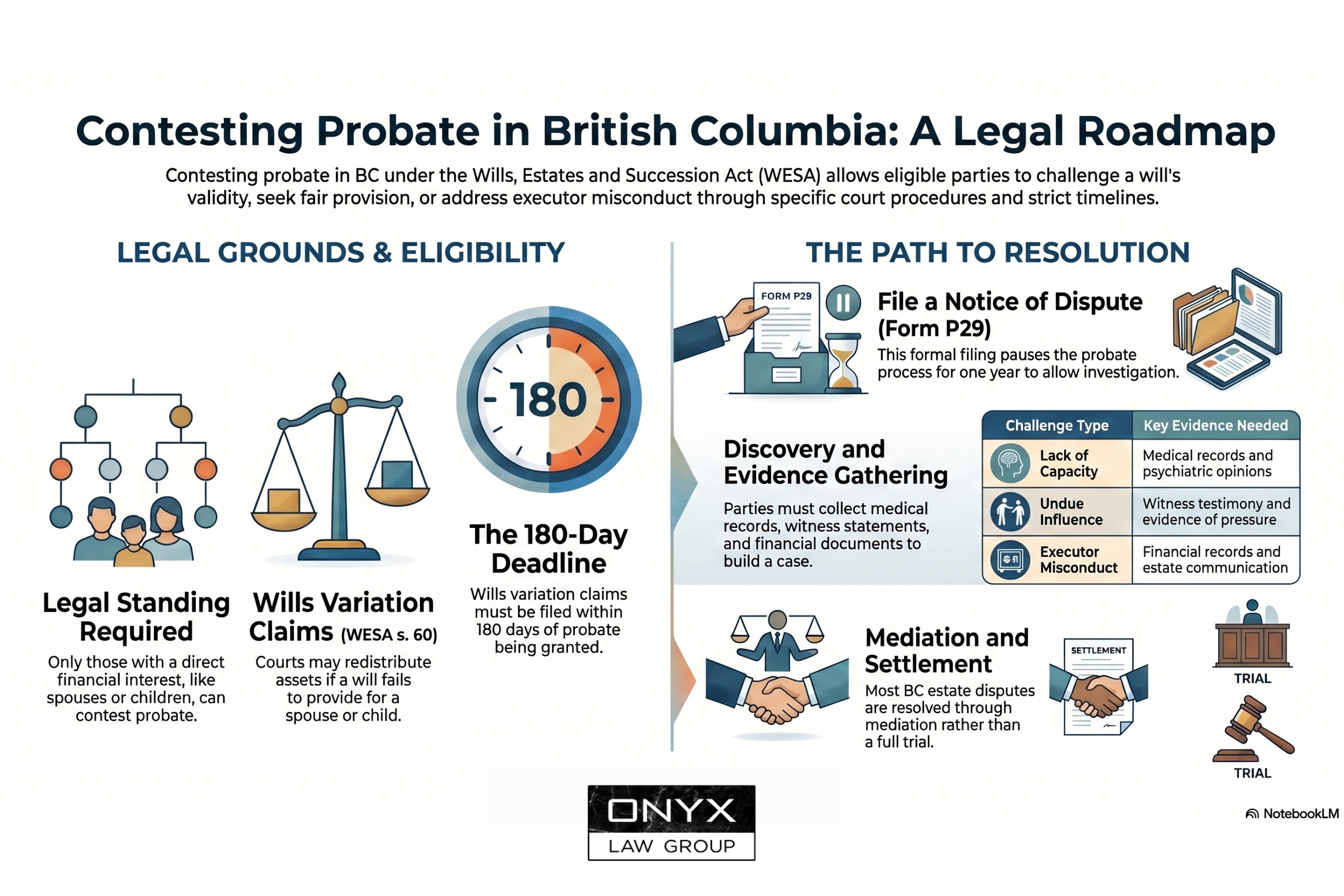
Probate is the legal process used to manage a person’s estate after they pass away. It usually involves proving that a willmaker’s will is valid, identifying assets, paying debts, and distributing property from the deceased’s estate to beneficiaries after the deceased person passes away.
If there is no will, probate still takes place, but intestacy rules under WESA Part 3 decide who receives the estate. The process is supervised by the Supreme Court of British Columbia to help ensure everything is handled properly.
Probate plays an important role in estate administration because it creates a clear legal process for transferring assets. It also helps protect creditors, beneficiaries, family members, and financial institutions that handle estate matters from disputes or improper handling of the estate. In some cases, probate can be simple and short. In others, it may take longer if the estate is large or contested.
The executor is the person responsible for managing the estate during the probate process. This person is usually named in the will. Their duties often include gathering assets such as bank accounts, life insurance policy proceeds, and other deceased’s property, notifying creditors, paying debts and taxes, and distributing property to beneficiaries. Executors also have a legal duty to act in the best interests of the estate and follow court procedures carefully.
The executor’s actions and authority can greatly affect how smoothly probate moves forward. Effective organization and communication can help reduce delays and conflicts between beneficiaries. On the other hand, mistakes or failure to follow legal requirements can slow the process and create additional court issues. Because of these factors, many executors work with probate lawyers for guidance throughout the estate administration process.
What Are the Eligibility Criteria for Contesting a Probate Application in BC?
In British Columbia, not everyone can contest a probate application. A person must usually have a direct financial interest and legal standing in the estate. Immediate family members, such as spouses and children, are the most common people who challenge a probate application, including a common-law spouse, a biological child, and adopted children. In some cases, other relatives may also raise concerns about the will or probate process.
Beneficiaries named in the will may also contest probate if they believe that someone created the will under suspicious circumstances or that it is invalid. Common issues include claims of undue influence, lack of mental capacity, or concerns that the will was not properly signed.
Creditors of the estate can sometimes become involved as well if unpaid debts affect their financial interests. Probate disputes often depend on the specific facts surrounding the estate and the parties involved.
Legal standing is an important part of any probate challenge in BC. Legal standing means that the person contesting probate must show that the outcome of the estate administration personally affects them. In some claims, only the spouse or biological or adopted children may have specific rights under estate legislation.
Courts generally prevent unrelated individuals without a connection to the estate from interfering in probate matters. The person bringing the challenge must show a legitimate reason for the court to review the probate application and how the outcome affects the relevant parties.
Establishing a legitimate interest in the estate usually requires evidence. This may include proof of family relationships, financial dependence, beneficiary status, or unpaid debts owed by the deceased. The court will review whether the person has a valid legal basis to contest probate before allowing the claim to move forward. Because probate disputes can become complex, many people seek legal guidance early in the process.
What Are the Legal Grounds for Contesting a Probate Application in BC?
Contesting a probate application in British Columbia usually requires a valid legal reason. Courts do not overturn probate simply because someone feels the outcome is unfair or believes they received an unfair will. Instead, there must be evidence showing a problem with the will, the executor, or the probate process itself. Below are some of the most common legal grounds used to challenge probate in BC.
1. Notice of Dispute: Pausing a Grant of Probate Before It Issues
A Notice of Dispute filed under Probate Rule 25-10 can temporarily stop the Supreme Court of British Columbia from issuing a grant of probate. It is designed to preserve the status quo while concerns about the will, the executor, or estate assets are investigated and may lead to court intervention if needed.
The Notice itself does not decide the dispute, but it prevents the executor from receiving formal authority until the issue is resolved, withdrawn, or removed by court order. It remains in effect for one year and can be renewed under Rule 25-11.
This procedure is available to anyone with an interest in the estate and is often used when there is a genuine concern that needs to be addressed before probate moves forward. However, the Notice of Dispute should not be used simply to delay the process. If the court finds the dispute is frivolous or unsupported, it can remove the Notice and may order costs against the person who filed it.
2. Wills Variation: When a Spouse or Child Believes the Will Did Not Provide Adequately
Under WESA sections 60 to 72, a BC court can vary a will if it failed to make adequate provision for the proper maintenance and support of a spouse or child. This claim is available only to spouses and children, including adult independent children, making the eligibility criteria in British Columbia broader than in many other jurisdictions. A “spouse” can include both a married spouse and someone who lived in a marriage-like relationship with the deceased for at least two years before death.
The deadline to bring a wills variation claim is strict: 180 days from the date probate is granted. Courts generally do not extend this limitation period, so missing it can permanently bar the claim. When deciding whether to vary a will, the court looks at both the deceased’s legal obligations and moral duty considerations based on established legal principles. If successful, the court can redistribute the estate or adjust inheritances without invalidating the will itself.
3. Challenging the Validity of the Will Itself
Challenging the validity of a will is different from a wills variation claim because it attacks the will itself as a legal document through a will contest. Common challenges involve allegations that the deceased lacked testamentary capacity, was subjected to undue influence, faced questionable circumstances, or that the will involved improper execution and was not executed properly.
To have testamentary capacity, the person making the will must generally understand the nature of the will, the property being distributed, and the people who might reasonably expect to benefit from it. Evidence often includes medical records, lawyers’ notes, witness observations, and sometimes expert medical opinions.
Claims involving undue influence or suspicious circumstances are also common in BC estate disputes. If there are concerns surrounding how the will was prepared or signed, the court may require proof of the willmaker’s true intentions even where the document appears valid.
However, ordinary family pressure or persuasion is usually not enough to invalidate a will. Challenges can also proceed in solemn form proceedings or focus on whether the will met BC’s formal legal requirements, although BC courts do empower WESA section 58 to validate certain non-compliant documents if they reflect the deceased’s true intentions.
In more serious cases, allegations of fraud or forgery may arise, including claims that the signature was falsified or the document was altered after signing. These disputes often involve forensic document analysis and detailed witness evidence. A validity challenge can generally be brought by anyone with a legitimate interest in the estate, including beneficiaries under an earlier will, intestate heirs, or even beneficiaries under the disputed will whose inheritance may have been affected.
4. Removing the Executor Under WESA Section 158
Under WESA section 158, the Supreme Court of British Columbia has the power to remove an executor and appoint a replacement when necessary to protect the estate and its beneficiaries. BC courts apply principles from cases such as Radford v. Wilkins and Nieweler Estate (Re), which focus on issues like dishonesty, incapacity, endangerment of estate property, or a lack of reasonable fidelity to the executor’s duties. However, courts are cautious about interfering with the testator’s chosen executor, and simple personality conflicts or tension with beneficiaries are usually not enough for removal.
Most successful applications involve clear evidence of serious mismanagement, unresolved conflicts of interest, or long periods of unexplained delay in administering the estate. Any beneficiary or person with an interest in the estate can apply, but the court’s focus is on whether removal is necessary for the proper administration of the estate, not on punishing the executor. If removal is ordered, the court can appoint another suitable executor to take over the administration of the estate.
How to File Form P29: Notice of Dispute (Step by Step)

In British Columbia, a person can formally challenge a probate application by filing Form P29: Notice of Dispute in the BC Supreme Court. The form must include the estate details, the probate file information, and the filer’s interest in the dispute involving the relevant parties. It is filed in the same court registry where the probate application was started.
Once filed, the Notice of Dispute must generally be served on the executor or probate applicant. The filing prevents the court from issuing a grant of probate and can temporarily affect the executor’s authority while related legal proceedings remain in effect under the Supreme Court Civil Rules. In most cases, a Notice of Dispute remains active for one year unless it is withdrawn, renewed, or removed by court order.
Contesting a Probate Application in BC: Common Grounds, Challenges, and Possible Outcomes
Not every probate dispute follows the same path, and the reason for contesting a probate application can affect the evidence required, the complexity of the case, and the possible outcome. The comparison table below breaks down some of the most common probate challenges in BC to help you better understand the trade-offs and what to expect during the process.
| Ground for Contesting Probate | What the Dispute Involves | Evidence Commonly Needed | Potential Challenges | Possible Outcome |
|---|---|---|---|---|
| Lack of Testamentary Capacity | Claims the deceased did not fully understand the will when it was signed | Medical records, doctor opinions, witness statements | Difficult to prove without strong medical evidence | The will may be declared invalid |
| Undue Influence | Claims someone pressured or manipulated the deceased into changing the will | Emails, witness testimony, unusual changes to the will | Influence can be difficult to prove directly | The court may set aside the will |
| Fraud or Forgery | Allegations that the will was falsified or improperly signed | Handwriting analysis, witness evidence, document review | Requires substantial evidence and investigation | Probate may be denied or reopened |
| Executor Misconduct | Concerns about mishandling estate assets or failing to act properly | Financial records, estate documents, communication records | Can create lengthy disputes between beneficiaries | Executor may be removed or replaced |
| Discovery of a Later Will | A newer will surfaces after probate has started | Original signed will, witness evidence | Verifying authenticity of the newer document | The newer will may replace the earlier one |
| Disputes Between Beneficiaries | Family disagreements about inheritance or estate administration | Correspondence, financial documents, testimony | Emotional tension can make settlement harder | Mediation or court resolution may be required |
Step-by-Step Guide to Contesting a Probate Application
Contesting a probate application can be stressful, especially when disagreements arise during an already emotional time. Whether you are questioning the validity of a will, the actions of an executor, or the circumstances surrounding the estate, understanding the legal process can help you feel more prepared. While every case is different, there are several common steps involved in challenging a probate application successfully.
Step 1: Initial assessment.
A BC estate lawyer reviews the will, the grant of probate (if issued), the relationships, the documents, and the timing. The first deliverable is a mapping of the facts onto the four procedures and helps clients seek legal advice and understand which deadlines are running, which remedies are realistic, and what legal representation may be needed.
Step 2: Preserve Evidence.
The original documents include the will, any earlier wills, medical records, correspondence, banking records, and witness contact details. The lawyer works to gather evidence, typically sends a litigation hold letter to the executor, and may apply to inspect the will and the drafting lawyer’s notes under WESA s. 33.
Step 3: File the Appropriate Procedural Document.
A Notice of Dispute under Rule 25-10 if the grant has not yet been issued and there are grounds to pause it. A notice of civil claim for wills variation, a probate proceeding for validity challenge, or an application to remove the executor under WESA s. 158 may begin formal legal proceedings.
Step 4: Discovery and Evidence Gathering.
We often remind clients, “Strong probate cases are often built on careful evidence gathering.” Examinations may include discovering the executor and witnesses, producing documents, and, in capacity cases, sometimes obtaining a retrospective psychiatric opinion. This phase often takes several months and helps organize the evidence presented later in the process.
Step 5: Mediation or Judicial Settlement Conference.
Most BC estate disputes are resolved before a trial. The court’s mediation programs and judicial settlement conferences provide structured paths toward a fair settlement that are typically faster and less costly than trial.
Step 6: Trial, if Needed.
If the case does not settle, it proceeds to trial in the Supreme Court of British Columbia. Estate trials are heard by a judge (no jury) and typically take several days to a few weeks, depending on the issues and witnesses.
What a Typical BC Probate Dispute Looks Like in Practice

A common BC probate dispute involves a parent who leaves most of their estate to the adult child who cared for them in their later years, while the other children receive significantly less. Often, one of the disinherited or disappointed children believes the caregiver influenced the parent to change the will, especially if an earlier version divided the estate more equally or created what appears to be an unfair will. These disputes often raise both emotional and legal questions about the parents’ true intentions, financial circumstances, and events surrounding the deceased’s death.
In practice, a lawyer may pursue two separate but related claims at the same time: a validity challenge alleging questionable circumstances or undue influence and a wills variation claim under WESA section 60. The first asks whether the will should stand, while the second asks whether the will has made adequate provision.
Because the 180-day wills variation deadline begins once probate is granted, a Notice of Dispute is often filed early while evidence is gathered. Many of these cases settle through mediation, but if they do not, both issues and the interests of the parties involved can be decided together at trial.
What Does It Cost to Contest a Probate Application in BC?
Contesting a probate application in British Columbia can range from relatively modest legal costs to significant estate litigation expenses, depending on how legally complex the dispute becomes. Simple disputes resolved early may involve limited court filings and negotiation costs, while contested court proceedings involving evidence, expert opinions, or multiple parties can become much pricier. Lawyers often charge hourly legal fees, although some estate disputes may be handled through alternative fee arrangements depending on the claim and the type of legal representation required.
In some cases, the court may order that legal costs be paid from the estate itself, particularly where the dispute raises legitimate questions about the will or estate administration under the Wills, Estates and Succession Act.
However, a party that brings an unsuccessful or unreasonable claim can also be ordered to personally pay costs. Because of these factors, many people speak with an estate litigation lawyer early to better understand the financial risks before starting a probate dispute and explore options for reaching a fair settlement.
How Onyx Law Group Approaches a Probate Dispute

The first conversation is a documented case review with an experienced estate litigation lawyer. We ask for the will, any earlier wills, the grant of probate (if issued), banking and property records the client has, and a written timeline of the relationships and events around the will’s preparation and the death. This helps us gather evidence and understand the facts from the beginning.
From there, the analysis follows a fixed sequence. Map the facts to the four procedures. Identify the controlling deadlines. Build the evidence list of what the client has, what the executor controls, and what may need expert testimony. Recommend a path of Notice of Dispute, wills variation, validity challenge, executor removal, or a combination, with a written explanation of trade-offs and expected timeline so clients can seek legal advice and resolve disputes effectively.
We work on a written engagement, and we explain costs at the start of the matter. Many BC estate disputes are resolved in mediation. We plan for that path while preparing the trial-ready file in parallel and ensuring clients receive appropriate legal representation throughout the process.
For Example, after her father passed away, a BC woman was shocked to learn that his final will left most of the estate to one sibling, even though earlier wills divided everything equally. Concerned about her father’s declining health and the sudden changes to the will, she quickly contacted Onyx Law Group for legal guidance.
Her lawyer helped file a Notice of Dispute before probate was granted, gathered medical records and witness statements, and pushed the matter into mediation. In the end, the family reached a settlement that resulted in a fairer distribution of the estate and avoided a long court battle.
Ready to Contest a Probate Application in BC?
Contesting a probate application in BC can be challenging, but there are legal options available if you believe something is wrong with the will or the executor’s appointment. Understanding the process, deadlines, and evidence required can help you make informed decisions and avoid unnecessary delays. Taking action early is often important, especially when estate administration is already underway.
Every probate dispute is different, and emotions can be intense when family and inheritance issues are involved. Speaking with an experienced probate lawyer can help you understand your rights, assess the strength of your case, and guide you through the next steps with confidence. Getting legal advice early can make the process smoother and help protect your interests moving forward.
Are you concerned that a probate application in BC does not reflect your loved one’s true wishes or best interests? At Onyx Law Group, we have spent over 13 years helping clients navigate complex estate and probate disputes with clear advice and compassionate support. Our team understands the legal and emotional challenges that can come with contesting a will or executor appointment, and we work closely with clients to protect their rights at every stage of the process. Contact us today to discuss your situation and get trusted guidance on the next steps available to you.
Frequently Asked Questions
This FAQ section explains whether you can contest a probate application in British Columbia and the situations where a challenge may be possible. It also answers common questions about probate disputes, legal grounds for contesting, and the steps involved in the process.
What Are the Grounds to Contest a Probate Application in BC?
A probate application may be contested if there are concerns about the validity of the will or the actions of the executor. Common grounds include lack of testamentary capacity, undue influence, fraud, forgery, or improper handling of the estate.
How Long Do I Have to Contest a Probate Application in BC?
The timeline can vary depending on the type of claim being made. It is important to act quickly because missing legal deadlines may affect your ability to challenge the probate application.
Do I Need a Lawyer to Contest a Probate Application?
You are not legally required to hire a lawyer, but legal guidance can be very helpful. Probate disputes can be complex, and a lawyer can help you understand your rights and the legal process.
What Are Valid Reasons for Contesting a Probate Application in BC?
Valid reasons may include claims that the deceased lacked mental capacity when making the will, was pressured into signing it, or that the will was forged or improperly executed. Disputes may also arise if the executor is believed to have acted improperly.
How Do You Contest a Probate Application in BC?
Contesting a probate application usually involves filing legal documents with the court and providing evidence to support your claim. The process may also include negotiations, mediation, or court hearings, depending on the dispute.
Disclaimer: The information on this page is general legal information about British Columbia law, not legal advice for any specific situation. Reading this page does not create a solicitor-client relationship. BC law changes, and the procedure that applies to a specific situation depends on facts not covered here. For advice on your situation, consult a qualified British Columbia estate lawyer directly. Past results, illustrative scenarios, and reference to typical fact patterns do not guarantee similar outcomes in any specific case.