


If you are a beneficiary of a trust, knowing how and when the assets get distributed protects your rights and spares you the surprises. The distribution process depends on the type of trust, its terms, and the trustee’s legal duties. A trust lawyer can tell you what you are actually entitled to receive and make sure your interests are looked after.
At Onyx Law Group, we regularly advise beneficiaries of their rights and assist trustees to ensure smooth distribution of trust assets. Sandy Minh Abley has spent more than 15 years working in trusts and estates, and Best Lawyers in Canada named her a Leading Lawyer in the field in 2020. She’s also a member of STEP, the international body for trust practitioners, so the rules a trustee has to follow are part of her daily work. If you want to know more about estate planning or wish to discuss your unique circumstances, book a free 30-minute consultation with us today.
In today’s article, we’ll walk through trustee duties and how trust assets get distributed to beneficiaries.
What Is a Trust?

A trust is an arrangement where one person holds and manages property for someone else’s benefit. In British Columbia, the trust is not a separate legal person that owns anything. The trustee holds legal title to the trust property and carries duties to manage it according to the terms of the trust and the law. The person who creates the trust is generally called the settlor. The people who benefit from the trust are called beneficiaries.
Most trusts start with a written document setting out how the assets should be managed and distributed, usually called a trust deed or trust agreement. A trust can also arise through a will or, in some circumstances, a court order. Either way the trustee has to follow the trust’s terms and BC law, including the Trustee Act. For beneficiaries, reading those terms matters, because they decide what rights you have and when you can expect to receive anything.
When Is a Trust Created?
A trust can be set up during the settlor’s lifetime, called an inter vivos trust or living trust, or in a will so it takes effect when the will-maker dies, called a testamentary trust. Where a trust is created in a will, the executor named in that will is the trustee unless the will-maker appoints someone else.
An inter vivos trust can be revocable or irrevocable. An irrevocable trust can’t be revoked during the lifetime of the person who created it, except in very specific situations. Family trusts benefiting family members are usually irrevocable.
What Is a Trust Used For?
Trusts can be used for many purposes. In 2023, 30% of Canadian homeowners reported receiving an inheritance, compared with 19.5% of families living in rental housing. Statistics Canada also found that the median inheritance received by homeowners increased to $85,100 in 2023, up from $67,000 in 2019.
A trust in a will can control how and when a child receives their inheritance. The will-maker can say that a child’s share is not paid out until the child reaches a certain age. In a discretionary trust, the trustee can still make distributions before then, for something like post-secondary education.
Trusts are also used for asset protection, for gifting property while keeping some control over it, and for incapacity planning through an alter ego trust or joint partner trust structured to benefit the settlor or their spouse. Add tax savings, pooling investments, investing for someone else’s benefit, and avoiding probate fees. They can also benefit charities or provide for a disabled person without costing them their eligibility for disability benefits.
What Is the Legal Framework for Distribution of Trust Assets to Beneficiaries in Canada?

A trustee holds legal title to the trust property, but the trust property does not belong to the trustee. The trustee must manage trust property and make distributions of trust income and capital assets to the trust’s beneficiaries in accordance with the terms of the trust deed and applicable laws, including the the Trustee Act and the Income Tax Act.
What Are the Responsibilities of Trustees During Distribution?
Being a trustee is a serious job with real powers attached. The duties include administering the trust according to the law and its terms, acting honestly, managing the assets in good faith, distributing income and capital when required, communicating with beneficiaries, and accounting to them.
The role is fiduciary. A trustee must act in the beneficiaries’ best interests. They cannot personally profit from dealing with trust assets, and they cannot exercise their powers where their own interests conflict with what they owe the beneficiaries.
In practice, that means a trustee must not borrow from the trust, lend trust assets to themselves, or mix trust money into their own bank accounts. They are also bound by the duty to maintain an even hand, so they can’t favour one beneficiary over another unless the trust deed specifically allows unequal treatment.
Exercising Trustee Powers
A trustee has to act personally and can’t hand their responsibilities to someone else. Running a discretionary family trust means personally deciding how to manage it and how to exercise those discretionary powers.
However, a trustee is allowed to hire professionals such as a tax lawyer, financial advisor, or accountant to assist/advise them in the decision-making process. Many trustees also choose to hire an estate and trust lawyer in BC to help them navigate the laws and regulations and ensure that all legal obligations are met.
Is It a Non-Discretionary Trust or a Discretionary Trust?
The trust agreement may create a discretionary trust, giving the trustee discretion over how and when trust income goes to beneficiaries. Income here means revenue earned from using or investing trust property, so interest, rent, stock dividends and the like. The deed may instead spell out which discretionary requests are allowed, such as distributions from a testamentary trust for a child’s education, care costs, or medical expenses.
Or the agreement may say the trustee has no discretion over income, capital, or both. That is a non-discretionary trust. A non-discretionary distribution might guarantee fixed payments, so the beneficiary receives funds on a schedule set out in the trust and the trustee cannot change the timing or the amount.
What Are the Key Steps in Distributing Trust Assets to Beneficiaries in Canada?
Distributing trust assets is more than handing over money or property. The trustee has to follow the trust’s terms, meet their legal duties, and clear the tax, debt, and administrative issues first. Every trust differs, but the steps below show how it usually goes in British Columbia.
Step 1: Review the Trust Document
Start with a careful read of the trust deed, will, or whatever document created the trust. It should identify the beneficiaries, the assets, the distribution terms, and any powers given to the trustee. Where there is discretion, it has to be exercised properly and within the trust’s terms. Reading the document first tells everyone what the trustee can and cannot do.
Step 2: Calculate Trust Assets
The trustee identifies and takes control of the property held in trust, which may be money, investments, real estate, business interests, or anything else. Keep accurate records and get reasonable valuations where they matter, particularly for assets that will be sold or transferred. Before any final distribution, the trust’s legitimate debts, expenses, and liabilities have to be dealt with.
Step 3: Determine Tax Liabilities
Tax issues should be addressed before trust assets are distributed. Depending on the type of trust and the income or gains it earns, the trustee may have to file a T3 Trust Income Tax and Information Return and report income or distributions to the Canada Revenue Agency. The tax treatment can vary depending on whether the trust distributes income, capital, or other property. Getting professional tax advice can help prevent unexpected tax problems for both the trust and its beneficiaries.
Trust reporting can involve more than simply calculating tax on distributions. The CRA’s latest trust statistics note that about 20,000 trusts are not captured in its statistical tables because they do not file a T3 return, highlighting that the available trust data does not cover every trust in Canada.
Step 4: Develop a Distribution Plan
Work out how and when the assets will be distributed. Where the trust document sets out specific distributions, the trustee generally has to follow them. Where there is discretion, it must be exercised properly, honestly, and for the trust’s purposes. Professional advice helps when deciding whether to sell an asset, pay a lump sum, or distribute over time.
Step 5: Communicate With Beneficiaries
Good communication makes the whole thing easier. Trustees should give beneficiaries appropriate information about significant decisions and the administration of the trust, within the trust’s terms and the law. Beneficiaries may also have rights to obtain trust information and accounts in the right circumstances. Talking clearly heads off most disputes before they start.
Step 6: Execute the Distribution
Once the trustee is satisfied the distribution can go ahead, the money or property transfers to the beneficiaries on the trust’s terms. Real estate and certain other assets need extra legal documents before ownership can change hands. Keep detailed records of income, expenses, investments, sales, distributions, and every other transaction. Those records are what show how the trust was administered if a beneficiary questions the distribution later.
Comparing Different Ways to Distribute Trust Assets
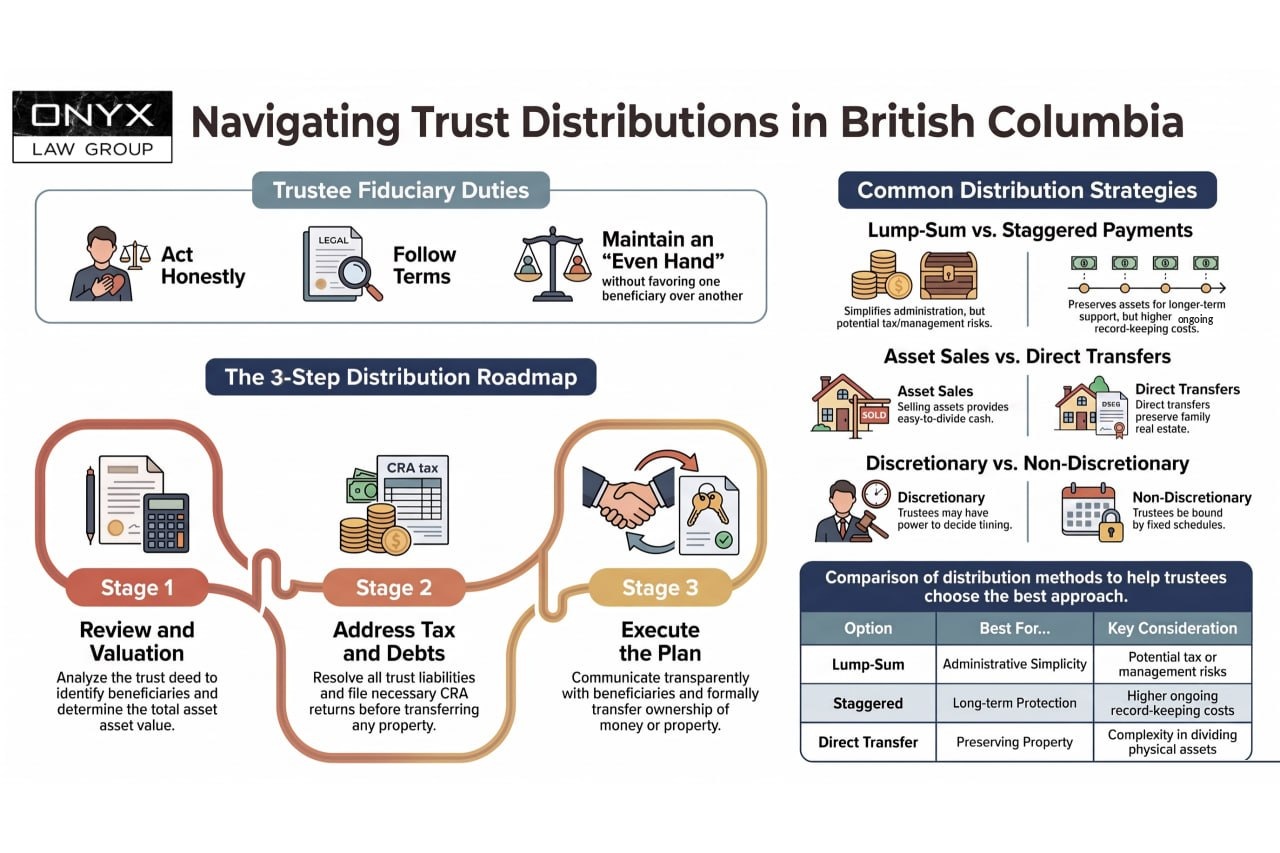
How best to distribute depends on the trust’s terms and the beneficiaries involved. A trustee with discretion often has to choose between several approaches. The table below sets out the common options with their advantages and drawbacks.
|
Distribution option |
Main benefit |
Potential drawback |
|---|---|---|
|
Lump-sum payment |
The beneficiary receives their entitlement at once. This can simplify the administration of the trust. |
The beneficiary may not be ready to manage a large amount of money. It may also have tax or financial planning consequences. |
|
Staggered payments |
Payments can provide support over a longer period. This may also help preserve trust assets. |
The trust may need to remain open longer. This means more administration, expenses, and record-keeping. |
|
Sell the asset and distribute cash |
Cash can be easier to divide between beneficiaries. It can also avoid disagreements about who should receive a particular asset. |
Selling an asset may trigger tax consequences and selling costs. The beneficiaries may also prefer to keep the asset. |
|
Transfer the asset directly |
A beneficiary can receive property such as real estate, shares, or another trust asset. This can preserve an important family or investment asset. |
The asset may be difficult to divide fairly. The beneficiary may also take on ongoing costs and responsibilities. |
|
Equal distributions |
Equal shares can make the distribution easier to understand and may reduce concerns about favouritism. |
Equal amounts are not always the same as equal treatment. The trust may give different beneficiaries different interests or rights. |
|
Discretionary distributions |
The trustee can respond to a beneficiary’s circumstances when the trust allows discretion. |
Beneficiaries may disagree with the trustee’s decisions or believe they are being treated unfairly. The trustee must still exercise discretion properly and follow their legal duties. |
What Are the Tax Implications of Receiving Trust Assets for Beneficiaries?

The general tax rule is that the trust pays tax on any income that stays in the trust. A trust beneficiary pays tax on income and/or capital that is paid from a trust to him or her. There are other situations where the settlor foots the tax bill due to attribution rules.
Trusts are often used to reduce taxes payable by transferring wealth to future generations on a tax-deferred basis. It’s possible to defer capital gains until the capital property is sold or distributed to beneficiaries (subject to deemed disposition imposed by the 21-year rule).
A trust beneficiary will bear the tax burden of a capital gain when a taxable capital gain is paid or payable to them. The bottom line is that Canadian tax law is highly complex, and beneficiaries should seek advice on tax consequences from a qualified professional.
How Long Does a Trustee Have to Distribute Assets?

The timeframe will depend on the type of trust and the distribution plan specified in the trust agreement (e.g., a one-time distribution upon the happening of a certain event vs. a trust created to benefit a particular person for the duration of their lifetime). If a beneficiary is concerned that the process is taking too long, they should reach out to a trust lawyer for advice. Trustees can be removed or found personally liable for loss caused by inaction or unreasonable delay.
How Can a Lawyer Help With Distributing Trust Assets to Beneficiaries in Canada?
A lawyer can help a trustee understand the trust document, identify the beneficiaries, and determine how the trust assets should be distributed. They can also help address legal and tax issues before any money or property is transferred. This is important because trustees have duties to act in accordance with the trust terms and in the beneficiaries’ interests.
For example, imagine Daniel was appointed trustee of his late father’s trust. He was unsure how to divide the investments between the beneficiaries and was concerned about making a mistake that could expose him to personal liability. Daniel contacted Onyx Law Group, where a lawyer reviewed the trust terms, helped him understand his responsibilities, and guided him through the distribution process. With proper legal guidance, Daniel was able to distribute the assets fairly and reach a favourable outcome without unnecessary conflict.
A lawyer can also help with the paperwork, tax considerations, beneficiary communications, and final distribution of the trust. In some situations, obtaining a CRA clearance certificate before distributing trust property can help protect the trustee from personal liability for unpaid amounts. If you are a trustee or beneficiary facing questions about a trust distribution, speaking with an experienced trust lawyer can help you move forward with confidence.
Need an Estate Planning Lawyer to Ensure a Smooth Distribution?
We are here to help with whatever issues you are facing. We provide advice to beneficiaries, ensuring efficient and fair distribution of the trust’s assets and intervening when actions taken by a trustee violate his or her duties. We can also advise trustees, executors, and administrators on their responsibilities every step of the way.
At Onyx Law Group, we believe it’s important to know your legal rights and obligations before making decisions. Sandy Minh Abley has spent more than 15 years working in trusts and estates, and Best Lawyers in Canada named her a leading lawyer in the field in 2020. We offer consultations to give you the opportunity to discuss your matter with a passionate and knowledgeable lawyer who can advise you on the best steps forward. We welcome you to contact our trust and estate planning lawyers in BC today!
Frequently Asked Questions
Trust and estate taxation in Canada depends on the type of trust, the nature of the distribution, and the beneficiary’s circumstances. Understanding the tax rules can help trustees and beneficiaries make informed decisions about tax planning, financial security, and estate administration.
Are Trust Distributions Taxable to the Beneficiary in Canada?
Trust distributions are not automatically taxable, as the treatment depends on whether the amount represents income or capital interest. Income distributed to a Canadian resident beneficiary may generally be included in the beneficiary’s tax return, while certain capital distributions may have different tax consequences.
How Do I Distribute Funds From a Trust to Beneficiaries?
A trustee must follow the trust document and applicable legal requirements when distributing funds to one or more beneficiaries. Before transferring significant assets, trustees should consider fair market value, the trust’s taxable income, and whether the distribution could generate income or affect the beneficiary’s tax position.
How Long Does an Executor Have to Distribute Assets in Canada?
There is no single deadline for distributing a parent’s estate or other estate assets across Canada. The timing can depend on estate debts, tax filings, probate requirements, and other factors affecting the remaining estate.
What Income Does the Trustee Distribute to the Beneficiaries?
A trustee may allocate income earned by the trust to all the beneficiaries or one or more beneficiaries according to the trust terms and applicable tax rules. In many cases, the allocated income is reported in the beneficiary’s hands, while the trust receives a deduction for the amount allocated.
Can an Executor Withhold Money From a Beneficiary in Canada?
An executor may delay distributions while resolving estate debts, tax obligations, or other legitimate estate matters. However, withholding a beneficiary’s entitlement without a proper reason can create legal issues, so trustees and executors should consider the relevant information and applicable law before acting.
What Is the 3-Year Rule for a Deceased Estate?
The three-year rule generally refers to the 36-month period during which an estate can qualify as a Graduated Rate Estate (GRE). During that period, a qualifying GRE can generally use graduated rates rather than the highest federal trust rate, subject to the applicable requirements.
Disclaimer: The information on this page is general legal information about British Columbia law, not legal advice for any specific situation. Reading this page does not create a solicitor-client relationship. BC law changes, and the procedure that applies to a specific situation depends on facts not covered here. For advice on your situation, consult a qualified British Columbia estate lawyer directly. Past results, illustrative scenarios, and reference to typical fact patterns do not guarantee similar outcomes in any specific case.