


Quick answer: The cost of setting up a family trust in Canada is mainly legal fees to draft the trust deed, plus ongoing costs to run it. Fees vary with complexity — a straightforward inter vivos family trust costs less than one holding a business or several properties. Beyond setup, expect yearly costs for trustee administration, accounting, and a T3 trust tax return. A family trust is a private arrangement, so there is no government fee to create one, but the tax rules — including the deemed disposition every 21 years — make professional advice worthwhile.
The cost of setting up a family trust in Canada typically ranges from $2,500 to $10,000, depending on its complexity and your legal and tax needs. A family trust can help protect assets, simplify estate planning, and provide tax planning opportunities for future generations. Because every situation is different, it’s a good idea to speak with a legal or tax professional for an accurate estimate.
At Onyx Law Group, we specialize in both Estates and Trusts Law and Family Law, so you can be certain that your Family trust is appropriately drafted and settled. Our estate planning team is led by Sandy Minh Abley, a Best Lawyers in Canada “Leading Lawyer” in Trusts and Estates, a STEP member, and a Certified Financial Planner. If you want to know more about estate planning or wish to discuss your unique circumstances, we welcome you to reach out to us today for a free consultation.
In this blog post, we’ll explore the topic of family trust in greater detail, explaining what it is, why it might be beneficial, and what influences the cost of setting it up.
Detailed Breakdown of the Cost of Setting up a Family Trust in Canada

The cost of setting up a family trust in Canada typically ranges from $2,500 to $10,000. The final price depends on the complexity of the trust, the assets involved, and the professionals you hire. In addition to legal fees, you should also budget for tax advice, registration costs, and ongoing administration.
1. Legal Fees
Legal fees are usually the largest upfront expense. Most estate planning lawyers charge between $1,500 and $5,000 to prepare the trust deed, advise on the trust structure, and complete the legal documents needed to transfer assets into the trust. Costs are generally higher for trusts involving businesses, multiple beneficiaries, or more complex tax planning. A lawyer’s experience and location may also affect the total fee.
2. Accounting and Tax Advisory Fees
Most families also work with an accountant or tax advisor to ensure the trust is structured properly. These services typically cost $500 to $1,500 during the initial setup. Professional tax advice can help identify planning opportunities and reduce the risk of costly mistakes.
3. Additional Setup and Ongoing Costs
Depending on the assets being transferred, you may also pay filing fees, land registration fees, title search fees, or property valuation fees. If you appoint a professional trustee instead of a family member, trustee fees will also apply. After the trust is established, there are ongoing costs for annual tax returns, accounting, record-keeping, and legal advice when changes are needed.
4. Low-End vs. High-End Cost Examples
A simple family trust holding investment assets with a straightforward structure may cost around $2,500 to $4,000 to establish. A more complex trust involving a family business, multiple beneficiaries, or advanced tax planning can easily cost $7,500 to $10,000 or more, especially when several professional advisors are involved.
DIY vs. Professional Legal Services
Some people consider using online templates or preparing a trust themselves to reduce costs. While this may save money upfront, mistakes in drafting or tax planning can lead to expensive legal and tax consequences later. Because family trusts involve complex legal and tax rules, most Canadians are better served by working with an experienced estate planning lawyer and tax professional.
| Feature | DIY Family Trust Setup | Lawyer-Assisted Family Trust Setup |
|---|---|---|
| Average Cost | $100–$1,000 (online templates and document services) | $2,500–$10,000+ (legal, tax, and accounting fees) |
| Pros | Lower upfront cost. Faster to complete. Suitable for very simple situations. | Professionally drafted documents. Proper tax planning. Reduced risk of legal errors. Tailored to your family’s needs. |
| Cons | May not comply with legal requirements. No personalized advice. Higher risk of costly mistakes or tax issues. | Higher upfront cost. Takes more time to complete. May require meetings with multiple professionals. |
| Best For | Individuals with very simple estates who understand trust law and tax rules. | Business owners, high-net-worth families, parents with complex estate planning goals, or anyone transferring significant assets. |
| Tax Planning | Limited or none. | Comprehensive tax planning tailored to your circumstances. |
| Asset Protection | Depends on how well the trust is drafted. | Stronger protection through a properly structured trust. |
| Long-Term Value | Can become more expensive if errors require legal corrections later. | Higher initial investment, but often saves time, taxes, and legal costs over the long term. |
| Recommended? | Generally not recommended unless your situation is very straightforward and you’ve obtained professional guidance. | Recommended for most Canadians establishing a family trust because of the legal and tax complexities involved. |
Is a Family Trust Worth the Cost in Canada?
For many families, a family trust can be well worth the cost. It can help with tax planning, protect certain assets from future risks, and make it easier to pass wealth to future generations. It can also provide more control over how and when beneficiaries receive assets.
A family trust is often most valuable for people with significant investments, business owners, or those with a growing estate. It may also make sense if you want to protect family wealth or create a long-term estate plan. The more complex your financial situation, the greater the potential benefits.
That said, a family trust is not the right choice for everyone. Setting one up can cost between $2,500 and $10,000, and there are ongoing legal, accounting, and tax filing responsibilities. Because most family trusts are irrevocable, you also give up some control over the assets placed in the trust.
If a family trust does not fit your needs, there are other estate planning options to consider. A well-drafted will, powers of attorney, beneficiary designations, or joint ownership may achieve your goals at a lower cost. A lawyer or estate planning professional can help you decide which approach works best for your situation.
Key Benefits and When to Consider a Family Trust
A family trust can offer several advantages for Canadian families. Depending on how it is structured, it may provide tax planning opportunities, help protect family assets, simplify the transfer of wealth, and keep certain estate matters private. In some cases, a trust can also help reduce probate by allowing trust assets to pass outside of an estate, although the outcome depends on how the trust is set up and the type of assets it holds.
A family trust is often worth considering if you own a business, have significant investments, expect your estate to grow, or want greater control over how assets are managed for children or future generations. It can also be useful if you are looking for long-term tax planning or want to protect family wealth. Since the rules can be complex, it’s important to get legal and tax advice before deciding whether a family trust is the right option.
How Much Does a Trust Cost to Maintain?
There are costs associated with maintaining a family trust on an ongoing basis. They include:
- Annual tax filings: A family trust is not a legal entity but is treated as a separate legal entity for tax purposes. T3 tax returns are required for each year of the trust’s existence, so you will need to budget for related accountant fees. These taxes may fall between $500 – $1,500+ per year.
- Trustee management fees: Trustees are entitled to claim compensation for their services. If you have hired a professional trustee to manage your family trust, their fees should be set out in a compensation agreement. Trustee compensation can be a flat fee or a percentage-based fee (e.g., an annual percentage on the income earned from the estate or a care and management fee based on the average value of the trust), not to exceed the limits set out in BC’s Trustee Act. Usually, the flat fee falls between $2,000 and $5,000+ per year, and the percentage-based fee is between 0.5% and 1.5% of trust assets annually.
- Accounting and reporting fees: A family trust must keep proper books and records. Requirements vary depending on how the trust is structured and the type of assets in the trust. There may be fees to prepare annual financial statements, income distribution reports, etc., as well as administration fees, bank account fees, etc. These fees typically range from $1,000 to $3,000+ per year.
- Investment management fees: Investment management fees may be charged to the family trust (e.g., commissions on the purchase and sale of investments). The investment management fee may be deductible against income from the trust. The industry standard for investment management fees is 0.5%–2% of assets under management.
What Is a Family Trust?

A family trust is a legal arrangement that is used to hold, manage, and distribute property and assets. A person (the “settlor”) transfers property to another person (a “trustee”) to hold for the benefit of another person or people (the “beneficiaries”). The trust’s assets can be money, real estate, a cottage or vacation property, business interests, investments, etc.
How to Set Up a Trust in Canada
Creating a trust in Canada involves several key steps. First, decide on the type of trust that suits your needs. Most people choose either a living trust (set up during your lifetime) or a testamentary trust (created through a will after death). Next, appoint a settlor, the person contributing the assets, along with a trustee to manage them and beneficiaries who will ultimately receive the benefits.
Once the structure is in place, determine which assets will go into the trust. This could include cash, investments, real estate, or business shares. Then, have a trust deed drafted, a legal document that outlines the trust’s terms, including how it will be managed, who receives what, and when.
After the trust is set up, assets must be formally transferred to it. This could mean changing titles on property or assigning shares to the trust’s name. Once that’s done, the trust may need to be registered with the CRA. From there, the trustees are responsible for managing the trust.
While setting up a trust can involve upfront legal and administrative costs, it can provide valuable control and protection, especially for those with significant assets or complex family situations.
What Influences the Cost of a Family Trust?
There are several factors that can impact the cost of setting up a family trust. First off, the complexity of the trust. More complex trusts will incur higher legal and advisory fees. Factors that can make a trust more complex include the number of beneficiaries and the level of detail required in the trust agreement (e.g., clauses pertaining to control and management of assets and clauses pertaining to distribution of trust income and capital property).
Another factor is the choice of trustee. As noted, trustees are entitled to compensation. Costs to maintain the family trust will vary depending on whether the trustee is a family member or a professional trustee.
Furthermore, the size and type of assets in the trust contribute to the cost. Larger, more complex assets will increase costs. A family trust to hold real estate, investments, business ownership shares, and/or foreign assets, for example, will typically incur higher ongoing maintenance costs.
Finally, provincial variations in trust law should be taken into account as well. Provincial laws and regulations can affect the cost to set up and maintain a family trust. For example, trusts must be registered in some provinces. A lawyer can advise you on provincial requirements that apply in your situation.
How to Reduce the Cost of Setting up a Family Trust
There are strategies to reduce the overall cost of setting up a family trust. Whether any of these strategies are viable in your situation depends on factors such as your needs, your comfort and knowledge of trust laws and tax laws, and your family dynamics. Here are some of the strategies we recommend using that may reduce costs:
- Use a Simple Trust Structure: Costs to establish and maintain the trust increase based on the complexity of the trust agreement and assets held in trust. A revocable trust may be less expensive to set up but doesn’t offer the same level of asset protection as an irrevocable trust.
- Hire an Estate Planning Lawyer: It can cost you more money in the long run if you don’t work with an estate planning lawyer. Mistakes in setting up a trust are expensive to fix.
- Use Family Members as Trustees: Professional trustees and corporate trustees are more expensive than family members. Bear in mind that trustees have a lot of responsibilities. As the old adage goes, you get what you pay for.
- Minimize Accounting and Tax Advisory Fees: Simpler trust structures may require less advice from a tax and accounting perspective.
- Choose a DIY Trust Management Software: It may be possible to set up a very simple family trust using a template and/or trust-management software. Bear in mind that the software may not be customizable, may not reflect local laws, and cannot advise you of risks.
Tax Implications of Setting up a Family Trust

As mentioned above, a family trust is considered a taxpayer even though it’s technically not a separate legal entity, which means the trust pays tax on any undistributed income. Please note that the tax information contained in this post is general and not advice. You’ll need to consult with a tax lawyer and accountant about tax implications in your particular situation.
Income generated by trust assets is taxable. It’s often best to pay any income out of the trust to the trust’s beneficiaries on an annual basis. Trusts are taxed at the highest marginal tax rate and can’t claim individual tax credits. When trust income is paid out, it is instead taxed in the hands of the beneficiaries, who pay tax based on their (likely much lower) tax bracket.
Attribution rules, which are intended to prevent tax avoidance in certain situations, must be carefully considered and well-understood. Trust income may be attributed back to the settlor in certain circumstances and may prevent income splitting with lower tax bracket beneficiaries, such as a minor child.
How Can Family Trusts Reduce Taxes?
A family trust can create tax planning opportunities when it is properly structured. One of the main benefits is income splitting, where trust income may be distributed to beneficiaries in lower tax brackets. In some cases, this can reduce the family’s overall tax bill, although Canadian tax rules and attribution rules may limit this strategy.
Family trusts can also help manage capital gains. Capital gains may be allocated to beneficiaries in lower tax brackets, and in some situations, taxes can be deferred until trust assets are sold or distributed, subject to the 21-year deemed disposition rule. If the trust owns shares of a qualifying Canadian-controlled private corporation, it may also allow multiple beneficiaries to benefit from the Lifetime Capital Gains Exemption when the shares are sold.
Another advantage is estate planning. Assets transferred to a properly established family trust generally do not form part of the settlor’s estate, which may reduce probate fees and simplify the transfer of wealth to future generations. Because these strategies depend on Canadian tax laws, professional legal and tax advice is essential.
Why Set Up a Family Trust?
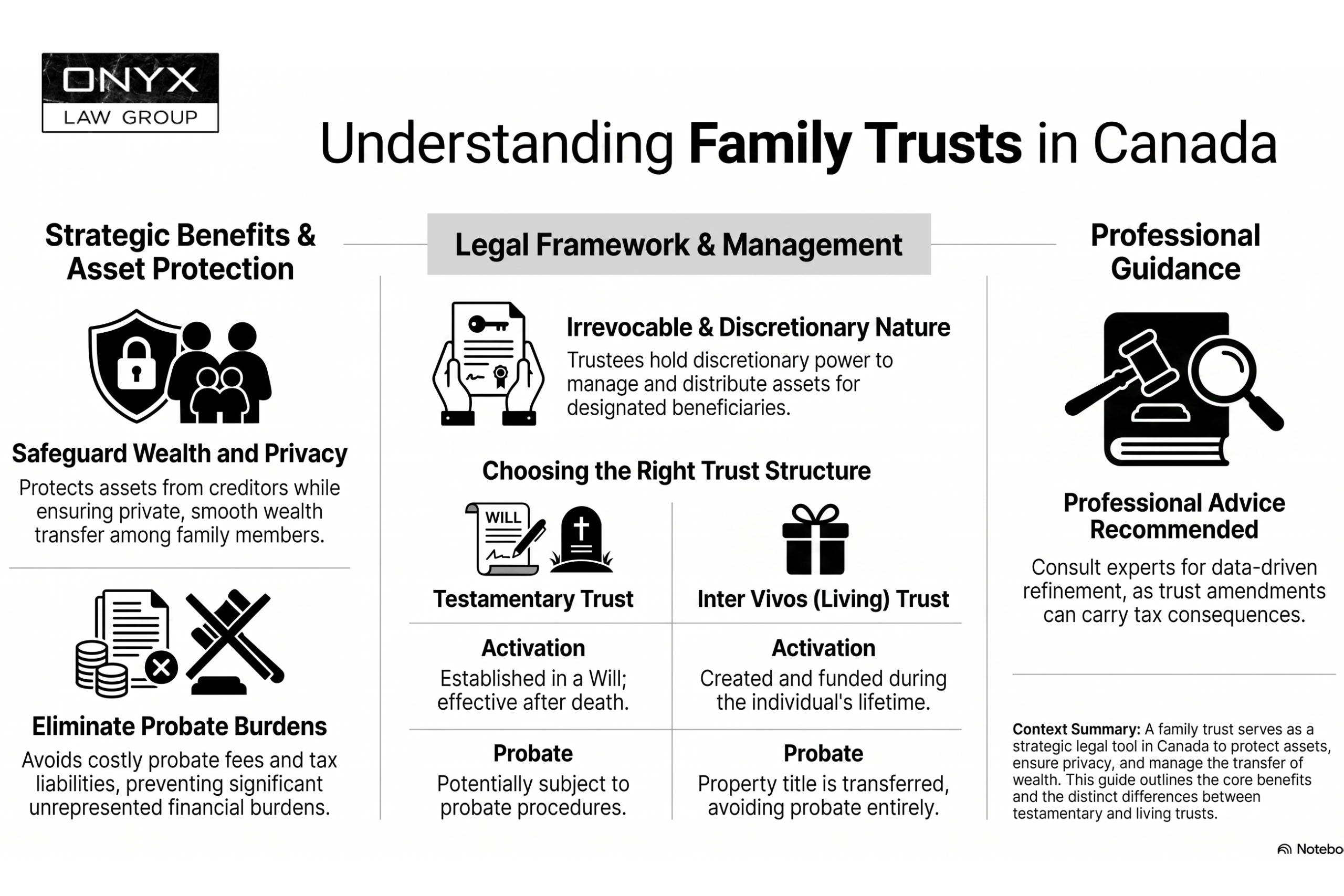
In addition to potential income tax benefits, the most common reasons to set up a family trust include safeguarding assets (e.g., creditor-proofing), increased privacy, protecting and providing for beneficiaries, and avoiding probate fees and probate tax liabilities. Family trusts can also be used to reduce family conflicts and ensure the smooth transfer of wealth among family members.
What Are the Types of Trusts in Canada?
A trust can be testamentary or inter vivos. A testamentary trust is set up in a person’s last will and comes into effect when the will-maker dies. The trust’s assets may still be subject to the probate process.
In comparison, an inter vivos trust is a living trust that Canadian residents may create while alive. The title to the trust property is transferred to the trust, so when the settlor passes away, the property does not form part of their estate and doesn’t attract probate fees.
An inter vivos trust can be revocable or irrevocable. An irrevocable trust can’t be revoked during the lifetime of the person who created the trust, except in very specific situations. While a family trust can be amended, there can be tax consequences, so advice from a tax professional is always recommended before amendments are made.
Family trusts are always irrevocable and are usually discretionary. A discretionary trust is one in which the trustee has the power to decide how and when to distribute trust property among the beneficiaries.
How Long Can a Family Trust Last in Canada?
A family trust can last for generations, can end at a set date, or can end when the settlor dies. It all depends on what the trust document says. However, most trusts in Canada are subject to what is known as the 21-year rule.
The rule is intended to prevent indefinite tax deferral. A trust is considered to have disposed of all of its assets at fair market value on the 21st anniversary of its creation and every 21 years thereafter, which has the potential to result in a sizeable tax bill.
Is It Better to Have a Will or a Trust in Canada?
The answer depends on your goals, wishes, and the needs of you and your family members. Trusts aren’t subject to probate, which makes them more private and can reduce the probate tax burden on your estate. Wills, on the other hand, become public, and probate fees must be paid on estate assets if probate is necessary. Another consideration: while wills are typically much less expensive to prepare, a will doesn’t come into effect until the will-maker’s death.
An estate planning lawyer can help you decide which offers greater benefits in your situation. In fact, you may want to have both, as they serve different purposes and achieve different goals.
Need an Estate Planning Lawyer to Set Up a Trust?
A family trust can be a powerful tool to manage assets, provide financial security, avoid probate, and ultimately distribute assets in a way you see fit. But there are cost considerations and other potential drawbacks that you must carefully weigh before deciding if a trust is right for you and your family members.
Wondering what a family trust actually costs to set up? The price shifts with your assets and your goals. Onyx Law Group builds family trusts that hold up, with lawyers like Sandy Minh Abley, a Best Lawyers “Leading Lawyer” in Trusts and Estates and a Certified Financial Planner. Contact the experienced team of British Columbia estate planning lawyers for a consultation today.
Frequently Asked Questions About the Cost of Setting up a Family Trust in Canada
Setting up a family trust in Canada involves legal, tax, and administrative costs that can vary depending on your situation. These frequently asked questions explain the typical expenses and the factors that can affect the total cost.
Can I Set Up a Family Trust Without a Lawyer?
Yes, but it is generally not recommended. A lawyer can ensure the trust is a legally sound legal structure, meets all legal obligations, and complies with the Income Tax Act.
How Long Does It Take to Set Up a Family Trust in Canada?
Most family trusts can be established within two to six weeks. The timeline depends on the complexity of the trust, the professionals involved, and the assets being transferred.
Can a Family Trust Own a Home in Canada?
Yes. A discretionary family trust can own real estate and other assets that family trusts commonly hold, but property transfers may have capital gains tax and other tax consequences.
Do Family Trusts Avoid Probate in Canada?
Yes. Assets held in a family trust generally bypass the probate process, making the estate planning process more efficient and private after the settlor’s death.
Are There Tax Advantages to Setting Up a Family Trust?
Possibly. A family trust may provide tax savings, help split income among multiple family members, and minimize taxes in some situations. However, trusts must follow the Income Tax Act, and retained taxable income is generally taxed at the highest rate.
What Happens if I No Longer Want the Trust? Can It Be Cancelled?
It depends on the type of trust. Some trusts can be changed or revoked during the settlor’s lifetime, while many family trusts are intended to be irrevocable.
Do You Pay Taxes on a Trust Inheritance in Canada?
Generally, no. Beneficiaries do not usually pay inheritance tax because Canada does not impose one, although the trust may owe capital gains tax or other taxes before assets are distributed.
Is a Family Trust Worth It in Canada?
It depends on your financial goals and overall tax burden. With careful planning, a family trust can simplify estate planning, protect assets, and provide long-term tax benefits.
What Is the 2 Year Rule for Trusts?
The two-year rule generally applies to certain trusts created after death for tax purposes. Because the rules are administered by the Canada Revenue Agency, professional advice is recommended.
At What Net Worth Do I Need a Trust in Canada?
There is no minimum net worth required to create a family trust. A trust may be worthwhile if you want to protect significant assets, reduce the administrative burden, or plan for future generations.
Disclaimer: The information on this page is general legal information about British Columbia law, not legal advice for any specific situation. Reading this page does not create a solicitor-client relationship. BC law changes, and the procedure that applies to a specific situation depends on facts not covered here. For advice on your situation, consult a qualified British Columbia estate lawyer directly. Past results, illustrative scenarios, and reference to typical fact patterns do not guarantee similar outcomes in any specific case.