


When a person with debt dies in British Columbia, their debts do not automatically become the responsibility of their spouse or family. Instead, the deceased’s estate is generally used to pay outstanding debts before any remaining assets are distributed to beneficiaries. However, surviving family members may still be legally responsible for certain debts, such as jointly held debts or co-signed loans.
When someone in BC dies owing money, the debts fall on their estate, not their family. Onyx Law Group has guided Vancouver families through exactly that since 2012. Veronica Manski leads our probate and estate administration, and King’s Counsel Candace Cho steps in when creditors or beneficiaries end up in a fight. If you’re facing a loved one’s debts, book a free 30-minute consultation with us today.
In today’s blog post, we’ll discuss how debt after death is handled and who is legally obligated to pay outstanding debts after a person dies.
How Is Debt Handled After a Person Dies in Canada?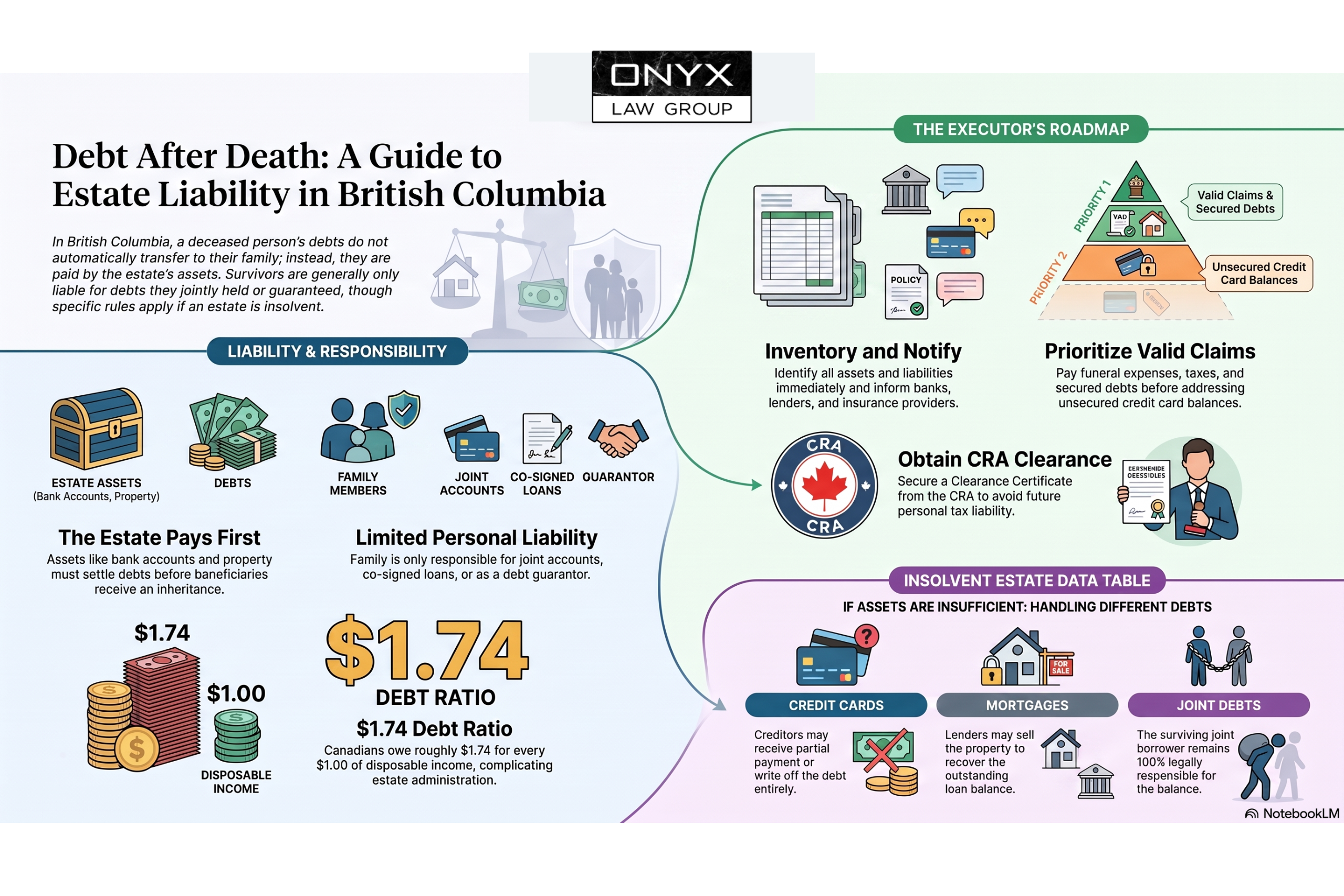
According to Statistics Canada, Canadian households owe roughly $1.74 in credit market debt for every $1.00 of disposable income. Because many people die while still carrying mortgages, loans, or credit card balances, understanding how debt is handled after death is an important part of estate administration.
Debt does not automatically disappear when someone dies. In Canada, including British Columbia, most outstanding debts are paid from the deceased’s estate before any assets are distributed to beneficiaries. The estate may include bank accounts, investments, real estate, and other property owned by the deceased. In most cases, family members are not personally responsible for these debts unless they jointly owed the debt or agreed to guarantee it.
The estate executor, or the estate administrator if there is no will, is responsible for managing the deceased’s financial affairs. This includes identifying assets, notifying creditors, reviewing debt claims, and paying valid debts from the estate. Only after debts, taxes, and estate expenses have been addressed can the remaining assets be distributed to beneficiaries.
Not all debts are treated the same. Secured debts, such as a mortgage or a vehicle loan, are generally tied to specific property and are typically dealt with first in relation to that property. Unsecured debts, such as most credit card balances or personal loans, are paid from the remaining estate assets according to the applicable legal rules if funds are available.
If the estate does not have enough money to pay every debt, it is considered insolvent. In that situation, the executor cannot choose which creditors to pay. Instead, the estate must be administered according to the legal priority rules that apply. Beneficiaries usually do not receive an inheritance until valid debts and estate obligations have been dealt with, and they are generally not required to use their own money to pay the deceased’s personal debts unless they were legally responsible for them.
What Happens if a Person Dies With No Estate or Insufficient Assets?

If a person dies with no estate or not enough assets to cover their debts, creditors may not recover the full amount they are owed. In British Columbia and across Canada, debts are generally paid from the deceased’s estate. If there are no assets, or the estate is insolvent, unpaid debts may be written off once the estate has been properly administered according to the applicable provincial laws.
In most cases, family members do not inherit a deceased person’s debts. A spouse, child, or other relative is generally not required to use their own money to pay those debts simply because of their relationship to the deceased. However, someone who co-signed a loan, was a joint borrower, or guaranteed the debt remains legally responsible for the amount they agreed to repay.
How a particular debt is handled depends on the type of obligation. Unpaid credit card balances and unsecured personal loans are typically paid from the estate if funds are available. If the estate has no remaining assets, the creditor may receive only part of what is owed or nothing at all.
Mortgages and other secured loans are different because they are tied to specific property. If mortgage payments cannot continue, the lender may enforce its security rights, which can include selling the property to recover the outstanding loan balance.
In British Columbia, the executor or estate administrator must follow the legal rules governing the administration of an insolvent estate. They cannot distribute assets to beneficiaries before paying valid debts in the order required by law. If the estate has insufficient assets, beneficiaries may receive a reduced inheritance or none at all. While this can be difficult for families, the law generally protects relatives from becoming personally liable for the deceased’s debts unless they had an independent legal obligation to repay them.
| Debt Type | If the Estate Has Enough Assets | If There Is No Estate or the Estate Has Insufficient Assets |
|---|---|---|
| Credit Card Debt | Paid from the estate before beneficiaries receive any inheritance. | The creditor may recover only part of the balance or write off the debt if no estate assets remain. Family members are generally not responsible unless they were joint account holders. |
| Personal Loans | Paid from estate funds if the claim is valid. | Any unpaid balance may be written off if the estate is insolvent. A co-signer or guarantor remains legally responsible for repayment. |
| Mortgage | The estate continues mortgage payments or the property may be sold to repay the loan before any remaining equity is distributed. | The lender may enforce its security, including selling the property. If the sale does not fully repay the loan, recovery depends on the estate’s remaining assets and any co-borrower’s liability. |
| Car Loan | The estate pays the loan or sells the vehicle to satisfy the debt. | The lender may repossess the vehicle if payments stop. Any remaining unsecured balance may go unpaid if the estate has no assets, unless another person is legally liable. |
| Line of Credit | Paid from estate assets before distributions to beneficiaries. | The creditor may receive only a partial payment or none at all if the estate has insufficient funds. Joint borrowers remain responsible for the debt. |
| Joint Debts | The estate may pay the deceased’s share where appropriate, but the surviving joint borrower remains responsible under the loan agreement. | The surviving joint borrower continues to be legally responsible for the outstanding balance, even if the estate has no assets. |
| Guaranteed Debts | The estate may repay the debt if funds are available. | If the estate cannot pay, the guarantor may be required to repay the outstanding amount under the guarantee agreement. |
Common Types of Debt and Their Impact After Death

Different types of debt are treated differently after a person dies. In British Columbia and across Canada, the first question is whether the debt was solely in the deceased’s name or shared with someone else. Debts in the deceased’s sole name are generally paid from the estate, while joint borrowers, co-signers, and guarantors usually remain responsible for debts they agreed to share.
Credit card debt is typically paid from the estate if the account was only in the deceased’s name. If there are not enough estate assets, the remaining balance may go unpaid. However, if the credit card was a joint account rather than simply an authorized user account, the surviving account holder may remain responsible for the outstanding balance. Personal loans and lines of credit follow similar rules. Sole debts are paid from the estate, while co-signers and joint borrowers remain legally liable for repayment.
Mortgages and other secured loans are handled differently because they are tied to specific property. If the mortgage is not paid, the lender has the right to enforce its security, which may include selling the home to recover the outstanding balance. In some cases, mortgage protection insurance or life insurance may pay off the remaining loan, allowing beneficiaries to keep the property without the mortgage debt. The executor should also review any loan protection policies that may reduce or eliminate the outstanding balance.
Child support and certain family law obligations can also affect an estate. Outstanding support payments that were owed before death may become claims against the estate, and in some situations ongoing support obligations may continue depending on the circumstances and applicable provincial family law. Because these issues can be complex, executors and family members should seek legal advice to understand their rights and responsibilities before distributing estate assets.
Steps to Take When a Person With Debt Dies in BC

If your loved one dies with outstanding debts, the estate must be administered carefully before any inheritance can be distributed. In British Columbia, the estate executor named in the will, or the court-appointed estate administrator if there is no will, is responsible for managing this process. Following these steps can help ensure the estate is handled properly.
Step 1: Gather Information About the Estate
Start by creating a complete inventory of the deceased’s assets and debts. This includes bank accounts, investments, real estate, vehicles, personal belongings, credit cards, mortgages, personal loans, lines of credit, taxes, and any other outstanding liabilities. Having a clear financial picture is essential before making any payments or distributions.
Step 2: Notify Financial Institutions and Creditors
Contact banks, mortgage lenders, credit card companies, insurance providers, and other known creditors to inform them of the death. The executor should also review incoming bills and financial records to identify any creditors that may not be immediately obvious. In some estates, it may also be appropriate to advertise for creditors to ensure unknown claims are identified.
Step 3: Apply for Probate if Required
If probate is necessary, the executor must file the required application with the BC Supreme Court before dealing with many estate assets. Probate confirms the executor’s legal authority to administer the estate and allows financial institutions and other organizations to release assets where required.
Step 4: Pay Debts in the Correct Order
Before beneficiaries receive an inheritance, the executor must pay valid estate expenses and debts according to the applicable legal priority rules. This may include funeral expenses, taxes, secured debts such as mortgages, and unsecured debts such as credit cards and personal loans. If the estate does not have enough cash, some assets may need to be sold to satisfy these obligations.
Step 5: Distribute the Remaining Estate
Once debts, taxes, and estate expenses have been paid, the executor can distribute the remaining assets to the beneficiaries named in the will or, if there is no will, according to British Columbia’s intestacy laws. Before making final distributions, it is generally advisable to obtain a Clearance Certificate from the Canada Revenue Agency to reduce the risk of future tax liability.
Step 6: Seek Legal Advice When Needed
Some estates are straightforward, while others involve creditor disputes, insolvent estates, complex assets, or disagreements among beneficiaries. If you are unsure about your responsibilities or how to handle estate debts, speaking with an experienced BC estate lawyer can help you avoid costly mistakes, reduce delays, and ensure the estate is administered in accordance with the law.
Who Is Responsible for a Deceased Person’s Debt?
The general rule is that a deceased person’s estate is responsible for paying all outstanding debts in the deceased person’s name. The deceased person’s assets and property are used to pay debts owed by the deceased person. After debts are settled, remaining assets and property are distributed to the beneficiaries named in the deceased person’s will (or to their intestate heirs if there was no valid will).
Are Family Members Ever Personally Responsible for Debt?
Debts in the name of a deceased person do not automatically transfer to their family members. Individual debt obligations remain the legal responsibility of the deceased’s estate. However, if a family member is a joint debtor, co-signer, or guarantor of debts with the deceased person, the surviving family member becomes personally responsible for the debt.
For example, if the deceased leaves credit card debt and the deceased person was the only one who signed the credit card agreement, the deceased’s estate is solely responsible for that unsecured debt. In comparison, if the deceased and their spouse were joint cardholders, the surviving spouse is automatically personally responsible for 100% of the credit card balance when their spouse passes away.
The same is true for secured debts such as mortgages. If the deceased person was the sole borrower, the remaining balance stays attached to the property. The deceased person’s estate is legally responsible for paying the mortgage debt. The lender can foreclose on the property if payments aren’t made by the estate. Conversely, if the mortgage was jointly held (e.g., by the deceased person and their spouse), the deceased person’s spouse is automatically personally responsible for 100% of the mortgage payments.
There is another exception for family members to be aware of, and that relates to the tax liabilities of a deceased person. If a person dies owing tax debt to the Canada Revenue Agency (“CRA”), that debt must be paid out of the estate. If the estate is insolvent (i.e., it does not have sufficient assets to pay debts), the Income Tax Act permits the CRA to recover money owed by the deceased from certain beneficiaries.
For example, if the deceased named their spouse or common-law partner as beneficiary of an RRSP or other registered investment, the recipient of that property can be held personally liable for the deceased person’s unpaid tax liability, up to the amount that the beneficiary received from the deceased.
What if There Are More Debts Than Assets?
When estate debts are greater than the value of estate assets, the estate is insolvent. If there is not enough money in the estate to pay debts, and there is no one who shared responsibility for the debt with the deceased person (e.g., spouse, child, friend, business partner), then certain debts may go unpaid. Creditors may not be able to recoup debts owed, or they may only recoup a portion of debt owed.
Certain creditors have priority over others; the usual priority is as follows:
- Tax debt owed to the CRA
- Tax debt owed to the provincial government
- Debts owed to secured creditors (e.g., mortgages, secured lines of credit)
- Debts owed to unsecured creditors (e.g., credit cards, unsecured loans)
You’re surely wondering what it means for beneficiaries if the estate has more debt than assets. If the value of estate debts exceeds the estate’s assets, beneficiaries may not receive an inheritance from the estate. Alternatively, if assets aren’t sufficient to pay off all estate debts, abatement may be necessary. Abatement is a process whereby the personal representative of the estate reduces gifts to beneficiaries named in a will on a pro rata or rateable basis so that debts of the estate can be paid in full.
What Creditors Can and Cannot Do After Death
Creditors can file a claim against the deceased person’s estate to collect debts owed. A creditor or collection company can also pursue payment of the full amount of the debt from anyone jointly responsible for it, such as a joint account holder, co-signer, or guarantor.
Debt collectors don’t always follow fair debt collection practices. A collection company may begin contacting a surviving spouse, for example, insisting that they are personally responsible for debt that was solely in the name of their deceased spouse. As discussed, that is generally not the case, and a surviving spouse or family member who is being harassed should seek guidance on dealing with debt collectors.
What to Do Immediately After Your Loved One Dies
The personal representative of the deceased’s estate, the estate executor or the estate administrator, is legally required to take certain steps, including:
- Create an inventory of all estate assets: Bank accounts, property, investments, personal belongings, etc. and their values.
- Create a debt inventory: List every debt, including credit cards, loans, mortgages, etc. and the amounts owing.
- Seek professional guidance: An estate lawyer or financial advisor can help avoid mistakes and delays.
- Bring a probate application: File the will with the BC Supreme Court and apply for probate, if necessary.
- Locate and notify creditors: Inform all known creditors about the death so they can file claims.
- Prioritize debt payments: Debts must be paid in the following order: funeral expenses, federal and provincial taxes, secured debts, and then unsecured debts.
- Liquidate assets if needed: Sell property or other assets as necessary to pay outstanding debts.
- Distribute remaining assets and residue: Once debts are paid and a clearance certificate has been obtained from the CRA, the remaining estate is distributed to the beneficiaries according to the will (or to the intestate heirs if there was no valid will).
How Can an Estate Lawyer Help?
An estate lawyer can help you understand exactly who is responsible for a loved one’s debts and make sure the estate is administered correctly. They can identify valid creditor claims, explain which debts must be paid from the estate, and advise whether family members have any personal liability.
A lawyer can also help apply for probate, communicate with creditors, and ensure assets are not distributed before debts and taxes have been properly dealt with. If the estate is insolvent or there are disputes between creditors, beneficiaries, or family members, legal advice can prevent costly mistakes and unnecessary delays.
Take the case of a Vancouver woman who contacted Onyx Law Group after her father passed away with a mortgage, credit card debt, and several personal loans. She was worried she would have to pay everything herself and wasn’t sure whether she could distribute the estate to her siblings.
Our probate team reviewed the estate, identified which debts were payable from the estate and which she wasn’t personally responsible for, and guided her through the administration process. With clear legal advice and careful estate administration, the debts were resolved correctly, the remaining assets were distributed to the beneficiaries, and she avoided costly mistakes and unnecessary stress.
Need Help Navigating Debt and Estates?
You won’t inherit debts of a loved one unless you were a joint account holder, co-signor, or guarantor. You may, however, be impacted by the debts accumulated during your loved one’s lifetime, as outstanding debts must be settled from the money and assets they leave behind. If the debts are large, there may be little to nothing left for the deceased person’s spouse, children, or other beneficiaries.
A clear estate plan can minimize the impact of debt on surviving loved ones. We strongly encourage British Columbia residents to create a will and make a plan to minimize debts on death. Working with an experienced estate planning lawyer and financial professional is recommended.
Worried you’ll be stuck with a loved one’s debt? In BC, the estate pays what’s owed before anyone inherits. Since 2012, Onyx Law Group’s Vancouver estate lawyers have handled these estates, with King’s Counsel Candace Cho leading the fight when creditors and beneficiaries clash. Contact us today for a free 30-minute consultation to find out where you stand.
Frequently Asked Questions
Debt does not automatically pass to family members when someone dies. Here are answers to common questions about how debts are handled after death in British Columbia.
What Happens if a Deceased Person Has More Debt Than Assets?
If the estate has more debts than assets, it is considered insolvent. During the probate process, the estate’s own assets are used to pay creditors, and some other debts or other claims may go unpaid if there is not enough money.
How Long Does It Take to Settle Debts After Death?
The timeline depends on the size and complexity of the estate. Probate can take six months to a year or longer, and most estates are not fully settled until debts have been resolved.
Do You Inherit Debt if Your Parents Die?
The short answer is no, you generally do not inherit a deceased relative’s debts. Your parents’ debts are usually paid from the estate, although specific circumstances may create personal liability.
Are Debts Forgiven When Someone Dies?
Not all debts are automatically forgiven when a person dies. If the estate cannot fully repay creditors, some remaining debts or other claims may go unpaid because law sets the order in which creditors are paid.
Do I Have to Pay My Deceased Husband’s Credit Card Debt?
Usually not. Credit card debt is generally paid from the deceased person’s estate unless the debt was jointly owned or you are otherwise legally responsible.
Will My Parents’ Debt Go to Me?
Generally, no. You are not personally responsible for your deceased relatives’ debts unless you co-signed the debt or another legal exception applies.
Who Pays off the Debt of a Deceased Person?
The executor or estate administrator uses estate assets to pay valid debts before distributing any inheritance. They may also need the death certificate and other financial documents to access accounts and complete the administration process.
Do I Take On My Father’s Debt When He Dies?
No, not simply because you are his child. You may only become responsible under specific circumstances, such as agreeing to repay the debt or becoming legally liable for it.
Do I Have to Pay My Deceased Mom’s Credit Card Debt?
Generally, no. The debt is usually paid from your mother’s estate unless the account was jointly owned or you accepted legal responsibility for the debt.
What Happens if a Person Dies Owing Child Support in BC?
Outstanding child support does not automatically disappear when a person dies. Depending on the circumstances, the estate may still be responsible because the law sets the priority for paying valid obligations.
Disclaimer: This article is provided for general informational purposes only and does not constitute legal advice. Reading this article does not create a solicitor-client relationship with Onyx Law Group or its lawyers. British Columbia estate and probate laws may change and apply differently depending on your specific circumstances. If you need legal advice about your situation, consult a qualified British Columbia estate lawyer.