


Losing a parent is one of life’s hardest experiences. After their passing, it’s important to handle key legal and administrative tasks to ensure everything is managed properly and in line with Canadian law. A checklist after the death of a parent in Canada should include obtaining the death certificate, notifying Service Canada and financial institutions, locating the will, contacting the executor, making funeral arrangements, settling debts and taxes, transferring assets, and updating beneficiary records.
Losing a parent brings enough to sort through without also worrying whether their estate is being handled correctly. Onyx Law Group’s lawyers focus entirely on estates and trusts litigation, including disputes over wills, undue influence, and resulting trusts between parents and adult children. Led by estate litigation practice leader Candace Cho, KC, the firm has represented families through these disputes since 2009. Schedule a free consultation with us to find out where you stand.
This piece will discuss what to do if a parent dies in Canada, who to inform of that fact, and how to plan things so that the process goes smoothly.
What Legal Steps Should I Take After a Parent’s Death in Canada?

There are several important legal steps to manage a loved one’s affairs when they pass away. Here’s a breakdown of the process.
Step 1: Locate Key Documents, Including the Will
The first step would be to find important papers that belonged to the deceased, such as their will. It’s important to determine if there is actually a valid will and also to figure out who is named as executor of that will.
Step 2: Check Provincial Intestacy Laws if There’s No Will
If there is no will, provincial intestacy laws will decide how the deceased’s assets are distributed. These laws determine how assets pass to family members or a common-law partner.
Step 3: Obtain Certified Copies of the Death Certificate
You will need certified copies of death certificates for important places like banks and government offices which handle settling a deceased’s estate. Getting those copies sooner rather than later will help avoid delays down the line.
Step 4: Contact the Funeral Home and Service Canada
Getting in touch with the funeral home and Service Canada is key to starting important administrative matters. Doing this helps safeguard the deceased’s assets and initiates necessary legal procedures.
Step 5: Secure Personal Property and Important Records
Protecting your parents’ personal belongings and important documents safeguards their assets during this precarious time. That also makes sure that executors have everything necessary to proceed with settling their affairs.
Step 6: Start the Estate Administration Process Early
Starting the estate administration process early means that you handle finances and other formalities in an orderly way and avoid unnecessary delays. While there are some differences depending on whether you live in one of the provinces, the general procedure is fairly consistent throughout Canada.
Step 7: Understand That Power of Attorney Ends at Death
In British Columbia, executors generally cannot deal with the finances of the deceased until they obtain probate. Also, power of attorney that was given to the deceased does not work anymore after death because such power just stops automatically in that province.
What Checklist Should Be Followed After the Death of a Parent in Canada?
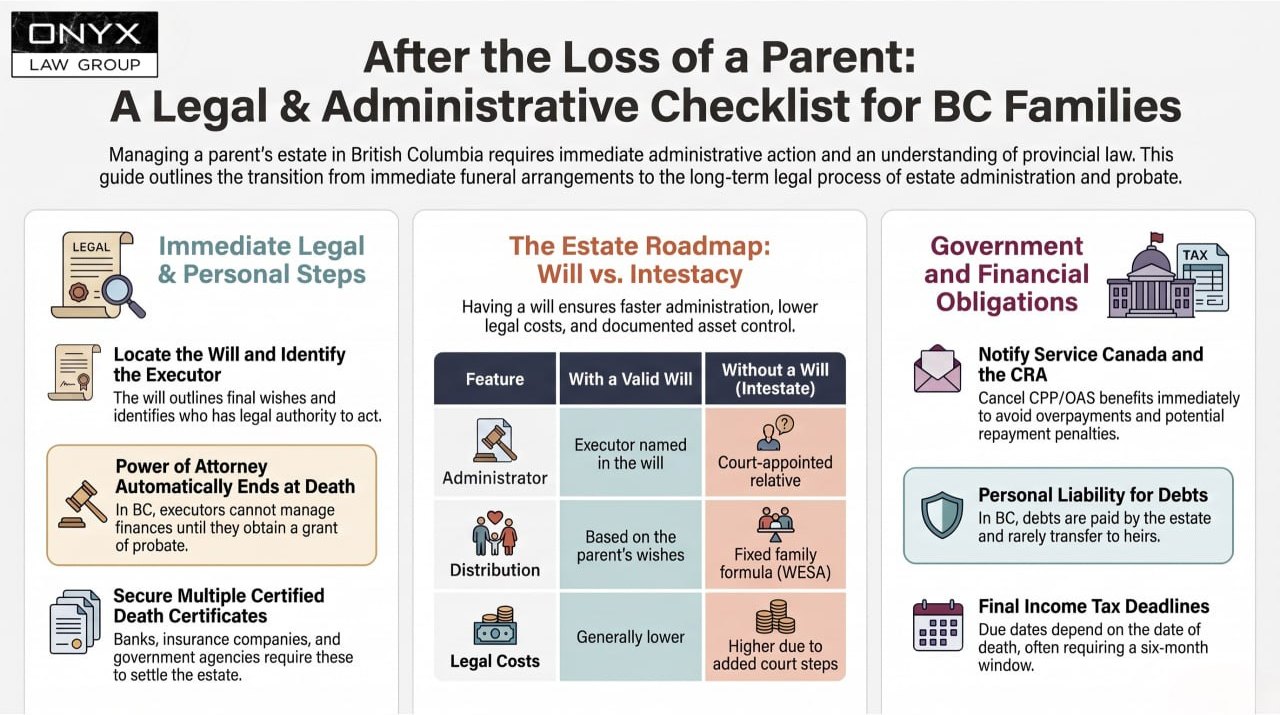
Handling the loss of a parent is emotionally taxing and dealing with their affairs can seem very daunting too. Getting started early is important if you want to settle affairs properly and reduce any possible financial burden. Here’s a list of important legal and administrative steps that should be taken after someone dies in Canada. This checklist helps you keep organized through this tough time.
1. Obtain the Death Certificate
You should probably get a copy of a death certificate because sometimes executors need this for settling affairs after someone has died. Copies also have to be sent to government agencies to notify them that someone has passed away. So you should ask for several copies just to be safe.
2. Arrange Funeral Plans
It is important to proceed smoothly and to handle the grieving process carefully, so you should contact a funeral home or funeral director promptly after your loved one has passed. They can help guide you through the process of funeral planning and paperwork. You might also need to decide whether to have a burial or cremation. However, before making any choice about funeral services, it’s really important to look into what the deceased person’s will says because people usually specify how they want their remains treated.
3. Check for a Will
When a parent dies, locating their will is essential, as it outlines their final wishes, names the appointed executor, and guides the probate process. The will also determines how estate assets and family trusts will be managed, making it a key step in handling a parent’s estate planning after death.
With a Will vs. Without a Will: What Changes for Your Family?
Whether your parent left a will affects nearly every step that follows. Here’s how the two paths compare.
|
With a Will |
Without a Will (Intestate) |
|
|---|---|---|
|
Who administers the estate? |
The executor named in the will |
The court appoints an administrator, usually the closest relative who applies |
|
Who inherits? |
Whoever the will names, in the shares specified |
BC’s Wills, Estates and Succession Act decides, based on a fixed family formula |
|
Timeline |
Typically faster, since the plan is already set out |
Often slower, since the court process to appoint an administrator adds extra steps |
|
Cost |
Probate fees still apply, but legal costs are usually lower |
Legal costs tend to run higher due to the added court application |
|
Control over asset distribution |
Full control rests with the parent’s wishes |
None. Assets pass strictly by statutory formula, regardless of what the parent may have wanted |
|
Common-law partners |
Can be named and protected like any other beneficiary |
May need to apply to the court to claim a share, since intestacy rules don’t always treat them the same as married spouses |
|
Risk of family disputes |
Lower, since intentions are documented |
Higher, since surviving family members may disagree on what the parent would have wanted |
Writing a will formalizes intentions of parents and helps the family to know exactly what to do next. Without one, under BC law there is no explicit intention followed, and this formula may not always align with what parents really meant. If you aren’t sure if there is a will or if intestacy rules would apply to your family, you might want to consult an estate lawyer sooner rather than later.
Who Should Be Notified After a Parent’s Death in Canada?

It’s really important when a parent dies to notify key groups that they are no longer alive. Usually this information is relayed by an executor who takes care of important legal and financial stuff. Quick communication prevents problems and makes sure that all duties and advantages are handled properly.
Service Canada should be contacted to cancel benefits the deceased may have received, such as the Canada Pension Plan (CPP) and Old Age Security (OAS). Notifying Service Canada ensures that benefits are properly stopped and prevents overpayments that may need to be repaid in the future.
The Canada Revenue Agency (CRA) must also be informed, as the deceased’s assets are often considered dispositions for tax purposes on the date of death. These are reported on the final income tax return, and it is critical to understand the tax implications and complete the necessary reporting to avoid penalties or interest.
Also contact financial institutions and provincial authorities. They need to close bank accounts and other financial accounts, transfer assets, pay off debts, and reduce credit card balances. Furthermore, provincial authorities should be informed to cancel licences for driving, health cards, and other benefits for the deceased. Executors should also communicate with insurance companies, employers, and managers of pension plans to avoid identity theft and unauthorized use of accounts or unnecessary charges; often you will need a certified copy of the death certificate.
How to Plan a Funeral and Burial in Canada?

When planning a funeral, it’s an intensely personal process reflecting both what the person who passed would have wanted and also the needs of those left behind. Usually, people specify clearly in their will how to handle their remains and the kind of funeral they desire.
Sometimes someone requests a traditional religious service, but others might prefer something simpler or even opt out of a funeral altogether. So it is really important to find the will quickly when someone we love has died.
It’s also important to consider legal matters when organizing a funeral. Different provinces have regulations about funeral directors, cemeteries, and crematoria to help families manage this difficult time smoothly. Getting in touch with a good and reputable funeral director early is better because they’re used to providing assistance to families dealing emotionally and logistically with planning services.
The first step to arranging a funeral is contacting a funeral home or director. They handle coordinating the funeral or memorial service and managing paperwork for burial or cremation as well. They also offer very supportive help right through the whole process. They can be really useful because they ensure everything is done with respect and efficiency.
Now, decide what kind of service you want: funeral, memorial service, or celebration of life. Use the preferences of your parents as well as any instructions they have left in their will. Plan details such as readings, music, and other cultural or religious traditions involved. Notify close friends and family about who is invited. Careful planning lets people who love them gather together, remember those who have passed, and think about their legacy.
What Emotional Support Resources Are Available After the Death of a Parent in Canada?
Coping with the loss of a parent involves encountering many tough emotions and challenges. Though this is something that many people face, having good support really helps you get through this time.
If someone has lost a parent, it’s very important to reach out to grief counselling services and other support groups in your community. Many provinces have resources for people who are dealing with grief. Funeral homes also offer bereavement resources, which can help families and close friends heal together. Getting in touch with these resources when you need them can really be very helpful.
What Financial Responsibilities Do I Have?
After someone dies, there are important financial matters to deal with, and usually these are handled by whoever is named as executor in their will. By law, the executor has the responsibility of settling the estate properly and making sure all financial and legal duties are met.
The executor has to notify banks, close bank accounts, pay debts, and file final tax returns for the estate of someone who has died. They also need to apply for survivors’ benefits if the surviving spouse or children qualify.
Executors also request from the court an “order of probate,” and they oversee handling trusts or distributing assets according to what is stated in the will or as ordered by the court. All of this work requires very careful management of deadlines and paperwork too.
Family members or other beneficiaries can help out with smaller tasks like sorting through personal belongings, cancelling subscriptions, and helping to arrange funerals. Of course, the executor manages things overall, but support from family makes dealing with these financial matters smoother and less stressful at a time when emotions run high.
Estate Planning Tips
One of the best ways to safeguard the future of your family is to have strong financial plans in place. This includes specifying how your assets will be managed when you are gone so that you can have control over what happens to your hard work. If you want to avoid confusion for your family members later on and ensure that your beneficiaries receive your inheritance as you wish, you need to regularly review and update your estate plan.
Beyond simply updating your will, consider creating a family trust or living trust as part of your broader strategy. It’s also worth taking time to understand the probate process in Canada, along with how executors distribute assets and the fees involved along the way.
By taking these steps, you can give your loved ones clarity and peace of mind during a difficult time. Proactive estate planning not only protects your assets but also ensures your family’s financial stability and legacy are preserved for future generations.
How Do You Honor a Parent’s Legacy?
While handling the financial and legal matters after a parent’s passing can take much of your attention, it is equally important to focus on preserving their memory and legacy during the grieving process. Honoring your parent helps keep their spirit alive and provides comfort to family and friends.
1. Preserving Memories
One of the most meaningful ways to celebrate your loved one’s life is by preserving their memories in a way that reflects who they were. Consider putting together memory books or photo albums, setting up an online digital legacy, making charitable donations in their name, or planting a tree or starting a memorial fund. Since time is limited, it’s worth starting this process early, and inviting immediate family members to share stories and photos along the way can turn it into a collaborative, healing experience for everyone involved.
2. Celebrating Their Life
You should also make time to celebrate your parents’ lives with friends and family. Some possibilities are to hold a life celebration event, create tribute videos, or mark annual remembrances with family and close friends. These gestures help ensure your parents’ legacy endures for generations, and they also give you a chance to allow the grieving process to happen at a natural and healthy speed.
Are You Coping With the Death of a Parent in Canada?
It’s an emotionally heavy experience to lose a parent, and dealing with their affairs is also overwhelming. Having a checklist for handling the death of a parent in Canada can help families deal with important matters, such as finding the will, figuring out who will handle the estate (executor), understanding how probate works, informing Service Canada and the CRA about the passing, and contacting financial institutions, provincial agencies, and people who provide pensions or insurance so that they can properly manage the assets left behind and avoid potential problems.
It’s equally important to take care of your family emotionally and plan for funerals and other memorial activities. Remembering your parents through memory books, digital heritage, or charitable gifts or memorials also matters. While grieving, it is important to deal with all legal matters, and you can honor your loved one’s legacy by getting good guidance. You can handle legal and financial affairs for managing an estate correctly and efficiently by consulting an experienced attorney.
Losing a parent is one of life’s hardest moments. Do you know the essential steps for handling their affairs in Canada? At Onyx Law Group, our experienced attorneys guide families through every stage of estate administration, from locating the will and understanding probate to notifying Service Canada and managing estate assets. We provide compassionate, expert support to ensure your loved one’s legacy is honored and their estate is handled correctly. Contact us to get compassionate legal guidance and peace of mind during this difficult time.
Frequently Asked Questions
Losing a parent is hard enough on its own, but also adding a bunch of legal and financial questions all together can be overwhelming. Below are some common questions we hear about those topics and I’ve answered them simply so you have one less burden to deal with.
What Legal Steps Should I Take After the Death of a Parent in Canada?
After a parent has passed away, the first things you should do are to get a copy of the death certificate, find the will if there is one, and determine who the executor is. Also, inform Service Canada and CRA and others involved that your parent has died so that any benefits they were receiving can be paid out properly.
How Does One Notify Government Agencies About the Death of a Parent in Canada?
It’s best to contact each government agency directly and individually regarding the death of someone. For example, you should speak with Service Canada about Canada Pension Plan or Old Age Security benefits. Contact the Canada Revenue Agency (CRA) to deal with tax matters. Also, contact provincial registries to cancel driver’s licences, health cards and other provincial benefits.
What Are the Steps Involved in Planning a Funeral and Burial in Canada?
You’ll have to pick a funeral home, decide whether you want burial or cremation (check the deceased’s will first), and plan a funeral or memorial service reflecting the deceased’s preferences.
Do I Inherit My Parent’s Debts in BC?
Debts don’t automatically transfer to you. They first come out of the inheritance money that goes to parents first. If there isn’t enough money to pay off the debt from their inheritance, then usually those debts just expire and don’t become your personal responsibility.
Am I Entitled to Bereavement Leave in BC When a Parent Dies?
Yes, under the BC Employment Standards Act, workers are entitled to at least three days off unpaid when they lose a close family member like a parent. Of course some employers have their own policies and provide additional paid leave for such situations, so you should check your specific terms with your employer.
What Is the Deadline to File My Parent’s Final Income Tax Return?
The due date depends on when your parent died. For deaths between January and October, we use April 30 of the year that follows; if someone dies in November or December, then we go six months after the date of death. Executors or administrators are responsible for filing this tax return on behalf of the estate.
Disclaimer: The information on this page is general legal information about British Columbia law, not legal advice for any specific situation. Reading this page does not create a solicitor-client relationship. BC law changes, and the procedure that applies to a specific situation depends on facts not covered here. For advice on your situation, consult a qualified British Columbia estate lawyer directly. Past results, illustrative scenarios, and reference to typical fact patterns do not guarantee similar outcomes in any specific case.