


Short answer: British Columbia has no inheritance tax, so you pay nothing just for receiving money or property from an estate. The catch is the estate itself pays first: probate fees to the BC courts, capital gains on assets the CRA treats as sold at death, plus executor and legal fees. Which costs apply, and whether planning can shrink them, depends on the estate.
Reviewed by Judith A. Janzen, member of the Law Society of British Columbia. Last updated July 2026.
British Columbia does not charge an inheritance tax. No one who receives money or property from an estate pays a tax just for inheriting it. That is the easy part, and it is where most answers stop.
The harder part is that the estate itself still pays. Before anything reaches beneficiaries, an estate can owe probate fees to the BC courts, capital gains tax on assets the CRA treats as sold at the moment of death, and executor and legal fees that come off the top. A single inherited property can trigger several of these at once, and the order they are paid in decides how much is left for the family.
Below we break down each cost with real BC numbers, show where families get caught off guard, and flag which costs planning can reduce and which it cannot.
If you’re looking to understand BC inheritance tax or want to discuss ways to reduce or avoid estate taxes in BC, Onyx Law Group is here to help. Our expert estate law lawyers and inheritance lawyers with over 20 years of experience have the knowledge necessary to assist you. We provide thorough, professional guidance on everything you need to know about inheritance taxes and probate taxes. Contact us today to schedule a consultation.
What a BC Estate Actually Pays Before You Inherit
These are the costs that come out of a BC estate before a beneficiary sees a dollar. For the wider picture of who inherits and in what order, see how BC inheritance law works.
| Cost | Applies to | How it is calculated in BC | Rough amount | Can planning reduce it? |
|---|---|---|---|---|
| Probate fees | Estates over $25,000 that need a grant | $0 on the first $25k; about $6 per $1,000 on $25k–$50k; about $14 per $1,000 above $50k; plus a $200 application fee | About $9,450 on a $700k estate | Yes. Assets held in joint tenancy or with a named beneficiary skip probate |
| Capital gains tax | The estate, on assets with an unrealized gain (not a principal residence) | Deemed disposition at fair market value on death; 50% of the gain is added to the deceased’s final-year income and taxed at their marginal rate | Often the largest single cost | Partly. Principal residence exemption, spousal rollover |
| Property transfer tax | Usually not charged on a transfer to a beneficiary; can apply if beneficiaries buy each other out | 1% on the first $200k, 2% to $2M, 3% above | $0 in most inheritances | Watch sibling buyouts and off-title transfers |
| Executor / trustee fees | The estate | Up to 5% of the gross estate plus up to 0.4% per year care fee (Trustee Act) | Up to 5% | Yes. A will can set or waive them; a family executor may waive |
| Debts, mortgage, taxes owing | The estate, paid before distribution | From estate assets first | Varies | Life insurance, planning |
| Legal & accounting fees | The estate | Probate application, terminal T1 and estate T3 filings, any disputes | Varies | Yes. A clean, valid estate costs less to settle |
No inheritance tax does not mean no tax. BC charges no tax on receiving an inheritance, but the estate is still taxed on the deceased’s final return through capital gains on inherited property and pays probate fees before a dollar moves. The bill lands before the beneficiaries do.
BC Estate-Cost Checklist
Run through these to see which costs a specific estate is likely to face:
- Is the gross estate over $25,000? (probate applies)
- Does the estate hold real estate, investments, or a business with unrealized gains? (capital gains)
- Was the home the deceased’s principal residence for every year they owned it? (exemption)
- Are any assets in joint tenancy or held with named beneficiaries? (skip probate)
- Is there a surviving spouse? (spousal rollover available)
- Are there debts, a mortgage, or taxes owing?
- Have the terminal T1 and estate T3 returns been filed, and a CRA clearance certificate obtained, before anything is distributed?
- Are executor fees set or waived in the will?
What Is Inheritance Tax in BC?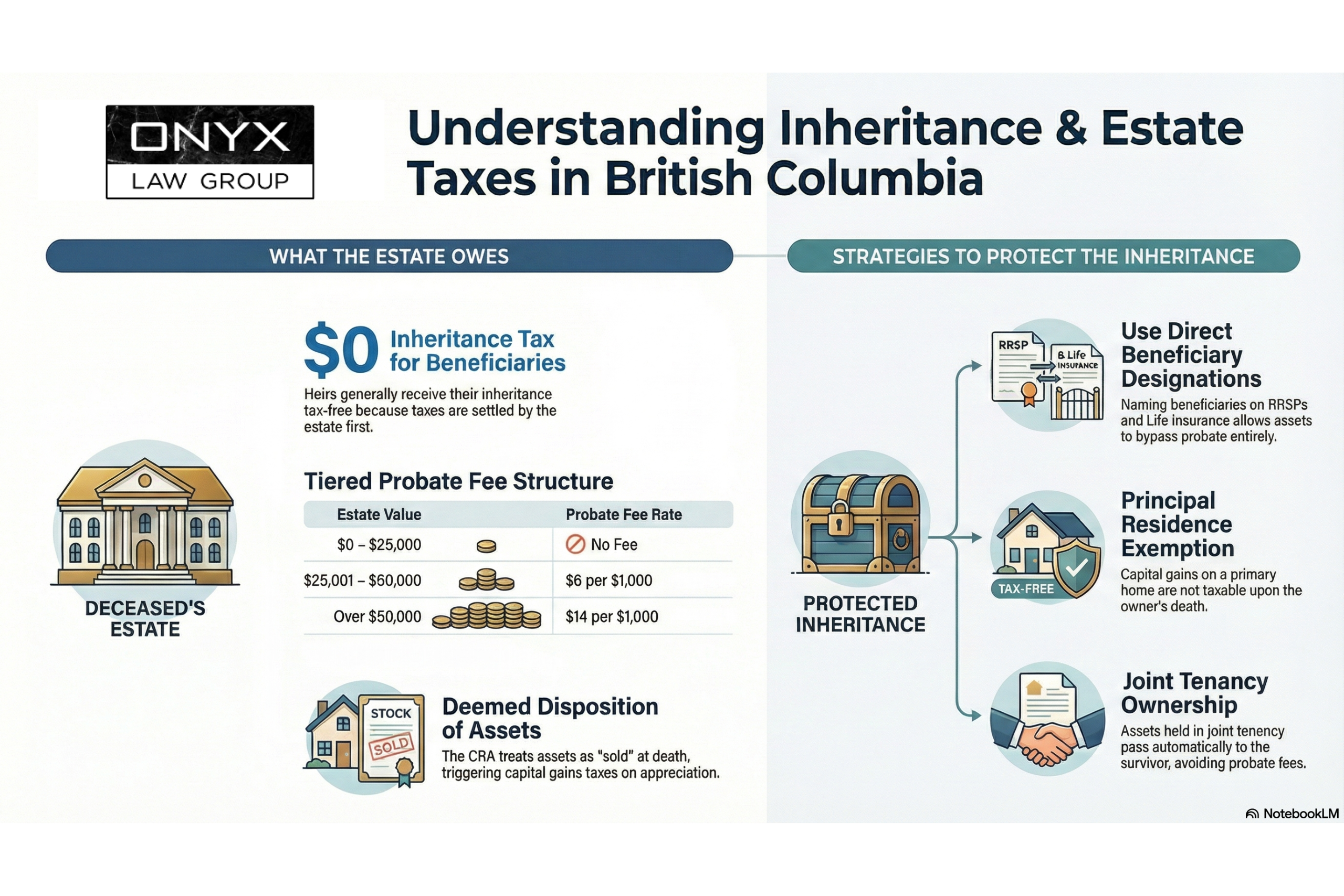
Inheritance tax is a levy charged in some countries on assets passed to beneficiaries, and it is often confused with estate tax, which is applied to the estate itself. In British Columbia and across all of Canada, there is no inheritance tax, meaning beneficiaries generally do not pay tax on what they receive.
However, this does not mean inheritances are entirely tax-free, as the deceased’s estate may still be subject to taxes, such as capital gains, before assets are distributed. These pre-distribution taxes are a key part of Canadian estate planning considerations.
Many people assume BC has an inheritance tax because of how it works in other countries. In reality, Canadian tax law does not impose this type of tax or include specific inheritance tax exemptions. What families often encounter instead are probate fees and taxes on certain assets, like capital gains on inherited property and other capital assets.
Proper estate planning is key to reducing these costs. Planning can help ensure more of your estate reaches your loved ones as inheritance money. Working with a professional can guide you through wills, trusts, and strategies to manage taxes efficiently, including handling tax owing.
Probate Fees and Their Impact on Inheritance
Probate fees in British Columbia are the costs paid to the court to confirm a will and give the executor authority to manage the estate. They’re often mistaken for inheritance tax, but they’re not the same thing and can vary as different probate fees. Instead of being charged to beneficiaries directly, these fees come out of the estate first. That means they can quietly reduce the amount your loved ones eventually receive, especially as probate fees vary.
In BC, probate fees are based on the total value of the estate. The higher the value, the more you can expect to pay, depending on the market value. While smaller estates may see little to no cost, larger ones can face more noticeable fees tied to capital assets. This detail can surprise families if they are unprepared for the tax consequences. Here’s a simple breakdown of how probate fees work in BC:
- No fee on estates valued at $25,000 or less
- $6 for every $1,000 between $25,000 and $50,000
- $14 for every $1,000 over $50,000
How Inheritance Tax Interacts with Capital Gains in BC

In British Columbia, when someone inherits property, there’s no inheritance tax, but capital gains tax can still apply. Capital gains tax is charged on the increase in value of an asset from the time it was acquired to the time it’s sold, based on its adjusted cost base. For inherited property, the deemed disposition rules mean the estate may owe tax on any capital gains earned before passing it to heirs.
Capital gains tax applies when the inherited property is sold. The gain is calculated as the difference between the fair market value at the date of death and the original purchase price, including any capital gains deduction where applicable. For example, if a parent bought a house for $300,000 and it’s worth $500,000 at their passing, the estate could owe tax on the $200,000 gain. Certain assets, like principal residences or a primary residence, may be exempt, but others, like non-registered investments, are taxable.
BC residents can use the Canadian capital gains tax on inherited property calculator to estimate potential taxes. This tool helps heirs plan for any tax liability and make informed decisions about selling or keeping inherited assets. Understanding this interaction can prevent surprises and support better estate planning.
Worried a cabin or rental will trigger a capital gains bill before it reaches your family? Ask an Onyx Law estate lawyer how to reduce it. Book a consultation.
Inheritance Tax Considerations for Non-Residents in BC
For non-residents inheriting property in British Columbia, there is still no inheritance tax to worry about. However, other taxes can apply, especially when Canadian assets are involved. The estate may be subject to capital gains tax before distribution, and non-residents who receive certain types of income-generating assets could face additional tax obligations.
Non-residents may also need to deal with withholding taxes and specific filing requirements. For example, if you inherit and later sell Canadian real estate, a portion of the sale proceeds may be withheld by the buyer and sent to the Canada Revenue Agency, with taxes owing determined later. You may then need to file a Canadian tax return to report the transaction and determine the final tax liability incurred or refunded.
Cross-border situations can become complex quickly. Tax rules in your home country may also apply, potentially leading to double taxation without proper planning and affecting income earned. This is why it’s important to consult legal and tax professionals who understand both Canadian and international laws to help you protect your inheritance and manage the deceased person’s estate while staying compliant.
Common Legal Issues Affecting Inheritance in BC
Inheritance matters in British Columbia can become complicated quickly. Disputes over wills are one of the most common issues. Family members may challenge a will if they feel it is unfair or does not reflect the deceased’s true intentions. In some cases, people bring variation claims to seek a more equitable share, especially spouses and children. Others may try to enforce a promised inheritance that was never formally documented.
Common law relationships can also affect inheritance rights. In BC, a common-law partner may have legal standing similar to a spouse, depending on the circumstances. Such arrangements can create tension if the will does not clearly account for them. It may also lead to disputes between partners and other family members over who is entitled to what.
There are also risks of misconduct, such as stolen inheritance or misuse of estate funds. This can happen when an executor or another party improperly takes or controls assets. Legal action can assist in recovering lost assets in these situations. Courts can step in to investigate and enforce the proper distribution of the estate.
Because these issues can be complex and emotional, legal guidance is essential. A lawyer can help you understand your rights and take the right steps to protect them, especially when handling non-registered capital assets. Whether you are dealing with a dispute or trying to prevent one, early advice can make the process smoother and less stressful while ensuring proper ways of paying taxes.
Enforcement of Promised Inheritance
Sometimes, a person may promise an inheritance without putting it clearly in a will. When that promise isn’t honored, legal options may still exist, even when a person died without clear instructions. Courts in British Columbia can look at concepts like resulting trusts, where it’s assumed that property held by one person was meant to benefit another, including direct beneficiary-designated assets.
This often comes up when someone contributes money or assets but isn’t listed as the legal owner, such as registered assets. The court may step in to recognize the true intention behind that arrangement.
Another approach involves enforcing a promise as a contract. If someone relied on a clear promise of inheritance and acted on it, the court may treat that promise as legally binding. In these cases, evidence is key. Messages, agreements, or witness testimony can all help support the claim. Because these situations can be complex, getting legal advice early can make a big difference in protecting your rights.
Taxes and Fees Affecting Inheritance in BC vs Other Canadian Provinces

When it comes to inheritance, taxes and fees can vary a lot across Canada. British Columbia has some unique rules that make it different from other provinces. While there’s no inheritance tax here, probate fees, capital gains, and income tax rules can still affect how much your beneficiaries receive. The table below breaks down the key differences so you can see at a glance how BC compares to other provinces.
| Tax/Fee Type | BC Rules | Other Provinces (brief notes) |
|---|---|---|
| Inheritance Tax | BC does not have an inheritance tax. | Most Canadian provinces also do not have an inheritance tax. Quebec abolished its inheritance tax in 1985; historically, some provinces had similar levies. |
| Probate Fees | Tiered structure: • No fee on estates ≤ $25,000 • $6 per $1,000 for $25,000–$50,000 • $14 per $1,000 over $50,000 | Varies widely: • Ontario charges $15 per $1,000 over $50,000 • Alberta charges a $250 flat fee for estates. • Other provinces have different thresholds and rates. |
| Capital Gains Tax | Applies to the “deemed disposition” of assets at death; the principal residence may be exempt. | Same federal rules apply; some provinces have additional rules for certain assets or property types. |
| Income Tax Implications | Estate may pay tax on accrued gains; beneficiaries generally don’t pay income tax on inherited property (except RRSP/RRIF withdrawals). | Similar rules across Canada; non-residents may face additional withholding taxes. |
How Much Money Can Be Gifted Tax-Free in Canada?
You can give or leave as much money as you want. A cash gift or inheritance is tax-free in the hands of the person receiving it. The recipient does not have to report or pay taxes on the money they receive.
However, if gift assets like real estate or stocks have appreciated since you acquired them, the Canada Revenue Agency (“CRA”) treats them as if you sold the asset at its fair market value. This deemed disposition can trigger capital gains tax for you, the giver, for any increase in value since you acquired the asset.
Additionally, when gifting income-generating property to a spouse or minor child, any income or capital gains generated from that property may be attributed back to you and taxed in your hands. These rules are designed to prevent income splitting and tax avoidance.
What Taxes Are Payable on Death in Canada?
In Canada, inheritances are taxed, even though beneficiaries don’t pay inheritance tax. This is because any amounts due upon death are charged to the deceased’s estate. The two main estate taxes in BC are income taxes and probate fees.
Before the estate is distributed to the beneficiaries named in your will (or to your heirs if you die without a will), income taxes and probate fees are calculated and paid. Your loved ones’ inheritances are tax-free because your estate was taxed first.
Put in yet other terms: Your loved ones’ inheritances will be reduced by your estate’s final income tax bill and any probate fees that must be paid. For that reason, it’s worth doing estate planning now to reduce tax implications and probate fees.
Are Income Taxes Paid When Someone Dies?
When a person dies, their executor or administrator must file a final income tax return on their behalf. The final tax return must include any taxable income the deceased person earned in their year of death, including employment income, Canada Pension Plan (CPP), Old Age Security (OAS), retirement pensions, and dividend income.
For example, if a person worked from January 1st up until their death on June 1st, their final tax return must report employment income for those months, and it will be taxed at their personal income tax rate.
Does an Estate Have to Pay Capital Gains?
When someone passes away in Canada, their estate must report all taxable income on the final tax return, including any capital gains. Capital gains happen when an asset, like a house or investment, is worth more when sold than when it was bought.
Even if the asset isn’t actually sold, the law treats it as if it was sold right before death. This is called a deemed disposition. Any profit from the deemed disposition is included in the final tax return, and half of the gain is usually taxable as income.
Capital gains can come from real estate, valuable personal property, investment accounts, or business assets. Registered accounts like RRSPs and RRIFs are taxed as if cashed in at death, and the full amount is included in the final return. Some exceptions may apply, but in general, these rules make sure the estate pays taxes on assets that increased in value during the deceased person’s lifetime.
What Is a Clearance Certificate?
The responsibility for settling a deceased person’s tax affairs falls squarely on the executor or personal representative (i.e., the legal representative appointed by the court if the deceased died without a will). They must file the deceased’s final tax return and obtain a clearance certificate from the CRA before making final distributions to beneficiaries. The clearance certificate confirms that all taxes owed by the deceased and their estate have been paid, protecting them from future claims by the CRA.
Are There Exemptions or Other Ways to Reduce Taxes Owed?
Your estate may incur tax liability, but there are several exceptions. For example:
- Principal residence exemption (capital gains on your principal residence are not taxable).
- The amount in your Tax-Free Savings Accounts (“TFSA”) is not taxable.
- The death benefit paid out of a life insurance policy to a designated beneficiary is not taxable.
- Provided certain conditions are met, the deemed disposition rule doesn’t apply when non-registered capital property (e.g., securities, mutual funds, personal property, or real estate like a home, cottage, or investment property) is transferred to your surviving spouse or common law partner after your death. Tax is deferred, meaning the capital gain is postponed until your spouse or common-law partner sells or is deemed to sell the property.
- Provided a qualifying survivor has been named as a beneficiary of your registered investments (e.g., RRSP, RRIF), then the income from these investments is not reported on the estate’s final income tax return. A “qualifying survivor” is your spouse or common law partner, a financially dependent child or grandchild of yours who is under 18 years of age, or a disabled child or grandchild of any age.
- Lifetime Capital Gains Exemption (If your estate makes a profit from selling a small business, a farm property, or fishing property, the Lifetime Capital Gains Exemption may apply to eliminate some or all of the taxable capital gains).
Depending on your situation, there may be other ways to minimize taxes payable by your estate. Start developing your tax-efficient strategy by understanding which property is taxable and when you can defer taxes. If you are concerned about the amount of income tax your estate might face, contact our estate planning team today.
What Is Probate and Why Is It Necessary?
Probate is the legal process of settling a person’s estate after they pass away. It verifies the will’s validity and gives the executor authority over the estate. If there is no will, the court appoints an administrator to handle things instead. This step helps ensure everything is handled properly and according to the law.
Not every estate needs to go through probate. It often depends on the size of the estate and how the assets are owned. For example, jointly owned property or assets with named beneficiaries, like RRSPs or TFSAs, usually pass outside the estate. These assets can go directly to the beneficiary and may not require probate at all.
In British Columbia, probate fees are based on the value of the estate. There is no fee for the first $25,000. Thereafter, a small court filing fee applies, along with 0.6% on amounts between $25,000 and $50,000, and 1.4% on anything over $50,000. These fees are paid by the estate, not the beneficiaries directly. The executor handles these costs before distributing what’s left to the beneficiaries.
How Do I Minimize Probate Fees in BC?
As mentioned above, probate is not always required. Even if probate is required, there are ways to avoid probate fees if you do some smart estate planning in advance. Here are ways to reduce or avoid BC probate fees:
- Use beneficiary designations to name a specific beneficiary or beneficiaries for your RRSPs, RRIFs, and life insurance policies. Your named beneficiary will receive those assets directly without the need for probate.
- Consider holding assets such as bank accounts or real property, such as homes, cottages, investment properties, etc., in joint tenancy with another person (such as the intended beneficiary of that asset from your estate). The effect of this form of ownership is that joint assets automatically pass to the surviving joint tenant when the first joint owner dies (this is known as the “right of survivorship”), without the need for probate.
- Set up trusts to hold assets such as real estate or investments. Alter ego trusts and joint partner trusts are excellent examples. Trust assets are not part of your estate at death, so they don’t go through probate.
- Prepare and execute multiple wills. For example, if you are a business owner, you can prepare a will for your personal property that requires probate and another will to bequeath the corporate shares you hold. The second will does not require probate, saving your estate from paying probate tax on the value of the shares.
BC Inheritance Tax and Estate Planning Advice

Planning with estate professionals can make a big difference for your estate. Estate planning isn’t just about reducing fees and taxes. It is about making sure your wishes are followed, your assets are transferred smoothly, and your loved ones are taken care of.
“Planning ahead means more of your estate reaches the people you care about.” – Onyx Law Group Team
A solid estate plan can also help reduce or defer income taxes and minimize probate fees. While BC doesn’t have an inheritance tax, capital gains and probate costs can still affect what your beneficiaries receive. Trusts and joint ownership can simplify the process and keep more of your estate for your loved ones.
What Our BC Estate Team Sees Families Miss
- “No inheritance tax” gets read as “no tax bill at all.” Then a cabin or rental produces a five- or six-figure capital gains hit because it never qualified for the principal residence exemption.
- Recreational and investment property, such as the Okanagan cabin or the Vancouver rental, is where the biggest deemed-disposition gains hide.
- Putting the family home in joint tenancy to “avoid probate,” or transferring property to children early, can backfire. It can trigger a deemed disposition, expose the home to a co-owner’s creditors or divorce, and start a resulting-trust fight among siblings.
- An executor who distributes before filing the terminal T1 and getting a CRA clearance certificate can be held personally liable for the unpaid tax.
- U.S. real estate or a U.S.-citizen beneficiary adds U.S. estate-tax exposure that BC’s “no inheritance tax” rule does nothing to shield.
These costs get heavier when they collide with a wider estate problem, such as a home caught up in an estate with no will. Tax is only one moving part.
Curious About Inheritance Tax in BC?
In British Columbia, there is no inheritance tax. That means beneficiaries don’t pay tax on what they inherit. However, estates may still face probate fees and capital gains taxes before assets are distributed. These costs can reduce what your loved ones ultimately receive. With proper planning, you can minimize these fees and protect your family’s inheritance.
Estate planning can feel overwhelming, but you don’t have to navigate it alone. Consulting an experienced estate lawyer can help you understand your options and make smart decisions. From wills and trusts to tax strategies, professional guidance ensures your assets are passed on smoothly and according to your wishes.
Worried about how inheritance taxes and fees could affect your family in BC? At Onyx Law Group, our estate and inheritance lawyers in BC have over a decade of experience guiding families through probate, capital gains, and estate planning. We help you protect your assets and ensure your loved ones receive what’s rightfully theirs. Schedule a consultation today and let our experts simplify the process for you.
Settling an estate and unsure which of these costs actually apply? Book a consultation with our BC estate team before you distribute a dollar. Contact Onyx Law.
Frequently Asked Questions
Here are answers to frequently asked questions about inheritance tax in BC to help you better understand how it works. This frequently asked questions section breaks things down in simple terms so you can feel more confident about your situation.
Is There an Inheritance Tax in BC?
No, British Columbia does not have an inheritance tax. However, estates may still be subject to probate fees and capital gains taxes before assets are passed to beneficiaries.
How Does Capital Gains Tax Affect Inherited Property in BC?
Capital gains tax may apply when a person passes away, as their assets are treated as if they were sold at fair market value. This means any increase in value could be taxed before the property is transferred to beneficiaries.
What Are Probate Fees in BC?
Probate fees are court fees paid to validate a will and allow the executor to distribute the estate. In BC, these fees are based on the total value of the estate.
Can Common-Law Partners Inherit Without a Will in BC?
Yes, common-law partners may inherit under BC law if they meet certain legal requirements. The exact share depends on whether there are other surviving family members, like children.
How Can I Recover a Stolen Inheritance in BC?
You may be able to take legal action if you believe your inheritance was taken unfairly or fraudulently. A court can review the situation and, if justified, order that the assets be returned or compensated.
Disclaimer: The information provided on this blog is for general informational purposes only and does not constitute legal advice. Reading this content does not create an attorney-client relationship. Laws and regulations vary by jurisdiction and may change over time, so you should consult a qualified estates and trust lawyer for advice regarding your specific situation. Past examples, case studies, or hypothetical scenarios are illustrative only and do not guarantee similar results.