


Parents may exclude a child for various reasons, such as favoring another child, leaving the estate to a second spouse, or considering previous gifts or financial support already provided. Under the Wills, Estates and Succession Act (WESA), children can apply to the court to vary a will if it does not make adequate provisions for their proper maintenance and support.
If you want to contest a will in BC, it’s best to seek legal advice from experienced legal professionals. Our wills and estates lawyers at Onyx Law Group have the experience and knowledge necessary to discuss your options, guide you through the process, and maximize settlement value. Schedule a free consultation and get confident, timely guidance.
In this blog, we will discuss the legal rights of children as they relate to contesting a will in BC, the possible outcomes, and other important things you need to know.
Legal Framework for Leaving a Child Out of Your Will in Canada
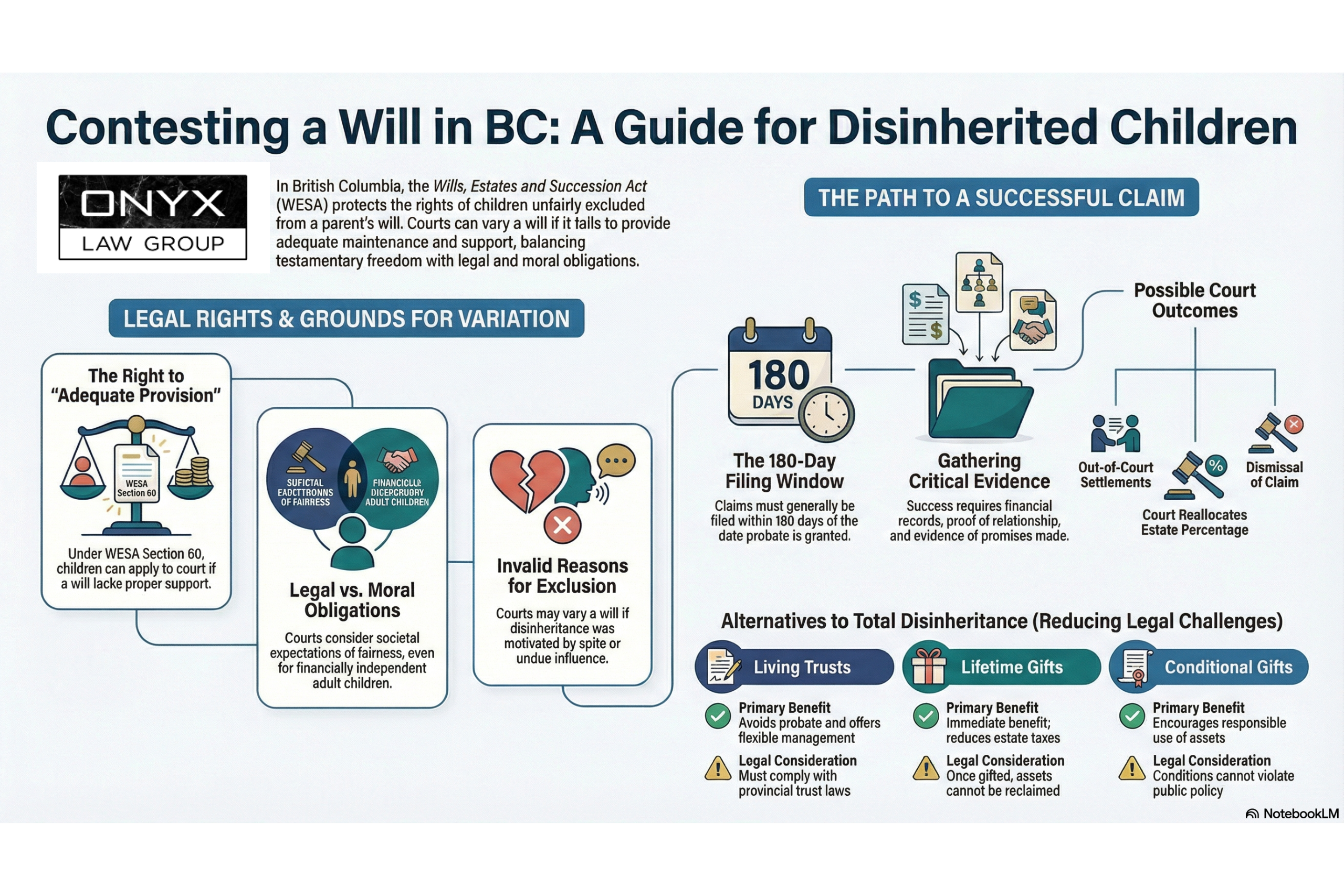
In Canada, estate law is governed by provincial legislation, which means the rules governing wills and inheritance can vary by province. In British Columbia, wills are primarily regulated by the Wills, Estates and Succession Act (WESA). This law sets out how a valid will is made, how estates are administered, and what happens if a person dies without a will.
Canadian law generally respects testamentary freedom, meaning a person has the right to decide how their assets will be distributed after death. However, this freedom is not absolute and can be limited by other laws designed to protect certain family members.
In British Columbia, children may have a legal obligation under the Wills, Estates and Succession Act if they believe they were unfairly excluded from a will. The law allows a spouse or children to apply to the court to vary a will if adequate provision was not made for their proper maintenance and support. This is sometimes called family maintenance legislation.
For legal purposes, a child can include biological children, adopted children, and sometimes adult independent children. Because of these statutory protections, leaving a child out of your will in BC can lead to a court challenge on several grounds.
Can You Leave a Child Out of Your Will in Canada?

Yes, in Canada, you can generally leave a child out of your will. Adults have the right to decide how their dollar-value assets are distributed after death, a principle called testamentary freedom. However, this freedom is not unlimited. In provinces like British Columbia, the Wills, Estates, and Succession Act (WESA) allows children to apply to the court for proper maintenance.
Excluding a child can lead to legal challenges, especially if the child feels the will does not provide adequately for them. Courts consider factors like undue influence, lack of capacity, or promises made during the testator’s life. Other consequences include family tension or delays in estate distribution for at least two years. People choose to exclude a child for many reasons, such as prior gifts, strained relationships, other reasons, or special circumstances. Understanding the legal limits and potential outcomes is essential before making this decision.
What Happens If a Child Is Left Out of a Will?
While a parent can choose to exclude their adult children, including biological or adopted children, from their wills, it is important to understand that if a child is left out of a will, they can contest it in British Columbia. If someone dies without a will, intestacy rules determine how the estate is distributed. In that case, children may be entitled to a share automatically. If a child believes he or she was wrongfully omitted from a will, they may have a civil claim.
In British Columbia, a child who has been disinherited can contest a will based on undue influence, lack of testamentary capacity, failure to provide adequate support, or improper execution of the will. The Wills, Estates, and Succession Act allows children to apply for a variation claim if adequate provision was not made for their proper maintenance and support based on reasonable expectations.
Keeping clear documentation about the reasons for disinheritance can be important for both the testator’s and the child’s legal protection. We strongly advise consulting an experienced estate lawyer early, as contesting a will can be a complex process.
Being left out of a will can also have emotional and family consequences. Disputes can create tension among siblings and other beneficiaries, and prolonged legal battles can affect the estate by increasing costs and delaying distributions. Understanding both the legal and personal implications is essential for families to navigate these situations effectively. With the right guidance, children and parents can protect their interests while managing the emotional challenges that may arise.
Alternatives to Excluding a Child from Your Will

There are ways to manage a child’s inheritance without outrightly excluding them from your will. One option is a trust, which lets you control how and when assets are distributed. You can also give lifetime gifts or transfer property while you are alive. These methods can help provide for a child but may have limits and tax implications, so planning carefully is important. Conditional gifts or disinheritance clauses can also guide how and when a child receives assets while making your intentions clear.
Using these alternatives can reduce the risk of legal challenges and family conflict. Every family situation is different, so it’s a good idea to speak with an experienced estate planning lawyer. They can help you create a plan that respects your wishes while following the law. This approach ensures that your estate plan is fair, clear, and enforceable.
Options for Managing Child Exclusion in Estate Planning
When planning your estate, you may want to limit or control a child’s inheritance. In the table below, we outline common options, showing the benefits, drawbacks, and legal considerations of each approach.
| Option | Description | Pros | Cons | Legal Considerations |
|---|---|---|---|---|
| Living Trusts | Assets are placed in a trust during your lifetime for the benefit of chosen beneficiaries. | Provides control over asset distribution, can avoid probate, and offers flexible management. | Can be complex to set up, and may involve ongoing administration costs. | Must comply with provincial trust laws; trustee duties are legally binding. |
| Lifetime Gifts | Giving assets directly to children or others while you are alive. | Immediate benefit to recipient, may reduce estate taxes and probate fees. | Once gifted, you cannot reclaim it. It may impact your financial security. | Gifts must follow provincial rules; large gifts may trigger tax considerations. |
| Conditional Gifts | Assets are given with specific conditions, such as reaching a certain age or achieving a milestone. | Encourages responsible use, allows targeted control over inheritance. | Conditions may be contested in court; enforcement can be complicated. | Must be clearly documented; conditions cannot violate law or public policy. |
| Disinheritance Clauses | Explicitly state in the will that a child or beneficiary receives nothing. | Provides clarity of intent; can prevent misunderstandings among other heirs. | May lead to legal challenges under family maintenance laws. | In BC, children can apply for a variation claim under the Wills, Estates, and Succession Act. |
What Is the Legal Process to Contest a Will?
Because the grounds and deadlines are strict, most disinherited beneficiaries bring in a lawyer to contest a will in BC before filing anything.
To contest a will if you were left out, the process usually begins when the will maker dies, leaving an estate. You must first determine whether you have legal standing, typically as a child, spouse, or other close relative of the deceased.
A disinherited child must identify valid grounds for contesting a will, such as undue influence, lack of testamentary capacity, or fraud, especially if the estate has sufficient assets to provide for them. After establishing grounds, the next step is to file a formal petition in probate court within the time frame set by the state, which is usually 30 to 120 days after the will is accepted for probate.
After filing, the court will schedule hearings where evidence is presented, witnesses may testify, and both sides can make their case. The probate judge then reviews the claims and decides whether the will, or parts of it, should be invalidated or upheld. Understanding the grounds for contesting a will as a disinherited child and acting promptly is crucial to protecting your rights in this legal process.
If a Child is Left Out of a Will, Can They Contest It?

Yes, children can contest a will in BC under the WESA. Section 60 of WESA allows a child, including an adult child, to apply to the court to vary a will if they believe it does not make adequate provision for their proper maintenance and support.
An adult child can contest a will if they are disinherited or if they receive unequal treatment compared to other beneficiaries. The courts consider several factors in these cases, including the child’s financial needs, relationship with the deceased, reason for disinheritance, and the size of the estate.
Steps to Take If You Are Excluded from a Will
If you have been excluded from a will, the first step is to remain calm and obtain a copy of the will and any related estate documents. Review the terms carefully to understand how the estate is being distributed.
Next, contact an experienced estate litigation lawyer as soon as possible, especially if you are in British Columbia, where strict deadlines apply under the Wills, Estates, and Succession Act. A lawyer can assess whether you have grounds to challenge the will and explain your legal options. Early legal advice is important because missing a deadline can prevent you from bringing a claim.
You should also begin gathering relevant documentation. This may include financial records, proof of your relationship to the deceased, medical records, past correspondence, and any evidence showing financial need or promises made to you.
In British Columbia, a wills variation claim generally must be filed within 180 days from the date probate is granted. Acting quickly ensures your rights are protected and gives your lawyer time to prepare a strong case. Taking organized and timely steps can significantly improve your chances of a successful outcome.
What Are the Requirements and Deadlines for Contesting a Will?
Yes, a child left out of a will can contest it, but they must adhere to strict deadlines that vary by jurisdiction. Contesting a will is highly time-sensitive, so acting promptly is essential. For example, in British Columbia, a claim under the Wills, Estates and Successions Act (WESA) must typically be filed with the probate registry within six months of the will being probated.
To initiate a claim, preliminary documentation is required, including a copy of the will, the death certificate, and evidence supporting the grounds for contesting, such as proof of undue influence, lack of capacity, or inadequate provision. Filing the correct forms with the probate registry within the legal timeframe is crucial to preserving your right to challenge the will and ensuring the court can consider your claim.
What Are the Legal Obligations and Moral Obligations in BC Wills?
In British Columbia, courts can intervene to adjust a valid will if it fails to meet certain legal or moral obligations to beneficiaries, making it important to understand these duties. Legal obligations are strict requirements, such as provision for the proper maintenance and support of children under 19 or those financially dependent, as well as ensuring proper support for a spouse, whether married or common-law. Courts often prioritize these legal obligations when deciding whether to vary a will.
Moral obligations are less defined but still important, reflecting societal expectations of fairness. While adult children are not automatically entitled to an inheritance, courts may consider their relationship with the will-maker, financial circumstances, and overall fairness. An adult child facing hardship may have a stronger claim than one who is financially secure, and estrangement or previous gifts can also affect moral considerations.
Courts weigh the needs of all potential beneficiaries, including spouses and adult children, to ensure fairness. If the estate is sufficient, the moral claims of all beneficiaries may be recognized, even for financially independent or estranged children. Consulting an estate lawyer can help determine whether contesting a will is a viable option and whether taking legal action aligns with your personal and financial interests.
British Columbia Wills Variations Claims
BC courts generally respect a will-maker’s right to decide how to distribute their estate. However, courts can step in if the will doesn’t meet the will-maker’s legal and moral obligations to certain people, like a child or spouse. BC law allows courts to change a will to ensure a disinherited child or spouse receives a fair share of the estate. This type of litigation is called Wills Variation claims, based on Section 60 of the Wills, Estates, and Succession Act (WESA).
If a child thinks their deceased parent’s will does not provide them enough money to live on, they can contest it in court. The court can adjust the will to provide what it believes is fair and what a reasonable will-maker would do in such a situation.
What Are the Possible Outcomes of a Wills Variation Claim?
The possible outcomes of a will variation claim in BC under the Wills, Estates and Succession Act (WESA) depend on the court’s assessment of the claim. Here are the potential results:
- Will Remains Unchanged: If the court determines the will-maker met their legal and moral obligations to the applicant, the will remains as it is. The claim is dismissed, and no changes are made.
- Will Is Varied: The court may vary the will to provide adequate maintenance and support for the claimant. This could involve allocating a specific portion of the estate to the applicant or increasing the applicant’s share compared to the original terms of the will.
- Settlement Outside of Court: Many will variation claims are resolved through negotiation or mediation before a court decision is made. The parties may agree on a settlement that adjusts the distribution of the estate without a court ruling.
- Partial Success: The court may partially approve the claim, awarding the applicant some additional benefits but not the full amount they sought. For example, the court might grant a smaller financial adjustment to balance the estate distribution.
- Costs Awards: Regardless of the outcome, the court may order one party to pay some or all of the legal fees. This could entail the estate covering all parties’ legal costs or requiring the losing party to cover the other’s legal expenses.
Real-Life Examples of Wills Variation Claims
There are many BC court cases brought by children who are disinherited or treated unfairly in their parent’s will. Here are some examples and important principles from real-life BC court cases:
- The court has recognized an enhanced moral obligation to the children of the will-maker’s first marriage, where the will-maker’s estate was built primarily during that first marriage, and the children never received an inheritance from the parent who died first. The enhanced moral obligation is supported by the reasoning that the spouse who died first would have wanted and expected the surviving spouse to provide their shared wealth to their biological children.
- Spite is not a valid reason for disinheriting a child. A BC woman who received just 1% of her mother’s $1 million estate filed a will variation claim after most of the estate went to two unrelated charities. The court granted the claim, increasing the daughter’s share to 40% of the estate residue, based on the evidence that spite motivated the mother’s disinheritance.
Common Challenges and Considerations
Contesting a will can be complex, especially with estranged family and will contests where past relationships affect the case. Estranged children or those deliberately disinherited may face emotional and legal challenges, and courts often review the previous will, the will-maker’s financial circumstances, and the reasons for exclusion. While a child may have the legal right to challenge a will, proving the disinheritance was unjust or that the will-maker lacked mental capacity can be difficult.
Other challenges include demonstrating undue influence or external pressures that affected the will-maker’s decisions. Family disagreements and competing claims can further complicate proceedings, making careful documentation and professional legal guidance essential. Understanding these factors is key for anyone considering whether to contest a will.
Why Do You Need Professional Legal Representation in Will Contests?
Contesting a will involves complex legal rules, strict deadlines, and detailed documentation, making professional guidance essential. The process can also be time-consuming, so retaining experienced legal professionals early ensures your claim is thoroughly prepared and your rights are fully protected.
Wills and estates lawyers can assess the strength of your case, help gather necessary evidence, and represent you in court proceedings. Their expertise also helps navigate family dynamics, prove valid grounds for contesting, and avoid procedural mistakes that could jeopardize your claim.
Need Help Contesting a Will in BC?
If a child is left out of a will, they can contest it under specific grounds such as undue influence, lack of testamentary capacity, fraud, or improper execution. Courts also consider the child’s financial circumstances, relationship with the deceased, previous gifts, and whether the exclusion was reasonable, especially when the estate has sufficient assets.
Contesting a will is time-sensitive, with strict deadlines and required filings at the probate registry or court. The process can be complex and time-consuming, so retaining experienced wills and estates lawyers early helps navigate documentation, court procedures, and family dynamics to protect the child’s legal rights. Challenging wills can be a complex and emotionally draining process. It is critical to seek legal advice before proceeding.
If you are considering contesting a will in BC, contact an experienced estate lawyer at Onyx Law Group today for clear advice and a professional assessment of your grounds for a successful challenge. Our team of estate planning and estate litigation lawyers in BC has helped clients navigate complex will disputes, providing knowledgeable guidance and strategic solutions. We are committed to protecting your rights and standing by you throughout the process, ensuring you receive the support and expertise you need during this challenging time.
Frequently Asked Questions
This FAQ section addresses a common concern families face when a child is left out of a will and questions arise about fairness and legal rights. Below, we explain when a child may be able to contest a will and what factors courts consider in these situations.
Can I Legally Exclude a Child From My Will in Canada?
Yes, a will maker’s spouse or parent can choose to exclude a child, but this does not remove their legal obligation to ensure fairness. If the exclusion results in an unfair will, the child may bring a civil claim based on moral and financial considerations.
What Legal Protections Exist for Children Excluded From Wills?
Courts look at reasonable expectations when deciding whether a child should receive support from the estate. In such cases, a family member like a biological child may challenge the will on several grounds.
How Can a Child Contest a Will if Left Out?
A child may contest a will if they believe the outcome does not reflect what most people would view as fair treatment. They may also argue that the testator thinks adequate provision was made when the actual dollar value of support was insufficient.
What Are Alternatives to Excluding a Child Outright?
Instead of fully disinheriting a child, a parent may structure distributions to reflect other reasons such as past gifts or financial independence. Planning options can also account for interests like a family farm or other shared assets.
How Long Does It Take to Resolve a Will Dispute?
Resolving a dispute can be complex and sometimes requires guidance from a managing partner in estate litigation. In more complicated matters, the process can take at least two years to conclude.
How Long Do I Have to Contest a Will?
The deadline to contest a will depends on state law, but it is often very short, sometimes as little as 30 to 120 days after the will is admitted to probate. Because missing the deadline can permanently bar your claim, it’s important to consult a probate attorney as soon as possible.
Disclaimer: The information provided on this blog is for general informational purposes only and does not constitute legal advice. Reading this content does not create an attorney-client relationship. Laws and regulations vary by jurisdiction and may change over time, so you should consult a qualified estates and trusts attorney for advice regarding your specific situation. Past examples, case studies, or hypothetical scenarios are illustrative only and do not guarantee similar results.