


If you want to become an administrator of an estate without a will in BC, you need to apply to the Supreme Court of British Columbia for a grant of administration. Section 130 of the Wills, Estates, and Succession Act (WESA) sets the priority order for who can apply, starting with the deceased’s spouse, then children, then other beneficiaries under the intestacy rules.
Veronica Manski heads probate and estate administration at Onyx Law Group, and estates and trusts are all she does. She was called to the BC bar in 2015, and the firm has been handling Vancouver estates since 2012. When relatives start disagreeing about who should administer, co-founder Candace Cho, KC, takes the contested files. If you are the one left sorting this out, contact us today and take the free 30-minute consultation.
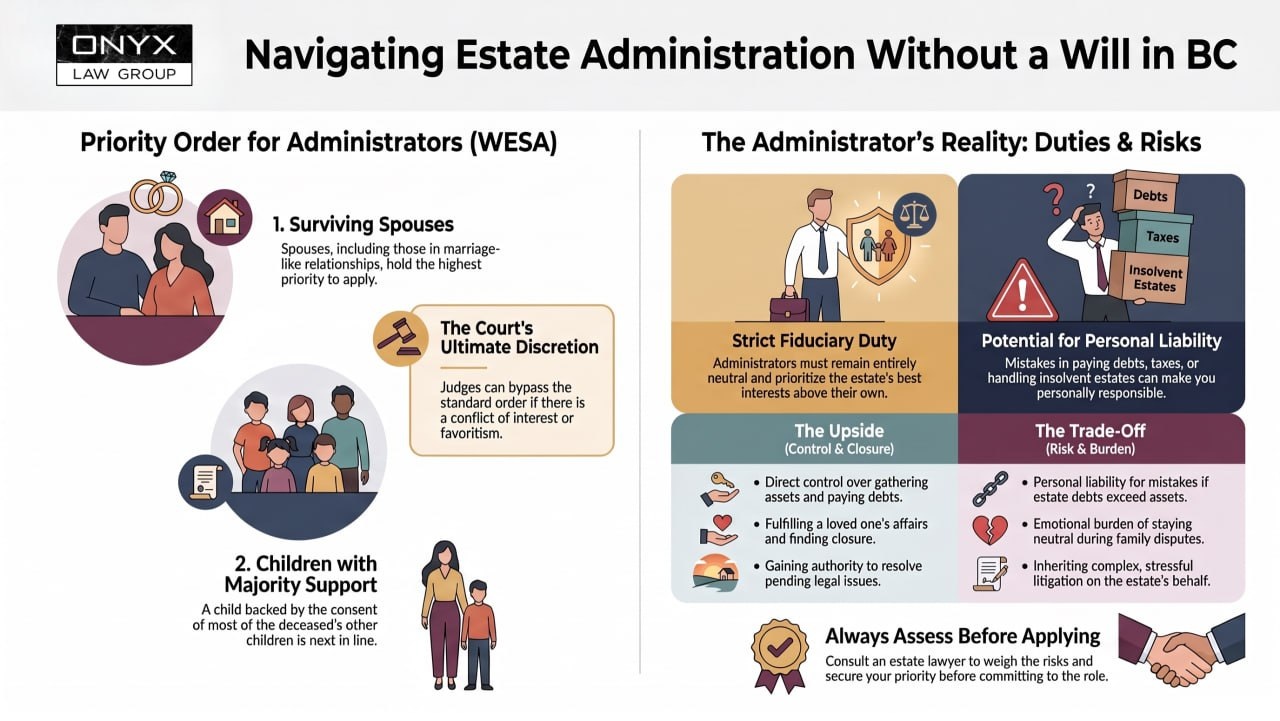
This guide walks you through everything involved in becoming an estate administrator in BC when there’s no will, from applying for a grant of administration to understanding your priority under WESA’s intestacy rules.
Can You Apply to Be the Administrator of an Estate?
According to a National Institute on Ageing report produced with RBC Royal Trust, only 48 percent of Canadians have a valid will, a number that drops to just 34 percent for those between 35 and 54. We often get calls from friends and family members asking if they can apply to administer the estate of a deceased person who has passed away. In most cases, the answer is yes. But whether your application succeeds depends on whether someone with higher priority under BC’s legislation also decides to apply for the role.

Even when no one else applies, it’s worth thinking things through before taking on the job. You’ll want to consider who the estate’s beneficiaries will be, what risks or liabilities come with managing estate assets as administrator, and whether the role is really right for you. In fact, some well-meaning family members or friends choose not to apply once they get legal advice about what the job actually involves.
Understanding the Administrator’s Role
With roughly 40,000 people dying in BC every year, the question of who steps in as the person responsible for administering an estate without a will comes up far more often than most people expect. Before diving into the application process, it’s essential to understand the duties and responsibilities of an estate administrator. This role is fiduciary, meaning an administrator must always prioritize the entire estate’s best interests and its beneficiaries.

They are responsible for paying valid debts and filing tax returns on behalf of the deceased’s estate, locating and managing bank accounts, and handling any legal issues, like ongoing divorce proceedings or personal injury cases. If there’s a conflict between beneficiaries, the administrator must maintain neutrality.
What Is the Hierarchy of Applicants to Be Appointed Administrator of an Estate in BC?
When someone dies without a will in BC, the Wills, Estates and Succession Act (WESA) sets out exactly who gets priority to apply as administrator. Section 130 lays out a clear order. The deceased’s spouse comes first, including a spouse from a marriage-like relationship, followed by a child who has the support of most of the deceased’s children, and then someone nominated by that child who has the same majority support.

After that comes a child without majority consent, then other intestate successors (people entitled to inherit under the intestacy rules), depending on whether they have majority support from the other successors. At the bottom of the list is anyone else the court considers appropriate, which can include the public guardian and trustee if no one else applies.
To understand who counts as an “intestate successor,” you need to look at Part 3 of WESA. If the deceased has a spouse but no children, the spouse inherits everything. If there’s a spouse and minor children, or children from a previous relationship, both share the estate.
Where there’s no spouse, it goes to the children, then parents, then siblings, then more distant relatives like grandparents and great-grandparents. If no relatives can be found within four degrees of kinship, the estate escheats to the Crown, meaning the government ends up with it.
The court isn’t limited to strictly following this list. Section 132 gives judges the power to appoint someone else entirely if special circumstances make it appropriate. Courts have found that a personal conflict with a beneficiary, or a real concern that the person won’t act in the estate’s best interests, can count as one of these special circumstances.
Recent case law has helped clarify how courts actually apply these rules. In Raye v. Phillip Estate, the court explained that judges must always keep the best interests of the estate, the beneficiaries, and the family’s future front and center, choosing whoever seems most capable of managing the estate well. Having the support of most beneficiaries carries real weight in this decision, and the law treats that support as a strong signal of who the person nominated for the role should be.
Beyond support and capability, courts also expect an administrator to act fairly and without bias. Someone appointed to the role needs to stay neutral, avoid taking sides between beneficiaries, and steer clear of any conflict of interest. If a judge sees signs of favoritism or a real conflict, they can step in and appoint someone else instead.
How to Apply to Be an Administrator of Estate in British Columbia
Here’s a simplified step-by-step guide to becoming the administrator of an estate in British Columbia. Whether someone died without a will or the named executor can’t act, this walks you through what the court requires and how to get appointed.

Step 1: Determine Your Eligibility
Before you begin the application process, determine your eligibility according to the order of priority outlined in Section 130 of the Wills, Estates and Succession Act. Understand where you stand in terms of priority and whether anyone else with a higher priority might also be interested in applying.
Step 2: Assess the Estate
Evaluate the size and complexity of the estate. If the estate is insolvent (debts and expenses exceed assets), it may involve more risk than reward to act as an administrator.
Step 3: Consult with an Attorney
Legal advice can be invaluable in this process. Consult with a lawyer experienced in estate law to understand the responsibilities, potential risks, and legal obligations that come with being an administrator.
Step 4: Obtain Consent
Depending on your priority, you may need to get consent from other eligible parties. For instance, a child of the deceased must have the consent of the majority of the deceased’s children to apply.
Step 5: Prepare Your Application
Prepare your application to the court, including the required forms and documents. These may vary depending on the specific circumstances of the estate. An attorney can assist you with this.
Step 6: File Your Application
Submit your application to the probate registry of the Supreme Court of British Columbia. You may need to pay a filing fee.
Step 7: Attend the Court Hearing
If a court hearing is scheduled, attend the BC Supreme Court and present your case on why you should be appointed as the administrator. Bring your documents and be ready to answer the judge’s questions about your relationship to the deceased and your plan for handling the estate.
Step 8: Administer the Estate
If your application is approved, you will receive a Grant of Administration from the court. You can then begin the process of administering the estate, which includes paying off debts and taxes, dealing with any legal issues, and distributing the remaining assets to the beneficiaries.
Is Becoming an Estate Administrator Worth It?
Becoming an administrator isn’t just paperwork. It’s a real commitment with real risk. This table lays out the trade-offs plainly, so you can see both sides before you file anything.
|
What You’re Weighing |
The Upside |
The Trade Off |
|---|---|---|
|
Control over the process |
You decide how debts get paid, assets get gathered, and the estate gets wound down. No waiting on someone else to act. |
You’re legally on the hook if you get it wrong. Mistakes can mean personal liability. |
|
Fulfilling a loved one’s affairs |
Many people find real closure in handling things themselves rather than watching a stranger do it. |
The job can be emotionally heavy, especially soon after a loss. |
|
Speed |
Applying early, especially with clear priority under Section 130, often means a faster grant and less delay for beneficiaries. |
Rushing without legal advice can lead to mistakes that slow things down later. |
|
Insolvent estates |
You get to decide whether taking on a debt heavy estate is worth it before committing. |
If you accept and the estate can’t cover its debts, you’re responsible for following the payment order under Section 170, and getting it wrong has consequences. |
|
Family disputes |
Acting as administrator lets you keep the process moving even if beneficiaries don’t get along. |
You have to stay neutral no matter what, and conflict between beneficiaries can land squarely on your plate. |
|
Legal disputes tied to the estate |
You gain the authority to resolve issues like a pending divorce or injury claim on the estate’s behalf. |
These disputes can be lengthy and stressful, and you inherit them whether you want to or not. |
|
Bonding requirements |
Courts use bonds to protect beneficiaries, which builds trust in the process. |
You may need to post security, an added cost and step, especially if minors or non consenting heirs are involved. |
What Are the Important Considerations for Grant of Administration?
Before applying to be an administrator, it’s worth thinking about whether someone else might apply too and whether they’d rank higher in priority or have special circumstances that could sway the court’s decision. A spouse or child often has first priority under BC’s rules, but that said, most families don’t run into this problem. Usually only one person wants the role, or the family easily sorts out who should take it on.

Even when there’s no competition for the role, getting legal advice beforehand is still important, because being an administrator comes with real responsibilities. The role is fiduciary in nature, meaning the administrator has to put the beneficiaries’ best interests first and treat everyone fairly.
That can get tricky when the administrator is also a beneficiary, or when beneficiaries don’t get along, such as siblings who are at odds with each other. On top of that, the administrator is legally responsible for making sure the estate’s debts and taxes get paid, and if there isn’t enough money to cover everything, they have to follow the payment order set out in section 170 of the Act. If the deceased left behind minor children, the administrator may also need to work alongside a property guardian appointed to manage anything those children inherit.
Some responsibilities can be surprising. If the deceased died insolvent, many family members or friends decide the role carries more risk than it’s worth. The administrator also has to handle any legal disputes tied to the estate, like ongoing divorce proceedings or personal injury claims, which can mean a lot of extra work and stress throughout the administration process.
Understandably, some people aren’t willing to take on a legal battle that isn’t theirs to begin with. These are just a few of the responsibilities involved, but with the right legal guidance, administrators handle them successfully every day.
There are upsides too, like the sense of fulfilling a moral duty to a loved one. But whatever the motivation, it’s worth getting a full picture of both the benefits and the burdens before deciding to apply.
How Can a Probate Lawyer Help?
A probate lawyer can guide you through the process of becoming an estate administrator in BC. First, they’ll check your place in the priority order under section 130 of WESA. They’ll also flag if someone else might have a stronger claim or if special circumstances could affect your case.
From there, they’ll help you put together a detailed inventory of the estate’s assets and gather the right documents. They’ll prepare your court application for a grant of administration and file it with the Supreme Court of British Columbia. This helps make sure nothing gets missed.
A lawyer can also help you understand what the role really involves. They’ll explain your fiduciary duties in plain terms. They’ll walk you through the risks if the estate has debts or is insolvent. They’ll also help you handle any legal disputes tied to the estate, like a divorce or personal injury claim already underway, and step in early if court issues come up unexpectedly.
This kind of guidance matters most when beneficiaries don’t get along or when you’re unsure if the role is right for you. With good advice, you can decide with confidence. And if you move forward, you’ll know how to carry out your duties well.
Need Help Applying to Administer an Estate in BC?
If your loved one died without a will in BC, you can apply to the Supreme Court of British Columbia to become the estate’s administrator. Section 130 of WESA sets the priority order, starting with the spouse, then children, then other intestate successors. But the role comes with real responsibilities. You’ll have fiduciary duties, need to settle debts and taxes, and may face legal disputes tied to the estate.
Before applying, it’s worth speaking with a probate and estate lawyer. They can confirm your place in the priority order, explain your responsibilities, and help you weigh the risks and benefits. With the right advice, you can decide with confidence whether becoming an administrator is right for you.
Not sure where to start with becoming an administrator? Veronica Manski heads probate and estate administration at Onyx Law Group, and estates and trusts are all she does. She was called to the BC bar in 2015, and the firm has been handling Vancouver estates since 2012. If relatives start disagreeing about who should take charge, co-founder Candace Cho, KC, steps in on the contested files, so contact us today and take the free 30-minute consultation.
Video FAQ
Who Becomes Administrator When There’s No Will in BC?

The family usually picks a trusted person who is organised and good with paperwork and money to apply for a grant of administration.
Frequently Asked Questions
Dying without a will in BC does not mean the estate goes unmanaged. It just means the rules for who steps in come from statute instead of a document. Here are the questions we hear most from families sorting out who administers the estate.
Who Has Priority to Administer an Estate Without a Will in BC?
Section 130 of WESA sets a fixed order, starting with the surviving spouse, then a child with majority consent from the other children, then other intestate successors, and finally the court’s own choice if needed. Someone higher on that list can displace an applicant ranked below them.
How Do You Apply to Become an Administrator in BC?
You file an application for a grant of administration with the Supreme Court of British Columbia, notify everyone entitled to the estate, and provide documents proving the deceased’s assets and your own priority to act. Once granted, you have legal authority to collect assets, pay debts, and distribute what remains.
How Is an Intestate Estate Divided in BC?
Sections 20 to 25 of WESA lay out a strict order: a spouse with no descendants inherits everything, while a spouse with descendants shares the estate after taking a preferential share first. Without a spouse, it passes to descendants, then parents, then more distant relatives, and to the government only if no one within four degrees survives.
Does an Administrator Have to Post Security or a Bond?
Often, yes, since an administrator was not chosen by the deceased, courts frequently require a bond to protect beneficiaries and creditors. This is especially common when minors or non-consenting heirs are involved, though the court can reduce or waive it in some cases.
What Are an Administrator’s Legal Duties?
An administrator holds a fiduciary role, meaning every decision has to serve the estate and its beneficiaries rather than themselves. That means protecting assets, paying debts and taxes in the correct order, keeping clear accounts, and staying neutral when beneficiaries disagree.
Disclaimer: The information on this page is general legal information about British Columbia law, not legal advice for any specific situation. Reading this page does not create a solicitor-client relationship. BC law changes, and the procedure that applies to a specific situation depends on facts not covered here. For advice on your situation, consult a qualified British Columbia estate lawyer directly. Past results, illustrative scenarios, and reference to typical fact patterns do not guarantee similar outcomes in any specific case.