


To prove a lack of testamentary capacity in British Columbia, you must show that the person who made the will did not fully understand what they were signing at the time the will was created. BC courts examine whether the will-maker understood the nature of the will, the extent of their assets, the people who may reasonably expect to benefit from the estate, and the effect of their decisions. Evidence often includes medical records, witness testimony, lawyer notes, and proof of cognitive decline, confusion, dementia, or suspicious circumstances surrounding the signing of the will.
Questioning whether a loved one truly understood the will they signed? At Onyx Law Group, we help families across BC challenge suspicious wills by uncovering the medical, factual, and legal evidence that matters most. Our estate litigation team brings over 13 years of experience handling complex probate and capacity disputes with a strategic, client-focused approach. Reach out today to discuss your concerns and find out what legal options may be available to protect your family’s interests.
In this post, we explain how to prove lack of testamentary capacity in BC, the types of evidence commonly used, and the legal steps involved in challenging a will.
Understanding Testamentary Capacity in BC
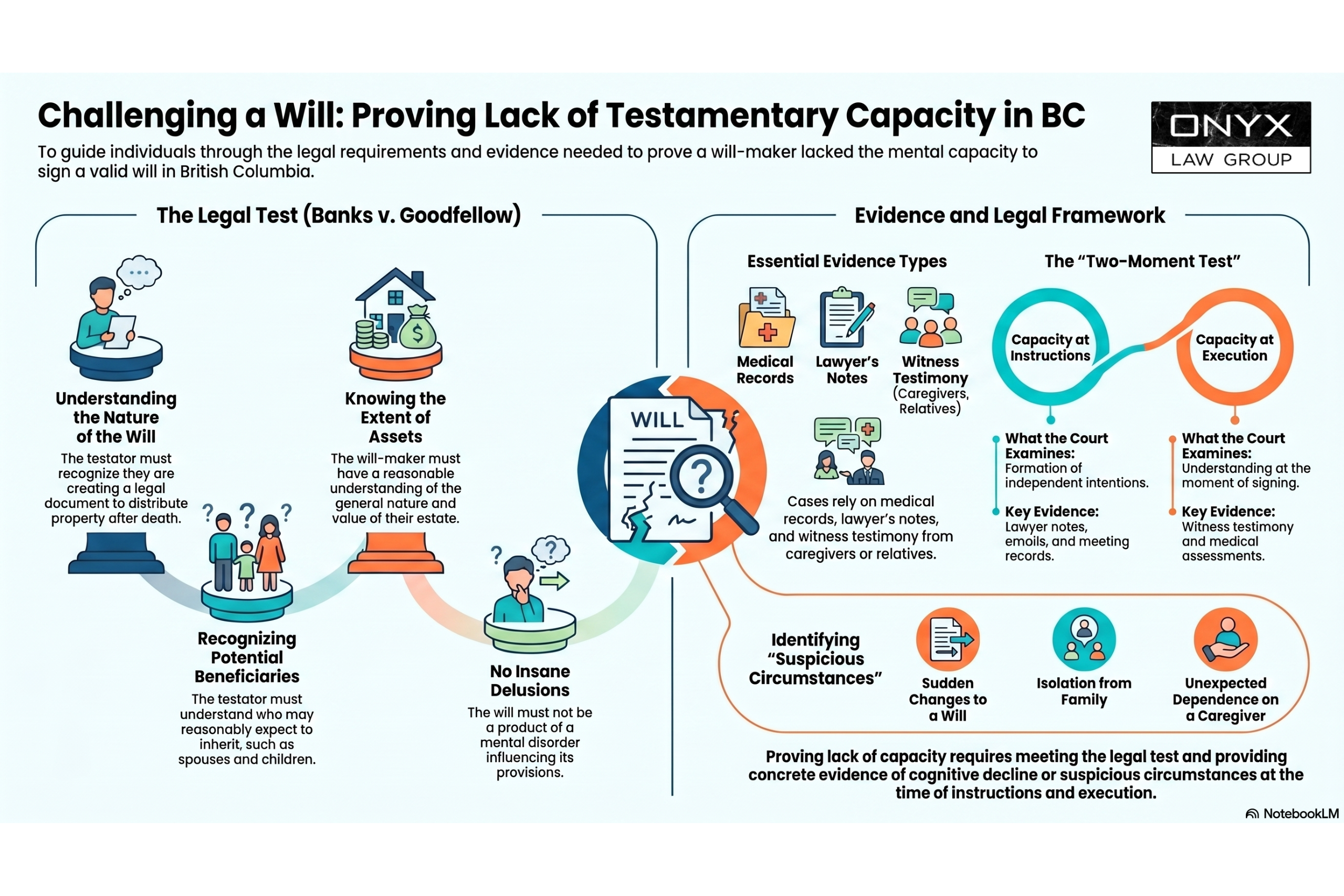
Testamentary capacity refers to a person’s legal and mental ability to make or change a will. In simple terms, the person creating the will must have the requisite mental capacity to understand what they are doing when the document is signed. This is an important part of estate law because a will may be challenged if there are concerns about the person’s mental capacity at the time it was made.
Testamentary capacity is crucial because it ensures the will reflects the creator’s true wishes and free will. A valid will should be created freely and with a clear understanding of its effects. If someone lacks testamentary capacity or the mental ability to understand their decisions, the court may decide that the will is invalid.
To have testamentary capacity, a person must meet certain legal requirements. They should understand that they are creating a will and know the general nature of the assets they own. They must also be able to recognize the people who may reasonably expect to benefit from their estate, such as spouses, children, or close family members.
A person making a will must also understand how their assets will be distributed. This means they should understand who is receiving property and how those decisions may affect others. Temporary illness, memory issues, or medical conditions do not automatically affect testamentary capacity or mean someone lacks testamentary capacity. The key question is whether the will-maker understood their decisions at the time the will was signed.
What Is the Legal Framework for Proving Lack of Testamentary Capacity?
In British Columbia, claims involving lack of testamentary capacity are mainly governed by the Wills, Estates and Succession Act and established court decisions. The law says a person making a will must understand what the will does, the assets they own, and how their decisions affect others under the capacity required by law. BC courts focus on the testator’s mental state at the exact time the will was signed.
One of the most important cases is Banks v. Goodfellow. This case created the common law test and legal test BC courts still use today. The will-maker must understand they are making a will, know the general extent of their property, recognize the people who may expect to benefit, and understand possible moral obligations while remaining free from delusions that affect their decisions.
Another major case is Vout v. Hay. This case explains how the burden of proof works in will disputes. Normally, the court starts with a rebuttable presumption that a properly signed will is valid. But if suspicious circumstances are raised, the person defending the will may need to prove the testator had testamentary capacity.
Suspicious circumstances can include sudden changes to a will, signs of cognitive decline, isolation from family, or concerns about undue influence. Courts often review medical records, lawyer notes, and witness statements to understand what was happening when the will was signed, including proceedings in solemn form when required. A dementia diagnosis alone does not automatically make a will invalid. What matters most is whether the person understood their decisions at that specific time.
Undue influence happens when someone pressures, manipulates, or controls a will-maker into making decisions they would not have made freely on their own. In British Columbia, courts may look for signs that another person isolated the testator, controlled access to information, participated heavily in preparing the will, or benefited unexpectedly from major changes to the estate. Undue influence claims often appear alongside concerns about diminished mental capacity, especially where an elderly or vulnerable person became dependent on a caregiver, family member, or close acquaintance before the will was signed.
These disputes can be stressful and emotionally difficult for families. Strong evidence and early legal advice can make a major difference in the outcome of a case. Onyx Law Group helps clients handle will challenges, probate disputes, and claims involving a lack of testamentary capacity across British Columbia.
What Is the Test for Testamentary Capacity in BC?

In British Columbia, the test for testamentary capacity comes from Banks v. Goodfellow. Under this four-part legal test, a person making a will must understand the nature of making a will, the extent of their assets, the people who may expect to benefit from the estate, and the effect of certain decisions.
BC courts use this framework to decide whether a will-maker had the mental capacity to make or change a valid will at the time it was signed, based on the testator’s understanding and specific circumstances. Testamentary capacity disputes often involve dementia, cognitive decline, illness, medication, or concerns about undue influence that may demonstrate capacity concerns
1. Understanding the Nature and Effect of Making a Will
The person must understand that they are creating a legal document that distributes their property after death through their own act and free will. They should know the will controls who receives their assets and who will administer the estate. A person does not need legal training or perfect memory. However, they must generally appreciate the significance and consequences of signing the will as a reflection of their independent decisions.
2. Understanding the Extent of Their Property
The will-maker must have a reasonable understanding of the assets they own. This includes major property, savings, investments, businesses, and other significant assets that require the capacity to manage finances and make certain decisions. BC courts do not require exact financial calculations or detailed inventories. The key question is whether the person broadly understood the nature and value of their estate.
3. Understanding the Claims of People Who Might Expect to Benefit
A capable will-maker must recognize the people who may reasonably expect to inherit from the estate. This often includes spouses, children, dependants, or others with close family relationships to the deceased, including situations involving two sons or other parties involved.
The law does not require someone to distribute assets equally or to leave anything at all to certain relatives. Still, the person must understand who those potential beneficiaries are, consider possible moral obligations, and review their claims before deciding how to distribute the estate.
4. Being Free From Delusions That Affect the Will
The final limb examines whether mental illness, delusions, or irrational beliefs influenced the terms of the will and may affect testamentary capacity or the testator’s understanding. If a false belief directly caused unfair or irrational decisions in the will, the document may be challenged.
For example, a will could face scrutiny if the deceased disinherited a child because of a paranoid delusion unsupported by reality or if someone exerted undue influence over the deceased. BC courts look closely at whether the alleged delusion actually affected the estate decisions being made.
Because these disputes can involve complicated medical and legal evidence, it is important to speak with an experienced estate litigation lawyer as early as possible. A lawyer can assess the strength of the evidence, explain your legal options, and help protect your interests during a will challenge.
The Two-Moment Test: Capacity at Instructions and at Execution
In British Columbia, testamentary capacity is not always assessed at just one moment. Courts often look at the testator’s mental capacity at two separate stages: when they gave instructions for the will and when they actually signed it. This is sometimes called the “two-moment test,” and it becomes especially important in disputes involving dementia, illness, medication, or fluctuating cognitive ability.
| Stage | What the Court Examines | Why It Matters | Common Evidence |
|---|---|---|---|
| Capacity at Instructions | Whether the testator understood their wishes and estate decisions when speaking with the lawyer | Shows the person formed independent intentions | Lawyer notes, conversations, emails, meeting records |
| Capacity at Execution | Whether the testator understood the will when signing it | Determines whether the will was validly executed | Witness testimony, signing observations, medical evidence |
BC courts often assess both moments together because mental capacity can fluctuate. A person may appear capable when giving instructions but confused at signing, or vice versa. Cases involving suspicious circumstances may also trigger the framework from Vout v. Hay, where the burden may shift to the person defending the will.
How BC Courts Apply the Test

Testamentary capacity is assessed at the time the will was signed. A diagnosis of dementia or cognitive decline alone does not automatically render a will invalid. Someone may still have periods of lucidity where they fully understand their decisions, even where the Supreme Court later reviews the matter.
Courts often review medical records, lawyer notes, witness testimony, and surrounding circumstances when evaluating capacity disputes. Often, the drafting lawyer’s observations and the presence of key facts become important evidence because they interacted directly with the will-maker during the signing process, especially in cases where the court emphasized concerns or found the will-maker incapable.
What Are the Steps to Challenge a Will Based on Testamentary Capacity?
Challenging a will based on testamentary capacity can be emotionally difficult, especially when questions arise about a loved one’s mental state before their passing. These disputes often involve concerns about dementia, memory loss, confusion, or diminished decision-making abilities at the time the will was signed. Because these cases require strong evidence and careful legal preparation, understanding the steps involved can help families better prepare for the process ahead.
Step 1: Initial Assessment
The first step is evaluating whether there are valid legal grounds to question the deceased person’s mental capacity at the time the will was signed. Courts generally examine whether the person had the capacity required to understand the nature of the will, the extent of their assets, and the individuals who would normally expect to inherit from the estate under the specific circumstances. A preliminary consultation with an estate litigation lawyer can help determine whether the facts, available evidence, or a medical opinion support moving forward with a challenge.
Step 2: Gathering Evidence
Evidence is one of the most important parts of a testamentary capacity case, and medical evidence is often central to the dispute. Medical records, physician notes, cognitive assessments, and medication histories may help establish whether the deceased was experiencing impaired judgment or mental decline when the will was created. Witness statements from caregivers, relatives, friends, or the lawyer who prepared the will can also provide concrete evidence, strong evidence, compelling evidence, and insight from credible witnesses about the person’s mental condition and decision-making abilities.
Step 3: Filing a Legal Challenge
Once enough supporting evidence has been collected, the next step is formally filing a legal challenge in court. This process usually involves preparing legal documents that explain why the will is being disputed and presenting evidence supporting the claim of lack of testamentary capacity, including solemn form proceedings involving the parties. Estate litigation procedures can be complex and deadline-sensitive, especially where a rebuttable presumption applies, which is why timely legal advice is often essential during this stage.
Step 4. Court Proceedings and Outcomes
If the dispute cannot be resolved through negotiation or mediation, the matter may proceed to trial before a judge in the Supreme Court. During the proceedings, both sides present evidence and question witnesses about the deceased’s mental capacity and the presence of relevant facts. Depending on the outcome, the court found incapable findings or issues the court emphasized may affect the validity of the will.
How to Spot Inconsistencies in the Testator’s Behavior
Spotting inconsistencies in a testator’s behavior can be important when concerns arise about testamentary capacity. Family members and loved ones may notice signs of confusion, memory loss, or unusual decision-making.
A person may forget close relatives, struggle to understand conversations, or make sudden changes that seem out of character. These behaviors may raise questions about whether the person fully understood their decisions when creating or changing a will.
Changes in personality or behavior can also be significant. For example, a normally careful person may begin making impulsive financial decisions or lose the ability to manage finances or make independent decisions. Sudden isolation, fearfulness, or dependence on one individual may also be concerning in some situations. Keeping records of these changes can help create a clearer picture of the testator’s mental state over time.
Witness statements often play an important role in estate disputes involving testamentary capacity. Friends, caregivers, medical professionals, and family members may have firsthand knowledge of the testator’s condition and behavior. Their observations can help support concerns about confusion, memory issues, or unusual conduct around the time the will was signed and may demonstrate changes in behavior.
When gathering testimony, it is important to focus on specific facts and observations. Witnesses should describe what they personally saw or heard rather than offering opinions or assumptions. Notes, emails, medical records, and written statements may also help support the testimony. Clear and consistent evidence can be valuable when assessing whether the testator had the mental capacity to make a valid will.
How Can a Lawyer Help You Prove Lack of Testamentary Capacity in BC?

An estate litigation lawyer can help prove lack of testamentary capacity in BC by gathering and analyzing the evidence needed to challenge the validity of a will. This often includes reviewing medical evidence such as medical records, lawyer notes, witness statements, cognitive assessments, and the circumstances surrounding the signing of the will. A lawyer can also identify suspicious circumstances, such as sudden changes to the estate plan, isolation from family members, or signs of undue influence that may support the claim with concrete evidence.
A lawyer also helps guide clients through the legal process and makes sure they do not miss important deadlines. Testamentary capacity disputes can be emotionally difficult for families, especially when disagreements arise among siblings, caregivers, or beneficiaries. An experienced estate litigation lawyer can prepare court documents, work with medical experts, question credible witnesses, and build a clear legal argument focused on the testator’s mental state at the time the will was signed.
At Onyx Law Group, one client reached out after her late father unexpectedly changed his will only months before his passing. She was concerned because he had been experiencing significant memory problems, confusion, and increasing dependence on another family member who became heavily involved in his finances and daily decisions.
Our team carefully reviewed medical records, obtained witness statements from people who observed the father’s condition, and identified inconsistencies surrounding the preparation of the new will. With strategic legal guidance and strong evidence supported by compelling evidence, the client was able to successfully challenge the disputed will and achieve a positive resolution for her family.
Ready to Prove Lack of Testamentary Capacity in BC?
Proving lack of testamentary capacity in BC often comes down to showing that the person who made the will did not fully understand what they were signing at the time the will was created. Medical records, witness statements, and evidence of confusion, memory loss, or cognitive decline can all play an important role. Because these cases can be emotionally and legally complex, having clear evidence is extremely important.
If you believe a loved one’s will may not reflect their true intentions, speaking with an experienced estate litigation lawyer can help you better understand your options. A lawyer can review the facts, gather supporting evidence, and guide you through the legal process with confidence.
At Onyx Law Group, we understand how emotional and complicated will disputes can become, especially when questions about testamentary capacity arise. With over 13 years of legal experience, our team of estate litigation lawyers in BC has helped clients across BC handle estate litigation matters with thoughtful guidance and practical legal strategies. If you are concerned about the validity of a loved one’s will, contact us to discuss your situation and learn how we can help protect your interests.
Frequently Asked Questions
This FAQ section explains how to prove a lack of testamentary capacity in British Columbia and the types of evidence that may be used in a will dispute. It also answers common questions about legal requirements, witness testimony, and the role of medical and estate records.
What Are the Legal Requirements for Proving Lack of Testamentary Capacity in BC?
In British Columbia, a person challenging a will must show evidence that the testator did not fully understand the nature and effect of the will when it was signed. The court looks at whether the person understood their assets, the people who may benefit from the estate, and the consequences of their decisions.
Can Medical Evidence Be Used to Prove Lack of Testamentary Capacity in BC?
Yes, medical evidence is often very important in these cases. Medical records, doctor assessments, and expert opinions may help show whether the testator was experiencing cognitive decline, dementia, or other conditions affecting mental capacity.
What Is the Time Frame for Contesting a Will?
The time limit for contesting a will in BC depends on the type of claim being made. It is important to seek legal advice quickly because missing legal deadlines may affect your ability to challenge the will.
What Factors Are Considered in Determining Lack of Testamentary Capacity in BC?
Courts may consider memory problems, confusion, unusual behavior, medical conditions, and the circumstances surrounding the signing of the will. They also examine whether the testator understood the extent of their estate and the people affected by their decisions.
How Can Lack of Testamentary Capacity Be Proven in BC?
Lack of testamentary capacity is usually proven through evidence such as medical records, witness testimony, lawyer notes, and documentation showing concerning behavior or mental decline. The court reviews all available evidence to determine the testator’s mental state at the time the will was signed.
Can a Lawyer Help in Proving Lack of Testamentary Capacity in BC?
Yes, an experienced estate lawyer can help gather evidence, review medical and legal records, and guide you through the court process. Legal support can be very helpful in complex estate disputes.
What Are the Legal Implications if Lack of Testamentary Capacity Is Proven in BC?
If the court finds that the testator lacked testamentary capacity, the will may be declared invalid. In some cases, an earlier valid will may be used instead, or the estate may be distributed according to BC intestacy laws.
Disclaimer: The information on this page is general legal information about British Columbia law, not legal advice for any specific situation. Reading this page does not create a solicitor-client relationship. BC law changes, and the procedure that applies to a specific situation depends on facts not covered here. For advice on your situation, consult a qualified British Columbia estate lawyer directly. Past results, illustrative scenarios, and reference to typical fact patterns do not guarantee similar outcomes in any specific case.