


In British Columbia you can contest a will on two tracks: challenging its validity — for example lack of capacity, undue influence, or improper signing under the Wills, Estates and Succession Act — or, as a spouse or child, asking the court to vary a valid will that leaves you inadequate provision under section 60. Both are subject to strict deadlines.
Contesting a will in BC can be emotional and legally complex, but knowing your rights can help you take the right steps. If you believe a will is unfair or was created under questionable circumstances, BC law allows certain family members or dependents to challenge it. Understanding when and how to contest a will ensures your actions are protected and your loved one’s true intentions are respected.
Wondering if you have the right to contest a will in BC? At Onyx Law Group, we’ve spent over a decade helping clients understand their rights and successfully challenge unfair wills, improperly executed, or legally invalid. Our wills and estates lawyers have the experience and knowledge necessary to discuss your options, guide you through the process, and maximize settlement value. Contact us today for a free consultation and let us help you win your case!
This post will explain who can contest a will in BC, the legal grounds for doing so, and the deadlines you need to know to protect your rights.
Contesting a Will in BC: What You Need to Know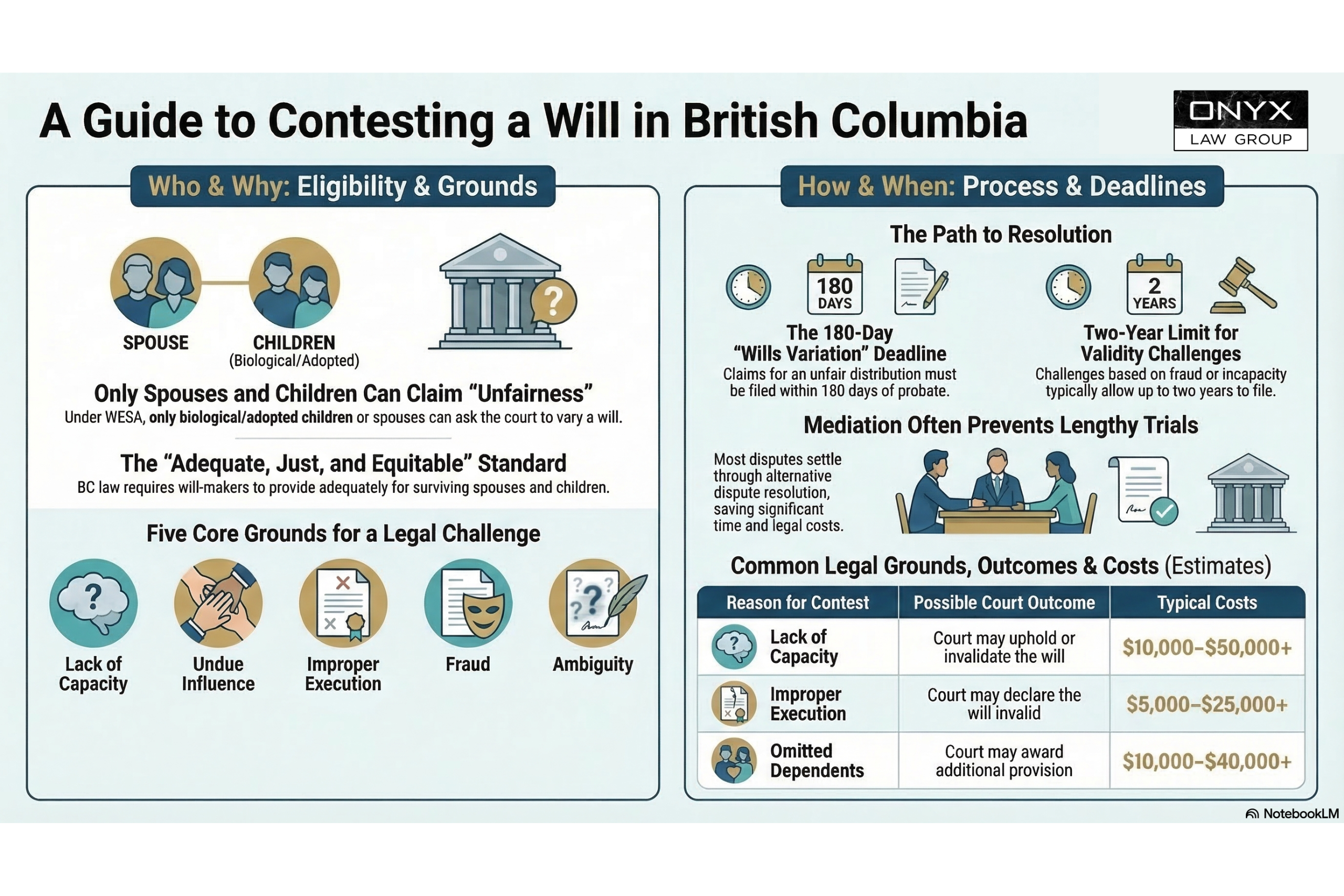
According to historical data referenced by the BC government, only about 55% of British Columbians have a signed and legally valid will. This data reflects that a significant number of British Columbians do not have up‑to‑date wills.
To challenge a will legally, you should understand the right steps in the legal process to be sure that your rights are protected while contesting a will in BC. There are time limits under British Columbia law, so it’s important to act promptly and seek professional guidance. We recommend following the steps below:
Step 1: Consult With an Experienced Estate Litigation Lawyer
The best first step is to consult with a lawyer who is experienced in contesting wills in British Columbia. Your lawyer can review the legal document and advise you on how to know if you can dispute a will and win, including whether there are valid grounds or legal grounds related to the will’s validity, explain the type of evidence you’ll need, and make sure that you meet all deadlines and legal requirements. A lawyer experienced in estate litigation can help design a legal strategy that aligns with your goals, whether it’s reaching a settlement or proceeding through court proceedings.
Step 2: Gather Evidence to Support Your Claim
The strength of your case depends on having clear, relevant evidence, which varies based on the specific grounds for contesting the will. Medical records or expert witness testimony can demonstrate mental incapacity, while financial records or evidence of family relationships may support a will challenge or show why the will should be declared invalid. Being thorough in gathering evidence can make a big difference in supporting your claim.
Step 3: Start Your Legal Action in Court
The next step is to start court proceedings in the BC Supreme Court. You will need to file a civil claim or other claims contesting the will. This step is critical because it preserves your right to pursue a will challenge and informs the executor that the estate distribution is being contested.
Filing your claim before the limitation period helps make sure that your challenge is heard. Working with your lawyer during this step will help ensure that all necessary legal document filings are completed correctly and that relevant parties are notified within the required timeframe.
Step 4: Notify the Executor and Estate Beneficiaries
Once you file your legal action, it’s important to notify the executor of the estate and all relevant parties, including estate beneficiaries and any financial institutions connected to the estate. The objective is to maintain transparency and ensure all parties involved have the opportunity to respond or prepare for the legal proceedings. While resolving the dispute, the executor may need to pause the asset distribution. Serving notice is a legal requirement that should be done as promptly as possible to avoid unnecessary delays.
Step 5: Attend Mediation or Alternative Dispute Resolution (if applicable)
Once your case is in court, there may be chances to settle without going to trial, often through mediation or other alternative dispute resolution options. Mediation can help preserve family relationships and address concerns about unequal treatment or financial circumstances among family members. Even if it doesn’t resolve everything, it can narrow the issues in dispute and make any eventual trial quicker and more focused.
Step 6: Proceed to Trial if Necessary
If a settlement can’t be reached through mediation, the case will go to trial, where you’ll present your evidence and witness testimony to support your claim regarding your loved one’s will. Trials can be long and complicated, so it’s vital to work closely with your lawyer. The judge will decide if the will is valid based on the will maker’s reasons and other evidence presented.
Step 7: Appeal the Court’s Decision (If Applicable)
If the court’s decision isn’t in your favor, you may be able to begin the appeal process in the BC Court of Appeal, but only for legal errors or misinterpretations, not just because you disagree with the outcome. Appeals are time-sensitive, requiring a Notice of Appeal within 30 days, so working with a lawyer experienced in appellate law is essential to assess your chances and navigate the legal process effectively.
What Are the Legal Grounds for Contesting a Will in BC?

Contesting a will can be a complex and challenging process, but it is possible to win if you have a valid civil claim and can provide evidence to support your case. In BC, there are only a few legal grounds for contesting a will:
1. Lack of Testamentary Capacity
One method of how to dispute a will is by contesting it based on a lack of testamentary capacity. It involves arguing that the person who made the will, known as the will-maker or the testator, suffered mental incapacity and did not understand the implications of the will or their moral and legal obligation toward biological or adopted children at the time it was made.
2. Undue Influence or Coercion
You can ask the court to set aside a will if you can prove undue influence on the will-maker. For example, you can cite threats or pressure from a relative or caretaker to the degree that the will does not reflect the will-maker’s true intentions.
3. Improper Execution of the Will
For a will to be valid, it must meet the formal requirements set out in s. 37 of the Wills, Estates, and Succession Act (WESA): it must be written and signed by the will-maker in the presence of two witnesses who also sign the will. You can ask the Courts, through the probate registry, to invalidate a will that doesn’t meet those formal requirements.
4. Fraud or Forgery
You can challenge a will that you believe was faked or forged. This is particularly common for handwritten wills. To prove the will is fraudulent, you’ll need a handwriting expert to support your case.
5. Ambiguity in the Will
A will can be contested if it is ambiguous or unclear (e.g., the list of beneficiaries is not clearly defined). The Court can interpret the will to resolve the ambiguity.
Procedural Steps to Contest a Will in BC
Contesting a will in BC starts with understanding the timelines and deadlines. Typically, you have 180 days from the date probate is granted to file a claim under the Wills, Estates and Succession Act, so acting promptly is essential. Missing this deadline can prevent you from having your case heard, making it crucial to plan carefully from the start.
The next step involves preparing and filing the necessary documents, most importantly, a Notice of Objection, which formally informs the court and interested parties that you are challenging the will. Supporting documents, such as medical records, witness statements, or financial evidence, help strengthen your claim. The court reviews these filings and may suggest mediation or settlement discussions before proceeding to a full hearing, which can save time and reduce costs.
Having legal representation is highly important throughout the process. An experienced estate lawyer can guide you through the paperwork, explain your rights, and help present your case effectively in court or during settlement talks. With proper guidance, you can navigate the procedural steps more confidently and improve your chances of achieving a fair outcome.
Common Challenges and Outcomes in Contesting a Will

Contesting a will in BC can come with several challenges, and it’s important to know what to expect before taking action. One common hurdle is the legal defenses the estate may raise, such as claiming the testator had full mental capacity or that no undue influence occurred. Gathering strong evidence can be difficult, and proving your case often requires detailed documentation and witness statements.
The court has a few possible outcomes when hearing a will dispute. It may uphold the will, leaving the estate as originally written, vary the will by making adjustments to provide for dependents, or completely invalidate it if serious issues like fraud or forgery are proven. Each outcome depends on the strength of the evidence and the specific circumstances of the case.
Contesting a will can also be emotionally draining and financially costly. Legal fees can quickly add up, and family tensions may increase during the process. It’s common for people to feel stressed and uncertain while waiting for a court decision, so having support and professional guidance is crucial.
In some cases, alternatives to going to court can help resolve disputes more smoothly. Mediation or family agreements can provide a faster, less adversarial solution and preserve relationships. Exploring these options with the help of an estate lawyer may save time, money, and emotional strain while still ensuring fair outcomes.
Can You Challenge a Will That Is Not Fair?
Yes, but only the spouse or child of the will maker can do so. BC’s wills law says that a person must provide for their surviving spouse and children in a way that is “adequate, just, or equitable.” Section 60 of British Columbia’s Wills, Estates, and Succession Act allows spouses and children of a will-maker to ask the Court to vary the terms of the deceased’s will on the basis that the spouse or child was unjustly disinherited or not adequately provided for in all the circumstances.
How Long Do You Have to Contest a Will in BC?

Generally, how long you have to contest a will depends on whether you want to vary the will with a wills variation claim or based on other legal grounds. The timeline for contesting a will for a wills variation claim is within 180 days from the day the will was probated.
On the other hand, if you want to contest the validity of a will, you must challenge the will within two years from the date you knew or ought to have known of the grounds for the claim. If you fail to meet these deadlines, you may lose the right to contest the will or influence the validity of the will.
Another point to keep in mind is that it’s preferable if you can contest the will before it goes into probate. It’s not that you can’t challenge a probated will; it is just that you will have to bring a motion in Court for the return of the Certificate of Appointment of Estate Trustee if the will has gone to probate. If you think you want to contest a will in BC, the best course of action is to talk to a lawyer immediately to ensure deadlines aren’t missed.
Who Can Contest a Will in BC?
Only a spouse or child of the deceased can bring a claim to vary the will. “Spouse” here means a legally married spouse and a common-law spouse. “Child” means biological child and includes adopted children of the deceased. In addition, if a child is left out of a will, they can contest it. Even adult children of a deceased person can apply to vary their parent’s will. The stepchild of a deceased person does not have legal standing to bring a will variation claim.
“Understanding your legal rights is the first step to protecting yourself when contesting a will. Many people don’t realize they can challenge a will if it’s unfair or improperly executed.” — Onyx Law Group Estates Team
To bring legal action using any of the other grounds, a person must have an interest in the estate. So, a person would be eligible to contest a will if they have an interest in the estate as a beneficiary named in the most recent will, as a beneficiary named in a previous will, or as an heir who would inherit under the rules of intestacy if the will is deemed invalid. People with a financial interest in the estate may also have legal standing (e.g., a person to whom the estate owes a debt).
What Is the Cost of Contesting a Will in BC?
Before you initiate any legal action to contest a will, you need to be aware of what it will cost to contest a will so you can budget effectively. On average, an experienced lawyer might charge $200 to $500 per hour to assist you in contesting a will.
However, given that each estate is different, the legal costs for challenging probate matters can vary depending on the specific circumstances of the case. The factors that affect the legal fees of contesting a will in BC include how complex the case is, how long it lasts, and the estate lawyer involved.
What Are the Potential Outcomes of Contesting a Will?
If you brought a will variation claim and the Court agrees that you have valid grounds and the will failed to make adequate provision or unfairly disinherited you, the Court may intervene. It will impose an alternative distribution of the estate assets that meets the deceased’s legal obligation and/or moral duty. The Court will redistribute the estate in a way that ensures the surviving spouse’s or child’s share is “adequate, just and equitable in the circumstances.”
If, on the other hand, you challenge the validity of the will on other grounds (e.g., undue influence, the will was not executed properly, fraud, or the will-maker was not mentally capable), there are a few possible outcomes of a successful case. Parts of the will may be invalidated, modified, or interpreted by the Court.
If the entire will is declared invalid, it is set aside and not given effect. The will-maker’s next most recent valid will takes its place. If the deceased person had no other valid will, his or her estate is distributed according to the laws of intestacy, which are set out in Part 3 of the WESA.
Lastly, please be aware of the risks associated with Court costs and other potential repercussions. The general rule is that where there is a genuine dispute about the validity of a will, even an unsuccessful party may be awarded costs paid out of the estate. But that does not mean you should expect to receive costs from the estate. The Court may order you to bear your costs or order you to pay another party’s costs if your case is unsuccessful or frivolous.
Case Example: Jane discovered her father’s will largely excluded her. She contacted Onyx Law Group immediately. Her lawyer reviewed the will, gathered supporting evidence, and filed a Notice of Objection within the 180-day deadline. Through mediation, Jane received a fair share of the estate, achieving a positive outcome without a lengthy court battle.
Common Reasons for Contesting a Will vs. Court Outcomes
When disputes arise over a will, understanding the common reasons for contesting it and the potential outcomes can help set realistic expectations. The table below breaks down the main causes, what courts may decide, and the typical timeframes and costs involved, giving you a clear snapshot of what to anticipate.
| Reason for Contest | Explanation | Possible Court Outcome | Typical Duration | Costs |
|---|---|---|---|---|
| Lack of Testamentary Capacity | Claiming the testator wasn’t mentally capable of understanding the will when it was made | Court may uphold or invalidate the will | 6–24 months | $10,000–$50,000+ |
| Undue Influence | Alleging someone pressured or manipulated the testator into making the will | Court may alter or set aside affected parts | 6–24 months | $15,000–$50,000+ |
| Improper Execution | Will wasn’t signed, witnessed, or followed legal requirements | Court may declare the will invalid | 3–12 months | $5,000–$25,000+ |
| Fraud or Forgery | Will or signatures were falsified | Court may completely invalidate the will | 6–24 months | $15,000–$50,000+ |
| Omitted Dependents | Spouse or child claims they were unfairly excluded | Court may award additional provision under Family Provision Act | 6–18 months | $10,000–$40,000+ |
Tips for Successfully Contesting a Will in BC
To improve your chances of success, it’s important to be well-prepared and follow the correct legal procedures. Here are some useful tips for successfully contesting a will in BC:
- Consult a lawyer early. We always tell our clients, “The sooner you speak with a lawyer, the better.” Seek legal advice from a wills and estates lawyer as soon as you believe there are grounds to contest the will. They can help you understand the law, your rights, and the strength of your case, and they can guide you through the entire process.
- Act as quickly as possible. Missing the limitation period deadline can make it difficult to challenge the will. For this reason, it’s important to file a notice of dispute promptly to stop the estate from being distributed.
- Gather strong evidence. Evidence is key to contesting a will. Collect documents, witness statements, and other forms of proof to support your claim. For example, if you’re contesting the will based on undue influence, gather evidence that shows the deceased was pressured into making certain decisions.
- Know your grounds for contesting. Common grounds include lack of mental capacity, undue influence, fraud, or failure to meet the formal legal requirements. Make sure your reason for contesting is valid under BC law.
- Consider mediation. Many will disputes in BC are settled out of court through mediation. Mediation is less expensive and faster than going to trial, and it allows both parties to negotiate a fair outcome. Be open to resolving the issue this way if possible.
- If mediation is unsuccessful, prepare for potential court proceedings. Contested wills can result in lengthy and expensive trials, so you’ll need a strong legal strategy. Work closely with your lawyer to prepare a convincing case.
- Stay objective. Contesting a will can be emotional, but try to stay focused on the legal facts of the case. Avoid making decisions based on anger or frustration, and trust your lawyer’s guidance throughout the process.
Need Help Contesting a Will in BC?
You have the right to legally contest a will if you believe it is unjust. However, before you take any formal action, be sure you’re legally eligible to challenge the will and that you have a valid legal ground.
Additionally, make sure you understand the BC laws regulating a will contest, including the timelines to observe. Above all, it is recommended to work with an experienced lawyer for effective legal representation and guidance when seeking a fair settlement.
If you want to know more about your legal rights to contest an unfair will or how to resolve a dispute relating to a deceased’s estate, we welcome you to reach out to our estate lawyers to schedule a free 30-minute consultation. You can discuss your matter with a passionate and knowledgeable lawyer who can advise you on the best steps forward.
Frequently Asked Questions
If you’re considering contesting a will in British Columbia, you probably have a lot of questions about your rights and the process. This FAQ section breaks down the key information to help you understand your options and next steps.
How Long Do I Have to Contest a Will in BC?
In British Columbia, a spouse or child typically has 180 days from the date probate is granted to contest a will if they believe it does not fairly provide for them. Because deadlines can affect your rights, it is wise to speak with an estate lawyer as soon as possible to understand your options and avoid missing the time limit.
Can Anyone Contest a Will?
Not everyone can contest a will in British Columbia, as the law generally limits this right to spouses, children, or people with a valid legal interest in the estate. If you believe you may have grounds to challenge a will, speaking with an estate lawyer can help you understand whether you are eligible and what steps to take next.
What Evidence Is Needed to Contest a Will?
To contest a will, you typically need evidence such as medical records, witness statements, financial documents, or other proof showing issues like undue influence, lack of mental capacity, or improper execution of the will. An experienced estate lawyer can help gather and present the right evidence to support your claim and strengthen your case.
How Much Does It Cost to Contest a Will?
Contesting a will in British Columbia can be expensive, often ranging from several thousand to tens of thousands of dollars, depending on the complexity of the case and whether it goes to trial. Because costs can add up quickly, it’s important to speak with an estate lawyer early to understand potential fees and plan your next steps wisely.
What Happens if the Court Upholds the Will?
If the court upholds the will, the estate is distributed exactly as the will specifies, and your claim to change it will be denied. In most cases, you may also be responsible for some of the legal costs, so it’s important to be prepared before pursuing a challenge.
Disclaimer: The information provided on this blog is for general informational purposes only and does not constitute legal advice. Reading this content does not create an attorney-client relationship. Laws and regulations vary by jurisdiction and may change over time, so you should consult a qualified estates and trust attorney for advice regarding your specific situation. Past examples, case studies, or hypothetical scenarios are illustrative only and do not guarantee similar results.