


Probate lawyer fees in British Columbia typically range from $3,500 to $7,500, depending on the complexity of the estate and the legal services required. Although hiring a probate lawyer is not mandatory, many executors choose legal assistance to avoid delays, costly mistakes, and probate application errors. Understanding how probate fees are calculated can help you budget for estate administration and decide whether professional guidance is right for your situation.
Working with a lawyer will provide you with much-needed support, peace of mind, and access to additional resources to make the probate process go as smoothly as possible. At Onyx Law Group, our probate and estate administration is led by Veronica Manski, who was called to the British Columbia bar in 2015 after her Juris Doctor at UBC. Before joining Onyx in 2021, she trained as a litigator in Toronto and worked in corporate banking, so the finance and legal aspects of an estate are explained properly rather than waved through. If you want to know more about how we can help after a loved one’s death, reach out for a free 30-minute consultation.
This article will explain how probate lawyer fees work in British Columbia, what services those fees typically cover, and the factors that can affect the overall cost of probate.
How Much Are Lawyer Fees for Probate in British Columbia?

Probate is a common part of estate administration in British Columbia. According to the BC Vital Statistics Agency, more than 43,000 deaths were registered in the province in 2024, meaning thousands of families each year may need to navigate estate administration and, in many cases, the probate process.
Fees will vary based on the services you hire the probate lawyer to provide. For example, you can hire a probate lawyer to assist with filing the probate application only, or you can hire a probate lawyer to assist with both filing the application and administering the estate once the estate grant has been obtained.
Legal fees also depend on factors unique to the lawyer (such as the lawyer’s years of experience, level of expertise, and where they are located) and factors unique to the estate matter itself (such as the size of the estate, the complexity of the estate, and whether the grant of probate is contested). See below for a discussion of additional factors that can impact the fees paid.
What Is the Average Cost of a Probate Lawyer in BC?
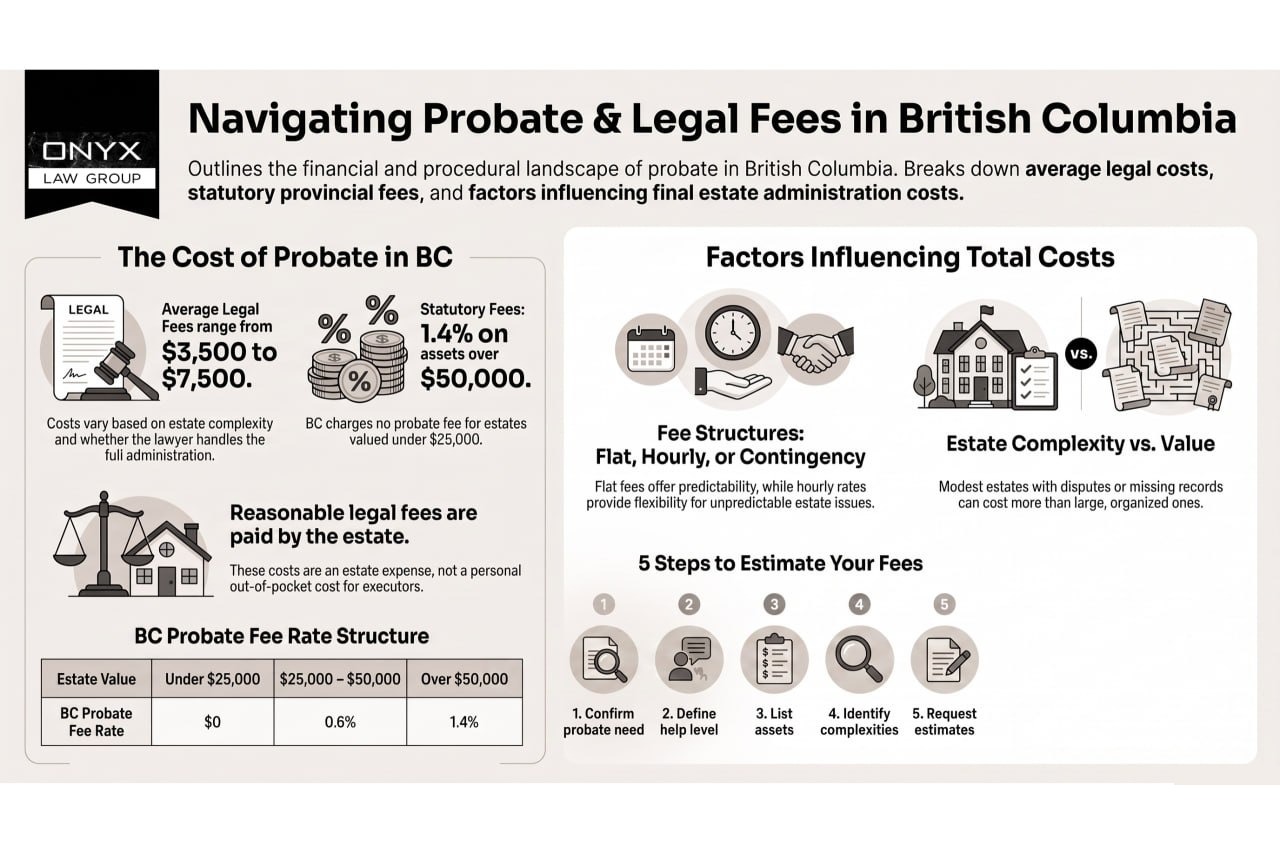
The average cost to obtain a grant of probate typically ranges from $3,500 to $7,500 in legal fees, plus disbursements and taxes, which may add an additional $1,000 to $2,000. If further legal services are provided by the lawyer after the estate grant has been issued (for example, assistance with administering and distributing the estate), those fees will be in addition.
Remember that reasonable legal fees are a proper expense of the estate, and executors should also be aware of their duties under the Trustee Act and other applicable estate laws. The best approach is to speak with the lawyer to determine the scope of work, the estimated costs of the probate application, and the potential for any complicating factors that may increase the time or cost associated with obtaining an estate grant from the Supreme Court.
Why Hire a Lawyer for Probate in BC?
Estate administration is a significant responsibility, and many families seek professional assistance along the way. The Public Guardian and Trustee of British Columbiaadministered more than 3,400 deceased estates during the 2023–2024 fiscal year, highlighting how frequently estates require formal legal administration.
Even if there are no disputes and the estate is relatively simple, an executor or administrator should seek legal advice and guidance as needed. Reasonable fees charged by a probate lawyer are paid by the estate, not the executor or administrator personally.
There are many benefits to having legal assistance. Probate lawyers can determine if probate is required (not all wills require probate), prepare the necessary paperwork to get court orders to facilitate the process, help identify and inventory estate assets and debts (necessary for the Statement of Assets and Liabilities), and help determine the value of the estate.
A skilled probate lawyer can also streamline the process of administering the estate. An executor or administrator handling the estate on their own is more likely to make mistakes or overlook important steps, which can cause delays and increase costs. Probate lawyers can also provide legal advice on the validity of any claims against the estate and manage/resolve disputes among family members should they arise (e.g., wills-variation claims by a surviving spouse or disinherited child, unequal inheritance between siblings, etc.).
How Are Lawyer Fees for Probate in BC Determined?

Different lawyers offer different payment options, so you should do some research before choosing a lawyer. Some charge fees based on an hourly rate, contingency, or a fixed fee. Here is a brief overview of common fee structures.
Hourly Rate
The lawyer might bill the client based on an hourly rate and invoice the client regularly for work done, along with out-of-pocket costs such as court filing fees, photocopies, couriers, etc. To ensure payment, a retainer (money paid up front) is requested, and the client is asked to top up the retainer when the retainer balance is running low.
Flat Fee
The lawyer can charge a set fee for specified work, plus disbursements (out-of-pocket expenses). For example, a probate lawyer may have a standard fee for preparing and filing a probate application where there is a will and a different standard fee for preparing and filing a probate application where there is no will. The lawyer may also charge a flat fee for estates valued under a certain amount and a different flat fee for estates valued over a certain amount.
Contingency Fee
With this option, which is commonly used in estate litigation matters, the lawyer and client enter a contingency fee agreement. The lawyer doesn’t receive payment for their services until the case has been resolved either by way of settlement or trial. At the resolution of the file, the lawyer takes a percentage from the final award. At Onyx Law Group, both hourly rate and contingency options are possible for estate law cases at the lawyer’s discretion.
How to Estimate Your Probate Lawyer Fees in BC
No two estates cost exactly the same to probate. However, understanding what lawyers consider when preparing a fee estimate can help you budget more accurately and avoid unexpected expenses. The five steps below will help you plan ahead, better understand what affects probate lawyer fees, and prepare before hiring legal counsel.
Step 1: Determine Whether Probate Is Required
Not every estate in British Columbia requires probate, so this should be your starting point. A probate lawyer can review the estate and advise whether a probate application is necessary, which may save both time and legal costs.
Step 2: Decide How Much Legal Help You Need
Think about which parts of the process you want a lawyer to handle. You may only need assistance preparing the probate application, or you may prefer ongoing support with administering the estate, and the scope of work will directly affect the legal fees.
Step 3: Prepare a List of Estate Assets and Debts
Gather information about the deceased’s real estate, mortgage, bank accounts, investments, vehicles, personal belongings, and outstanding debts. Having this information organized helps the lawyer estimate the amount of work involved and identify any issues that could increase costs.
Step 4: Identify Any Factors That Could Increase Fees
Some estates require more legal work than others because of their complexity. Businesses, rental properties, assets outside British Columbia, missing beneficiaries, incomplete records, or legal disputes can all increase the time needed to complete the probate process.
Step 5: Request a Detailed Fee Estimate
Before hiring a lawyer, ask how they charge for their services and what is included in the estimate. Understanding whether the fee is hourly or fixed, along with any expected disbursements or court costs, will help you compare options and budget with confidence.
What Factors Influence Probate Lawyer Fees in BC?
No two estates are exactly alike, so probate lawyer fees can vary significantly. The two biggest factors are the size of the estate and how much legal work is required. A straightforward estate with a valid will, a few beneficiaries, and easily identified assets will usually cost less to administer than a large or complicated estate.
The value of the estate is not the only consideration. Lawyers also consider the number and type of assets that must be collected, valued, and transferred. Estates that include businesses, rental properties, investment portfolios, or assets located outside British Columbia often require additional legal work and coordination, which can increase fees. While speaking with a client, Kevin Campbell, an estate lawyer at Onyx Law Group said, “A larger estate doesn’t always mean a more expensive probate. Sometimes a modest estate with missing records or family disagreements takes much longer to deal with.”
The probate process can also become more expensive when there are practical challenges. For example, extra time may be needed to locate beneficiaries, identify missing estate assets, or obtain financial information from banks and other institutions. Estates with incomplete records or property in other provinces or countries may require additional documentation and legal assistance.
Legal disputes are another common reason probate costs increase. Fees may be higher if there is a disagreement over who should act as executor, if someone challenges the validity of the will, or if a beneficiary brings a claim against the estate. These matters often require additional legal advice and, in some cases, court proceedings beyond the standard probate application.
Some estates involve special legal responsibilities that add to the work involved. For example, if a beneficiary is a minor or lacks legal capacity, the interests of that beneficiary may require additional oversight, and the involvement of the public guardian and trustee may be necessary in certain circumstances. When these issues arise, the probate process typically becomes more complex and may result in higher legal fees.
Which Probate Lawyer Fee Structure Is Right for You?
Choosing the right fee arrangement can make it easier to budget for probate and avoid unexpected legal costs. While every estate is different, this comparison shows when each billing method is typically the best fit.
| Fee Structure | Best For | Advantages | Potential Drawbacks |
|---|---|---|---|
|
Flat Fee |
Simple, straightforward estates with a clear scope of work |
Predictable cost, easier budgeting, and no surprises if the work stays within the agreed scope |
Extra work outside the original agreement may result in additional fees |
|
Hourly Rate |
Estates with unknown issues or varying levels of complexity |
You only pay for the time spent, making it flexible for changing circumstances |
The final bill can be difficult to predict if unexpected issues arise |
|
Contingency Fee |
Estate disputes and litigation, such as will challenges or beneficiary claims |
Little or no upfront legal fees because payment is tied to the outcome of the case |
The lawyer receives a percentage of the recovery, so it is generally not used for routine probate applications |
What Are the Other Expenses Involved in Probate?

There are other expenses involved in probating an estate that must be budgeted for. Tax debts of the estate must be paid from the estate. It may be necessary for the executor or administrator to retain other professionals to provide services (accountant, tax lawyer, appraiser to determine the value of estate estates, etc.).
Executors and administrators are entitled to be reimbursed for reasonable expenses incurred, and those are payable from the estate. The personal representative of the estate is also entitled to compensation for the time and work involved with administering the estate.
If probate is necessary, BC probate feesare assessed as follows:
-
No probate fee if the value of the estate does not exceed $25,000
-
0.6% on the value of estate assets between $25,000 and $50,000, and
-
1.4% on the value of estate assets exceeding $50,000.
(See the Probate Fee Act, [SBC 1999] CHAPTER 4, s. 2)
That works out to roughly $14,000 on each million dollars’ worth of estate assets. For a deceased person who died ordinarily resident in British Columbia, the fee is assessed on the value of real and tangible personal property of the deceased located in British Columbia as well as the value of intangible personal property of the deceased wherever situated (Probate Fee Act, s. 1). Intangible personal property includes bank accounts, stocks, life insurance, and other intangible assets.
When probate is required, the Supreme Court charges a $200 filing fee for the probate application if the estate’s value is over $25,000. In addition to the filing fee, the court charges for court-certified copies of the estate grant and Statement of Assets and Liabilities ($40 for each court-certified copy).
How to Save On Lawyer’s Probate Fees

It may seem counterintuitive, but working with an experienced probate lawyer can be a way to save on fees and develop strategies for avoiding probate fees where appropriate under British Columbia law. The lawyer’s hourly rate may be higher than a lawyer with less experience, but a more seasoned lawyer can streamline the probate process, anticipate problems before they arise, and draw on their expertise to resolve unexpected challenges.
As discussed above, legal fees will also depend on the scope of work. You can communicate with your lawyer at the outset to determine what steps you want help with and what steps you will undertake on your own. The personal representative can take on more of the administrative tasks, such as obtaining and organizing documents and preparing a detailed inventory of estate assets and debts.
An executor or administrator can also reduce fees involved with probate by being organized and keeping beneficiaries informed. Open communication with beneficiaries tends to reduce the odds of a dispute.
Looking for a Reliable Probate Lawyer in BC?
Quality legal advice is worth every penny. We believe it’s important to know your legal rights and obligations before making any decisions to discuss your matter with a passionate and knowledgeable lawyer who can advise you on the best steps forward.
At Onyx Law Group, our probate and estate administration is led by Veronica Manski, who was called to the British Columbia bar in 2015 after her Juris Doctor at UBC. Our experienced probate lawyers in BC provide quality legal representation to beneficiaries, executors, administrators, trustees, guardians, and other family members. If you want to know more about how we can help after a loved one’s death, reach out for a free 30-minute consultation.
Frequently Asked Questions
Probate in British Columbia can vary depending on the estate’s total value and the type of assets held. Here are answers to some of the questions executors and beneficiaries ask most often.
Do I Need a Lawyer to Probate a Will in BC?
No, hiring a lawyer is not always required to obtain a representation grant under the Succession Act. However, professional advice can help reduce the administrative burden, especially when dealing with financial institutions, investment accounts, or jointly held assets.
How Much Are Solicitor Fees for Probate?
Lawyer fees for probate BC vary depending on the complexity and gross value of the estate. In addition to legal fees, you may also need to pay probate filing fees, and a BC probate fee calculator can help estimate costs based on the gross aggregate value of the estate.
How Long Does Probate Normally Take In BC?
Most probate applications take several months, although delays can occur if additional documents or information are required. The executor cannot always act on behalf of the estate until the court grants the necessary authority through a representation grant.
How Much Is Probate in Canada?
Probate costs vary by province because each government sets its own fee structure and probate rules. In BC, fees are generally based on the gross aggregate of the estate, although named beneficiaries, joint tenancy, and certain assets held outside the estate may help avoid probate and reduce costs.
Disclaimer: The information on this page is general legal information about British Columbia law, not legal advice for any specific situation. Reading this page does not create a solicitor-client relationship. BC law changes, and the procedure that applies to a specific situation depends on facts not covered here. For advice on your situation, consult a qualified British Columbia estate lawyer directly. Past results, illustrative scenarios, and reference to typical fact patterns do not guarantee similar outcomes in any specific case.