


Quick answer: A will goes to probate so a court can confirm it is the deceased’s valid last will and formally recognize the executor’s authority to act. Probate gives third parties — banks, the Land Title Office, investment firms — the assurance they need before releasing assets or transferring property into the estate’s or beneficiaries’ names. Not every estate needs it: assets that pass outside the will (joint property with survivorship, or accounts and policies with a named beneficiary) usually do not require probate, and some small or simple estates can be handled without it.
Probate can feel like an unnecessary hurdle when your goal is to pass on as much of your estate as possible to your loved ones. In Canada, wills go to probate to legally confirm the will’s validity, authorize the executor, ensure assets are distributed correctly, and address any outstanding debts or claims. While not all wills require probate, the process is often manageable, and, with proper planning, probate costs can sometimes be reduced or avoided.
If you’re looking for experienced help with estate planning or navigating the probate process in BC, reach out to Onyx Law Group. Our probate and estate administration lawyers can provide you with effective strategies to protect your wealth and your beneficiaries’ inheritance, via the estate planning process. We also provide legal advice to beneficiaries, executors, administrators, and trustees throughout the probate and estate administration process, including handling will disputes. Contact us today to schedule a free consultation.
In this blog, we will explain why wills go to probate, when the process is required, what assets are affected, and how proper planning may help in reducing or avoiding probate.
What Is Probate and Why Is It Necessary?
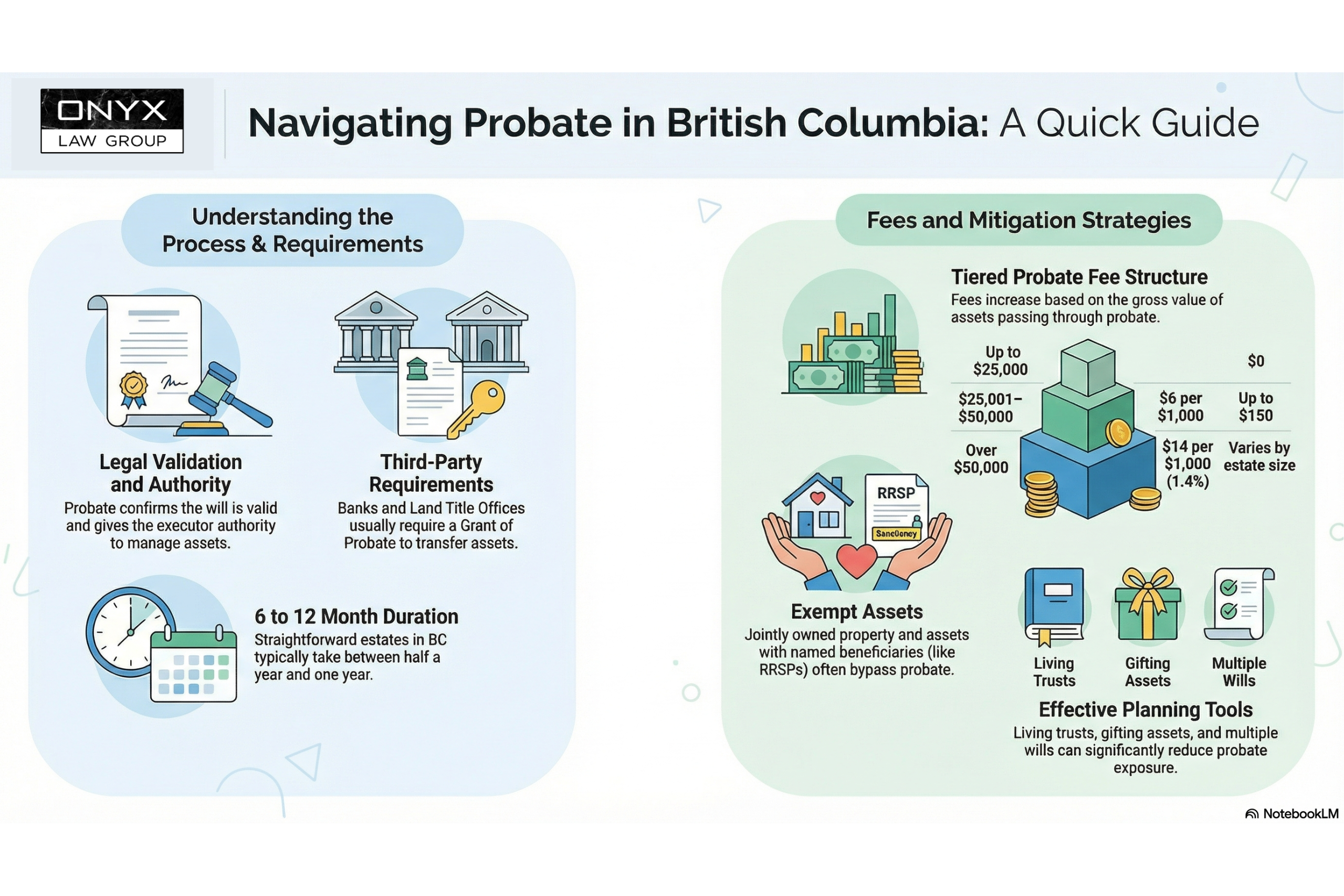
Probate is the legal process used in Canada, including British Columbia, to formally settle the estate of a deceased person. It involves a court application made by the executor to confirm that the will is valid and legally binding. This step is necessary because it allows the court to review the will and verify that it reflects the deceased person’s true intentions.
When probate is required, the court issues a Grant of Probate. This document confirms that the executor named in the will has legal authority to act on behalf of the estate. With this authority, the executor can collect assets, sell or transfer property, close bank accounts, and proceed with transferring assets in accordance with the will.
Probate also serves an important protective role. It helps ensure assets are distributed properly, reduces the risk of fraud or disputes, and provides a clear process for creditors to make valid claims against the estate. By overseeing the process, the court protects both beneficiaries and creditors while ensuring the estate is handled lawfully and fairly.
Common Reasons a Will Must Go Through Probate

A will often must go through probate when key assets were owned solely in the deceased person’s name. This includes real estate, bank accounts, investments, and vehicles with no joint owner or named beneficiary. Probate creates a legal pathway to transfer these assets properly, especially when designating beneficiaries was not done in advance.
Another common reason is that financial institutions and government bodies require formal proof of authority. Banks, land title offices, and tax authorities usually will not release or transfer assets without a court-issued Grant of Probate. This document confirms that the will is valid and that the executor has legal authority to act.
Probate also serves important legal and protective functions. It helps prevent fraud, confirms the executor’s role, and reduces the risk of disputes among heirs. Joint ownership or beneficiary designations may avoid probate in some cases, but many estates still require it to ensure lawful handling.
Legal Verification and Executor Authority
When advising our clients, we often remind them, “Probate removes doubt by formally confirming the executor’s role and authority.”’ Probate provides the legal verification an executor needs to act on behalf of an estate under applicable probate laws. Without probate, third parties may refuse to recognize the executor’s authority. The process confirms that the will is valid and that the named executor is the proper person to manage the estate.
Once a Grant of Probate is issued, the executor has clear legal authority to deal with estate assets. This includes accessing bank accounts, transferring or selling property, and distributing assets to beneficiaries. Probate also helps prevent unauthorized or improper distribution by ensuring only the court-approved executor can act.
How Probate Fees Are Calculated in British Columbia

Probate fees in British Columbia are based on the total value of the deceased person’s estate. The province uses a tiered fee structure, meaning the fee increases as the estate value increases. These fees are paid when the probate application is filed with the court.
The main factor affecting probate fees is the gross value of estate assets that pass through probate. This can include real estate, bank accounts, investments, and other property owned solely by the deceased. Estate complexity can also affect overall costs, especially if legal or accounting help is required.
Probate fees reduce the value of the estate available to beneficiaries. For that reason, many executors and estate planners want to estimate costs early. Online probate fee calculators can provide a quick estimate and help families understand potential expenses before starting the probate process.
Breakdown of Probate Fees by Estate Value
We always tell our clients, “Estimating probate fees early helps families avoid surprises and helps in making informed decisions.” In British Columbia, probate fees are calculated using set value brackets based on the gross value of the estate. The table below shows how fees are typically assessed and how costs increase as estate value rises.
| Estate Value Range | Fee % / Rate | Estimated Fee Amount | Notes |
|---|---|---|---|
| Up to $25,000 | 0% | $0 | No probate fee applies |
| $25,001–$50,000 | $6 per $1,000 | Up to $150 | Fee applies only to amounts over $25,000 |
| Over $50,000 | $14 per $1,000 (1.4%) | Varies by estate size | Applies only to values above $50,000 |
| $500,000 estate (example) | Effective ~1.4% | ~$6,950 | Common planning benchmark |
In general, the cost to obtain a Grant of Probate typically ranges from $3,500 to $7,500 in legal fees, plus disbursements and taxes, which may add $1,000 to $2,000. There are also court fees of $200, plus $40 for each court-certified copy of the Grant of Probate.
How to Minimize Probate Requirements and Costs

There are several ways to reduce probate requirements and costs with proper planning. Joint ownership held as joint tenancy allows assets to pass directly to the surviving owner through a right of survivorship. Naming beneficiaries on assets such as life insurance policies, RRSPs, RRIFs, and TFSAs can also keep those assets out of probate.
Trusts and other estate planning tools may further limit probate exposure. Assets held in a trust are generally not subject to probate because they are not owned by the deceased at death. In some cases, smaller estates may fall below thresholds where probate is required, depending on the type of assets involved and third-party requirements.
Clear and careful will drafting is also essential. A well-written will can reduce delays, confusion, and disputes that increase probate costs. Speaking with an estate planning lawyer helps ensure the plan is legally sound and tailored to your specific goals.
Why Do Wills Go to Probate?
A common misconception is that all wills automatically go through probate. In some cases, an executor can administer the estate without applying for probate, depending on factors such as the total value of the estate, the types of assets involved, and how those assets were owned before death. Smaller estates or assets held jointly or with designated beneficiaries may not require probate at all.
Wills typically go to probate when third parties require proof that the executor has authority to act. This usually happens when dealing with assets like bank accounts, real estate, investments, or vehicles. Institutions such as financial institutions, the Land Title Office, ICBC, and the Canada Revenue Agency require a court-issued Grant of Probate to ensure assets are transferred lawfully. A court-certified grant confirms the executor’s legal authority to manage, transfer, or sell estate property.”
When Does a Will Go Through Probate?
As discussed above, a will goes through probate when a Grant of Probate is required to give the named executor legal authority to deal with estate assets and carry out the wishes outlined in the will. There are other situations where a will must go through probate. For example, wills go through probate in the following situations:
- When there is a dispute as to the validity or authenticity of the will.
- If there is a dispute about who should be the executor.
- If the will is ambiguous or unclear.
- When the fairness of the will is challenged by the deceased’s surviving spouse or children (wills variation claim).
When Does a Will Not Need to Go Through Probate?
There are exemptions for small estates. If the value of an estate is $25,000 or less, a probate application may not be required, depending on the type of assets owned at death. In some cases, assets may be transferred directly to a surviving partner or beneficiary, but items like vehicles, bank accounts, or certain investments may still require probate, even for a small estate.
If probate is required for an estate valued at $25,000 or less, the entire process can be completed without paying probate fees or court fees. In these situations, the court may issue a Grant of Probate at no cost to the estate.
How to Avoid Probate?
There are steps you can take during the estate planning process to organize your affairs and simplify your estate. Doing so can reduce the probate tax burden and may help bypass probate altogether. Probate applies to only assets that form part of your estate when a person dies, meaning assets that pass through a valid will and are assets titled in the deceased’s name alone.
Assets that are not subject to probate are those that pass outside of your will and are often released directly by a financial institution or other third party. These are common examples of assets that avoid probate because they pass outside of a deceased person’s estate:
- Jointly Owned Property: Jointly held property (e.g., real estate) and jointly held assets (e.g., bank accounts) don’t form part of a deceased person’s estate. When one joint owner dies, the property or asset automatically goes to the surviving joint owner. For example, if you and your spouse own your home as joint tenants, the property automatically passes to the surviving spouse without incurring probate or property transfer taxes.
- Assets with a Beneficiary Designation: Assets with named beneficiaries bypass probate entirely. This includes life insurance policies, retirement accounts such as RRSPs and RRIFs, TFSAs, and employer pension plans. These assets are paid directly to the named beneficiary upon death, usually after providing a death certificate to the financial institution.
- Living Trusts: Assets placed into a trust during your lifetime do not form part of your estate. A revocable living trust, alter ego trust, or joint partner trust can hold property for your benefit during your lifetime and for beneficiaries after death. Because the trust owns the assets, probate is not required for property held in the trust.
- Gifting Assets: Property and assets that you give away during your lifetime, called inter vivos gifts, are excluded from your estate and escape probate tax on your death. To be valid, a gift must be properly documented so there is no question about whether you intended to give the property away.
- Multiple Wills: You can prepare and execute multiple wills. One will deals with assets and property that must go through the probate process, and the other will deals with private company shares or certain other types of property. The assets passing through the second will not need to go through the probate process.
What Assets Go Through Probate?
Assets that go through probate generally include property that was owned solely by the deceased or that requires formal legal authority to transfer. Common examples include real estate in British Columbia held in the deceased’s name alone or as a tenant in common, bank and investment accounts, shares, bonds, vehicles, and business interests. Life insurance proceeds are also subject to probate when they are payable to the estate rather than a named beneficiary, as are registered assets like RRSPs, RRIFs, and TFSAs when no beneficiary is appointed or the estate is listed as the beneficiary.
Personal and household items are technically part of the estate and therefore fall under the probate process. This can include everyday items such as furniture, tools, and collectibles. In practice, however, most of these items are usually distributed directly to beneficiaries without requiring specific probate approval, especially when their value is modest and there is no dispute.
That said, certain personal effects may still require probate. Probate fees or taxes may apply to high-value items like jewelry, valuable artwork, or family heirlooms, which are likely to undergo scrutiny. Because these items can raise legal and tax issues, it’s often wise to speak with a probate lawyer to ensure valuable personal property is handled properly and efficiently.
The Probate Process in Canada
According to Veronica Manski, our associate counsel here at Onyx Law Group, “Probate is a process, not a single event, and each step plays a role in protecting the estate and its beneficiaries.” The probate process in Canada begins with the executor locating the original, signed will and preparing it for submission to the court as part of the probate proceedings.
Legal advice is often sought at this stage to confirm whether probate is required and to check the Wills Registry for any later wills. The executor must then gather key information, including beneficiary details and a full inventory of estate assets and liabilities, while also securing estate property and insurance.
Next, the executor is required to formally notify beneficiaries, potential heirs, and creditors in accordance with court rules. A mandatory 21-day waiting period follows the delivery of these notices. Once that period has passed, the executor files the probate application with the court, seeking court approval by submitting the required affidavits, the original will, and the death certificate.
After the court accepts the application and probate fees are paid, the Supreme Court issues the estate grant. This step can take several months. After probate is granted, the executor can administer the estate, pay debts and taxes, manage any trusts created by the will, and eventually distribute assets to beneficiaries.
Need a Probate and Estate Lawyer in BC?
It’s worth your while to do some estate planning now to protect your loved ones in the future. By arranging your affairs properly, you can process your estate without the need for a probate application. A good estate plan can reduce or defer tax consequences your estate must otherwise pay and minimize the impact of probate fees on your estate and your beneficiaries.
Professional advice is the key to a good estate plan. We welcome you to reach out for a free consultation with our experienced family and estate lawyers in BC for more information or to discuss questions concerning probate, estate planning, or an estate administration matter.
Frequently Asked Questions
Probate can seem confusing, but it plays a key role in handling a deceased person’s estate. This FAQ section will help explain why wills go through probate and what the process involves.
Why Does a Will Have to Go Through Probate?
A will goes through probate to legally validate it and give the executor authority to manage the deceased’s estate. Probate ensures that debts are paid, taxes are settled, and assets are distributed properly to the rightful beneficiaries.
How Long Does Probate Take In BC?
In British Columbia, probate typically takes 6 to 12 months for straightforward estates. Complex estates, disputes among heirs, or missing documentation can extend the process to a year or more.
Can Probate Fees Be Waived or Reduced?
In British Columbia, probate fees (Estate Administration Tax) are generally fixed and cannot be waived or reduced. However, small estates or certain transfers may qualify for simplified procedures that avoid full probate and reduce costs.
What Happens if There Is No Will?
If there is no will, the estate is distributed according to intestate succession laws, which dictate who inherits based on family relationships. The court appoints an administrator to manage and distribute the estate according to these rules.
Can Probate Be Contested?
Yes, probate can be contested if someone believes the will is invalid due to fraud, undue influence, or lack of capacity. Interested parties can file a challenge in court to dispute the executor’s authority or the terms of the will.
What Is the Difference Between Intestate and Probate?
If you die without a will, which is known as dying intestate, your estate will be distributed according to the BC estate law. Probate, on the other hand, is the legal process of validating a deceased person’s will and administering their estate according to its terms under the supervision of the court.
Disclaimer: The information provided on this blog is for general informational purposes only and does not constitute legal advice. Reading this content does not create an attorney-client relationship. Laws and regulations vary by jurisdiction and may change over time, so you should consult a qualified Estates and Trust Attorney for advice regarding your specific situation. Past examples, case studies, or hypothetical scenarios are illustrative only and do not guarantee similar results.