


The penalty for stealing from an estate in Canada can include criminal charges for theft, fraud, or breach of trust, with consequences such as fines, restitution, and imprisonment under the Criminal Code. How severe it gets depends on the value of what was taken, the offender’s intent, and whether the person was an executor or otherwise in a position of trust. In serious cases, courts can impose jail time, remove the offender from their role in the estate, and order repayment to the beneficiaries.
Worried about the penalties for stealing from an estate in Canada? Onyx Law Group has been serving clients since 2012 and offers experienced legal counsel in estate and trust matters, helping you understand potential consequences and protect your rights. Veronica Manski leads the probate and estate administration team, and we guide you through complex probate and criminal processes, ensuring your case is handled strategically and professionally. If you think an executor is taking from an estate you have an interest in, contact us today for a consultation and get the expert support you need to navigate these challenging legal issues.
This blog explains what stealing from an estate in Canada means, the laws that apply, and the potential penalties and legal processes involved.
What Is the Penalty for Stealing From an Estate in Canada?

Fraud is not a rare concern in British Columbia. Statistics Canada recorded 25,910 police-reported fraud incidents in BC in 2024, equal to a rate of 437.8 incidents per 100,000 people. That figure covers fraud generally and does not track estate theft on its own, but it is a fair reason to take unexplained estate transactions seriously.
Stealing from an estate in Canada refers to unlawfully taking, withholding, or misusing estate funds or other estate property that belongs to a deceased person, often through fraudulent means or false pretences. An estate is everything left behind after death: property, money, and assets, distributed according to a will or, where there is no will, through the rules that apply to intestacy.
Theft can come from executor misconduct, where the executor helps themselves to estate assets. It can also come from a beneficiary, a personal representative, or a third party who takes estate property for personal use, alters records, conceals assets, or diverts funds intended for rightful beneficiaries, thereby breaching their fiduciary duty to act in a trustworthy manner as an executor.
Under Canadian law, stealing from an estate falls mainly under the Criminal Code and may be prosecuted as an indictable offence, particularly where the value is significant or the offender held a position of trust. The charges tend to be theft, fraud, or breach of trust. A person found guilty may be ordered to pay restitution, fined, or sent to jail.
Where large sums or an abuse of fiduciary authority are involved, the sentence can run to a lengthy prison term, up to fourteen years, depending on the offence charged and the amount at stake.
Criminal penalties are only half of it. The civil consequences can be just as serious: removal as executor, repayment of what was taken, loss of executor compensation, or being barred from benefiting under the will.
Those remedies exist to reinforce a strict duty. Executors and personal representatives have to manage estates honestly, openly, and in the beneficiaries’ best interests, and courts watch fiduciary conduct closely once a dispute starts.
How Is the Penalty Determined for Stealing From an Estate in Canada?

Courts weigh several factors when deciding how serious the offence is. The value of the property or money taken is one of the biggest. Higher-value thefts draw harsher penalties.
Courts also closely review the offender’s conduct, including suspicious financial transactions, misuse of estate bank accounts, failure to provide a full accounting, or the absence of proper records, as executors and fiduciaries are legally required to maintain transparency. Criminal intent is also assessed, particularly where the conduct involved deception, concealment, or other fraudulent means, along with any aggravating or mitigating factors that may increase or reduce the sentence.
The offender’s relationship to the deceased is another key factor, particularly where the person was an executor or was otherwise trusted to manage the estate. That relationship raises the odds of being held liable for losses caused by a breach of trust.
A prior criminal record may also lead to harsher consequences, while first-time offences, cooperation with authorities, or efforts to repay stolen assets may reduce penalties. In some cases, two years may be relevant to the applicable limitation period, depending on the nature of the civil claim and the circumstances. By weighing these elements together, Canadian courts aim to impose penalties that are proportionate, fair, and reflective of the harm caused to the estate and its beneficiaries.
Common Examples of Estate Theft and Misappropriation
Estate theft often involves stolen funds or property taken under false pretences, such as claiming money is needed to pay debts. Misappropriation can range from a few hundred to thousands of dollars and sometimes occurs during the probate process without proper oversight. Family members or executors may misuse estate assets, fail to provide a formal accounting, or misrepresent the subject matter of a testamentary instrument.
Other examples include unauthorized sales of estate property or improper use of bank accounts. Such actions can lead to even criminal charges, especially when fiduciaries violate their legally required duties, leaving heirs deprived of their rightful inheritance.
How Can Beneficiaries Prove Estate Theft?
Beneficiaries can prove estate theft by carefully documenting any financial loss suffered as a result of misappropriation. The evidence might be missing assets, unauthorized transfers of securities, or gaps in the executor’s year-end accounting.
Amounts that sound modest still matter, and the $5,000 mark carries particular weight because it is the line the Criminal Code draws between theft over and theft under. Beneficiaries should speak to estate lawyers about exactly what paperwork and proof they need to show that money or property was mishandled.
You can also establish theft by showing the executor failed to distribute money according to the will or made transactions without proper authority. Bank statements, receipts, and witness testimony all help build the case. Courts weigh that evidence closely to decide whether fiduciary duties were breached and whether the missing assets have to be returned.
What Are the Legal Processes Involved in a Case of Stealing From an Estate?

When someone is accused of stealing from an estate in Canada, the matter may involve both estate law and criminal law processes. The legal process typically begins once suspicious activity is identified during estate administration, and what happens next can include an investigation, court proceedings, and a final verdict.
Step 1. Discovery of Theft
The process often starts when irregularities are discovered during the administration of the estate. These can include missing funds, altered records, or unexplained transfers identified by beneficiaries or during probate court proceedings.
Step 2. Reporting to the Police
If theft is suspected, the matter may be reported to the police, especially when there is evidence of fraud or misuse of estate assets. This step can trigger potential criminal charges in addition to civil remedies.
Step 3. Investigation
Law enforcement investigates the allegations by reviewing financial records, wills, probate documents, and witness statements to determine whether a criminal offence has occurred. They may also examine bank accounts, estate transactions, and any irregularities in the executor’s handling of assets to build a comprehensive case.
Step 4. Charges
If sufficient evidence exists, formal criminal charges may be laid against the accused, such as theft, fraud, or breach of trust, depending on the circumstances. The case may then proceed to court, where the accused can be tried, and if found guilty, face penalties including fines, restitution, or imprisonment.
Step 5. Court Proceedings
The case then moves to court, where pre-trial motions, disclosure, and a trial may take place. Both sides present evidence and arguments before a judge or jury.
Step 6. Verdict
The process concludes with a verdict, where the court determines guilt or innocence. If convicted, penalties may include fines, restitution, or imprisonment, along with possible civil consequences related to the estate.
Should You Pursue Criminal Charges or Civil Remedies for Estate Theft?
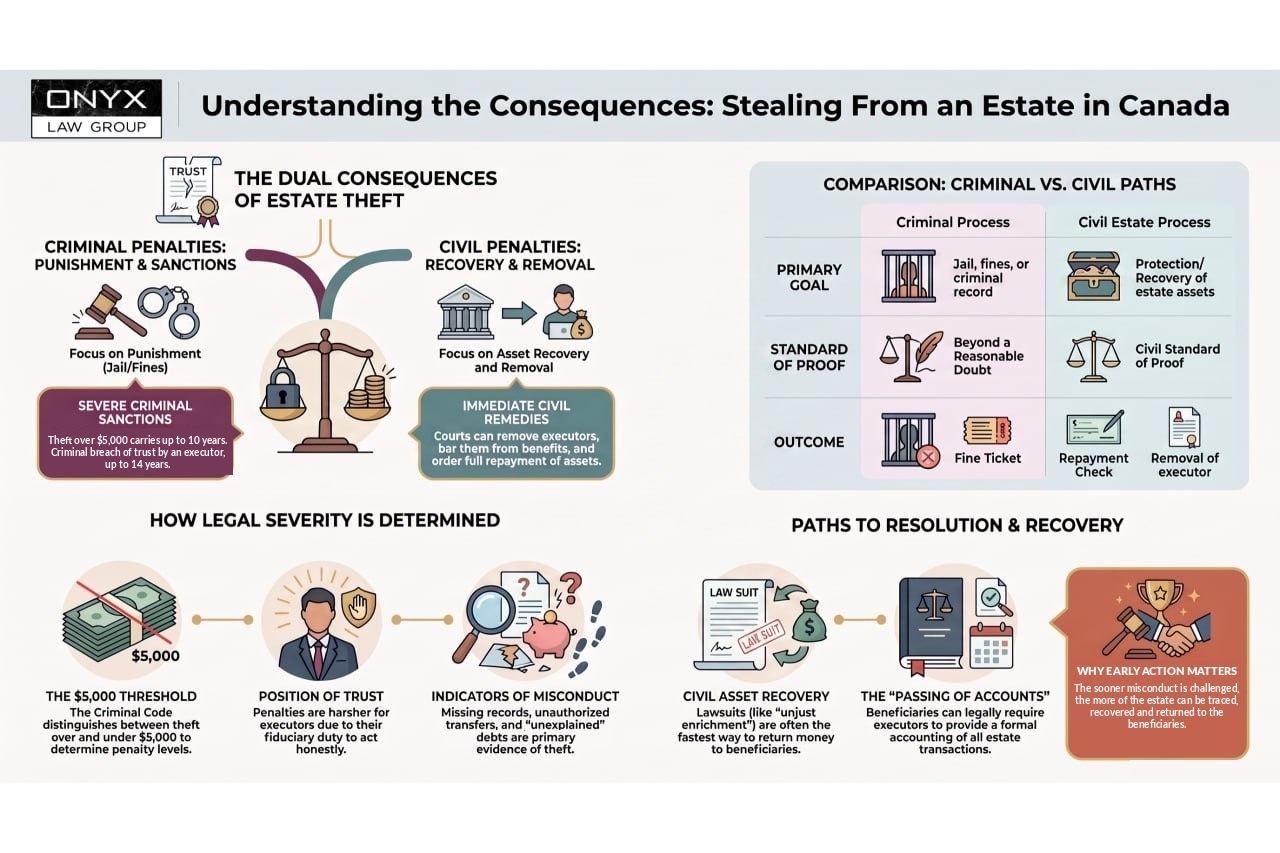
When estate money or property goes missing, you may have more than one legal option. Criminal proceedings focus on whether an offence such as theft or fraud occurred, while civil estate proceedings focus on recovering assets and addressing misconduct. The key differences between these two approaches are outlined in the table below.
|
Criminal process |
Civil estate process |
|---|---|
|
Focuses on whether a criminal offence was committed. |
Focuses on protecting the estate and recovering assets. |
|
May involve charges such as theft or fraud. |
May involve an application concerning an executor’s conduct, accounting, or recovery of estate property. |
|
The Crown must prove the offence beyond a reasonable doubt. |
The applicable civil proceeding uses the civil standard of proof. |
|
A conviction can result in imprisonment or other criminal penalties. |
The court may order remedies such as repayment, accounting, costs, or other appropriate relief. |
|
The process is generally handled by law enforcement and Crown counsel. |
Beneficiaries or other interested parties may bring or participate in estate proceedings. |
|
A criminal conviction is not required before a beneficiary can pursue appropriate civil remedies. |
Civil proceedings can address estate losses and other wrongdoing even when criminal charges are not pursued. |
In British Columbia, a personal representative has legal duties to administer and distribute the estate and to account to beneficiaries and others who are entitled to an accounting. Under WESA s. 158, a person with an interest in the estate can also apply to have a personal representative removed or passed over in certain circumstances.
There is also a formal process for reviewing estate accounts. Under the BC Trustee Act, beneficiaries can require an executor, administrator, or trustee to pass accounts in certain circumstances, and the court has the power to give directions where accounts are incomplete or inaccurate.
The important point is that these options are not necessarily an either-or choice. If you suspect estate theft, getting legal advice early can help you understand whether the facts support a criminal complaint, a civil estate proceeding, or both.
How Can One Protect Themselves From Accusations of Stealing From an Estate?
Protecting yourself from accusations of stealing from an estate starts with acting transparently and responsibly, especially if you are an executor or involved in estate administration. Always act in the best interest of the beneficiaries, avoid using estate funds for personal expenses, and keep detailed records while following the terms of the will and probate requirements. Clear communication with beneficiaries can also help prevent misunderstandings that may lead to allegations.
If accusations arise or you are handling complex cases, it is important to seek legal advice from an experienced estate lawyer. Professional guidance can help ensure you comply with your legal duties, protect your rights, and take appropriate steps, including legal action if necessary, to address claims promptly and reduce the risk of serious consequences.
What Is the Importance of Professional Legal Representation in Cases of Estate Theft?
Professional legal representation can make a significant difference when estate assets are suspected of being stolen or misappropriated. An estate lawyer can review the will, estate records, financial transactions, and other evidence to determine what happened and explain the legal options available. This can be especially important when family members disagree about how assets were handled or when there is a risk that estate property could be lost before the dispute is resolved.
For example, suppose a beneficiary discovers that a sibling acting as executor transferred money from the estate account to a personal account without a clear explanation. The beneficiary may not know whether the transfer was authorized or what steps can be taken to recover the money. After contacting Onyx Law Group, the beneficiary could have the estate records and relevant transactions reviewed, with the lawyer assessing the available evidence and advising on the appropriate legal steps. Where the evidence supports a claim, legal action may help seek the return of misappropriated estate assets or other available remedies.
In this type of situation, getting legal advice early can help protect the estate and prevent the dispute from becoming more difficult to resolve. An estate lawyer can also handle negotiations, correspondence, court proceedings, or a civil claim when necessary, rather than leaving the beneficiary to manage the dispute alone. In the example above, the matter was resolved favourably after the legal team helped establish that the disputed transfer was not properly authorized and assisted in recovering the estate funds.
Facing Estate Theft Charges?
Stealing from an estate in Canada is a serious offence with potential criminal charges for theft, fraud, or breach of trust. Penalties can include fines, restitution, and imprisonment, depending on the value of stolen assets, intent, and the offender’s relationship to the deceased. Executors, beneficiaries, or others entrusted with estate assets have heightened responsibilities, and breaches are treated seriously under both criminal and civil law.
Estate theft accusations and disputes can be intricate, encompassing both probate and criminal court procedures. Consulting an experienced estate lawyer is essential to protect your rights, ensure compliance with legal obligations, and develop an effective defence or recovery strategy. A lawyer can guide you through every step, from understanding potential penalties to representing your interests in court, helping to minimize risk and secure the best possible outcome.
Worried about the consequences of stealing from an estate in Canada? When an executor helps themselves to estate assets, the money usually comes back through a civil court application rather than a criminal charge, which is the route Onyx Law Group took in Sangha v. Sangha to win a $400,000 unjust enrichment judgment for the estate. Our experienced estate lawyers in Canada handle every step, from understanding the law to defending against accusations or recovering assets. Contact us today for a consultation and secure the professional support you need.
Frequently Asked Questions
The following FAQs address common questions regarding the penalties for stealing from an estate in Canada and the associated legal consequences. These answers are designed to help you understand potential criminal charges, penalties, and what to expect if you find yourself in such a situation.
What Is the Penalty for Stealing From an Estate in Canada?
In Canada, stealing from an estate is considered theft under the Criminal Code, and penalties can include imprisonment for up to 10 years where the value of the property exceeds $5,000, and up to 14 years where the Crown proceeds on criminal breach of trust, the charge that most often fits an executor or trustee. The outcome depends on the value of the property stolen and the circumstances of the case. Courts may also order restitution to compensate the estate for the stolen assets.
Can You Go to Jail for Stealing From an Estate in Canada?
Yes, stealing from an estate in Canada is treated as theft under the Criminal Code, and a person can face jail time if convicted. The length of imprisonment varies based on the severity of the theft and the value of the stolen property.
What Are the Potential Penalties for Stealing From an Estate in Canada?
Stealing from an estate in Canada is considered theft under the Criminal Code, and potential penalties include imprisonment, fines, and restitution to the estate. The severity of the punishment depends on factors such as the value of the stolen property and whether the offense is prosecuted as a summary or indictable offense.
How Can One Effectively Analyze the Costs and Budget for Legal Proceedings Related to Stealing From an Estate in Canada?
To effectively analyze costs and budget for legal proceedings related to stealing from an estate in Canada, begin by estimating legal fees, court costs, and potential expenses for expert witnesses or investigations. Additionally, consider the possibility of fines, restitution, and any ancillary costs, and then compare these expenses against the available funds or insurance coverage to create a realistic budget.
Disclaimer: The information on this page is general legal information about British Columbia law, not legal advice for any specific situation. Reading this page does not create a solicitor-client relationship. BC law changes, and the procedure that applies to a specific situation depends on facts not covered here. For advice on your situation, consult a qualified British Columbia estate lawyer directly. Past results, illustrative scenarios, and reference to typical fact patterns do not guarantee similar outcomes in any specific case.