


Dealing with greedy siblings after a parent’s death can be stressful and emotionally draining. Start by reviewing the will, trust, and estate records to understand each sibling’s legal rights. If a sibling is trying to take more than they are entitled to, an estate lawyer can help protect your inheritance and resolve the dispute.
These fights are rarely about money alone, which is why they so often outlast the estate itself. Jackson Todd practices estates and trusts litigation at Onyx Law Group, was called to the British Columbia bar in 2014, and was co-counsel in Grewal v. Litt, the case in which four daughters left seven per cent of a $9 million estate had their share varied to sixty. He acts for people who believe they were disinherited or inadequately provided for, and equally for those defending an estate plan against a challenge. If you find yourself in a dispute with a greedy sibling or other greedy family members, contact an estate lawyer at for legal guidance.
This article will discuss how to handle inheritance disputes with greedy siblings, protect your legal rights, and resolve conflicts over a parent’s estate.
What Are the Roots of Inheritance Dispute Between Siblings?

Estate disputes are likely to become increasingly relevant as Canada’s population ages. In the 2021 Census, 19% of Canadians were 65 or older, representing more than 7 million people.
The roots of inheritance disputes between siblings may extend back to childhood or stem from more recent relationship issues, and several factors can increase the likelihood of such disputes. They include:
Sibling rivalry, jealousy, resentment, grudges, and unresolved past conflicts (real or perceived) among siblings
A parent who encourages competition among siblings or shows favoritism to one child over other children
Estrangement from a parent, brother, or sister
Unequal treatment of siblings in the will or outright disinheritance of a child or children by a parent
Blended families or second marriages involving children and stepchildren
Beneficiaries in dire financial need, or large disparity in financial affairs among siblings
Mental illness or substance abuse issues (drug or alcohol addiction)
Whatever the root cause is, the emotional and financial stakes are high. If not handled well, inheritance disputes between siblings can lead to long-lasting relationship damage.
Common Scenarios Involving Greedy Sibling

Inheritance disputes can take beneficiaries by surprise, especially when siblings disagree about a parent’s wishes or the handling of estate assets. Some disputes begin with long-standing family tensions, while others involve specific conduct that raises legal concerns. Recognizing these warning signs early can help you decide when it may be time to seek legal advice.
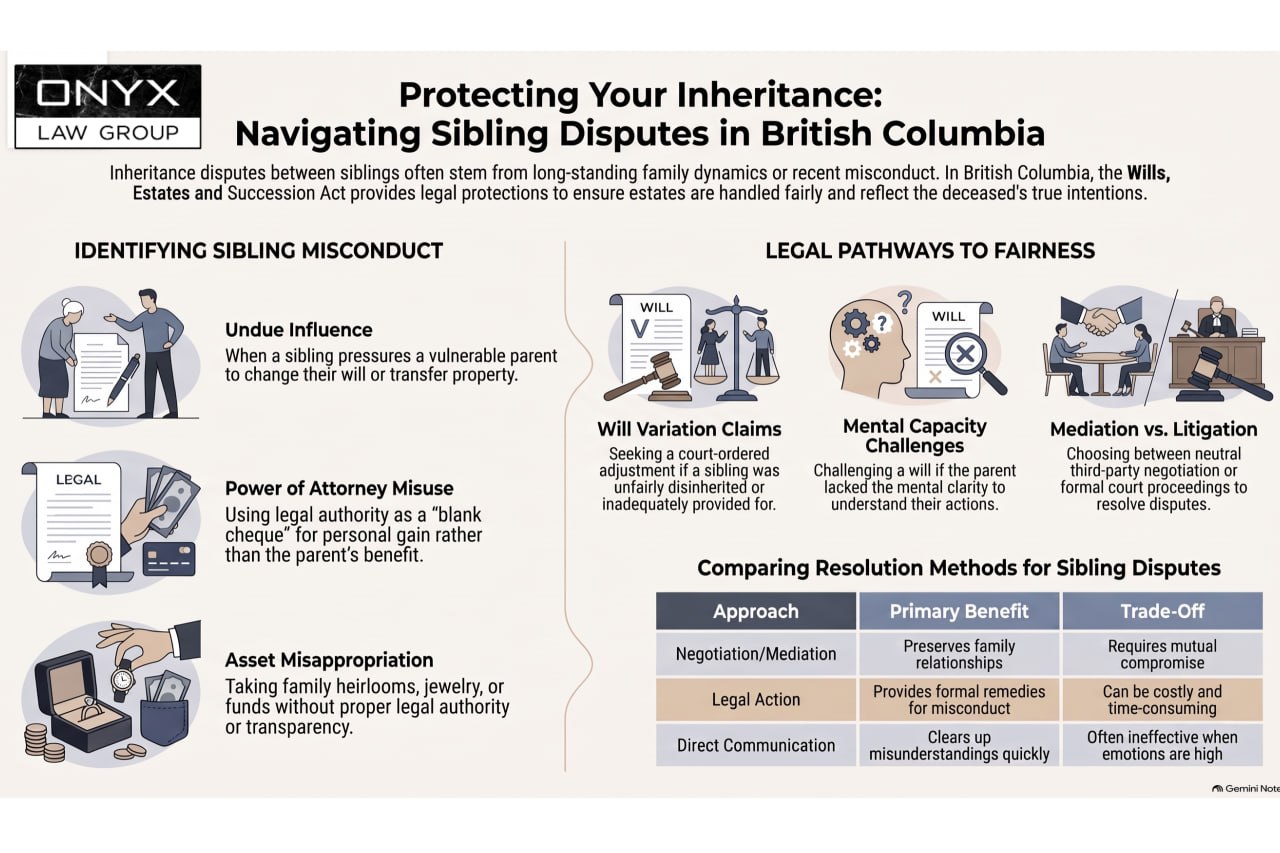
One common concern is undue influence by one sibling. This can arise when a sibling is in a position of dependence or domination over an aging or vulnerable parent and uses that position to influence the parent’s will or another estate decision.
For example, a sibling who becomes a parent’s primary caregiver may isolate the parent from other family members or pressure them to change their estate plan, transfer property, or make significant financial gifts. Under B.C.’s Wills, Estates and Succession Act, section 52 addresses claims that a will or provision resulted from undue influence.
A related problem can arise when a sibling is appointed under an enduring Power of Attorney and misuses that authority. According to Louisa Ledesma, a family lawyer at Onyx Law Group, “A power of attorney comes with serious responsibilities, not a blank cheque.”
In B.C., an attorney must act honestly and in good faith, stay within the authority granted, and act in the adult’s best interests when managing their financial affairs. Misusing that authority could include taking funds for personal use or transferring the parent’s property for the attorney’s benefit rather than the parent’s interests.
Another serious concern is misappropriation of a parent’s or estate’s assets. A sibling may take money, jewellery, artwork, family heirlooms, or other property without proper authority, either before or after the parent’s death. If the sibling is also acting as the estate’s personal representative, concerns can arise if estate property is used for their own benefit rather than administered according to their legal duties. When these issues arise, the appropriate response will depend on the evidence, the estate documents, and the specific legal rights involved.
Case Study for Greedy Siblings
One specific case of inheritance disputes is the Grewal v. Litt case. In this case, the court dealt with an inheritance that was not distributed equally among siblings. The parents left a larger portion of their estate to their sons, based on their cultural values, which traditionally favored sons over daughters.
However, the case was revisited, and the court decided to increase the daughters’ share of the inheritance, considering factors such as the daughters’ contributions to the care of their parents in their later years and the lifetime gifts and benefits received by the sons. This case highlights how courts can intervene in inheritance disputes to ensure fairness.
What Are Strategies to Manage Family Conflict Over Inheritance of Property?

There are ways to manage conflict with greedy siblings. If there are red flags or warning signs when your parent is still alive, your parent can work with an estate planning lawyer to protect assets, smooth tensions, and ensure their final wishes are clear. There are so many estate planning options. For example, your parent can:
Set up trusts to manage property and prevent assets from depletion by a greedy sibling;
Prepare legal documents evidencing their intention with respect to their estate (e.g., carefully clarifying reasons for unequal treatment of siblings in their will)
Appoint neutral friends or relatives or a professional trustee to act as their Power of Attorney during their life or as executor during the probate process.
If the family conflict over inheritance of property arises after your parents’ death, calm communication and clear boundaries are essential. A frank discussion among siblings about expectations and concerns can go a long way to eliminating confusion, mending hurt feelings, and easing tensions.
Of course, dealing with greedy family members one-on-one may not be possible or preferable. Not everyone is willing or able to act reasonably. In those situations, legal help is strongly recommended. Mason Heller, a family lawyer at Onyx Law Group, always says, “The sooner you understand your options, the more effectively you can decide what to do next.”
An experienced estate lawyer can facilitate constructive conversations among siblings and use negotiation and mediation techniques to resolve inheritance conflicts. Your estate lawyer can also help you understand your inheritance rights and explain the legal remedies available to you should court proceedings be necessary.
Ways to Resolve a Sibling Inheritance Dispute
Inheritance disputes do not always have to end up in court. The right approach depends on the seriousness of the dispute, the evidence available, and whether the siblings are willing to work together. Before deciding how to move forward, it helps to understand what you gain and what you may give up with each option.
| Approach | Potential Benefits | Potential Trade-Offs |
|---|---|---|
| Direct communication | Can clear up misunderstandings quickly and preserve family relationships. | May not work when emotions are high or a sibling is acting unreasonably. |
| Negotiation | Gives siblings more control over the outcome and can avoid a lengthy court process. | Requires both sides to compromise and may not resolve serious misconduct. |
| Mediation | A neutral mediator can help siblings reach a practical agreement while keeping the dispute out of court. | The parties must be willing to participate and agree on a resolution. |
| Legal action | Can provide formal remedies when a sibling misuses estate assets, challenges a will, or breaches their duties. | Litigation can be costly, time-consuming, and harder on family relationships. |
How to Protect Your Inheritance From Siblings

In BC, the distribution of an estate is primarily governed by the Wills, Estates, and Succession Act. This law outlines how assets should be allocated if a valid will is present. It also outlines the procedures to follow if someone dies intestate (without a will).
Most legal systems will respect the right of an individual to decide how their assets should be distributed after death, which is known as testamentary freedom. However, this freedom is not absolute and can be overridden to address fairness concerns.
Adequate provision is also mandated for the deceased’s dependents to prevent financial hardship and potential destitution of the deceased’s spouse, children, or dependent relatives. That being said, inheritance laws also include mechanisms to challenge a will that might have been the result of fraud, coercion, or undue influence. This helps ensure that the distribution of the estate truly reflects the wishes of the deceased.
What Is the Role of a Will in Dealing With Sibling Greed?
A will is crucial, as it directs the distribution of the estate according to the deceased’s wishes. Executors play a vital role in ensuring that the will’s directives are followed, but disputes can arise when the contents of the will are contested or unclear. Inheritance disputes between siblings are a common issue in families, particularly when substantial assets are at stake, so it’s best to write your wills so that your estate can be divided as per your wishes.
Every year, hundreds of thousands of Canadian families face the administration of an estate after a loved one dies. Statistics Canada recorded 326,571 deaths in Canada in 2023. For some families, that process is straightforward. For others, disagreements over the will, estate assets, or a sibling’s conduct can quickly turn into a legal dispute.
Greedy siblings will attempt to dispute a will as soon as the reading of the will is complete. If you notice suspicious behavior or are facing a dispute with your siblings after your parent’s death, reach out to a skilled estate attorney as soon as possible.
The legal remedies open to you will depend on the circumstances and the issue(s) at stake. Here are some potential options to ensure you receive a fair inheritance:
A will or gift made during your parent’s lifetime that was the product of undue influence by a greedy sibling can be challenged and set aside.
A will or gift made by a parent who lacked mental capacity can be challenged and set aside. Medical records are often needed to do so (e.g., medical records indicating that your parent was suffering from dementia or delusions to the extent that they could not understand their actions).
A lawsuit can be brought to have misappropriated property or funds returned to your parent’s estate.
A sibling who is disinherited or treated unfairly can bring a will variation claim to have their parent’s Will altered in their favor.
Court proceedings can be brought to remove a sibling from acting as executor of your parent’s estate (e.g., a sibling stealing from the estate while acting as executor).
What Preventative Measures Can Lead to a Peaceful Inheritance Process?

To foster a peaceful inheritance process, proactive estate planning and transparent communication are key. No one wishes for bitter lawsuits among family members after a loved one’s passing, and thankfully, there are steps parents can take to minimize conflict.
Above, we discussed options for a parent’s estate plan that can reduce conflict and streamline the inheritance process, including establishing trusts, selecting neutral attorneys and estate executors, and clearly documenting intentions/last wishes.
Transparency about their estate plan can also prevent sibling conflict down the road. Parents may want to call a family meeting to explain their estate plan so there are no surprises or confusion after their death. This allows adult children to understand their parents’ wishes, clarify misunderstandings, and make appropriate plans for their own future.
Should you find yourself in a dispute with a greedy sibling after your parent has died, it does not mean it can’t still be a relatively peaceful inheritance process. Be proactive and address issues before they spiral out of control. An experienced estate lawyer can de-escalate conflict and help keep the focus on the legal issues and letter of the law, instead of getting bogged down in personal disputes and animosity.
Get Legal Help to Protect Your Fair Inheritance
Greedy siblings can make a parent’s death that much more painful. The emotional and financial stakes are high. Legal action can place a significant strain on family relationships. There are important time limits for contesting a will in BC, and there are various rules and procedures to follow that make the legal process daunting. Legal guidance is strongly recommended if you find yourself in a dispute with siblings following your parent’s death. Experienced estate litigators can help.
An attorney at Onyx Law Group in BC can help you evaluate your legal rights and options and the strength of the claim, whether it’s your claim or a claim being brought by your sibling(s). Jackson Todd practices estates and trusts litigation and was called to the British Columbia bar in 2014 and was co-counsel in Grewal v. Litt. We can also provide legal guidance on alternative dispute resolution methods to reach a fair and amicable resolution of legal matters while preserving family relationships as much as possible. Contact us today for a free consultation.
Frequently Asked Questions
Inheritance disputes between siblings can create difficult legal and family issues. Here are answers to some of the most common questions about wills, executors, and inheritance disputes in British Columbia.
Can a Will Be Contested by a Sibling Even if It Seems Valid?
Yes, a sibling may challenge a will if there are legal grounds to do so. If a parent dies, concerns about capacity, undue influence, or beneficiary designations may become relevant.
What Are Common Causes of Family Conflict Over Inheritance of Property?
Family conflict can arise from unequal inheritances, disagreements over personal items, or long-standing family dynamics. When a mom, dad, or other parent dies, disputes can become especially difficult when family wealth is involved.
How Can I Protect My Inheritance From Siblings Who Are Trying to Take More Than Their Share?
Review the will and estate records to determine each beneficiary’s fair share. Setting healthy boundaries and working with a probate attorney can help protect your interests without unnecessarily escalating the dispute.
What Does Undue Influence Mean in the Context of Inheritance Disputes?
Undue influence occurs when a person improperly pressures someone to change their will or estate plan. This may be particularly concerning when most people would expect the estate to be divided differently based on the family’s circumstances.
Is It Possible to Remove an Executor Sibling if They Are Mismanaging the Estate?
Yes, a court may remove an executor who seriously breaches their fiduciary duties or mismanages estate property. An independent fiduciary may sometimes be appointed when continued family involvement would put the estate at risk.
How Long Do I Have to Contest a Will in British Columbia?
The deadline depends on the type of claim and the circumstances of the estate. Even if siblings have been separated for two decades, it is important to seek legal advice promptly because limitation periods can apply.
Is It Common for Siblings to Fight Over Inheritance?
Yes, disagreements over money, property, and expectations can create serious family conflict after a parent dies. Most people benefit from trying to stay calm and resolve disputes without damaging relationships unnecessarily.
What to Do When Siblings Steal Your Inheritance
Gather estate records, financial statements, the will, and evidence showing what happened to the assets. If siblings have withheld property or proceeds evenly meant for beneficiaries, a lawyer can help determine the appropriate next step.
Disclaimer: The information on this page is general legal information about British Columbia law, not legal advice for any specific situation. Reading this page does not create a solicitor-client relationship. BC law changes, and the procedure that applies to a specific situation depends on facts not covered here. For advice on your situation, consult a qualified British Columbia estate lawyer directly. Past results, illustrative scenarios, and reference to typical fact patterns do not guarantee similar outcomes in any specific case.