


In Canada, RRSP beneficiary rules determine who receives your RRSP when you die and how the funds are taxed and transferred. Your RRSP can generally pass directly to a named beneficiary rather than through your estate, but the tax treatment depends on who you name, such as a spouse or common-law partner, child, or another beneficiary. Understanding these rules can help you avoid unexpected taxes and ensure your RRSP is distributed according to your wishes.
At Onyx law group, we have a diverse team of lawyers, well-versed in the art of estate litigation and family law. Sandy Minh Abley is a Certified Financial Planner as well as an estate lawyer, which is exactly the overlap registered accounts call for. She has spent more than 15 years in trusts and estates at Onyx Law Group and advises clients in English and Vietnamese. if you’re not sure whether your RRSP designation still matches your will, book a free 30-minute consultation with us today.
This guide explains RRSP beneficiary rules in Canada, including who you can name, tax implications, beneficiary options, and how to keep your designation aligned with your estate plan.
What Is an RRSP?
A Registered Retirement Savings Plan (RRSP) is a Canadian savings and investment account designed primarily to help people save for retirement. Contributions may be deductible from taxable income, and investment income earned within the RRSP is generally not taxed while it remains in the plan.
RRSPs are widely used as part of Canadian retirement planning. The Department of Finance Canada reported that approximately 9.3 million Canadian households had individuals with RRSPs or RRIFs in 2019. The RRSP is commonly used to build retirement savings and may also be used for certain approved purposes, such as the Home Buyers’ Plan or Lifelong Learning Plan, if the eligibility requirements are met.
An RRSP can be opened through a financial institution, and it can later be converted into a registered retirement income fund (RRIF) to provide retirement income, such as a bank, credit union, trust company, or insurance company, and you can contribute when you have available RRSP contribution room. People often contribute during their working years when their income is higher, then withdraw the funds in retirement to provide retirement income when their income and tax rate may be lower.
Withdrawals are generally taxable, so you will generally pay tax when you withdraw funds. An RRSP is best viewed as a way to defer tax while saving and investing for the future rather than as a completely tax-free account.
What Are the Beneficiary Designations of an RRSP in Canada?

Beneficiary designations are an important part of RRSP and estate planning in Canada. An RRSP with a named beneficiary generally passes to the beneficiary directly rather than being distributed under the deceased’s will. This means your estate plan should consider not only your will, but also reviewing all your assets alongside your beneficiary designations can help identify conflicts before they become an issue and also how your RRSP, RRIF, TFSA, life insurance, and other estate assets are legally held.
When designating an RRSP beneficiary, you can generally name an individual, multiple beneficiaries, a charity, or your estate, depending on the plan terms. You may also be able to specify how the RRSP should be divided and name contingent beneficiaries in case your first choice dies before you. It is important to keep beneficiary designations current, particularly after major life events such as marriage, divorce, separation, the birth of a child, or the death of a beneficiary.
Outdated designations can lead to unexpected results. For example, someone who named a parent or sibling as their RRSP beneficiary while single may later marry or have children but forget to update the designation. In that situation, the RRSP may still pass according to the existing beneficiary designation, potentially leaving the surviving spouse or children without the benefit the deceased intended for them. Reviewing RRSP beneficiary designations regularly can help ensure they continue to reflect your wishes and work with your overall estate plan.
What Is the Importance of Designating Beneficiaries for RRSPs?
Designating a beneficiary for an RRSP is an important part of estate planning in British Columbia. A valid beneficiary designation can allow the RRSP proceeds to be paid directly to the named beneficiary rather than becoming part of the estate. This can help avoid the need to administer those RRSP funds through the estate, although the exact treatment depends on the RRSP contract and applicable succession law.
Beneficiary designations can also have significant tax consequences. Generally, the fair market value of an unmatured RRSP at death is included in the deceased person’s income for the year of death. However, special rules can apply when a spouse or common-law partner is the sole beneficiary and the RRSP is transferred directly to an eligible registered plan by the applicable deadline, potentially allowing the proceeds to pass on a tax-deferred basis.
Choosing the right beneficiary also helps ensure your RRSP provides financial support to the people you intend to provide for after your death. You should review your beneficiary designation when your circumstances change, such as after marriage, separation, divorce, the birth of a child, or a change to your estate plan. Because RRSP designations and tax rules can interact with your will and estate, getting legal advice can help ensure your documents work together and reduce the risk of unintended consequences.
What Are the RRSP Beneficiary Rules in Canada?

In Canada, you can name a spouse or common-law partner as the beneficiary of your RRSP. When the requirements are met, the RRSP can generally be transferred to the spouse or partner on a tax-deferred basis. The proceeds may be transferred to their RRSP, RRIF, or used to purchase an eligible annuity without the full value being immediately included in the deceased person’s taxable income.
In some circumstances, a financially dependent child may also be eligible for a transfer to a Registered Disability Savings Plan (RDSP), subject to the applicable requirements. However, when someone other than an eligible spouse or common-law partner receives the RRSP, including non-qualified beneficiaries, the fair market value of the RRSP at death is generally included in the deceased’s income for the year of death. This can create a significant tax liability for the estate, including taxes owed on the RRSP, even though the beneficiary receives the proceeds.
Special tax rules can apply when the beneficiary is a financially dependent child or grandchild. In certain circumstances, the RRSP proceeds may be used to purchase an annuity that provides payments to the dependent child or grandchild over a specified period. These rules can provide more favourable tax treatment, but eligibility depends on the individual’s circumstances and the requirements under the Income Tax Act.
It is important to review your RRSP beneficiary designation regularly and keep it consistent with your overall estate plan. A current designation can help ensure the funds pass to the intended person and reduce the risk of unexpected tax or estate-planning consequences.
Who Should You Name as Your RRSP Beneficiary?
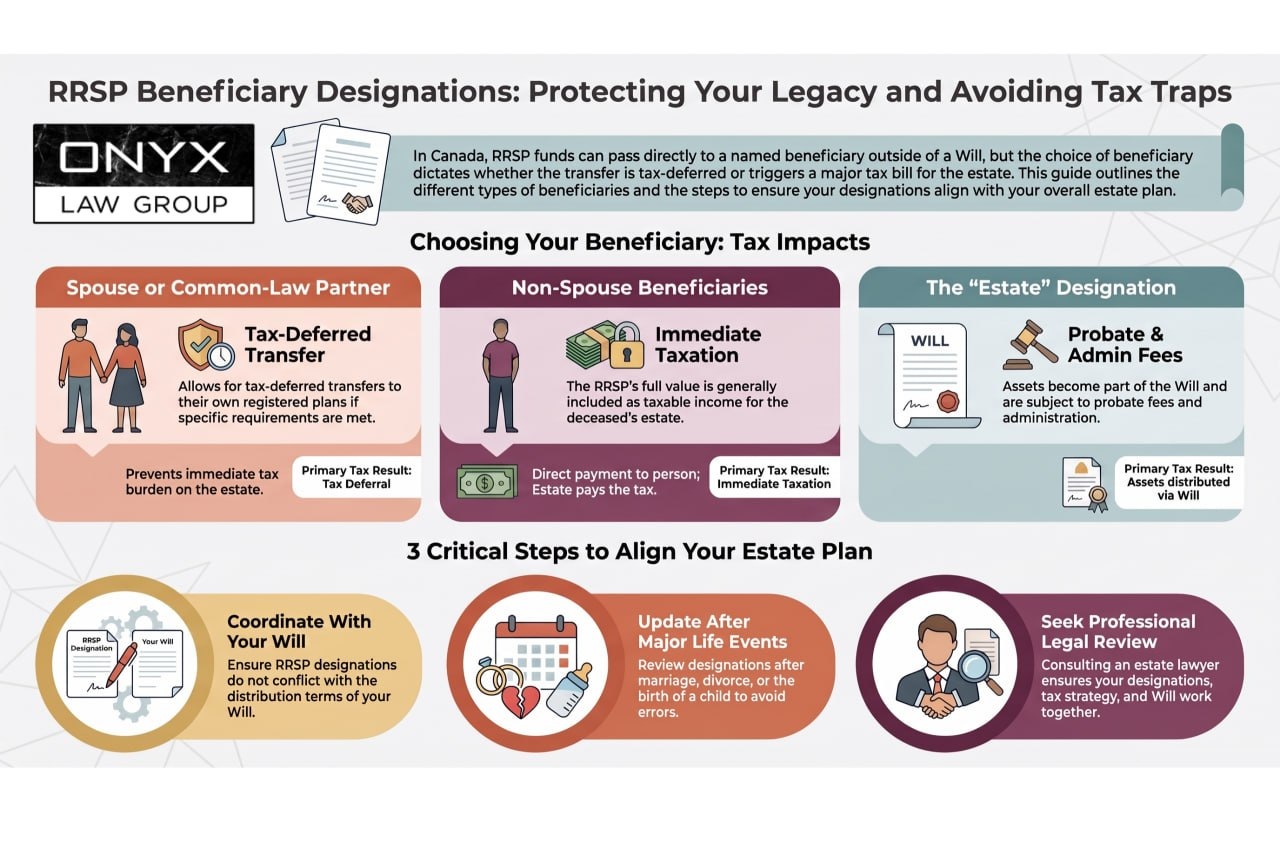
Choosing an RRSP beneficiary is not simply about deciding who receives the money. Different choices can produce different tax and estate-planning consequences. The following table highlights the main trade-offs:
|
Beneficiary |
Main Benefit |
Main Trade-Off |
|---|---|---|
|
Spouse or common-law partner |
May allow the RRSP to pass on a tax-deferred basis if the requirements are met. |
The tax is generally deferred rather than eliminated, and specific CRA requirements must be satisfied. |
|
Child or other individual |
Directly provides the RRSP proceeds to the person you choose. |
The RRSP’s value will generally be included in the deceased’s income for the year of death, which can create a significant tax liability. |
|
Financially dependent child or grandchild |
May qualify for special tax treatment under certain circumstances. |
Strict eligibility requirements apply, including financial dependency. |
|
Estate |
Allows the RRSP to be dealt with as part of the estate and coordinated with the Will. |
The RRSP generally becomes subject to estate administration, and its value may still create a tax liability for the estate. |
How to Choose and Update Your RRSP Beneficiary
Choosing an RRSP beneficiary should be part of your overall estate and financial plan. These steps can help you make an informed choice and avoid problems caused by outdated beneficiary designations.
Step 1: Review Your Current Beneficiary Designation
Check your RRSP documents or contact your financial institution to confirm who is currently named as your beneficiary. Do not assume your will automatically changes the beneficiary designation on your RRSP.
Step 2: Consider Your Family and Financial Circumstances
Think about your spouse or common-law partner, minor children, adult children, dependents, and other people you want to provide for. Major life changes, such as marriage, separation, divorce, or the birth of a child, may mean your existing designation no longer reflects your wishes.
Step 3: Understand the Tax Consequences
Consider how your choice of beneficiary could affect the tax payable when you die. A spouse or common-law partner may qualify for tax-deferred treatment, while other beneficiaries can result in the RRSP’s value being included in your income for the year of death.
Step 4: Decide How the RRSP Should Be Divided
If you want to name multiple beneficiaries, determine how much or what percentage each person should receive. You may also want to name contingent beneficiaries in case your primary beneficiary dies before you.
Step 5: Coordinate the RRSP With Your Will
Make sure your RRSP beneficiary designation works with the rest of your estate plan and does not create unintended consequences. Remember that an RRSP with a valid beneficiary designation may pass outside the estate rather than according to the terms of your will.
Step 6: Update the Designation When Circumstances Change
Submit the appropriate beneficiary designation form through your financial institution when you need to make a change. Review the designation periodically, particularly after major family or financial changes, to ensure it still reflects your wishes.
How Can a Lawyer Help With RRSP in Canada?
A lawyer can help you review your RRSP beneficiary designation, will, and overall estate plan to make sure they work together. This is important because an RRSP with a valid beneficiary designation will generally pass directly to that beneficiary rather than through the estate. A lawyer can also explain potential tax consequences and help you choose a beneficiary structure that reflects your wishes.
For example, you may have named a sibling as your RRSP beneficiary years ago, but your circumstances have since changed after getting married or having children. If you later discover that your RRSP designation does not match your current wishes, an estate lawyer at Onyx Law Group can review the designation, identify potential legal or tax issues, and help you take steps to correct the problem. Where a dispute has already arisen, the lawyer can also advise you on available legal options and work toward a favourable resolution.
At Onyx Law Group, our estate lawyers assist with RRSP beneficiary designations, estate planning, and estate disputes. Sandy Minh Abley is both a certified financial planner and an estate lawyer, with more than 15 years of experience in trusts and estates. If you are unsure whether your RRSP beneficiary designation still reflects your wishes, consulting an estate lawyer can help you avoid costly mistakes and future family disputes.
Vancouver Estate Planner

In the last year or so, two files were worked on where the beneficiary designations were not updated and the spouses and young children suffered significantly from a loss of assets and had to endure an unnecessary tax burden. Finally, they also had unexpected legal costs to try to resolve the issues. In both cases, the spouses had filled in the forms prior to marriage and did not update them with the employers or financial institutions.
As you can imagine, such a situation can cause an enormous amount of stress and family disharmony. In the case of an RRSP or RRIF, the situation is further magnified by the fact that these assets are fully taxable as straight income as of the date of death. However, if the surviving spouse is the named beneficiary, then tax rules allow the spouse to defer the taxes during his or her lifetime. But this tax deferral is lost if the funds are given to anyone else.
In practice, this means when the entire fund is given to another relative, the estate bears the entire tax bill associated with the RRSP, which means even less money is available for the beneficiaries of the will, who may be the surviving spouse and/or children. Essentially, the surviving spouse who did not receive the RRSP/RRIF proceeds now also has to pay for the taxes in respect of it out of the estate.
Need Help With RRSP in Canada?
Beneficiary designations on life insurance policies, RRSPs, segregated funds, and other registered accounts should be reviewed regularly to ensure they reflect your wishes. Errors and outdated forms can create problems later, so checking your designations with your employer or financial institution can help prevent unintended outcomes.
If you are unsure who to name, you may consider naming your estate as the beneficiary and allowing your will to determine how those assets are distributed. However, assets paid to the estate may be subject to probate fees, and the right choice depends on your circumstances. If you are unsure how to structure your beneficiary designations, consulting an estate lawyer can help you understand the options and avoid costly mistakes.
Not sure whether your RRSP beneficiary designation still matches your will? At Onyx Law Group, our lawyers in BC bring extensive experience in estate planning, trusts, and estate litigation, helping clients avoid costly beneficiary mistakes. Sandy Minh Abley is both a certified financial planner and an estate lawyer, with more than 15 years of experience in trusts and estates at Onyx Law Group, and advises clients in English and Vietnamese. Contact us today to review your RRSP designation and make sure your estate plan reflects your wishes.
Frequently Asked Questions
RRSP beneficiary rules in Canada can affect both the deceased’s estate and the person who receives the funds. The Canada Revenue Agency (CRA) applies specific tax rules based on the beneficiary, the RRSP value, and how the registered funds are transferred.
What Happens to RRSP Money When Someone Dies?
Generally, the RRSP value at death is included in the deceased’s income for the tax year and reported on the deceased’s final tax return. However, a qualifying survivor, such as a spouse, common-law partner, or certain financially dependent children or grandchildren, may qualify for tax-deferred treatment.
How Much Tax Do I Pay on a $10,000 RRSP Withdrawal?
The amount of tax you pay depends on your total income, province or territory, and other factors for that tax year. Your RRSP issuer generally withholds tax when you withdraw funds, but your final tax return determines your actual tax obligations.
Can I Name My Child as Beneficiary of My RRSP?
Yes, if you own an RRSP, you can generally name your child as a direct beneficiary through the RRSP issuer. However, different tax outcomes can apply depending on whether the child is a qualified beneficiary, including whether a financially dependent child qualifies for a rollover or an RDSP transfer.
What Is the 3-Year Rule for RRSP?
There is no general three-year rule requiring all RRSP funds to be transferred within three years after the RRSP holder’s death. Certain qualifying transfers have specific deadlines, including transfers that may be completed in the year the refund of premiums is received or within 60 days after the end of that year.
Disclaimer: The information on this page is general legal information about British Columbia law, not legal advice for any specific situation. Reading this page does not create a solicitor-client relationship. BC law changes, and the procedure that applies to a specific situation depends on facts not covered here. For advice on your situation, consult a qualified British Columbia estate lawyer directly. Past results, illustrative scenarios, and reference to typical fact patterns do not guarantee similar outcomes in any specific case.