


When a person dies, their finances become part of their estate and are handled through the estate administration process. Bank accounts, debts, taxes, and assets are managed according to the deceased’s will or, if there is no will, the applicable inheritance laws. Understanding what happens to a person’s finances when they die can help families navigate the process, protect estate assets, and avoid unnecessary delays.
At Onyx Law Group, we’ve spent more than ten years helping Vancouver families sort out what happens to a person’s money, property, and debts after they die. Our estate litigation is led by Candace Cho, KC, appointed King’s Counsel in 2025, while Veronica Manski runs our probate and estate administration work, focusing solely on estates and trusts. That depth shows in results like a $400,000 judgment for the estate in Sangha v. Sangha and the landmark wills-variation case Grewal v. Litt (2019 BCSC 1154). If you are sorting out a loved one’s finances in BC, book a free 30-minute consultation with us to learn where the estate stands and what to do next.
In this blog, we’ll guide you through the process that occurs when a person dies, including how debts and taxes are handled, and how assets and benefits are distributed.
What Happens to a Person’s Debts When They Die in Canada?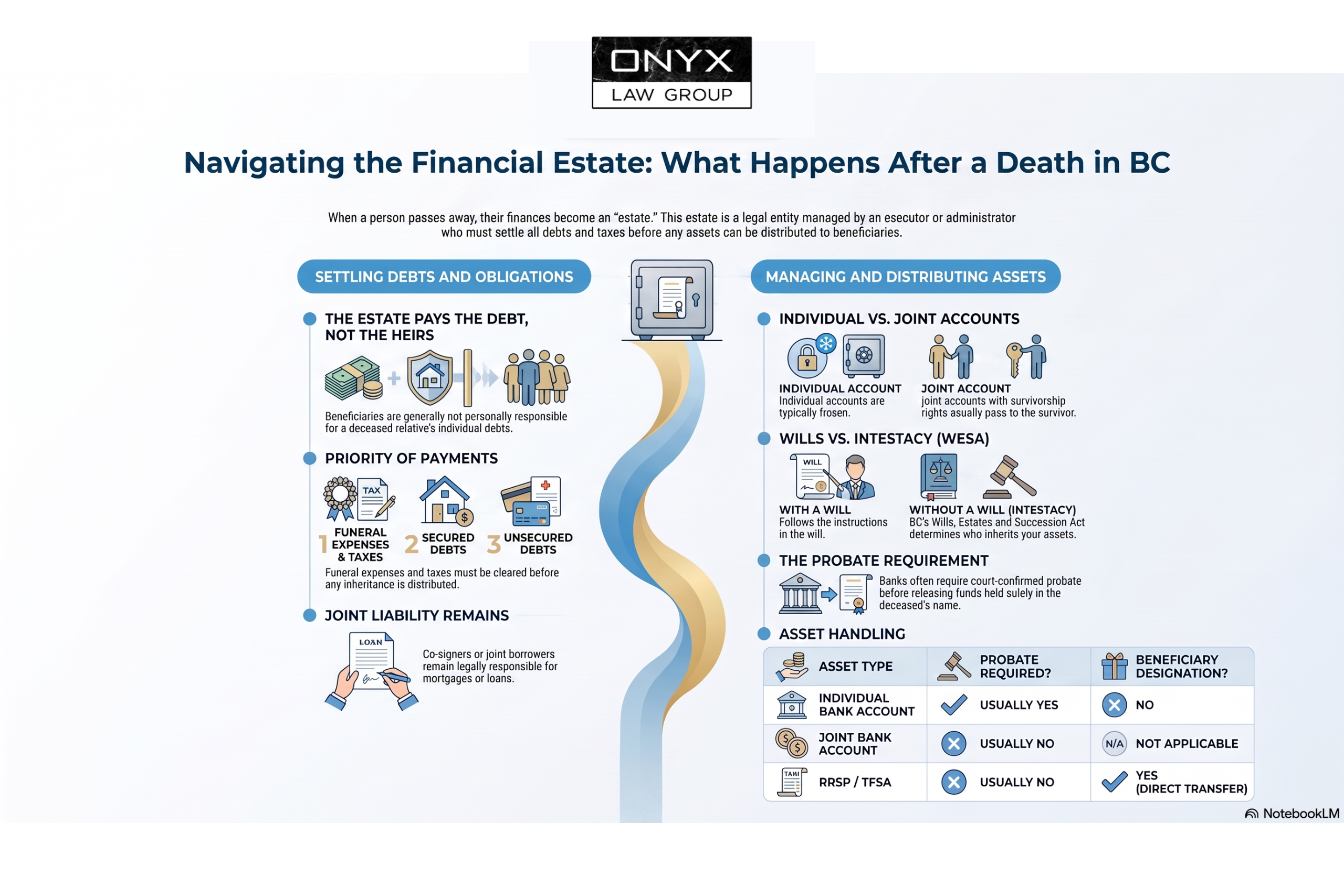
A person’s debts do not disappear when they die. Instead, they become the responsibility of the deceased’s estate, which is administered by the executor named in the will or, if there is no will, by a court-appointed estate administrator. Before any beneficiaries receive an inheritance, the estate must pay all valid debts, taxes, and estate administration expenses using the deceased’s available assets.
Common debts that may need to be repaid include credit card balances, mortgages, home equity lines of credit, personal loans, vehicle loans, and unpaid income taxes. Secured debts, such as mortgages or car loans, are tied to specific assets, meaning the lender may repossess or require the asset to be sold if payments cannot continue. Unsecured debts, such as credit cards or personal loans, are generally paid only if sufficient funds remain in the estate after higher-priority obligations have been satisfied.
If the estate does not have enough assets to pay every debt, it is considered insolvent. In most cases, beneficiaries are not personally responsible for the deceased’s unpaid debts simply because they inherit from the estate.
However, anyone who co-signed a loan, jointly borrowed money, or guaranteed a debt remains legally responsible for that obligation. Similarly, a surviving joint borrower on a mortgage or line of credit must continue making payments regardless of the estate’s financial position.
While the overall principles are similar across Canada, estate administration is governed by provincial law. In British Columbia, the executor or administrator must identify estate assets, notify creditors where appropriate, and pay debts in the legal order of priority before distributing any inheritance. The Wills, Estates and Succession Act (WESA) and other provincial laws govern how estates are administered, particularly when there is no valid will or the estate cannot satisfy all outstanding obligations.
What Happens to Bank Accounts and Investments After Death in Canada?

What happens to a person’s bank accounts and investments after death depends on how those assets are owned and whether a beneficiary has been designated. Individual bank accounts are generally frozen once the financial institution is notified of the account holder’s death. The funds remain inaccessible until the executor or estate administrator provides the required documents, which may include a death certificate, proof of authority, and, where necessary, a grant of probate.
Joint bank accounts with a right of survivorship are usually treated differently. The surviving account holder can often continue accessing their own money without waiting for the estate administration process, provided the account truly includes a right of survivorship.
In most cases, ownership transfers directly to the surviving account holder without becoming part of the deceased’s estate, allowing continued access to the funds. However, the legal treatment of jointly owned accounts can vary depending on the circumstances, including the account holders’ intentions and the province’s laws, so not every joint account automatically avoids estate administration.
Probate often plays an important role when accessing assets held solely in the deceased’s name. Financial institutions may require probate before releasing money from individual accounts or transferring investments, particularly if the account balance is substantial or there is uncertainty about the executor’s authority. Registered accounts, such as RRSPs and TFSAs, may be handled differently if a spouse or another designated beneficiary has been named, as these assets can often pass directly to that beneficiary outside the estate, although tax consequences may still apply depending on the type of account and the beneficiary.
Unlike the United States, Canada does not provide a “step-up in basis” for inherited assets. Instead, Canadian tax rules generally treat a person’s assets as having been disposed of at fair market value immediately before death, which may trigger capital gains tax on the deceased’s final tax return.
If someone dies without a valid will in British Columbia, the distribution of bank accounts and investments held solely in their name is governed by the province’s intestacy rules under the Wills, Estates and Succession Act (WESA). An administrator must first be appointed to manage the estate before financial institutions can release funds. After debts, taxes, and estate expenses have been paid, the remaining assets are distributed according to BC’s statutory succession rules rather than the deceased’s personal wishes.
| Asset Type | What Happens After Death? | Probate Required? | Can a Beneficiary Be Named? | Special Considerations |
|---|---|---|---|---|
| Individual Bank Account | The account is typically frozen once the bank is notified of the death. Funds are released to the executor or estate administrator after the required legal documents are provided. | Usually Yes | No | If the deceased died without a will, an estate administrator must be appointed before funds can be accessed in BC. |
| Joint Bank Account (with Right of Survivorship) | Ownership generally passes directly to the surviving account holder without becoming part of the estate. | Usually No | Not Applicable | The right of survivorship must apply. In some situations, ownership may be disputed, particularly if the account was intended for convenience rather than as a true joint asset. |
| RRSP (Registered Retirement Savings Plan) | If a qualified beneficiary (such as a spouse or common-law partner) is designated, the RRSP can transfer directly to them. Otherwise, its value generally becomes part of the estate. | Usually No (if a beneficiary is designated) | Yes | RRSPs may trigger income tax on the deceased’s final tax return unless a tax-deferred rollover is available. |
| TFSA (Tax-Free Savings Account) | A designated beneficiary or successor holder may receive the TFSA directly without it passing through the estate. | Usually No (if a beneficiary is designated) | Yes | A spouse named as a successor holder can generally continue the TFSA while preserving its tax-free status. |
| Non-Registered Investments (Stocks, Bonds, Mutual Funds) | Investments held solely in the deceased’s name generally become part of the estate and are distributed according to the will or provincial intestacy laws. | Often Yes | Sometimes | The estate may owe capital gains tax based on the deemed disposition of the investments at death. |
| Real Estate | Property is transferred according to the will or intestacy rules after debts, taxes, and estate administration requirements are addressed. | Often Yes | Depends | Jointly owned property with right of survivorship may pass directly to the surviving owner, while solely owned property typically forms part of the estate. |
How Does Probate Affect the Distribution of Finances After Death in British Columbia?

Probate is the legal process through which the Supreme Court of British Columbia confirms that a deceased person’s will is valid and gives the executor the authority to administer the estate. Probate is commonly required when the deceased owned assets solely in their name, such as bank accounts, brokerage accounts, other investments, or real estate, and financial institutions or land title authorities require proof that the executor has the legal authority to act. However, some assets, such as jointly owned property with a right of survivorship or accounts with designated beneficiaries, may pass outside the estate and not require probate.
Once probate is granted, the executor can collect and safeguard the estate’s assets, pay outstanding debts, taxes, and administration expenses, and then distribute the remaining assets to the beneficiaries according to the will. Before applying for probate, the executor must locate the original will, identify the estate’s assets and liabilities, notify beneficiaries, and prepare the required court documents. Although every estate is different, the probate process in British Columbia commonly takes several months, and more complex estates or disputes can extend the timeline significantly.
Probate timelines vary depending on the court, the complexity of the estate, and whether the probate application is complete when submitted. Unlike some other jurisdictions, such as England and Wales, British Columbia does not have a standard timeline like 15 weeks for probate applications submitted by post, and processing times vary from case to case.
Probate also affects the value of the estate because BC charges probate fees based on the estate’s value. These fees, along with legal costs and other estate administration expenses, are paid from the estate before beneficiaries receive their inheritance. While probate cannot always be avoided, thoughtful estate planning may help reduce delays, simplify the transfer of certain assets, and, in some situations, reduce probate fees or other estate administration costs through a reduced fee structure where permitted.
What Happens to a Person’s Finances When They Die Without a Will in BC?
When a person dies without a valid will in British Columbia, they are considered to have died intestate. Instead of following the deceased’s wishes, their finances and assets are distributed according to the Wills, Estates and Succession Act (WESA). The law determines who inherits the estate, with spouses, children, and other close relatives receiving priority based on the statutory order of succession. Before any inheritance is distributed, however, the estate must first pay outstanding debts, taxes, and estate administration expenses.
Because there is no executor named in a will, the court appoints an estate administrator to manage the estate. The administrator performs many of the same duties as an executor, including locating assets, collecting funds from bank accounts and investments, paying creditors, filing the deceased’s final tax return, and distributing the remaining assets to the legal beneficiaries. Since there are no written instructions from the deceased, every decision must comply with BC’s intestacy laws rather than personal preferences.
Dying without a will often makes estate administration more time-consuming and expensive. The court appointment process, additional legal requirements, and the need to identify heirs under BC law can delay access to bank accounts and other assets. It may also increase the likelihood of family disputes, particularly in blended families or where relatives have different expectations about who should inherit, making a valid will one of the most effective ways to simplify the transfer of finances after death.
Who Inherits a Deceased Person’s Assets?
When a person dies, their assets, such as property, savings, investments, and personal belongings, must be transferred to new owners. How those assets are distributed depends largely on whether the deceased left a valid will, had trusts or other arrangements in place, or died without a will (intestate). Understanding these scenarios helps families know what to expect during the estate settlement process.
What Happens to Assets When Someone Leaves a Will?
When someone leaves a valid will, their assets are distributed according to the instructions outlined in that document. The will may specify who inherits specific property, how investments should be divided, or who receives sentimental belongings. It can also set conditions, such as requiring a beneficiary to reach a certain age before receiving an inheritance.
The executor named in the will is responsible for carrying out these wishes. This includes gathering all assets, filing necessary legal and tax paperwork, and ensuring debts and expenses are paid before distributions are made. The executor essentially acts as the estate’s manager, ensuring the process is handled correctly and in accordance with the deceased’s instructions.
Beneficiaries ultimately receive the remaining assets after all obligations have been fulfilled. These may include real estate, bank accounts, retirement funds, or personal possessions. Because the will provides clear direction, the distribution process is usually more straightforward than it would be if the person had died without one.
How Trusts and Special Arrangements Affect Asset Distribution
Trusts are another way assets can be passed on, and they often bypass the probate process entirely. Assets placed in a trust are managed according to the terms set by the person who created it (the settlor or grantor). This allows for direct transfers to beneficiaries without the delays and costs of probate.
Trusts can also include special instructions for distribution, such as staged inheritances or funds earmarked for the care of minors or dependents with disabilities. In some cases, trusts may shield assets from creditor claims and ease the burden of debt repayment, helping reduce taxes and financial stress for beneficiaries, which makes them a valuable estate planning tool.
Beyond trusts, there may be other special arrangements that affect inheritance. For example, a life estate allows someone to use property during their lifetime, after which it passes to another beneficiary. Charitable bequests may also direct certain assets to organizations rather than family members. In these cases, trustees, licensed insolvency trustees, or designated representatives ensure the arrangements are followed in compliance with both legal and financial obligations.
What Should You Do Financially After a Loved One Dies?

Losing a loved one is an emotional and overwhelming experience, and managing their financial affairs can feel daunting in the midst of grief. Organizing their estate ensures proper handling, protects beneficiaries, and avoids unnecessary complications.
1. Notify Relevant Parties
Notifying Service Canada should be one of the first financial steps after a death. According to the Government of Canada, approximately 204,000 CPP death benefits were paid to estates or next of kin during the 2023–24 fiscal year, highlighting how many families need to navigate government benefit claims alongside estate administration. Banks, credit card companies, and other financial institutions should be informed promptly so accounts can be frozen or adjusted to prevent unauthorized use.
Insurance companies also need to be contacted to begin the claims process for life insurance benefits. Additionally, government agencies such as the Canada Pension Plan (CPP) or other pension providers should be notified to stop payments and determine survivor or death benefits.
2. Collect Important Documents
Gathering the right documents early will make the process much smoother. The will is essential for guiding how the estate should be distributed.
Estate administration will also require financial records such as bank statements, deeds, tax documents, and investment account information. Insurance policies and any paperwork showing beneficiary designations should also be collected to help claim benefits quickly.
3. Settle Debts and Obligations
Before the deceased individual’s estate can be distributed, remaining debts and immediate costs must be addressed. This includes identifying the remaining balance on bills, loans, and credit card debts that belonged to the deceased.
Funeral expenses, including invoices from the funeral director, and other urgent payments are typically prioritized and are often paid from the estate. Working closely with the estate’s executor or administrator ensures all obligations are handled correctly and legally before inheritance is passed on to beneficiaries.
What Are the Duties and Responsibilities of an Estate Executor or Administrator?
An estate executor (named in a will) or administrator (appointed when there is no will) is legally responsible for managing and overseeing the deceased person’s estate in accordance with either the will or provincial intestacy laws. This role begins with collecting and organizing essential financial documents, accounts, and assets, ensuring that everything from bank accounts and investments to property and insurance policies is properly accounted for.
Executors or administrators must also handle probate proceedings when required, working with the court to confirm their legal authority to act and validate the will if it exists. Once the estate is organized, the executor or administrator must use estate funds to cover outstanding debts, bills, and taxes owed. This includes paying funeral expenses, settling secured or unsecured debts, and filing the deceased’s final tax return to ensure all tax obligations are met.
While life insurance policy proceeds typically go directly to named beneficiaries and are not part of the estate, the executor must still ensure that any taxes owed by the estate are properly handled. Throughout this process, accurate financial records must be maintained, as transparency is essential for fair settlement, and the executor may also need to resolve creditor claims or disputes among heirs in line with legal requirements.
After debts and taxes are resolved, the executor or administrator distributes the remaining assets to heirs and beneficiaries as directed by the will or by law if there is no will. This distribution may involve transferring property, dividing investments, or allocating personal belongings, all while ensuring the process aligns with legal requirements.
Ultimately, the executor or administrator serves as the estate’s manager and legal representative, carrying out the deceased’s wishes or the law’s instructions while balancing the needs of creditors, beneficiaries, and the court.
How Can Estate Planning Help Protect Your Finances After Death?
Estate planning is one of the most effective ways to protect your finances and ensure your assets are distributed according to your wishes after you die. A comprehensive estate plan may include a valid will, trusts, beneficiary designations, and powers of attorney for financial and personal matters. Together, these tools help ensure the right people can manage your affairs if you become incapable and make the administration of your estate much smoother after your passing.
Proper estate planning can also reduce unnecessary delays, legal costs, and family disputes. While probate cannot always be avoided, careful planning may allow certain assets, such as jointly owned property or accounts with designated beneficiaries, to pass outside the estate, helping loved ones access funds more quickly.
It also ensures debts, taxes, and other financial obligations are managed efficiently before assets are distributed, reducing the risk of complications for your beneficiaries. For BC residents, an estate plan that complies with the Wills, Estates and Succession Act (WESA) provides greater certainty that your estate will be administered according to your intentions while meeting provincial legal requirements. Whether you’re creating your first estate plan or updating an existing one, experienced legal guidance and tax advice can help you avoid costly mistakes and protect your family’s financial future.
For example, when David’s mother passed away in Vancouver, he wasn’t sure where to start. Between frozen bank accounts, unpaid bills, and questions about probate, he worried he would make an expensive mistake. After contacting Onyx Law Group, our team helped him identify the estate’s assets, guide him through the probate process, settle outstanding debts, and distribute the estate correctly. With experienced legal support, David was able to focus on his family, knowing his mother’s estate was being handled properly and efficiently.
Need Help Managing Finances After a Loved One Dies?
When a person dies, their finances must be carefully settled before any inheritance is passed on. Debts, including credit cards, loans, and outstanding bills, are paid from the estate first, while taxes such as final income returns and capital gains must also be filed and cleared. Only after these obligations are met can the remaining assets, such as property, investments, and personal belongings, be distributed to heirs or beneficiaries, either according to a valid will or under intestacy laws if no will exists.
Planning with tools like wills, trusts, and beneficiary designations helps make this process smoother and less stressful for loved ones. By setting clear instructions and addressing potential tax or debt issues in advance, individuals can protect their estate, reduce delays, and ensure their assets are passed on according to their wishes.
Not sure what happens to a loved one’s finances after they pass away? For more than 10 years, Onyx Law Group has helped Vancouver families confidently navigate probate, estate administration, and estate disputes. Our team of Vancouver probate estate administration lawyers includes Candace Cho, KC, who leads our estate litigation practice, and Veronica Manski, whose practice is dedicated exclusively to estates and trusts, backed by successful outcomes including a $400,000 judgment in Sangha v. Sangha. Contact us for a free 30-minute consultation today and get clear, practical guidance on your next steps.
Frequently Asked Questions
Managing a loved one’s finances after death can be confusing, especially when it comes to bank accounts, debts, and probate. Here are answers to common questions about what happens to a deceased person’s debts and money.
What Happens to a Deceased Person’s Credit Cards?
Credit card accounts are generally closed or frozen after the account owner dies. Any outstanding balances become part of the estate, and a debt collector must follow applicable debt collection laws and fair debt collection practices when seeking payment.
How Long Does It Take to Settle a Deceased Person’s Finances?
The process can take anywhere from a few months to more than a year, depending on the size of the estate and whether probate court proceedings are required. Costs such as legal fees, attorney fees, and taxes can also affect the timeline.
Can a Joint Account Avoid Probate?
Yes, a joint account with survivorship rights usually passes directly to the surviving joint owner when one owner dies. However, you should double-check the account terms because the rules may vary depending on state law or provincial law.
Can a Beneficiary Withdraw Money From a Bank Account After Death?
Generally, no, unless they are the joint owner or the person named to receive the funds under the account terms. In most cases, the personal representative must manage the account until the estate is distributed.
Do You Get Your Parents’ Debt if They Die in Canada?
No. Deceased relative’s debts are generally paid from the estate, and family members are not personally responsible unless they agreed to the debt.
What Debts Are Forgiven Upon Death?
Not all debts are automatically forgiven when someone dies. If there is not enough money in the estate to pay creditors, some remaining balances may go unpaid.
Can I Take Money Out of My Dad’s Bank Account After He Dies?
Generally, no, unless you are legally authorized to access the account. You may need to provide a certified copy of the death certificate before a financial institution releases funds to the personal representative.
Do My Family Have to Pay My Debt if I Die?
No, your family does not usually have to pay your debts after you die. Your debts are generally paid from your estate before any property left is distributed to beneficiaries.
What Is the 40 Day Rule After Someone Dies?
The “40-day rule” is not a general legal rule that applies to every estate in Canada. A probate attorney, estate planning attorney, financial advisor, or certified financial planner can explain the rules that apply in your jurisdiction.
What Happens to Someone’s Money When They Die Without Family?
If no eligible beneficiaries can be found, the estate is distributed according to the applicable succession laws. The personal representative must also distribute any personal effects and other assets as required by law.
Disclaimer: The information on this page is general legal information about British Columbia law, not legal advice for any specific situation. Reading this page does not create a solicitor-client relationship. BC law changes, and the procedure that applies to a specific situation depends on facts not covered here. For advice on your situation, consult a qualified British Columbia estate lawyer directly. Past results, illustrative scenarios, and reference to typical fact patterns do not guarantee similar outcomes in any specific case.