


Quick answer: An unclaimed inheritance is money or property a beneficiary is entitled to but has never collected — often because they cannot be found, do not know about it, or the estate stalled. In British Columbia, unclaimed funds are frequently transferred to the BC Unclaimed Property Society, which keeps a free searchable database. Unclaimed bank accounts across Canada are held by the Bank of Canada. If someone dies with no will and no locatable heirs, their estate can eventually escheat to the provincial government under the Escheat Act. There is generally no deadline to claim your own funds from the BC registry.
Unclaimed inheritances in Canada refer to assets or funds left by a deceased individual that their rightful heirs have not yet claimed. These can go unclaimed if beneficiaries are unaware of their entitlement or difficult to locate due to outdated contact information. To search for unclaimed inheritances, Canadians can use resources like the Canadian Bankers Association, the Bank of Canada’s online search, or the British Columbia Unclaimed Property Society.
Tracking down an inheritance that has gone unclaimed often means chasing old bank records and estate files, which is where an inheritance lawyer can do the legwork for you.
Our knowledgeable estate law lawyers at Onyx Law Group have over 20 years of experience under their belts and can assist you in preparing a will that will decrease the likelihood of unclaimed accounts by your beneficiaries after your passing. If you’d like to know more about preparing a strong will, feel free to contact us for a consultation today.
In this blog post, we will answer questions about identifying whether you have an unclaimed inheritance, how to claim unclaimed property and unclaimed balances in Canada, and the benefits of preparing a will to ensure your assets are given to your beneficiaries.
Understanding Unclaimed Inheritance in Canada
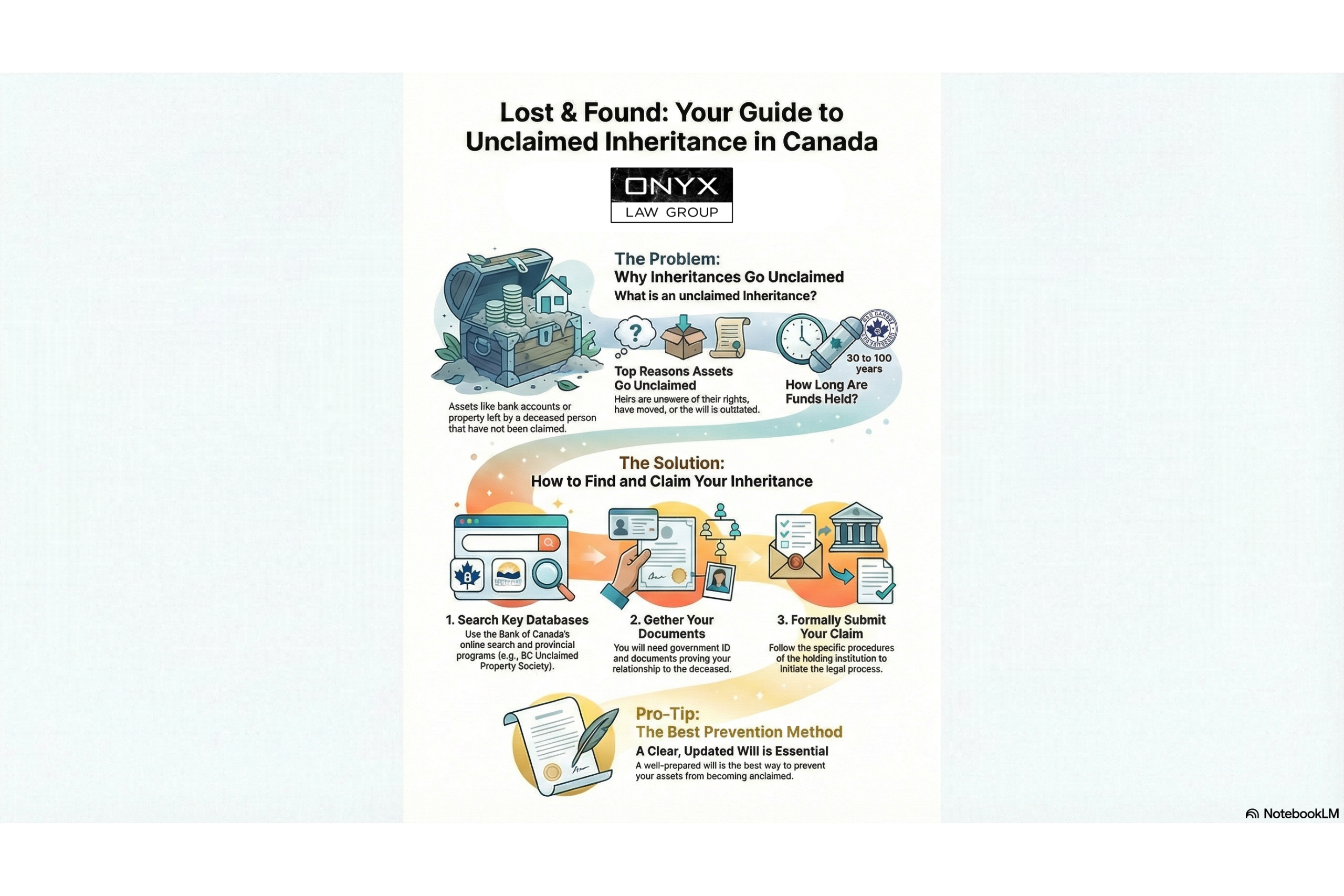
In Canada, unclaimed inheritance refers to assets, funds, or property left behind by a deceased individual that have not been claimed by the rightful owners or beneficiaries. Legally, these inheritances can include bank accounts, real estate, investments, uncashed cheques, or personal possessions that remain uncollected after the estate has gone through probate.
Canadian law requires that estates be distributed according to the will or, in the absence of a will, under provincial intestacy rules. But if heirs don’t know they have a right to the assets, can’t be found, or the estate lacks proper documentation, these assets often go unclaimed for years.
There are several common reasons inheritances go unclaimed in Canada. Beneficiaries may be unaware of their rights, especially if the deceased’s will was outdated or unclear. Others may have moved, changed contact information, or passed away themselves, making it difficult for executors or financial institutions to reach them.
Typically, unclaimed inheritances can be traced through the executor of the estate, probate courts, or public records, and provincial offices often maintain registries for unclaimed property. While the overall process is similar across Canada, there are provincial differences in how unclaimed assets are handled, including varying timelines for reporting, claiming procedures, and legal requirements for estate administration.
Legal Steps to Recover Unclaimed Inheritance in Canada
Recovering an unclaimed inheritance in Canada can seem complex, but understanding the legal steps can make the process much smoother. By following the proper procedures to find unclaimed property, beneficiaries can ensure they receive what they are rightfully entitled to while complying with provincial laws and probate requirements.
Step 1. Verify the Existence of a Will
Check if the deceased left a valid will and identify the executor or estate administrator in charge of the estate. This ensures you know who to contact and what legal authority manages the assets.
Step 2. Confirm Your Status as a Beneficiary
Gather documents proving your relationship to the deceased, such as birth certificates, marriage certificates, or legal affidavits. Being able to clearly demonstrate your entitlement is crucial for submitting a successful claim.
Step 3. Check Probate Records
Confirm whether the estate has gone through probate, the legal process that validates the will and authorizes asset distribution. Unclaimed inheritances often cannot be accessed until probate is completed.
Step 4. Submit a Claim
Formally notify the executor or estate administrator of your claim and provide all necessary identification and supporting documents. This step initiates the legal process of receiving your inheritance.
Step 5. Follow Provincial Procedures
Each province has specific rules for handling unclaimed assets, including public registries or unclaimed property offices. Following the correct provincial process ensures your claim is recognized and processed efficiently.
Step 6. Address Legal Hurdles
Be prepared for potential disputes among heirs, unclear instructions in the will, or missing documentation. Resolving these issues may require additional legal support or court intervention.
Step 7. Observe Time Limits
Provinces often set deadlines for claiming uncollected inheritance, so acting promptly is essential. Missing these deadlines could result in losing your legal right to the assets.
Step 8. Seek Legal Assistance
According to our Principal lawyer Candace Cho, “Executors and financial institutions play a key role, but having a lawyer ensures your rights are protected.” Consulting an estate or probate lawyer can help navigate complex cases and protect your rights. Professional guidance greatly increases the likelihood of a successful inheritance claim.
Navigating Probate for Unclaimed Inheritances

Probate is the legal process that validates a will and authorizes the distribution of assets. It can be confusing, especially when heirs are unknown or hard to find. Executors must locate beneficiaries and notify them. Courts may require detailed inventories of the estate. This stage ensures that unclaimed inheritances are properly tracked. Understanding each step makes the process smoother.
What Is the Role of Estate Trustees and Executors?
Estate trustees and executors manage the estate of a deceased person. They pay debts, file taxes, and distribute assets according to the will. They may also work with a financial institution to access accounts and locate beneficiaries. Executors act in the best interest of the estate. Their role is legal and fiduciary. Clear records and communication reduce mistakes and disputes.
When to Seek Legal Help
Legal help is important when the estate is large or complicated. Lawyers assist with probate, disputes, and locating missing heirs. They ensure the executor follows the law. Legal advice can prevent delays and errors. Hiring a lawyer early makes the process faster and safer.
Common Issues and Disputes Over Unclaimed Inheritance in Canada
Family disputes are common when inheritances go unclaimed. Siblings or distant relatives may contest a will or argue over who is entitled. Legal claims can include will variations, promised inheritance claims, or challenges to increased inheritance for an only child. These disputes often arise when beneficiaries are unaware of their rights or when the will is unclear.
Common law relationships can also complicate inheritance rights. Partners may claim a share even if not named in the will. Stealing from an estate or mismanagement by an executor is another risk. Executors who misappropriate funds can face legal action. These issues can delay distribution and reduce the value of the inheritance for rightful heirs.
At Onyx Law Group, we often say, “Even complex cases, like increased inheritance for an only child or promised inheritances, can be handled with proper documentation and legal support.” We recommend seeking legal support to navigate complex inheritance issues.
Wills Variation Claims
Wills variation claims allow beneficiaries to challenge a will if they feel unfairly excluded. Courts can adjust the distribution to provide reasonable support for dependents. For example, a child left out of a will may claim that they were financially dependent on the deceased. These claims require legal proof and careful documentation. They often involve family disputes and can delay the estate process.
Enforcing Promised Inheritances
A promised inheritance is one the deceased verbally committed but did not include in the will. Beneficiaries can take legal action to enforce it if they have evidence, like written notes or witness testimony. For instance, a parent may have promised a property to a child but left it to another in the will. Lawyers can help file claims and gather proof to uphold these promises in court.
Inheritance Rights of Common Law Partners
Common-law partners may have inheritance rights even if not named in a will. Rights depend on the length and nature of the relationship under provincial law. For example, a partner living with the deceased for several years may claim a share of the estate. Legal guidance is essential to navigate these claims and protect both partners’ interests.
Tax Implications of Unclaimed Inheritance for Canadian Residents and Non-Residents

In Canadian provinces, there is no inheritance tax for residents. Instead, the estate may face taxes on capital gains accrued before death. However, inheritance tax for non-residents may apply to certain property types, like real estate or investments. Executors are responsible for filing the final tax return for the deceased. Understanding these rules is crucial to avoid surprises.
Tax liabilities can vary by province. For example, Quebec has specific estate filing rules. Legally, strategies such as claiming allowable deductions or transferring assets to certain beneficiaries can minimize taxes. Seeking advice from a tax professional helps ensure compliance and reduces the financial burden. Proper planning also protects the value of the inheritance for the heirs.
How to Know if You Have an Unclaimed Inheritance in Canada?
There are various steps you can take to find out if you have an unclaimed inheritance in Canada so that you can claim any assets that may be rightfully yours. Here are our recommended steps to follow:
- Search for Unclaimed Bank Balances: Federally regulated banks transfer inactive accounts to the Bank of Canada after ten years. Use the Bank of Canada’s online database or the Unclaimed Properties Office search tool by entering your name and province or consider other advanced search options.
- Check with Provincial Unclaimed Property Programs: Some provinces have their own programs. For example, the BC Unclaimed Property Society lets you search for unclaimed assets in British Columbia. In provinces without programs, the Bank of Canada database is the main resource.
- Contact the Public Guardian and Trustee: If you suspect you’re an heir to an unclaimed estate, reach out to the Public Guardian and Trustee office in the relevant province. For example, in British Columbia, the Public Guardian and Trustee of BC handles such matters.
- Investigate Unclaimed Insurance Benefits: You might be entitled to unclaimed life insurance benefits if you’re a beneficiary of a policy. The OmbudService for Life and Health Insurance offers a policy search service to help locate policies from deceased family members.
- Explore Old Stock Certificates and Investments: Old stocks or bonds may still hold value. The Canadian Securities Administrators can help determine validity. Even if the company no longer exists, the certificates may have value.
- Utilize Genealogical Resources: If you don’t know potential inheritances, genealogical research can uncover family connections. Services like Ancestry.ca can help trace family histories and identify possible inheritances.
As you follow these steps, be ready to provide proof of identity and your relationship to the deceased, such as birth certificates, wills, or death certificates. Handling unclaimed inheritances can be complex, so consult an estate lawyer to ensure you follow the correct procedures. Keep your contact information updated and communicate with family to prevent assets from becoming unclaimed.
| Aspect | Claimed Inheritance | Unclaimed Inheritance | Impact on Beneficiaries |
|---|---|---|---|
| Timeframe to claim | Typically claimed soon after probate | Can remain unclaimed for years | Delays reduce access to funds and may complicate estate closure |
| Legal process | Straightforward probate process | May require additional legal steps to locate heirs | Beneficiaries may face extra paperwork and court involvement |
| Tax implications | Standard estate taxes apply | Potential additional taxes if assets grow or remain unclaimed | Beneficiaries may inherit less after taxes and fees |
| Common disputes | Rare if will is clear | More common due to unclear heirs or missing beneficiaries | Can lead to delays, legal fees, or contested claims |
| Access to funds | Immediately once probate is complete | Limited until heirs are found or the court approves | Delayed financial benefit; some assets may lose value over time |
How Do I Claim Unclaimed Money in Canada

Unclaimed money in Canada refers to funds from dormant accounts, unclaimed bank accounts, uncashed checks, forgotten investments, or unclaimed estates that individuals may not even realize they’re entitled to. These funds are held by institutions or government agencies until the rightful owner steps forward to claim them. Whether it’s money from a forgotten bank account or an inheritance you didn’t know about, there are straightforward ways to check and claim what’s yours. Here’s how you can begin the process:
- Search for Unclaimed Bank Balances – Visit the Bank of Canada Unclaimed Properties Office. Enter your name and other relevant details to search for any unclaimed funds. If you find a match, follow the instructions to file a claim. The Bank of Canada holds unclaimed money from bank accounts that have been inactive for 10 years or more.
- Check Provincial Unclaimed Property Programs – Some provinces in Canada have their own unclaimed property systems. For example, you can visit the BC Unclaimed Property Society. For provinces without dedicated programs, the Bank of Canada database may be the best resource.
- Gather Required Documentation – To claim unclaimed money, you need to prove your identity and connection to the funds. Required documents typically include Government-issued ID (e.g., driver’s license, passport), social insurance number, and additional documentation linking you to the account or property (e.g., old account statements, correspondence).
- Submit Your Claim – Follow the instructions provided by the specific database or provincial program. Submit all required documents online or via mail as per the guidelines. Some claims may require a small processing fee.
- Wait for Processing – Claims are reviewed to verify your identity and ownership. Processing times vary depending on the organization, but it can take several weeks.
How to Claim Unclaimed Property in BC
If you believe you have unclaimed property in British Columbia (BC), the BC Unclaimed Property Society (BCUPS) can help you locate and claim these assets. Unclaimed property, through the British Columbia Unclaimed Property, includes intestate estates, forgotten funds in credit union accounts, court trust funds, unpaid wages, and other sources. Here’s a step-by-step guide to assist you:
- Search for Unclaimed Property – Visit the BC Unclaimed Property Society’s website and use their search tool to look for unclaimed funds under your name. Enter your full name and any other relevant details to refine the search.
- Initiate a Claim – If you find a match, select the “Start claim” option on the website to begin the process. You’ll need to create an account on the BCUPS website to manage your claim.
- Provide Necessary Documentation – Submit two pieces of government-issued identification, such as a driver’s license and passport. Provide documents that link you to the unclaimed property, like old account statements or correspondence. Depending on the property’s nature, further documents may be required. Refer to BCUPS’s documentation requirements for specifics.
- Submit Your Claim – Upload all necessary documents through your BCUPS account. You can contact the BCUPS official line if you need help.
- Claim Review and Resolution Process – BCUPS will review your submitted documents to confirm your identity and ownership. The review typically takes about four weeks, but its length can vary based on claim complexity. If your claim is approved, BCUPS will issue a check for the unclaimed funds. If denied, BCUPS will inform you via email.
If your unclaimed property originates from court funds, additional steps may be necessary. Very importantly, be cautious of scams. BCUPS does not charge fees for their services. It is advisable to work with an estate lawyer to assist in reclaiming your inheritance, as the process and documentation required are extensive and sometimes complicated.
What Do You Do if You Are a Beneficiary and Are Not Contacted by the Estate Administrator?
If you are a beneficiary and have not been contacted, we recommend you take prompt action. Provinces often have time limits for claiming inheritances. First, confirm your status in the will by checking with family, the executor, or the probate court. Keep your mailing address up to date with financial institutions to ensure you receive any notices or funds.
If you know the executor, send a formal written request for information about the estate. Include proof of your relationship or documents supporting your claim. If the executor doesn’t respond, consult an estate lawyer. Even without a will, provincial intestacy laws may entitle you to inherit. When handling estates without a will, the Public Guardian and Trustee can provide guidance.
What Happens if the Executor Is Unable to Locate the Beneficiary?
If an executor of a deceased person’s will is unable to locate a beneficiary, even after making reasonable efforts, and the deceased left a specific gift of property to that beneficiary, the executor may exercise discretion to sell the property. They can deduct any costs related to storage, transportation, and sale, and hold the net proceeds in trust.
The net proceeds can also be transferred to the Public Guardian and Trustee of British Columbia to hold in trust for the rightful heir. Alternatively, the executor may apply to pay the net proceeds into court after deducting the costs of doing so.
What Happens if the Beneficiary Neglects the Unclaimed Properties?
If a beneficiary has been located and notified of the specific gift but neglects or refuses to make arrangements to take delivery of the property, the executor may sell it, deduct any costs related to the storage, transportation, and sale of it, and send the net proceeds to the beneficiary.
Also, federally regulated banks will consider the balance of a dormant bank account after 10 years to be unclaimed funds and they will transfer the unclaimed funds to the Bank of Canada. The financial institutions must advise you in writing, at your last known address on their file, of the unclaimed funds after two, five, and nine years of inactivity. After 10 years of inactivity, the unclaimed balance transfers to the Bank of Canada.
Unclaimed balances are held by the Bank of Canada for 30 years if the amount is less than $1,000 and for 100 years if the amount is $1,000 or over. At the end of the prescription period, the balance is transferred to the Receiver General of Canada.
Avoiding Unclaimed Inheritances: Why You Should Write a Will
Estate planners can prevent unclaimed inheritances by keeping wills, trusts, and beneficiary information up to date. Communicating with beneficiaries ensures they know about their inheritance and can contact the executor if needed. We often advise our clients, “a well-prepared will can save your beneficiaries years of uncertainty and help avoid unclaimed assets altogether.”
Choosing the right timing and conducting a planned, direct, and transparent discussion are crucial for effective communication with your beneficiaries. Ideally, a conversation with a beneficiary regarding their inheritance should happen when the estate planning process is underway or nearing completion, but before the individual’s passing, to avoid waiting until the last minute or during times of emotional distress.
Need Help With Getting Ownership of Unclaimed Money?
Having a well-written will is the first step in making sure your assets are distributed according to your wishes, thus preventing the possibility of an unclaimed inheritance. By clearly outlining your beneficiaries and specifying how assets should be divided, a will can provide legal clarity and minimize the risk of disputes among potential inheritors.
Wondering how to recover an unclaimed inheritance in British Columbia or elsewhere in Canada? Onyx Law Group’s experienced estate lawyers guide you through the complex process, ensuring your rights are fully protected. With personalized advice and expert advocacy, they help you navigate probate, claims, and estate administration efficiently. Don’t leave your inheritance unclaimed. Contact us today to secure what rightfully belongs to you.
Frequently Asked Questions
Unclaimed inheritances in Canada can be confusing, leaving many unsure of their rights or how to claim them. This FAQ answers common questions about who can inherit, the time limits for claiming an inheritance, and what happens if no one comes forward.
What Happens if an Inheritance Goes Unclaimed in Canada?
In Canada, if an inheritance goes unclaimed, the assets are typically turned over to the provincial or territorial government after a certain period. The government holds the funds in a trust or unclaimed property fund, and beneficiaries can still claim them later by providing proof of entitlement.
How Long Do I Have to Claim an Inheritance?
The time to claim an inheritance depends on the type of asset and state law, but in California, heirs typically have up to four years from the date the estate is opened to file a claim in probate. Some unclaimed assets held by banks or government agencies may be claimed indefinitely, though acting sooner helps avoid complications.
Can Common Law Partners Claim Unclaimed Inheritances?
Common law partners generally cannot automatically claim an inheritance unless they are named in a will or recognized under state law. In California, inheritance rights usually apply to legal spouses or registered domestic partners, not informal common law relationships.
Are There Taxes on Inherited Assets?
In most cases, inherited assets are not subject to income tax when you receive them, and California does not have a state inheritance tax. However, federal estate taxes may apply to very large estates, and you may owe taxes later if you sell inherited assets or withdraw funds from inherited retirement accounts.
How Can Onyx Law Help Me Recover an Unclaimed Inheritance, Canada?
Onyx Law Group can help you find unclaimed money, identify, validate, and recover unclaimed inheritance or estate assets by reviewing your situation, interpreting estate and probate laws, and advising you on the legal steps to assert your rights as a beneficiary. A qualified estate lawyer from the firm can also handle complex paperwork, communicate with executors or administrators, and represent you in court if needed to secure what’s rightfully yours.”
Disclaimer: The information provided on this blog is for general informational purposes only and does not constitute legal advice. Reading this content does not create an attorney-client relationship. Laws and regulations vary by jurisdiction and may change over time, so you should consult a qualified estates and trust attorney for advice regarding your specific situation. Past examples, case studies, or hypothetical scenarios are illustrative only and do not guarantee similar results.