


In British Columbia, a spouse cannot directly override a will, but they may apply to the court to vary it under the Wills, Estates and Succession Act if the will does not make adequate provision for them. This is where the importance of understanding spousal rights in estate planning becomes critical, as the court considers both legal and moral obligations when deciding whether to change the distribution of an estate. Without this knowledge, a surviving spouse may not realize they have the right to seek a variation and could accept an outcome that does not reflect their legal entitlements.
Onyx Law Group has extensive experience guiding clients through estate disputes and spousal claims under the Wills, Estates and Succession Act in British Columbia. Our legal team understands how courts assess spousal rights, including when a will may be varied to ensure fair and adequate provision. We provide clear, practical advice tailored to your unique family and financial situation, helping you make informed decisions with confidence. If you are dealing with a will dispute or want to understand your rights as a spouse, contact us today to protect your interests and get trusted legal guidance.
In this blog, we will explain how spousal rights work under the Wills, Estates and Succession Act and when a surviving spouse may apply to the court to vary a will if they have not been adequately provided for.
Understanding Wills Variation Claims in BC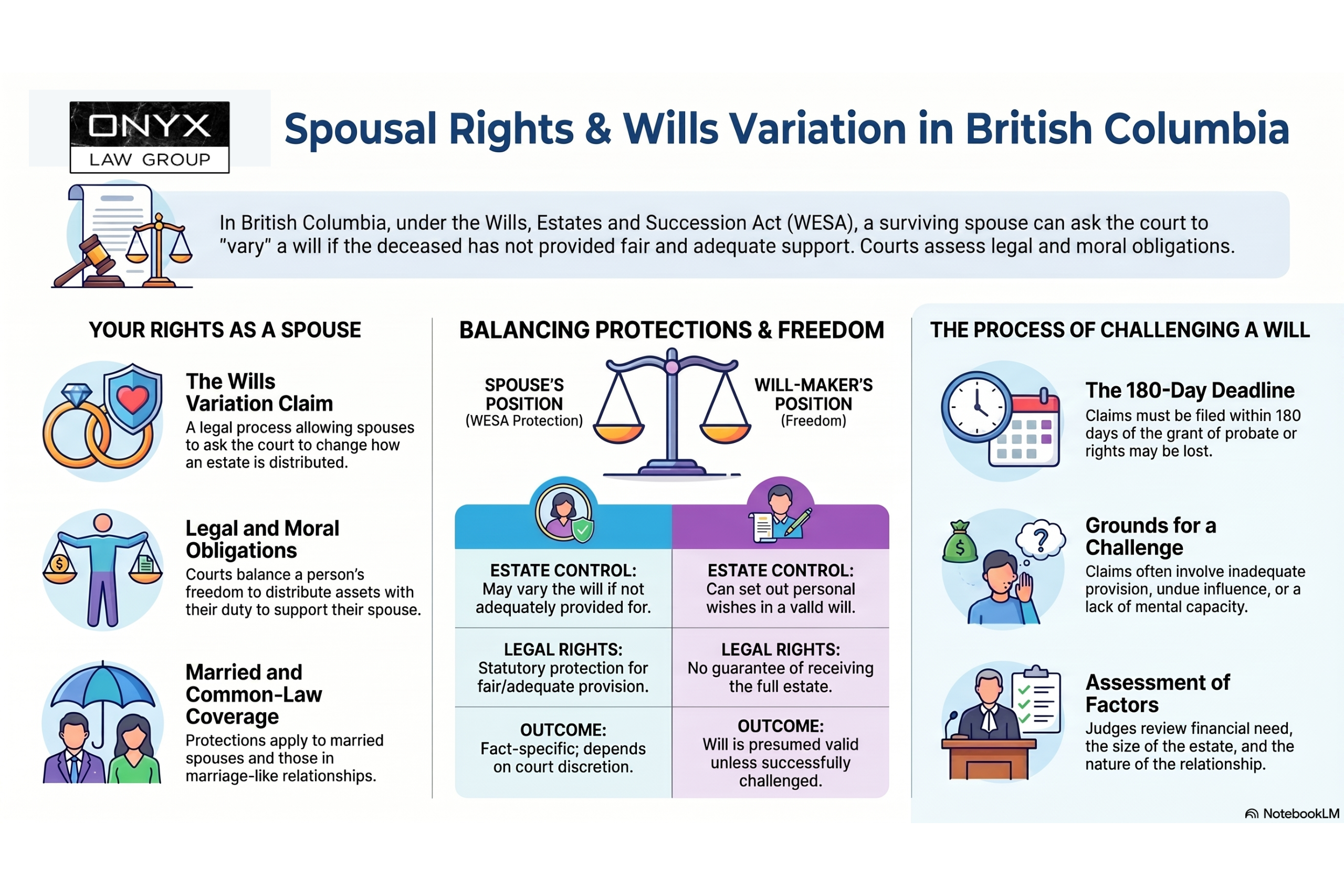
A wills variation claim is a legal process that allows certain family members to ask the court to change how a will distributes an estate. The purpose is to ensure that a will-maker has made adequate provision for eligible family members. In British Columbia, these claims are governed by provincial estate laws and BC estate law, including WESA legislation. The court may review whether the will-maker met both legal and moral obligations while balancing testamentary freedom and family responsibilities.
Not everyone can file a wills variation claim in BC. Generally, spouses and children of the deceased may have the right to bring a claim. These rights can apply to married spouses, certain common-law spouses, and biological or adopted children. The law provides these protections to help ensure fair treatment in estate matters while recognizing testamentary autonomy.
The process of filing a wills variation claim involves several important steps. A person usually begins by reviewing the will and gathering information related to the estate and family circumstances. Legal documents must then be filed with the court within the required time limits. Missing deadlines can affect a person’s ability to move forward with a claim and may complicate wills variation disputes.
Timing and preparation are important considerations in these cases. Courts may look at financial needs, family relationships, and the overall circumstances surrounding the estate. Each case is unique and depends on its specific facts. Understanding the process early can help individuals better protect their rights and interests.
Can a Spouse Override a Will in BC?
A spouse cannot automatically override a will in British Columbia simply because they disagree with its contents. However, BC law gives spouses certain legal rights in estate matters. These protections are designed to help ensure that spouses are treated fairly after the death of a partner. Understanding these rights can help families better navigate estate issues.
British Columbia law recognizes that a will-maker may have legal and moral obligations toward a spouse. A spouse may have the right to seek changes if they believe that proper provision has not been made for them. These rights can apply to married spouses and, in some situations, spouses in a common law relationship or marriage like relationship. Estate laws aim to balance personal wishes with legal responsibilities.
There are certain situations where a spouse may challenge a will. Common examples can include claims involving inadequate provision, concerns about testamentary capacity, undue influence, or questions about the validity of the will. Courts in BC may look at factors such as financial needs, family relationships, and the overall circumstances surrounding the estate. Each case is reviewed based on its specific facts and may involve the will maker’s spouse or deceased’s spouse.
In British Columbia, a spouse or child must bring a wills variation claim within 180 days of the grant of probate. Missing this deadline can permanently bar a claim, even if the person would otherwise have strong legal grounds.
Not having a will in place can create additional challenges for spouses and family members. Estate distribution may then follow provincial laws rather than personal wishes. This can sometimes lead to confusion, delays, or disputes among family members. Proper estate planning can help protect spousal rights and provide clearer guidance for loved ones, including situations where spouses may have the same rights under the law.
Legal Grounds for Challenging a Will in BC
Challenging a will in British Columbia usually requires specific legal grounds. A person cannot contest a will simply because they disagree with its contents. The court generally requires evidence showing that a legal issue may affect the validity or fairness of the will. Understanding these grounds can help families better understand their rights and options.
One common issue involves testamentary capacity. Testamentary capacity refers to a person’s mental ability to understand the nature and effect of creating a will. The person making the will should understand what property they own, who may have a claim to the estate, and how their decisions affect others. If there are concerns about mental capacity, questions may arise about whether the will is legally valid and whether a reasonable will maker understood the consequences of their decisions.
Undue influence and fraud can also create legal concerns. Undue influence happens when someone pressures or manipulates a person into making decisions they would not have made freely. Fraud may involve deception or misleading information that affects the contents of a will. If there is evidence of these issues, the court may review whether the will accurately reflects the will-maker’s true intentions.
In British Columbia, spouses may also challenge a will if they believe adequate provision was not made for them. Courts may consider whether the will-maker met their legal and moral obligations to a spouse, including the will maker’s moral duty to provide proper maintenance and proper maintenance and support. Past court decisions have shown that factors such as financial needs, family circumstances, and the overall relationship can influence the outcome. Each case depends on its own facts and circumstances, including situations involving a disinherited child.
Spousal Rights vs. Will Maker’s Intentions in BC
Understanding spousal rights in British Columbia estate law often comes down to a balance between what a will says and what the law considers fair. While a spouse cannot directly override a will, they may still have the right to challenge or vary its terms under the Wills, Estates and Succession Act if adequate provision has not been made. The table below breaks down the key trade-offs between a spouse’s legal protections and a will-maker’s ability to distribute their estate, helping clarify how these competing interests are assessed in practice.
| Issue | Spouse’s Position (Protection under WESA) | Will-Maker’s Position (Freedom to Distribute Estate) | Court Consideration / Trade-Off |
|---|---|---|---|
| Estate distribution control | May apply to vary the will if not adequately provided for | Can set out personal wishes in a valid will | Court balances personal autonomy with fairness obligations |
| Legal rights | Spouses (including some common-law partners) may have statutory protection | No guarantee spouse will receive full estate share | Court may override will if legal/moral duties are not met |
| Moral obligations | Expectation of fair and adequate provision based on relationship | Testator may prioritize other beneficiaries | Courts assess “adequate, just and equitable” provision |
| Financial dependency | Stronger claims if spouse was financially dependent | Estate plan may not reflect dependency unless planned for | Dependency can significantly increase likelihood of variation |
| Validity of will | Can challenge based on undue influence, capacity, or unfair provision | Will presumed valid if properly executed | Burden shifts to challenger to prove legal grounds |
| Outcome certainty | Outcome depends on court discretion and facts | Will provides certainty only if not successfully challenged | Estate disputes are fact-specific and unpredictable |
Practical Steps for Protecting Spousal Rights

Protecting spousal rights often starts long before a dispute happens. Proper planning can help reduce confusion, avoid future conflicts, and provide better protection for loved ones. Here are important steps to consider when planning an estate or handling a potential estate dispute.
Step 1: Create a Comprehensive Estate Plan
A clear estate plan can help ensure a spouse is properly considered and protected. Wills, trusts, and other planning tools can help reduce uncertainty and make intentions easier to understand. This can be especially important in blended families and blended family situations where estate plans may need to clearly explain how to distribute assets.
Step 2: Review and Update Estate Documents Regularly
Life changes can affect estate plans over time. Marriage, separation, financial changes, or family changes may make updates necessary to keep documents current. Reviewing an existing will can help address issues involving a former spouse, one spouse, or changes affecting a deceased person.
Step 3: Consider Strategies That Support Spousal Protection
Estate planning strategies should reflect financial needs and family circumstances. Proper planning may help provide security and reduce the risk of future challenges or disagreements. Factors such as financial contributions, step-children, and legally adopted children may also influence planning decisions.
Step 4: Work With a Legal Advisor During Estate Planning
Legal professionals can help explain estate laws and identify potential issues before they become problems. They can also help create documents that reflect personal goals and legal requirements. Guidance from professionals with a deep understanding of family law may also help address concerns related to a will maker’s reasons for certain decisions.
Step 5: Consult an Estate Lawyer if a Dispute Arises
Early legal advice can be valuable when disagreements involve wills or estate rights. An estate litigation lawyer or experienced estate litigation lawyers can review the facts and explain available legal options involving estate litigation.
Step 6: Evaluate Available Dispute Resolution Options
Not every estate dispute must end in court. Mediation, negotiation, or other forms of resolution may help parties reach an agreement while reducing time and legal costs before pursuing legal action. Alternative approaches may also affect how courts accept evidence or how a court finds facts in a dispute. Planning should also consider beneficiary designations and ensure documents align with current law.
Importance of Legal Guidance

In British Columbia, a spouse may have the right to challenge or “vary” a will if they feel they were not adequately provided for. This is not always straightforward. The law looks at many factors, including the nature of the relationship, the size of the estate, and any moral or legal obligations. BC courts and the BC Supreme Court may also consider evolving legal principles and contemporary community standards when reviewing these claims. Without legal guidance, it is easy to misunderstand your rights or miss key deadlines. Small mistakes can have a big impact on the outcome.
Legal support helps you build a clear and realistic claim. An experienced lawyer can explain what courts typically consider and what evidence is needed. They can also help you avoid costly disputes and guide you through negotiation or court if needed. In many cases, early advice leads to faster and more practical resolutions. It also helps reduce stress during an already difficult time and may provide insight into how the Supreme Court has approached contemporary justice concerns in estate matters.
In a past case, a surviving spouse in British Columbia believed they had been unfairly left with a small share of the estate. The will primarily benefited adult children from a previous relationship. After the spouse received the probate documents, they contacted a lawyer for advice. The lawyer reviewed the will, the family’s financial situation, and the legal test under the Wills, Estates and Succession Act. A wills variation claim was filed shortly after.
During negotiations, the lawyer presented evidence of the spouse’s financial dependence and long-term contribution to the household. The matter was resolved before trial. The spouse received a significantly increased share of the estate through a settlement, avoiding a lengthy court battle and securing a more stable financial outcome.
Do You Need Help With a Will in BC?

In British Columbia, a spouse cannot directly override a will, but they may apply to court to vary it under the Wills, Estates and Succession Act if they believe they have not been adequately provided for. The court looks at both legal and moral obligations when deciding whether to change how an estate is distributed. This means outcomes depend on the specific facts of each case, including the relationship and the overall estate plan.
This is why understanding spousal rights in estate planning is so important. Many people are not aware that these rights exist or how they work in practice. Getting legal advice early can help spouses understand their position and avoid unnecessary disputes. It also ensures that estate plans are clear, fair, and less likely to be challenged later on.
Are you unsure about your rights when a spouse is excluded from a will in British Columbia? Onyx Law Group helps clients understand how the Wills, Estates and Succession Act applies to spousal claims and estate disputes. Our experienced estate and probate lawyers in BC provide clear guidance on when a will may be challenged and how courts assess fair provision. Contact us today for practical advice and strong legal support that we tailor to your situation.
Frequently Asked Questions
This FAQ section answers common questions about whether a spouse can override a will in British Columbia. It explains spousal rights, legal considerations, and situations where a spouse may have the ability to challenge or vary a will.
Can a Spouse Override a Will in BC if They Are Not Mentioned in It?
Yes, in some situations, a spouse may be able to challenge a will even if they are not included. In British Columbia, spouses may have rights to seek changes if they believe adequate provision was not made for them.
What Legal Grounds Can a Spouse Use to Contest a Will in BC?
A spouse may challenge a will for several reasons. Common grounds can include inadequate provision, lack of testamentary capacity, undue influence, or concerns about the validity of the will.
How Does a Spouse Go About Contesting a Will in BC?
The process usually starts by filing a legal claim with the court. A spouse may also need to gather documents and evidence that support the challenge.
What Factors Does the Court Consider When Determining if a Spouse Should Override a Will in BC?
The court may consider factors such as the relationship between the spouses, financial needs, the size of the estate, and the will-maker’s legal and moral obligations. The specific facts of each case can affect the outcome.
Is It Advisable for a Spouse to Seek Legal Advice When Considering Contesting a Will in BC?
Yes, legal advice can be helpful because estate disputes can be complex. A lawyer can explain legal rights, review the circumstances, and help determine possible options.
Disclaimer: The information on this page is general legal information about British Columbia law, not legal advice for any specific situation. Reading this page does not create a solicitor-client relationship. BC law changes and the procedure that applies to a specific situation depends on facts not covered here. For advice on your situation, consult a qualified British Columbia estate lawyer directly. Past results, illustrative scenarios, and reference to typical fact patterns do not guarantee similar outcomes in any specific case.