


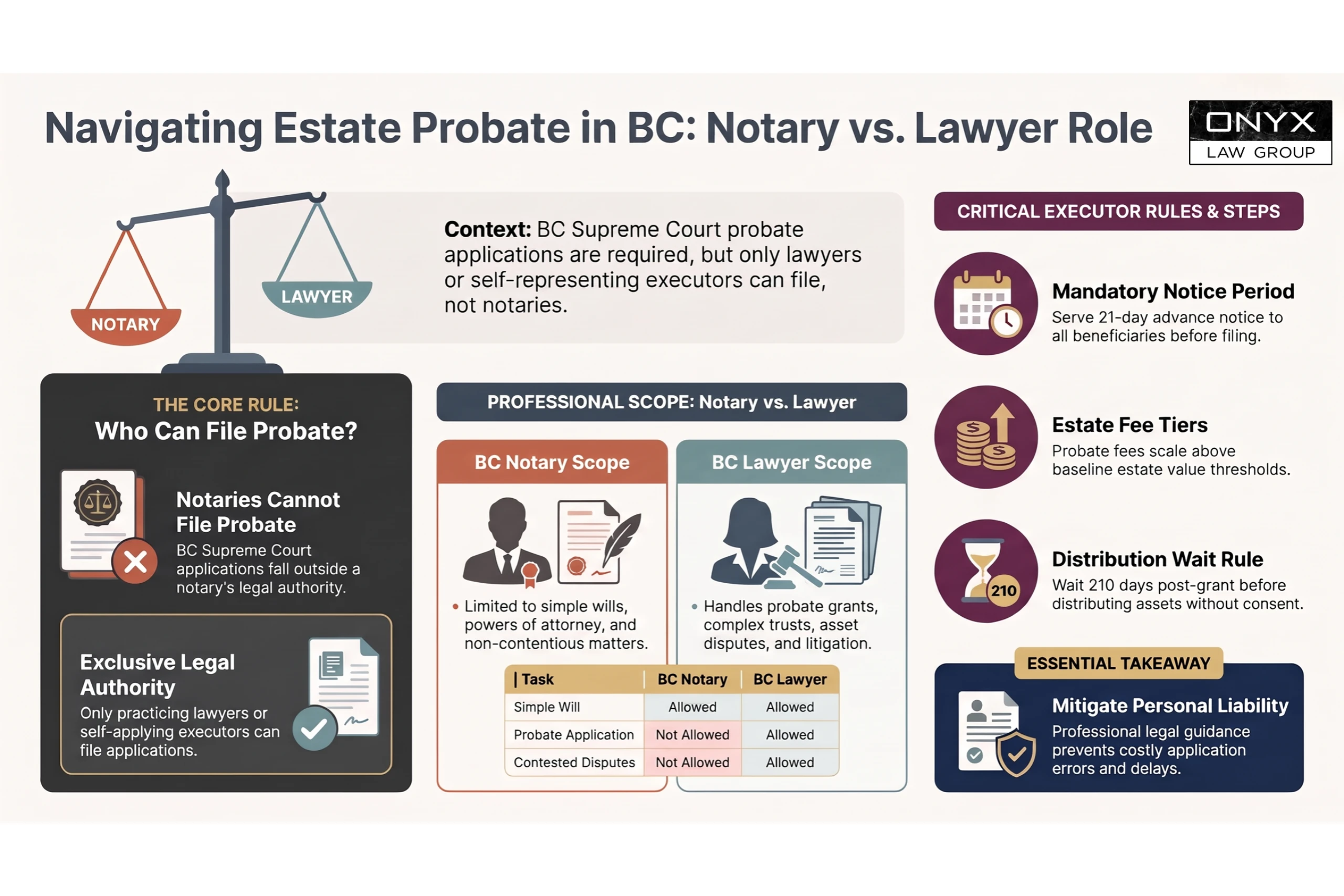
A notary public in British Columbia can draft a simple will, but a notary cannot prepare or file a probate application. Probate runs through the Supreme Court of British Columbia, which issues the grant that confirms a will and proves the executor’s authority. Executors can apply themselves or have a lawyer do the applying.
The probate and estate administration lawyers at Onyx Law Group have been helping families navigate the legal process for over a decade with care and precision. We understand that probate can feel overwhelming, and our experienced team of Vancouver wills and estates lawyers ensures every step is handled efficiently and in full compliance with BC law. Contact us today to get trusted legal guidance and peace of mind as you settle your loved one’s estate.
This blog explains whether a notary can probate a will in British Columbia, what their legal limits are, and when you’ll need a lawyer to handle the probate process.
Can a Notary Probate a Will in BC?

A notary cannot probate wills in British Columbia because probating is a process supervised by courts, and the Notaries Act does not have any legal authority to do that. Section 18 of the Notaries Act, RSBC 1996, c 334, lists what a notary may draw. That list covers property instruments, certain wills, powers of attorney, representation agreements, affidavits, and oaths. This part doesn’t talk about probate applications or grants of administration, so a notary has no right to prepare either one.
The Legal Profession Act, SBC 1998, c 9, ss 1 and 15, explains why. Drafting a document relating to probate counts as the practice of law. Only practicing lawyers or individuals acting for themselves may do this work. Strictly speaking, nobody but the court probates a will, because the court issues the grant. The application goes through the Supreme Court registry under Rule 25-2 of the Supreme Court Civil Rules. The Wills, Estates and Succession Act, SBC 2009, c 13 (WESA) s 121, requires that there be notice first.
Notaries still do useful work around the edges of an estate, including estate documents that need no court. A notary can draft a simple will, witness signatures, administer oaths, and draw land title transfer documents. Services like these are suitable for clients who have clear intentions and do not foresee disputes arising. A probate application, a contested estate, or a legal opinion on a dispute belongs with a lawyer, and a notary will refer you onward.
What Are the Alternatives if a Notary Cannot Probate a Will?
You have two realistic paths if a notary cannot probate a will. The first is hiring a probate lawyer, who can prepare the application, deliver the notices, collect the necessary documents, and deal with the court registry on the executor’s behalf. Lawyers also catch problems early, like ambiguous language in the will or missing details of the estate that the deceased left behind.
The second way is to take on being the executor named in your will. You file your application, pay any court fees, and do all the paperwork. This option can save legal fees, and it works best for small estates with clear instructions and cooperative beneficiaries.
The risks grow when the estate holds real property, investments, several beneficiary designations, or debts. Errors in forms, missed notices, or an incomplete asset list can send the application back and delay everything. Executors personally owe fiduciary responsibility to beneficiaries if errors cost the estate money.
Some executors split the difference by hiring a lawyer for one step, such as reviewing the application before filing. Whichever route you pick, a notary cannot take the court-facing role, and the will must still meet the legal requirements for validity.
Why Do People Confuse Notaries and Lawyers in BC?

People confuse the two roles because BC notaries are authorized legal advisors within the limits set by the Notaries Act. They draft legal documents, prepare certain wills, and handle powers of attorney and representation agreements, which are the same documents many lawyers prepare. From a client’s view, the two offices can look alike when no court is involved.
Use the table below to match your estate to the right person before you book anything, since the limits reflect British Columbia’s legal standards as of October 2026.
| Task | BC Notary | BC Lawyer |
|---|---|---|
| Simple will | Yes, where gifts become effective upon death or at age 25. | Yes |
| Complex will with trusts or delayed gifts | No, outside the Notaries Act | Yes |
| Probate application | No | Yes, or the executor alone |
| Estate disputes and contested wills | No | Yes |
| Scope of legal advice | Non-contentious matters within the Notaries Act | Any area of law, including court proceedings. |
Overlapping services explain only half of the confusion in this area. Many people also assume that whoever drafts a will can finish the job after a death. The real distinction is court authority, since lawyers can appear in the Supreme Court and notaries cannot.
Knowing this upfront can save you from having to pay twice for the same service. A notary remains a sensible, affordable choice for plain planning, while a lawyer is the right call once a court or a dispute enters the picture.
What Happens if You Try to Probate Without a Lawyer?

Many individuals attempt to apply for probate on their own, and many succeed. The Province of BC says that you don’t need to hire a lawyer to apply for probate or letters of administration. The process of applying for probate involves using Form P2 along with a notice to search wills, and the court registry reviews both documents.
The first step under legal considerations is that the executor must serve notice regarding the intended application to Form P1 along with a copy of the will. Rule 25-2 of the Supreme Court Civil Rules lists who receives it, including other named executors, beneficiaries, and intestate successors. The application cannot be made until at least 21 days after delivery, and WESA s 121 requires the notice itself.
Cost is the next question for most executors. The court charges a $200 filing fee when the estate is worth more than $25,000. The Probate Fee Act, section 2, sets a separate probate fee of $6 for each $1,000 or part thereof on the portion between $25,000 and $50,000. It adds $14 for each $1,000 or part thereof on the portion above $50,000. Estates of $25,000 or less pay no fee, so the final cost grows only on value above each band. For example, an $845,000 estate would owe $150 plus $11,130 in probate fees before the $200 filing fee.
The $25,000 figure is a fee threshold, not a legal rule that forces probate. Whether you need a grant depends on the asset and on the institution holding it, since banks and land registries often ask for one. Some assets can avoid probate altogether, which lowers the value of the estate that needs a grant. Land held as joint tenants passes by survivorship under WESA section 162, so jointly owned land often moves outside the estate. RRSP, RRIF, and TFSA benefits payable to a named beneficiary are not part of the estate under WESA section 95. Life insurance with a named beneficiary also bypasses the will and goes directly outside the estate. Assets properly held in a trust outside the estate generally stay out too, although a testamentary trust created by a will still needs that will to be probated.
Mistakes often cost more than people expect, and wrong forms, missed notices, or an incomplete list of estate assets can lead the registry to send the file back for correction. Different registries have different timelines based on whether the application is neat; no one can give an exact time range. One fixed rule applies after the grant, and it surprises many executors. Under WESA section 155, an executor generally cannot distribute the estate for 210 days unless the beneficiaries consent.
When you have multiple heirs, minors, a family house, or questions regarding an original will, it pays to seek professional help. Executors also have duties beyond the court, such as filing the final tax return with the Canada Revenue Agency and paying debts before beneficiaries receive anything. During a time when emotions run high, a lawyer can lighten your load.
Choosing the Right Professional for Your Estate Needs

The right choice depends on how complicated your family and your assets are. A notary suits a simple will, a power of attorney, or a representation agreement covering medical decisions. That holds when your plans are clear, and nobody is likely to object. A lawyer fits better when the estate has blended families, trusts, a business, or property in more than one place.
There are some basic things that are true regardless of who writes your last will and testament, and those come from WESA. Under section 36, you must be at least 16 years old and have the legal capacity to understand what you are signing. Under section 37, you sign in front of two witnesses who are present at the same time, and both witnesses sign in your presence. This will is legally binding for your assets, and loved ones have clear documents they can rely on.
A codicil amends an existing will and must meet the same signing rules, while a new will revokes the old one under section 55. Good planning is important, but many people avoid it. The Province of BC’s Make a Will Week page cites a 2020 survey by BC notaries, which found that about half of British Columbians have a current will.
If you are making a will with trusts or delayed gifts, our wills and estate planning lawyers can prepare it under BC legislation and the provincial laws that govern it. The same lawyers help when you expect a family member to contest a will. Our estate services cover creating wills, reviewing old ones, and giving legal expertise on specific circumstances before problems start.
Before you sign anything, carefully review the draft with the person who prepared it and gather your important documents. Ask the drafter to confirm which assets the will actually controls, because bank accounts, financial accounts, and insurance policies may follow separate beneficiary rules. Strict rules explain why two people may end up needing quite different papers for the same property.
Need Help Probating a Will in BC?
A notary can write a simple will, but they can’t file an application for probate; executors can file on their own or with a lawyer. The notice period, the fee bands, and the formalities for wills all carry strict rules that reward careful preparation. If any part of the estate feels uncertain, speaking with a lawyer before you file can spare you months of correction.
Our BC probate lawyers guide executors through each stage, from the first notice to the final distribution. We explain fee categories and rules in simple language because dealing with probate can be perplexing. Contact us today, and a member of our team will review where your estate stands.
FAQs
If you’re still unsure about how probate works or what a notary can do, you’re not alone. These FAQs answer some common questions to help you understand the process and your next steps.
How Much Does It Cost to Probate a Will in BC?
In British Columbia, if the gross value of the estate is $25,000 or less, no probate fee is required. If it is more than $25,000, a $200 filing fee applies, plus fees of $6 for each $1,000 (0.6%) on amounts between $25,000 and $50,000, and $14 for each $1,000 (1.4%) on amounts above $50,000.
Who Can Probate a Will in BC?
In BC, the person named as the executor in the will is responsible for applying for probate. If the named executor or an alternate executor is unable or unwilling to act, the court can appoint an administrator, often a close family member, to handle the estate instead.
Does a Notarized Will Need to Be Probated?
Yes, a notarized will may still need to be probated in BC if the deceased person owned assets that require probate, such as real estate or significant bank accounts. Probate confirms the will is legally valid and gives the trustee legal authority to manage and distribute the estate.
How Long Does It Take to Probate a Will in BC?
The probate process in BC typically takes three to six months, depending on the complexity of the estate and the court’s workload. Delays can occur due to errors in the application, disputes among beneficiaries, or missing documents.
Can a Notary Help Me File Probate Applications?
In BC, only lawyers licensed by the Law Society of British Columbia, or executors acting for themselves, can file probate applications with the Supreme Court. However, a notary can still help you organize documents or refer you to a probate litigator for legal representation.
Can a Notary Draft a Will in BC?
Yes, a notary public in BC can draft a simple standard will, especially when the will-maker’s estate and wishes are straightforward. For instance, this rule is applicable in scenarios where there is joint ownership or joint tenancy. For more complex circumstances, such as blended families, trusts, or large estates, it’s best to work with a wills and estates attorney to ensure everything is legally sound.
How Long Do You Have to File Probate After Death in BC?
There is no strict deadline to file for probate after someone dies in BC, but it’s best to start the process as soon as possible to avoid delays in administering the estate. Waiting too long can create complications, especially if assets need to be sold, taxes must be filed, or beneficiaries are waiting for their inheritance.
What Triggers the Need for Probate?
Probate is typically triggered when a court order is needed to confirm the executor’s legal authority to manage the deceased’s assets. Whether probate is required depends on what the person owned when they were alive. For example, if they owned property in their sole name or had other high-value assets, you’ll likely need probate to administer their estate.
Does Every Will Have to Be Probated in BC?
No, not every will has to be probated in BC. Some estates can avoid probate if assets are jointly owned, have named beneficiaries (like life insurance or RRSPs), or are of low value and can be transferred without a court grant.
The information on this page contains general legal information about British Columbia law, but it does not provide specific legal advice for any specific situation. Reading this page does not create an attorney-client relationship either. Changes in BC laws and procedures also depend on facts, which are not addressed here. If you need help understanding what applies to your specific situation, you should consult a qualified estate lawyer from British Columbia directly. Past results, illustrative scenarios, and reference to typical fact patterns do not guarantee similar outcomes in any specific case.