


An executor named in a will is the legal representative of the deceased, and the role comes with significant responsibility. In BC, there is no strict fixed deadline, but executors are generally expected to distribute estate funds within a reasonable timeframe, often around 12 months depending on the complexity of the estate. Executors must handle tasks such as arranging the funeral, paying debts, locating beneficiaries, filing final tax returns, and distributing estate assets, all of which can take time to complete properly.
Onyx Law Group has over a decade of experience helping clients with estate disputes and executor issues across British Columbia. Our lawyers understand how estate timelines work and what is considered a reasonable delay under Canadian law. We regularly assist beneficiaries and executors in resolving conflicts, obtaining accountings, and ensuring estates are administered properly. If you are dealing with delays in receiving your inheritance, contact us for clear legal guidance and support.
In this blog, we will explain how long an executor can legally withhold money from a beneficiary, the reasons for delays, and what steps you can take if the process is taking too long.
What Are the Roles and Responsibilities of an Executor?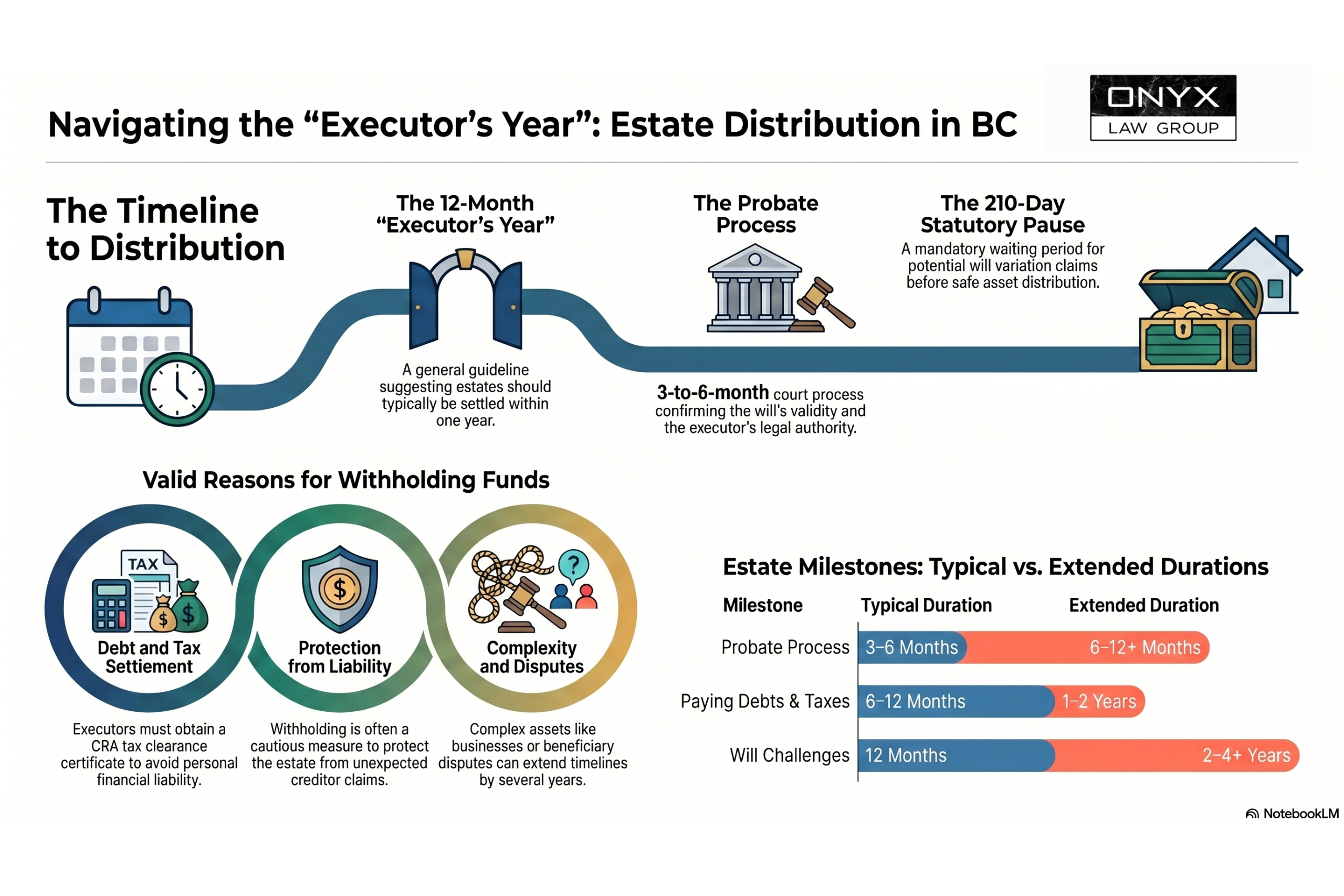
An executor is the person legally responsible for managing and settling an estate after someone passes away. In Canada, this role as a personal representative comes with strict fiduciary duties, meaning the executor must act honestly, in good faith, and in the best interests of the beneficiaries.
An executor’s responsibilities include locating assets, dealing with financial institutions, valuing the estate, notifying beneficiaries, and following the instructions in the will based on the specific circumstances surrounding the date of the deceased person’s death. It is not just paperwork. It is a legal obligation that must be handled carefully to avoid undue delay or being held personally liable.
Executors often hold onto estate funds for valid reasons based on the specific circumstances. They may need to pay outstanding estate debts, file final tax returns, or cover funeral and administrative expenses.
In some cases, executors also set aside a reserve in case unexpected costs arise or issues related to income earned. This process can feel frustrating for beneficiaries, but it is usually necessary within a reasonable time. The executor may face legal and financial risks if they distribute money too early, potentially leading to personal liability.
Timelines can vary depending on the date, but many estates in Canada follow what is often called the executor’s year. This is a general guideline suggesting the estate should be settled within about 12 months. However, delays are common, especially if probate is required.
Probate is the court process that confirms the will is valid and gives the executor authority to act. Until probate is granted, executors may not be able to access or distribute certain assets, including interim distribution, without the court’s permission or a court order.
BC Executor Checklist

Before moving forward, it helps to break down the executor’s responsibilities into clear, manageable steps. Here’s a checklist of tasks that an executor in British Columbia, Canada, may need to complete:
- Obtain a death certificate.
- Notify beneficiaries and other interested parties of the deceased’s passing.
- Locate the deceased’s will and any other relevant documents.
- Determine the assets and liabilities of the estate.
- Secure and value assets, including property, investments, and personal property.
- File the will with the BC Supreme Court and apply for probate, if necessary.
- Notify creditors of the deceased’s passing and settle outstanding debts.
- File any necessary tax returns, including a final income tax return and estate tax return.
- Distribute the estate’s assets to the beneficiaries according to the will or intestacy laws.
- Keep accurate records of all transactions and decisions made on behalf of the estate.
- Obtain legal advice and guidance as necessary.
It’s worth noting that the specific tasks required may vary depending on the complexity of the estate and the instructions laid out in the will. It’s also important for the executor to act with honesty, integrity, and transparency throughout the process.
Legal Timeframes for Withholding Money From Beneficiaries in Canada
Estate administration in BC is governed by the Wills, Estates and Succession Act (WESA), which sets rules for executors and beneficiaries. In BC, there is no single fixed deadline that tells an executor exactly when they must release money to beneficiaries. Instead, courts follow general expectations.
We always remind clients, “Often, what feels like withholding is actually the executor acting cautiously to avoid personal liability.” Many estates operate under the “executor’s year,” which gives about 12 months to gather assets, pay debts, and begin distributions. Courts expect steady progress during this time. Executors should communicate clearly and avoid unnecessary delays.
Statutory deadlines and probate timelines in BC also shape how long funds may be withheld. In British Columbia, executors often need to complete probate before distributing most assets. This process can take several months, depending on the complexity of the estate. There is also a waiting period for potential claims against the estate, such as will variation claims. During this time, executors may reasonably hold onto funds to avoid legal risk.
There are also extensions and exceptions to standard timeframes. Some delays are completely valid. For example, unresolved disputes between beneficiaries, creditor claims, or complex tax filings can extend timelines. Property sales or business interests in the estate may require additional time. These situations justify holding funds longer, as rushing distribution could create bigger problems later.
However, unreasonable delays can lead to serious consequences. If an executor fails to act diligently or communicate, beneficiaries may take legal action. Courts can order the executor to account for their actions, force distributions, or even remove and replace them. In some cases, executors may be personally liable for losses caused by delay. Beneficiaries can protect their rights by speaking with a lawyer and, if needed, applying to the court for relief.
What Are the Consequences for Unreasonable Delays by Executors?
When an executor delays distributing an estate without a valid reason, there can be real consequences. Beneficiaries can ask the court for an accounting, which requires the executor to explain their handling of the estate. If the delay is serious, the court can order the executor to make distributions or follow a strict timeline. In some cases, the executor can be removed and replaced with someone else.
“Beneficiaries are entitled to transparency, and if there are delays, they have the right to request an accounting of the estate.” – Veronica Manski, Probate and Estates Attorney, Onyx Law Group
Executors can also face personal financial risk. If their delay results in losses, such as missed investment opportunities or penalties, they may be required to cover those costs personally. Courts can also reduce or deny their compensation for poor performance. These consequences are meant to ensure executors act responsibly and do not hold onto estate funds longer than necessary.
Typical Timeframes vs. Possible Delays for Executor Withholding

Understanding executor timelines can be confusing, especially when delays start to feel longer than expected. Some withholding of funds is completely normal, while other delays may signal more profound issues with the estate administration. The table below breaks down common reasons for withholding inheritance, how long each situation usually takes, and what beneficiaries can do if delays go beyond what is expected.
| Reason for Withholding | Typical Duration | Possible Extended Duration | Beneficiary Options or Remedies |
|---|---|---|---|
| Probate process | 3–6 months | 6–12+ months | Request status updates and seek legal advice if delays seem excessive |
| Paying debts and taxes | 6–12 months | 1–2 years | Ask for an accounting and ensure taxes are being properly handled |
| Creditor claims period | 6–12 months | 1–2 years | Confirm notice to creditors was given; apply to the court if stalled |
| Beneficiary disputes | 6–12 months | 1–3+ years | Consider mediation and apply to the court to resolve disputes |
| Will challenges | 12 months | 2–4+ years | Participate in legal proceedings and seek independent legal counsel |
| Complex assets (e.g., property or business) | 6–12 months | 1–3+ years | Request updates on asset sales and apply to compel action if no progress |
| Executor inaction or misconduct | N/A (not typical) | Indefinite without intervention | Demand a formal accounting and apply to remove or replace the executor |
Common Reasons Executors May Withhold Funds from Beneficiaries
Executors may withhold funds for several valid reasons. One of the most common is paying the estate’s outstanding debts and taxes. Before any inheritance is distributed, all liabilities must be settled. This includes final income taxes and any property-related taxes. In Canada, executors often wait for a tax clearance certificate from the Canada Revenue Agency. This certificate confirms that all taxes are paid. Without it, distributing funds too early can create personal liability for the executor.
Another major reason is the probate process. In many cases, executors must wait for the court to officially approve the will before they can access or distribute assets. This helps confirm that the executor has legal authority to act. During this stage, creditor claims must also be addressed. Creditors are given time to come forward and claim money owed by the estate. Executors are required to ensure these debts are fully resolved before making final distributions.
Disputes can also delay payouts. Beneficiaries may disagree about how the estate should be handled or challenge the will itself. Executors must pause distribution until these issues are resolved. Occasionally, there are also unknown or unclaimed assets that need to be located and verified. This can take time, especially in larger or more complex estates.
Finally, executors must manage their fees and protect themselves legally. They are entitled to reasonable compensation for their work. They also have executor indemnity, which protects them from personal liability if they act properly and obey the law. Because of these protections, they may hold back a reserve amount to cover expenses or potential claims before fully closing the estate.
Why Is the “Executor’s Year” Necessary?

The “executor’s year” is a practical guideline used in estate administration. It reflects the reality that settling an estate takes time and involves many detailed steps. An executor must gather and protect assets, apply for probate if needed, notify beneficiaries, and deal with creditors. They also need to pay debts, handle taxes, and keep clear financial records throughout the process. Often, they must work with banks and insurers and sometimes even manage or sell property.
Delays are common, even when the executor is acting responsibly. Assets may be difficult to locate or sell. Probate applications can take longer than expected. Some estates also involve foreign property or complex investments that slow things down. Because of these practical challenges, the executor’s year helps set a realistic expectation that full estate administration often takes up to 12 months.
There are also legal reasons behind this timeframe in British Columbia. Under the Wills, Estates and Successions Act (WESA), there is a 210-day waiting period before an executor can safely distribute most estate assets without risk. This timeframe allows for will variation claims, which a spouse or children who feel inadequately provided for can initiate. If someone challenges a will or makes a claim, it may delay distribution even further, and the executor might require court approval before proceeding.
What if the Estate Settlement Doesn’t Happen Within the Executor’s Year?
Ideally, the executor will keep beneficiaries informed as to the status of the estate’s administration. Not all executors follow this good practice. If the estate administration process takes longer than one year, and beneficiaries are not satisfied with the level of communication or with the executor’s performance of their duties, there are options:
- After the executor’s year has passed, a beneficiary can apply to the court to compel the executor to pass their accounts. The judge will consider the situation and make an order setting the time and method of passing the accounts. If the estate is particularly complex, the court may be sympathetic to the executor and accept that he needs more time.
- If accounts have not been passed after two years, a beneficiary can again apply to the court to require the passing of the executor’s accounts. The executor will need to explain why the estate has not yet been settled.
- In some situations, a beneficiary can apply to the court demanding payment from the estate.
- In more extreme cases, a beneficiary can apply to the court to have the estate trustee removed for inaction or undue delay.
Ways to Speed up the Estate Settlement Process
The estate settlement process can be sped up by good estate planning. There are many simple and effective steps that can cut down on how time-consuming estate settlement will be. “Inter vivos” transfer of real property or a bank account into joint tenancy is one option; these assets will automatically transfer to the surviving joint tenant after the death of the first joint tenant. If this is done during a person’s lifetime, there is no need for a probate application to transfer that property after their death.
The use of trusts is another estate planning strategy that can streamline the process. Assets that are placed in the trust are owned by the trust and not the deceased’s estate.
What Can Beneficiaries Do if Money Is Withheld for Too Long?
When money is withheld for too long, the first step is usually direct communication. Beneficiaries should ask the executor for clear updates on the estate. This includes requesting a basic timeline and reasons for any delay. It is also reasonable to ask for an accounting, which is a breakdown of assets, debts, and expenses. Open and consistent communication resolves many issues at this stage.
If communication does not work, seeking legal advice is the next step. A lawyer can review the situation and explain whether the delay is reasonable under Canadian law. In British Columbia, beneficiaries may apply to the court to compel an accounting or force the executor to act. In more serious cases, the court can remove the executor or order the distribution of funds. Mediation is also an option if there is a dispute, but both sides are willing to negotiate.
There are time limits that may apply depending on the type of claim, so it is important not to wait too long. Acting early helps preserve legal rights and prevents further delay. In complex or high-value estates, legal representation becomes especially important. A lawyer can guide beneficiaries through court applications, protect their interests, and ensure the executor is held accountable when necessary.
For example, a beneficiary in British Columbia waited over 18 months for their inheritance with little communication from the executor. After getting no clear answers, they requested a formal accounting of the estate. When that did not help, they spoke with an estate lawyer from Onyx Law Group. The lawyer reviewed the delay and helped file a court application to compel action. This pushed the executor to provide records and move things forward. The court then set a timeline for distribution. The beneficiary then received their share, and the estate was finalized shortly after.
Do You Need Help With the Estate Settlement Process?
The estate settlement process can be time-consuming and stressful for both executors and named beneficiaries. Our team of expert estate planning lawyers and litigators in BC can help you navigate the process. Contact us today for practical advice and effective solutions.
Frequently Asked Questions
Here are some frequently asked questions about how long an executor can withhold money from a beneficiary. These answers will help you understand timelines, rights, and what to expect.
How Long Does an Executor Usually Take to Distribute an Estate in BC?
In British Columbia, many estates are handled within about one year, often called the executor’s year. The timeline can be longer if the estate is complex or delays happen.
Can Beneficiaries Force an Executor to Release Funds?
Yes, beneficiaries can ask the court to step in if there are unreasonable delays. The court may order the executor to act or take further action if needed.
Does the Role of an Executor Have a Time Limit?
Because each estate is different, there is no hard deadline or time limit. The estate settlement process can take longer if the estate is complicated or if issues arise.
What Happens if an Executor Withholds Money Without a Valid Reason?
An executor can face legal consequences for holding funds without a good reason. Beneficiaries can challenge this in court and may seek to have the executor removed.
Are Executor Fees Deducted Before Distribution to Beneficiaries?
Yes, executor fees are usually taken from the estate before funds are shared. These fees must be reasonable and are often approved as part of the process.
How Can I Contest Delays in Estate Administration?
You can start by requesting updates and records from the executor. If delays continue, you may apply to the court for a review or further action.
Disclaimer: The information provided on this blog is for general informational purposes only and does not constitute legal advice. Reading this content does not create an attorney-client relationship. Laws and regulations vary by jurisdiction and may change over time, so you should consult a qualified estate and trusts attorney directly for advice regarding your specific situation. Past examples, case studies, or hypothetical scenarios are illustrative only and do not guarantee similar results.