
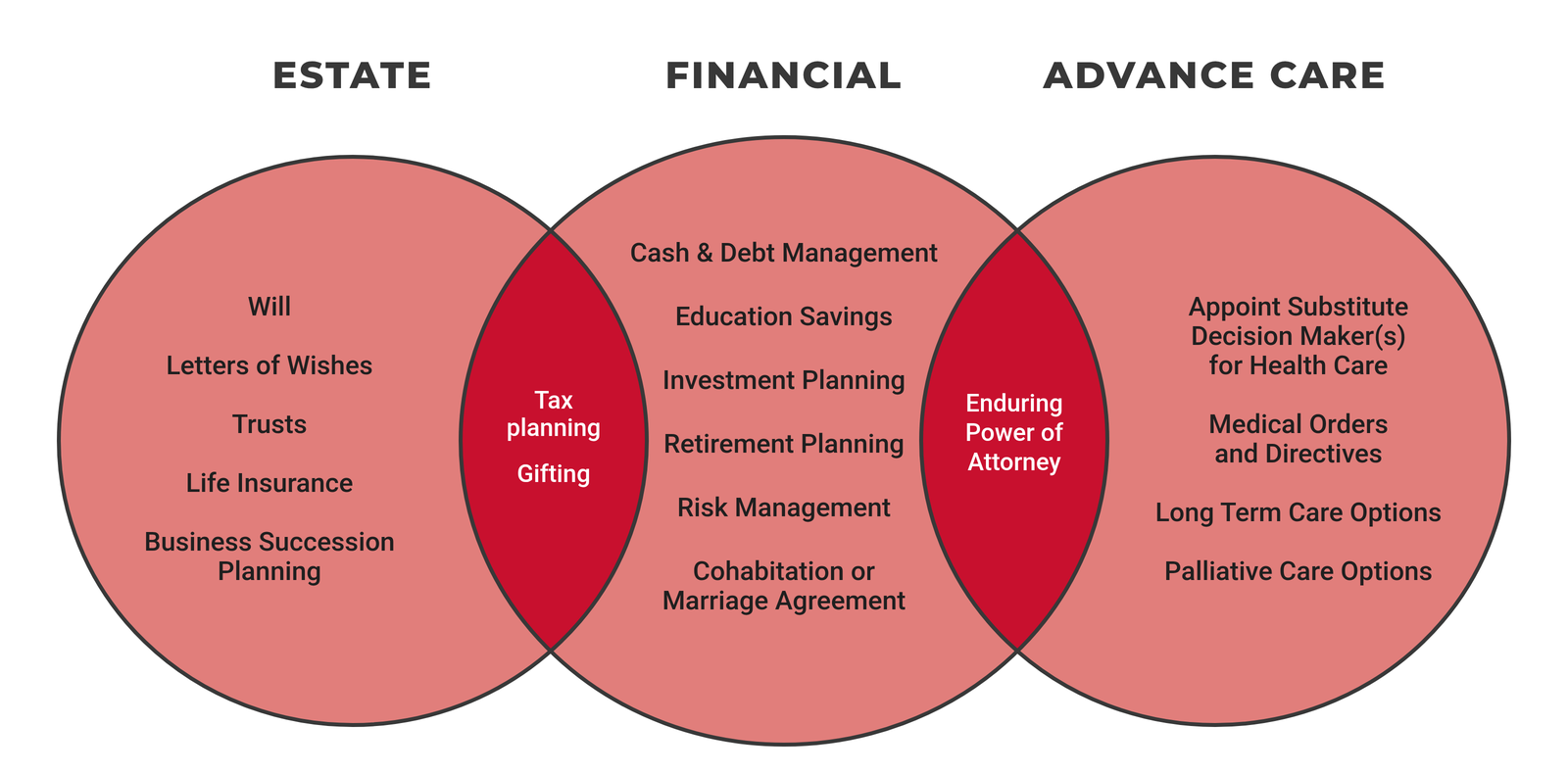
The Life Planning Model above illustrates that there are many areas in our lives we should carefully think about and plan for. As you can see from the model, making a Will is part of a much larger picture. Your professional advisors, which may include your lawyer(s), accountant, financial advisor, banker and others, can help you and your family ensure that your goals and objectives are met. Your goals may be family harmony, tax minimization, charitable gifting, living well as you age, etc.
Assets Inside and Outside Your Estate
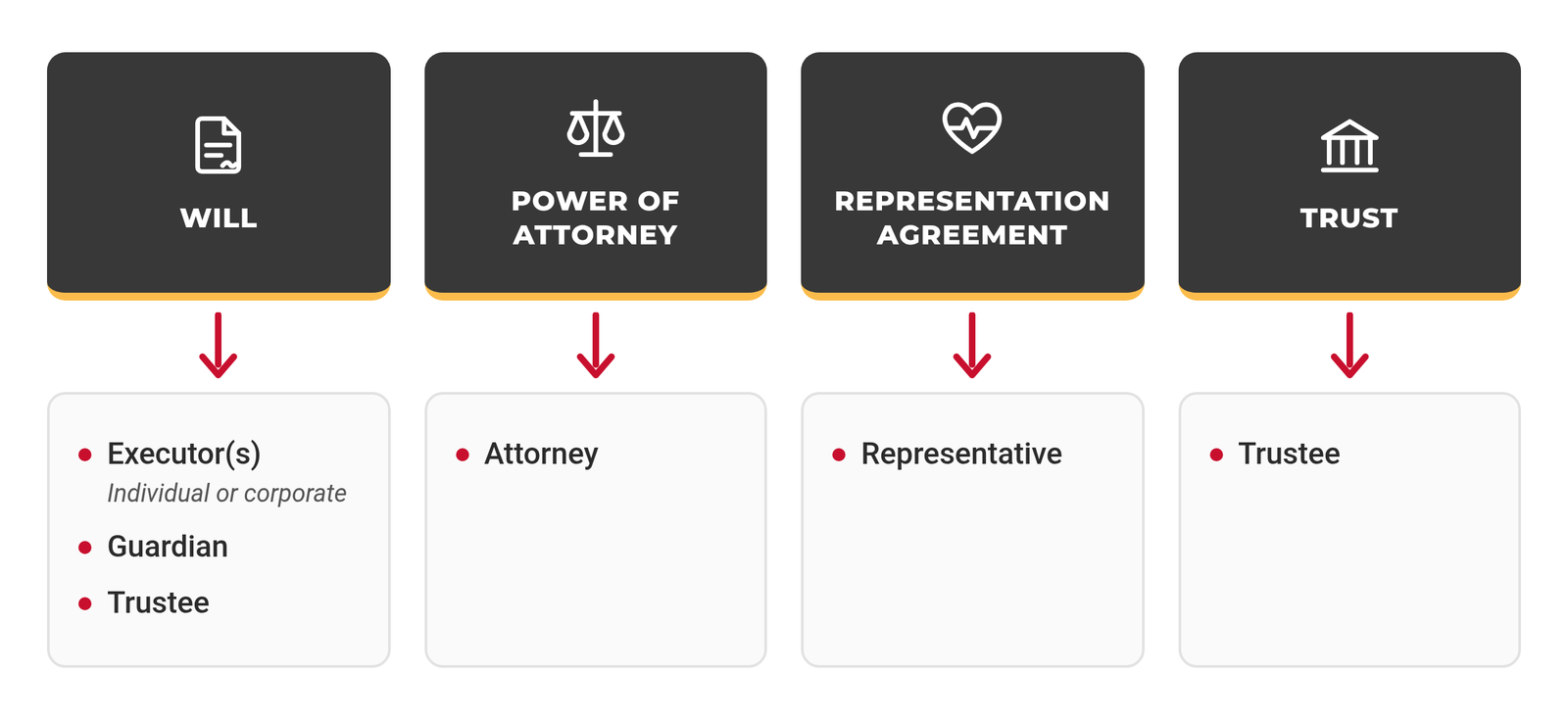
Your Will governs how assets inside your estate (typically, assets legally held in your sole name when you are alive) will be distributed on your death and provides instructions to your executor. Your Will does not generally govern how assets registered in joint tenancy (for example, joint bank accounts and real property held in joint names) and assets with named beneficiaries (such as life insurance proceeds, RRSPs, RRIFs, and TFSAs) will be distributed. Your Will needs to be carefully drafted because it will not take effect today and whether you did it right may not be known until decades down the road (unlike contracts or court pleadings). A Will is not a letter but is more like a flow-chart with numerous “what if” scenarios.
Estate Planning is an Investment
A Will should not be a document that you want to pay the least amount of money for; you have spent a lifetime building your wealth and assets, so your investment in an estate plan should be appropriate for your circumstances. You are paying a professional to consider many issues as part of the exercise of drafting your Will. Your lawyer is not a transcription service who will draft the Will you think you should have, but he or she should strive to understand your goals and objectives and inform you of your planning options and legal obligations.
Your Will is not your estate plan; your estate plan may include a Will but it may also include other strategies and documents that you may not have contemplated before. Sometimes more than one solution must be considered and over time, as a client’s goals or circumstances change, the plan will change and evolve. A plan for a young entrepreneur in her 30’s with young children should look vastly different from a newly divorced businessperson who recently sold her successful business and has adult children and grandchildren.
Considerations
When drafting your “simple” Will, your lawyer must consider many things, including:
- The possibility that a beneficiary or family member may be unhappy and start legal action against the estate;
- Whether vulnerable beneficiaries such as minor children or a family member with a disability will need a special trust established from assets in your estate;
- Whether you should minimize your estate during your lifetime;
- Which assets you should gift during your lifetime;
- Who will receive cash directly by being named beneficiaries of your registered accounts (RRSP, RRIF, LIF and TFSA) and whether your estate will have the ability to pay its tax liability once that cash goes directly to the beneficiaries (because those funds will bypass the estate entirely);
- How to balance your desire to minimize taxes and probate fees with your other objectives;
- In blended families, how assets should be distributed so that children from a previous relationship and current spouses are satisfied and estate litigation is minimized (this may be done in conjunction with a marriage agreement or co-habitation agreement);
- For the owner-manager who has a business or private company, business succession and tax minimization planning;
- Naming the appropriate executor(s) or corporate executor given the unique circumstances of your estate and family dynamics; and
- For clients who are residents in more than one country and who have assets in more than one jurisdiction, tax and legal advice from professionals around the world.
The above are merely examples. All estate planning should be customized for each individual and each family.

When you speak to a lawyer about your Will, you should be prepared to discuss many facets of your life, including your family relationships, how assets are held legally and beneficially and discuss which assets will fall in your estate and which assets will go directly to beneficiaries (for example, proceeds from an insurance policy or an RRSP). There are also probate fees and tax implications to consider and your professional advisors should discuss how your estate will pay those taxes and if there are ways to minimize or defer those taxes. For example, some assets may take longer to liquidate (like a private company or commercial real estate) but taxes will be owing so there should be a plan in place to ensure that the estate is not forced to accept an imprudent, quick sale.
I review many strategies with my clients to help achieve their objectives. This may include conversations about gifting while they are alive, setting up a trust now (rather than in their Will), drafting a letter of wishes, and selling assets and simplifying their lives. Often, I collaborate with a client’s accountant and financial professionals (investment advisor, banker, portfolio manager and/or insurance specialist).
Living Well and Planning Well
Your lawyer also knows that there is a possibility that you may become ill or injured during your lifetime, so other documents such as your Enduring Power of Attorney and Representation Agreement for health care should be put in place so that someone you trust can make financial, legal and health care decisions on your behalf. Note, these documents are invalid as soon as you die. Many of my clients would like to live well and not suffer as they age.
Accordingly, it is important to have conversations with your lawyer, friends, family and doctors about your advance care plan to ensure that when you are not able to speak for yourself due to physical or mental decline, your wishes, beliefs and values are heard and followed. Conversations about your advance care plan and what happens during your lifetime are as important as your estate plan. Planning well and living well often goes hand in hand.
Do Not Wait Too Long
One of the mistakes people often make is waiting too long to put their estate and advance care plans in place (or to update them). If you become incapable of providing instructions, then it will be too late to make a new Will, Enduring Power of Attorney and Representation Agreement for health and personal care. This also means you will no longer be able to restructure your assets or make any gifts during your lifetime. Finally, sophisticated plans often take many months to fully implement so it is best to ensure that your professionals have the time to carefully draft and consider your personal situation.
Who You Can Appoint in Your Estate Planning Documents