


In British Columbia, a power of attorney manages your financial and legal affairs while you are alive, while an executor manages your estate after you die. An enduring power of attorney can continue if you become incapable, but the authority of an attorney ends when you die, at which point the executor named in your will can act as your personal representative. Understanding these two roles can help you choose the right people to manage your affairs during your lifetime and administer your estate after death.
A power of attorney dies with you. The moment you pass, your attorney’s authority ends and your executor’s begins, and Onyx Law Group works both sides of that line. Sandy Minh Abley handles the incapacity planning while Veronica Manski leads probate and estate administration once a will takes effect, and the firm has been advising BC families on both since 2012. If you’re not sure which document you need, or whether the one you signed still does the job, book a free consultation with us today.
Today’s blog post will break down the key differences between the roles of attorney and executor, explain the distinct responsibilities and powers, and provide tips on how to choose the right people for these roles.
What Is the Difference Between Power of Attorney and Executor of Will?

Estate planning is particularly relevant in a province with an aging population. As of July 2025, 20.5% of British Columbia’s population was age 65 or older, according to Statistics Canada.
A power of attorney and an executor of a will have different roles in British Columbia because they operate at different stages of a person’s life and estate. A power of attorney allows someone you appoint to act on your behalf while you are alive, and the document grants authority over the matters you specify, including managing certain financial or legal matters within the authority you have granted. An executor, by contrast, is named in your will to administer your estate after your death.
The key difference is when each role has authority to act. Depending on its terms, a power of attorney may allow your attorney to manage your affairs during your lifetime, including if you later become incapable. In BC, an enduring power of attorney terminates when the adult who made it dies. At the principal’s death, the executor or other personal representative takes on responsibility for administering the estate.
The responsibilities are also different. An attorney must act within the authority granted by the power of attorney and comply with the applicable legal duties while acting on your behalf. An executor is responsible for administering and distributing your estate, which can include dealing with estate assets and debts, accounting to beneficiaries and creditors, and carrying out the terms of your will, subject to BC law.
Both documents are normally prepared during your lifetime as part of an estate plan, while you have the legal capacity to make them. In simple terms, a power of attorney is designed to help manage your affairs while you are alive, while an executor is responsible for dealing with your estate after you die.
What Is a Power of Attorney (POA)?

Power of Attorney, or “POA”, is a legal document. The POA document appoints a specific person you want to step in to make decisions and manage legal and financial matters on your behalf if you are not able to do so during your lifetime. The agent’s authority under a power of attorney ends when you die
The person you appoint in the POA document is called your attorney-in-fact, or simply your attorney. You can appoint one individual as your attorney, or more than one. If you choose to appoint more than one individual, the POA document should state whether they must make decisions together (joint authority) or separately (joint and several authority).
An attorney acting under a power of attorney has a fiduciary duty to act only for the benefit of the person who appointed them and not for his or her own profit, benefit, or advantage. These duties can also help protect against financial abuse by someone who misuses the authority granted under a power of attorney.
What Powers Does Your Attorney Have?
An attorney’s authority is granted for situations where you are unable to manage your own affairs (e.g., due to illness, injury, travel, or incapacity). They must make decisions and act in your best interests. Examples of tasks your attorney can handle include paying bills, selling real estate, managing business affairs and investments, and signing legal documents on your behalf.
Your attorney can’t make healthcare decisions on your behalf. A representation agreement is a legal document that allows you to appoint someone to make healthcare and personal care decisions on your behalf if you become incapable. Unlike a Power of Attorney, which covers financial and legal matters, a representation agreement deals with medical decisions, health care, living arrangements, and end-of-life decisions.
What Are the Types of Powers of Attorney?
British Columbia law recognizes different types of powers of attorney, each designed for a specific purpose. The type of POA you choose determines what authority your attorney has and when that authority can be used. Understanding the differences can help you choose the right document for your circumstances.
-
General Power of Attorney: Grants broad authority over financial and legal matters, but becomes invalid if you become mentally incapable.
-
Specific (or Limited) Power of Attorney: Unlike a General Power of Attorney, this type of POA document is used for a defined task, such as selling a house while you’re out of the country. It expires once that task is complete.
-
Enduring Power of Attorney (“EPA”): Remains effective even if you are no longer mentally capable. Without an EPA, your loved ones may have to go to court to be appointed as your committee through the BC Supreme Court, which can be a complex and expensive legal process involving court fees and other costs.
Each type has different legal and practical implications. Choosing the right one depends on your needs. If you’re unsure which POA suits your situation, seeking legal guidance is a smart move.
How to Create a Valid POA in BC
Creating a valid power of attorney (POA) in British Columbia involves several important steps. Following the proper process can help ensure your document reflects your wishes and meets BC legal requirements.
Step 1: Decide Who to Appoint
Choose a trusted family member, friend, or professional to act as your attorney and make decisions on your behalf. Consider their reliability, judgement, and ability to manage the responsibilities you give them.
Step 2: Define the Attorney’s Authority
Clearly state what your attorney can and cannot do under the POA. Include any limitations or conditions you want to place on their authority.
Step 3: Prepare the POA Document
The POA must be in writing and should clearly identify you, your attorney, and the powers being granted. A lawyer can help tailor the document to your specific circumstances and ensure it complies with BC law.
Step 4: Sign the Document Properly
Follow the required signing and witnessing rules when executing the POA. Depending on the type of authority being granted, additional formalities may apply.
Step 5: Address Real Estate Authority
If the POA gives your attorney authority over real estate, additional requirements may apply, including notarization or other formal execution requirements. These requirements should be confirmed before the document is signed.
Step 6: Keep the POA Safe and Accessible
Store the original document in a secure place and make sure your attorney knows where it can be found. You may also want to provide copies to relevant professionals or institutions when appropriate.
How Do You Make a Valid Will in BC?
It’s extremely important to ensure your last will and testament is a legally binding document made in accordance with BC law. If your will doesn’t comply with formal and legal requirements, it may be challenged after your death.
If your will is found to be invalid, your choice of executor and the wishes you expressed in your will won’t be given effect. We strongly recommend working with an experienced estate and trust lawyer to avoid the possibility of that distressing outcome.
What Is an Executor of a Will?

An executor is appointed in your last will, although the executor may need to obtain probate before exercising certain powers or dealing with particular estate assets. When you prepare your will, you select the person or people you want to manage your estate, carry out your final wishes, and distribute estate assets to the beneficiaries named in your will.
Your executor is the only person who has the legal and fiduciary responsibility to manage estate assets and administer your estate. It’s a time-consuming role that comes with many duties, which can become quite complex depending on the estate’s size and intricacies.
Your executor may need to file the will with the Supreme Court of British Columbia as part of a probate application through the probate court. Probate is a legal process that validates a deceased person’s will and gives the executor legal authority to act on behalf of the deceased person’s estate.
What Are an Executor’s Duties?
Being an executor in British Columbia comes with significant responsibility. The executor is responsible for administering the deceased person’s estate, protecting estate assets, paying debts and taxes, and ultimately distributing the estate according to the will. The specific steps can vary depending on the size and complexity of the estate.
One of the executor’s first responsibilities is to identify and protect the deceased person’s assets. This may include securing property, maintaining appropriate insurance, locating financial accounts, and determining whether a probate application is required. The executor must also pay valid debts and estate expenses and handle any required tax returns, estate taxes, and other taxes before distributing the estate.
Once these obligations have been addressed, the executor can distribute gifts to the beneficiaries named in the will. The executor is also responsible for distributing the remaining residue of the estate, which generally includes assets that were not specifically given to a particular beneficiary under the will.
Executors in BC must meet important legal duties when administering an estate, including acting honestly and in good faith and keeping appropriate records. They should also communicate appropriately with beneficiaries and exercise reasonable care and diligence. If an executor fails to properly carry out their responsibilities or engages in misconduct, beneficiaries or other interested parties may have legal options to challenge the administration of the estate.
How to Choose Between a Power of Attorney and Executor
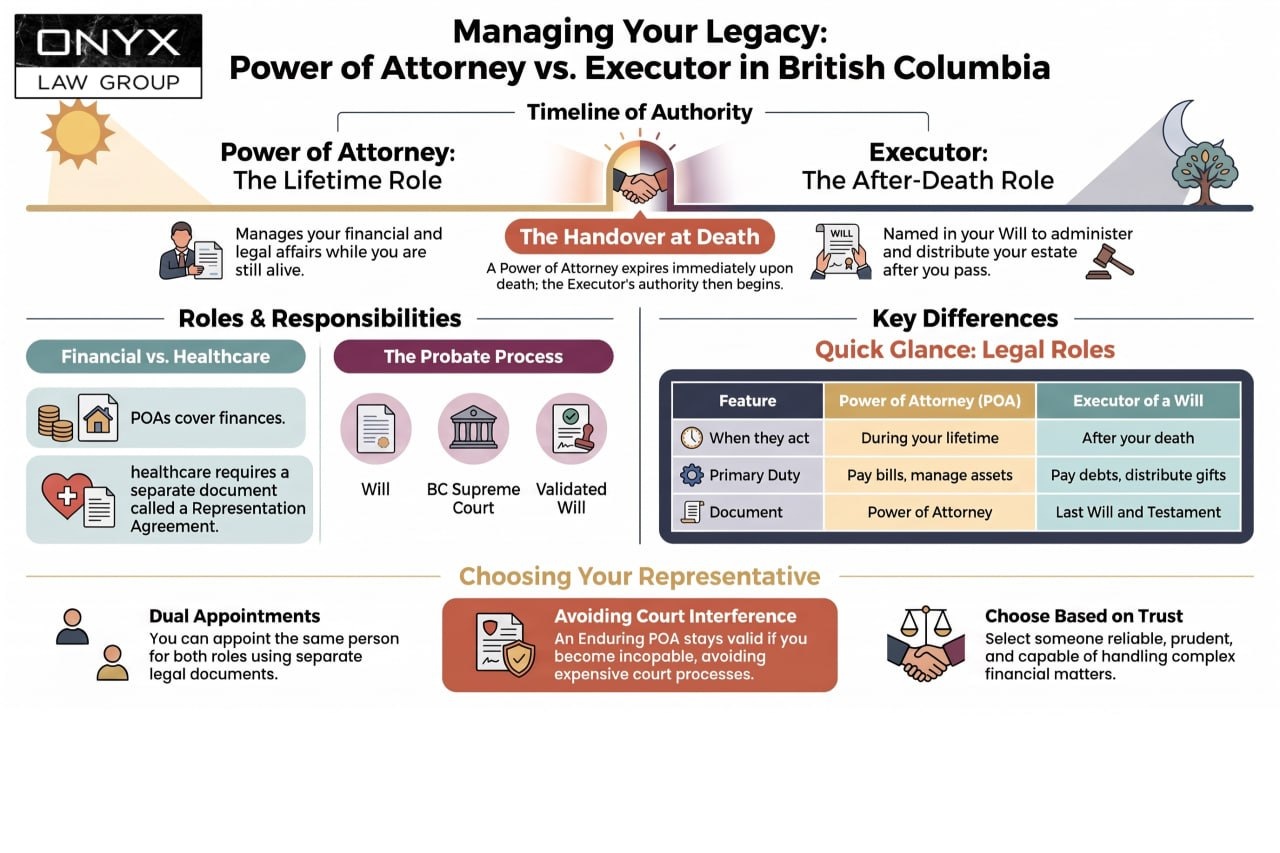
A power of attorney and an executor are not interchangeable, so you generally do not choose one over the other. Instead, you may want to appoint both as part of a complete estate plan. Your attorney can act on your behalf during your lifetime, while your executor is responsible for administering your estate and carrying out your wishes after your death.
You can appoint the same person to serve as both your attorney and executor, but the two roles must be created through separate legal documents. You would need a power of attorney that appoints the person as your attorney and a will that names them as your executor. For example, you could appoint your spouse to both roles, allowing them to act as your attorney during your lifetime and then take on the separate role of executor after your death.
Combining roles may lead to emotional and administrative burdens, particularly when the same person must manage both lifetime affairs and estate administration. Conflicts of interest may arise if the dual appointee is also a beneficiary, so it is important to consider whether that person can act fairly and manage potential disputes.
Tips for Choosing Attorneys and Executors

Choosing the right person for these roles requires careful consideration. The person or people you choose should be trustworthy, responsible, reasonably prudent, and capable of handling finances and financial matters. You can choose a family member, friend, or even a professional, such as a lawyer or a corporate trustee.
Practical considerations should also be weighed. Do they live in BC? Will they outlive you? Are they willing and able to take on the role? If you’re appointing more than one person, will they be able to work together and get along with other family members if a dispute or issue arises? Are they good at communicating and handling conflict, should a dispute or issue arise? Our legal professionals are here to guide you and help you make informed decisions about who to appoint.
Final Thoughts on Power of Attorney vs. Executor in Canada
A good estate plan covers your personal and financial affairs during your lifetime and after you’ve passed away. There is much to consider when it comes to estate planning, but the process will be greatly simplified when you have the right advice.
Not sure whether your power of attorney still protects you or what happens when it ends? A power of attorney generally ends when you die, at which point your attorney’s authority stops, and the personal representative of your estate takes over. At Onyx Law Group, Sandy Minh Abley focuses on incapacity planning, while Veronica Manski leads probate and estate administration, giving BC families access to legal guidance across both stages. If you are unsure whether your documents are up to date, book a free consultation with us today.
Frequently Asked Questions
A power of attorney and an executor serve different roles and have different legal authority. The FAQs below explain when each role applies, what powers they have, and how they differ under BC law.
Do I Need Both a Power of Attorney and an Executor of a Will?
They serve different purposes, so having both can provide broader protection and estate planning. A person granting a power of attorney can authorize an attorney to make financial decisions while they are alive, while an executor handles the estate after death.
What Is the Difference Between a Power of Attorney and an Executor?
An attorney appointed under a power of attorney can have significant authority over financial transactions, managing bank accounts, and other financial assets while the adult is living. An executor’s authority begins after death and involves estate management, including collecting estate property, paying obligations, and distributing the remaining assets.
Does a Power of Attorney Have Any Authority After Death?
Generally, no. An attorney’s authority automatically terminates when the adult dies, so the attorney cannot continue acting as the deceased’s agent. The executor or other personal representative then assumes responsibility for the estate, although they may need probate to access accounts or deal with certain financial institutions.
Can the Same Person Be Both My Attorney and My Executor?
Yes, the same trusted individual can serve as both attorney and executor. These remain separate legal roles, with the attorney acting for the living person and the executor managing the estate after death.
Does a Power of Attorney Cover Healthcare or Medical Decisions in BC?
A power of attorney generally provides financial power and authority over legal matters, not health-care decisions. A representation agreement may address personal and health-care matters, while professional guidance can help determine which documents are appropriate.
Do I Need to Go to Court for a Power of Attorney or an Executor?
A power of attorney does not normally require court approval simply for the attorney to act under the document. An executor may need to complete the probate process through the Supreme Court of British Columbia, but not every estate requires probate or court involvement.
Disclaimer: The information on this page is general legal information about British Columbia law, not legal advice for any specific situation. Reading this page does not create a solicitor-client relationship. BC law changes, and the procedure that applies to a specific situation depends on facts not covered here. For advice on your situation, consult a qualified British Columbia estate lawyer directly. Past results, illustrative scenarios, and reference to typical fact patterns do not guarantee similar outcomes in any specific case.