


No two marriages are exactly alike, yet British Columbia law generally applies a default 50/50 split of family property and debt when couples separate. Many couples feel uncertain about the process, especially when it comes to assets, spousal support, and broader financial arrangements. A prenuptial agreement is a legal document that states how you and your partner will deal with financial issues if your relationship ends.
Working with an experienced family law lawyer is the best way to protect yourself and what’s important to you. The family lawyers at Onyx Law Group have a deep understanding of the legal issues and challenges that can arise in marriage and divorce. We can help you craft a written prenuptial agreement tailored to your needs, goals, and circumstances. Reach out to us today for a consultation with one of our dedicated family lawyers.
In this blog, we will explain what a prenup is, how it works, how a written agreement can protect you, what it can cover, and how to prepare a legally binding prenuptial agreement, specifically in British Columbia under bc law, including how it compares to a cohabitation or prenuptial agreement.
What Is a Prenuptial Agreement?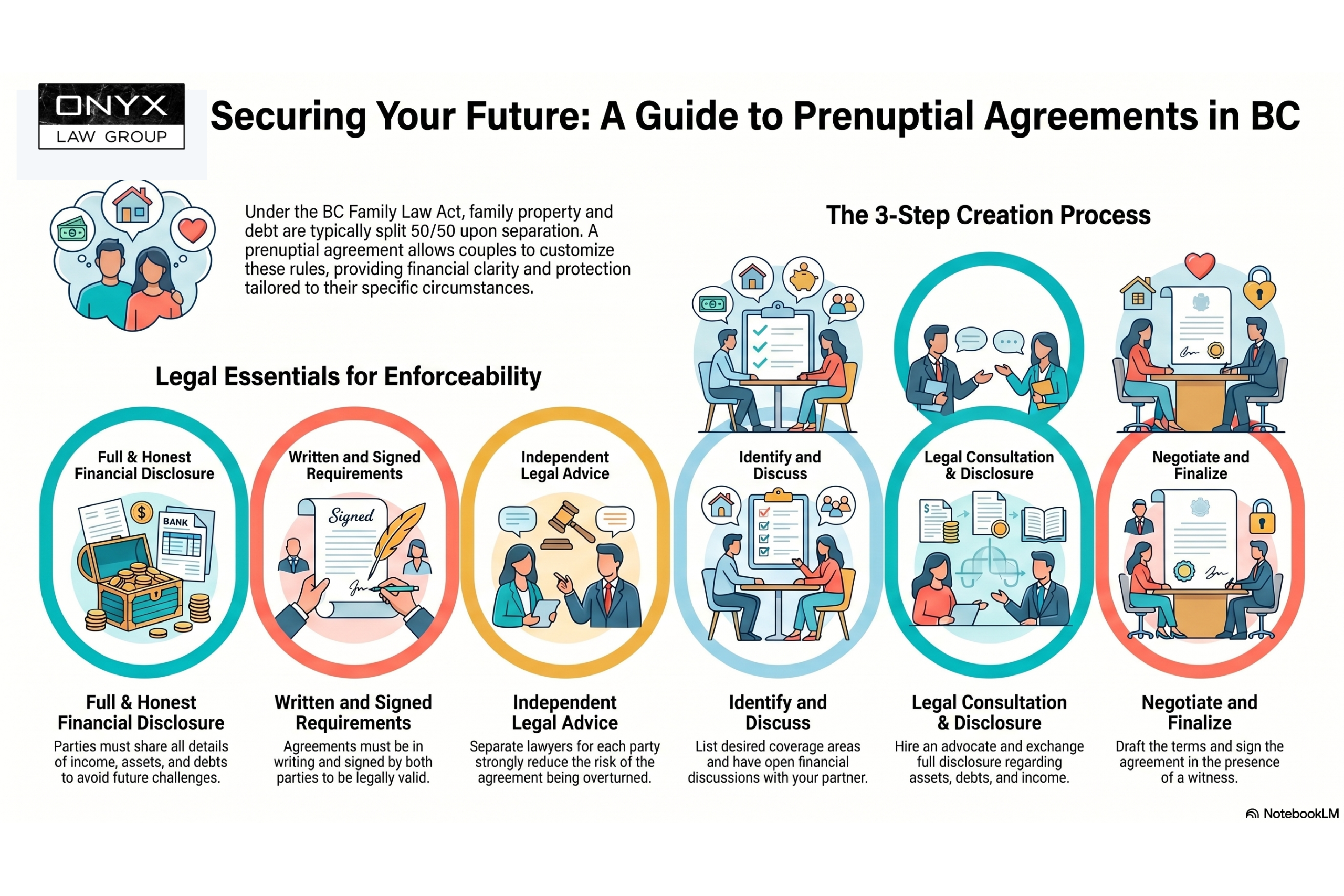
A prenuptial agreement in British Columbia is a written contract made before marriage, often called a marriage agreement, that outlines how finances will be handled if the relationship ends, helping couples set clear expectations and stay in control of all their assets. It can also contain your agreement about how you will deal with issues during your relationship (e.g., respective contributions to mortgage or other household expenses), including your overall financial circumstances and shared financial arrangements.
We used the term “prenuptial agreement,” but these types of agreements are also referred to as a cohabitation agreement (for those in a common-law relationship) or a marriage agreement. You and your partner can make an agreement before you start to live together or before you get married, including situations involving common-law partners. You can also make an agreement while living together or during your marriage (the latter is a postnuptial agreement), depending on the following circumstances.
What Are the Legal Requirements and Formalities for Prenuptial Agreements in BC?

A prenuptial agreement in British Columbia must be written to be legally valid under bc law. Oral agreements are not enforceable in this context, even for married couples. The document must also be signed by both parties to show clear consent and that it was entered into agreement willingly.
Full and honest financial disclosure is also required. Each person must share details about their income, assets, debts, and financial situation, including assets acquired and any owned property interests. Without proper disclosure, the agreement may be challenged or set aside later, especially in bc courts.
Independent legal advice is strongly recommended for both parties. This helps ensure each person understands their rights before signing. Failure to adhere to these formalities may lead a court to deem the agreement invalid and address key issues.
Timing also matters, as a prenup should be signed before marriage or cohabitation begins, especially for one party. If the parties do not adhere to these formalities, a court may rule the agreement as unfair or unenforceable under BC law.
How are Prenuptial Agreements Enforced and Challenged in BC?
In British Columbia, the courts enforce prenuptial agreements if they are fair, thoroughly prepared, and both parties understand what they are signing. The Family Law Act in BC typically upholds these agreements, provided both parties entered into them voluntarily, and they adhere to legal standards. The goal is to honor what the couple agreed to in advance.
However, a prenup can be challenged on certain grounds. Common issues include insufficient financial disclosure, pressure or duress during signing, or one party misunderstanding the terms. If one person hides assets or signs under unfair conditions, the court may set the agreement aside or change parts of it. Independent legal advice for each party helps reduce these risks and strengthens enforceability.
BC courts will closely review how the agreement was made, not just what it says. If the process were fair and transparent, the agreement would be more likely to stand. If it was rushed, unclear, or dishonest, it is more likely to be challenged successfully.
What Happens if You Don’t Have a Prenuptial Agreement?
If you don’t have an agreement in place and your relationship breaks down, you and your partner may be able to settle issues arising from your relationship in a different type of legal document, known as a separation agreement. The problem with waiting is that it’s often much more challenging to reach an agreement once your relationship has broken down, when tensions are high, and emotions are raw.
Separation laws state that if you cannot negotiate a separation agreement, you must apply to the court for a court order to resolve the disputed issues. A judge will decide matters for you, and the judge must apply the default BC family law regime.
Why Consider a Prenuptial Agreement in British Columbia?

We always remind clients, “A prenuptial agreement isn’t about expecting the worst but about creating clarity so both partners feel secure moving forward.” Prenuptial agreements in British Columbia are often misunderstood. It does not mean a couple expects their relationship to fail. It is also not only for wealthy couples. Instead, it is a practical way to plan for important financial and legal matters in a relationship.
Think of it like insurance. It provides clarity, protection, and peace of mind if things change in the future. Courts in British Columbia also support fair agreements between partners, since couples are often best placed to decide what feels fair for their situation.
Case example: Daniel and Melissa decided to get a prenuptial agreement before marrying in British Columbia. Daniel owned a small business, and Melissa had investments and expected an inheritance. With help from a lawyer at Onyx Law Group, they listed their assets, shared full financial disclosure, and each got independent legal advice. Their lawyer helped them draft and sign a clear, written agreement before the wedding. Years later, they separated. The agreement held up under BC law due to the proper execution of all procedures. It clearly set out how property would be divided, which avoided conflict and a costly court battle.
How Do Prenuptial Agreements Affect Divorce and Separation in BC?
At the start of this post, we explained that British Columbia family law applies default rules when couples separate. Under the BC Family Law Act, relationships are treated as economic partnerships. This means family property and family debt are usually divided equally, from the start of the relationship to the date of separation, no matter whose name is on the asset.
A Prenuptial Agreement in British Columbia allows couples to change these default rules. It gives spouses the ability to decide in advance how property and debt will be divided in a way that feels fair to them.
It can clarify what remains separate, protect assets brought into the relationship, and safeguard things like pensions, business interests, investments, or inheritances. It can also address what happens to property in the event of death, which is especially important in blended families.
Prenuptial agreements can also deal with spousal support. BC law allows for support claims after separation in both marriages and common-law relationships. A prenup can waive spousal support rights or set clear terms for when support would apply, including amount and duration. In this way, a prenuptial agreement gives couples more control and certainty if the relationship ends.
What Can’t Be Included in a Prenuptial Agreement?

We just discussed what can be included in a prenuptial agreement. Now, let’s talk about what can’t. First, a prenuptial agreement can’t deal with custody or access to children, nor can it deal with child support:
- Section 148 of the BC Family Law Act states that child support agreements are only binding if made after separation or in anticipation of separation, only to become effective after separation.
- Section 44 says the same about agreements respecting parenting arrangements.
The rationale for these prohibitions is that decisions about the care and support of children must be made based on what is in their best interests, including matters like child custody. That can’t be predetermined, especially in the following circumstances where needs may change.
Second, a prenuptial agreement should not include clauses that would be considered illegal (not in compliance with the general principles in BC family law and Canada’s Divorce Act), immoral, or unconscionable (e.g., a clause relating to fidelity that says there is no entitlement to spousal support if one spouse commits adultery); or significantly unfair (e.g., the agreement says one spouse gets nothing from the wealthier spouse, but then they have children together).
Is a Prenuptial Agreement Legally Binding in BC?
A prenuptial agreement is legally binding in British Columbia provided it meets certain legal requirements. At its most basic, a prenuptial agreement must be in writing, signed by both parties, and witnessed to be legally binding.
Beyond those basic legal requirements, other important elements make a prenuptial agreement valid and legally enforceable. An agreement may not be legally binding and can be set aside by the court if:
- One spouse or both spouses misrepresented their financial situation or failed to make a full financial disclosure (current assets, debts, income, etc.)
- A spouse was pressured or coerced into signing the agreement
- A spouse was not given enough time to review, understand, and negotiate the agreement before the marriage (e.g., a prenuptial agreement presented the morning of the wedding)
- The agreement does not comply with the BC Family Law Act and Canada’s Divorce Act (e.g., an online template agreement that is based on the laws of another province or state).
- One spouse took improper advantage of the other spouse’s vulnerability in terms of ignorance, need, or distress.
Independent legal advice is another key element. Strictly speaking, there is no legal requirement for parties to obtain independent legal advice in British Columbia before signing a prenuptial agreement. However, the court can easily challenge and set aside an agreement signed without independent legal advice.
Can a Prenuptial Agreement Be Challenged After Marriage?
A prenuptial agreement can be challenged in court. If the court challenge is successful, the agreement can be set aside in whole or in part and replaced with a court order that may differ significantly from the written agreement.
The Family Law Act contains the grounds for setting aside an agreement respecting property division (section 93) and the grounds for setting aside an agreement respecting spousal support (section 164). The most common grounds for challenging a prenuptial agreement in court include lack of full disclosure, lack of independent legal advice, fraud, misrepresentation, and duress or coercion
The court can also intervene if the agreement is significantly unfair. The significant unfairness test considers factors such as the length of time that has passed since the agreement was made and the degree to which the spouses relied on the terms of the agreement.
Do Both Parties Need a Lawyer for a Prenuptial Agreement?
A prenuptial agreement in British Columbia can technically be prepared without a lawyer, but this often leads to mistakes or unclear terms. Without proper legal guidance, one or both parties may agree to unfair terms or miss important issues. In certain instances, the court may nullify the agreement if it deems it improper or lacking full disclosure.
The best approach is for each party to have its own lawyer. Independent legal advice helps both people understand their rights and the impact of the agreement. Family lawyers also ensure full financial disclosure and help create a clear, fair, and enforceable contract. This greatly reduces the risk of future disputes.
How to Create a Prenuptial Agreement in British Columbia
Rupinder Shoker, a family lawyer at Onyx law Group regularly tells clients, “A properly prepared prenup can save couples significant stress, time, and legal costs if the relationship ends.” The general steps involved in creating a prenuptial agreement in British Columbia are as follows:
- Step 1: Make a list of the issues you want the agreement to cover
- Step 2: Have an open and honest discussion with your partner to find out where you’re on the same page and where you need some help to reach an agreement
- Step 3: Hire one of the family law lawyers at Onyx Law Group for advice on your rights, obligations, and legal interests, and so that you have an advocate for your views and wants
- Step 4: Exchange financial disclosure with respect to assets, debts, and income
- Step 5: Negotiate, draft, and review the agreement
- Step 6: Finalize and sign the agreement in the presence of a witness.
Following those steps is the best way to get a customized prenuptial agreement that is fair and enforceable should your relationship break down.
Prenuptial Agreements vs. Separation Agreements in British Columbia
A prenuptial agreement in British Columbia is made before marriage, while a separation agreement is created after a couple separates. A prenup is used to plan and set out how assets, debts, and financial responsibilities will be handled if the relationship ends. A separation agreement, on the other hand, deals with real issues after separation, such as property division, support, and parenting arrangements.
Each agreement applies at a different stage of the relationship. A prenup helps couples set expectations early, before marriage or cohabitation. A separation agreement is used when the relationship has already broken down, and both parties need clear terms to move forward. In short, one is about planning for the future, while the other is about resolving the present situation.
A separation agreement can also update or replace a prenuptial agreement if the couple later separates. Both documents should be written clearly and signed by both parties to be valid. It is also important that each person gets independent legal advice to ensure the agreement is fair and enforceable.
Consult a Family Lawyer for Your Prenup in British Columbia
Protect yourself by consulting a dedicated family lawyer at our British Columbia law firm before you agree to anything. Your lawyer can ensure you understand the applicable laws and that you have received full financial disclosure, both of which are essential to the question of whether a proposed prenuptial agreement is fair.
Without an experienced family lawyer on your side, you may not be able to protect yourself, your assets, and your family. Onyx Law Group’s lawyers use detailed knowledge and years of experience to find creative approaches to even the most challenging legal situations. Contact us today.
Frequently Asked Questions
Planning a prenuptial agreement in British Columbia can help you and your partner clearly define financial expectations before marriage. This FAQ section answers common questions in simple terms so you can better understand your rights and options.
How Much Does a Prenup Cost in BC?
The cost of a Prenuptial Agreement in British Columbia depends on how complex your financial situation is and whether each party hires separate lawyers. In most cases, it typically ranges from about $1,000 to $5,000 or more, with more complex assets like businesses, investments, or multiple properties increasing the overall cost.
Can I Change My Prenuptial Agreement After Marriage in BC?
Yes, if you and your spouse agree, you can change some or all of the agreement. In fact, a well-drafted prenuptial agreement will contain terms allowing for review of the agreement in the future if circumstances change (you have children, your financial situation changes, one of you becomes ill, you start a new business or acquire new property, etc.).
What Happens if I Don’t Get Independent Legal Advice Before Signing?
The agreement may still be valid, but it is easier for one party to challenge it in court. Independent legal advice helps show that both parties understood what they were signing.
Are Prenuptial Agreements Enforceable in British Columbia?
Yes, they are generally enforceable if they are fair, properly signed, and made with full financial disclosure. Courts may set them aside if they are found to be unfair or improperly prepared.
How Do Prenuptial Agreements Affect Spousal Support?
A prenup can outline how spousal support will be handled, including limiting or waiving it. However, courts can override these terms if they are considered unfair at the time of enforcement.
Do I Need to Disclose All Assets in a Prenuptial Agreement?
Yes, full and honest disclosure of all assets and debts is very important. Failing to do so can make the agreement invalid or unenforceable.
Disclaimer: The information provided on this blog is for general informational purposes only and does not constitute legal advice. Reading this content does not create an attorney-client relationship. Laws and regulations vary by jurisdiction and may change over time, so you should consult a qualified family law attorney directly for advice regarding your specific situation. Past examples, case studies, or hypothetical scenarios are illustrative only and do not guarantee similar results.