


Getting a divorce in British Columbia usually starts with court filing fees that range from about $290 to $330. You may also need to pay for things like a process server or a notary if you are handling paperwork without a lawyer. Because every situation is different, it is important to speak with a family lawyer to get a clearer idea of the total cost based on your specific circumstances.
Our experienced divorce and family law lawyers at Onyx Law Group have the expertise and knowledge to help guide you through the process of a divorce and answer any questions you may have regarding the cost of divorce in BC. Contact us today to schedule a consultation and get the competent legal advice you need during a divorce.
In this guide, you will learn how much it costs to get a divorce in BC and get pro tips on how to minimize the costs.
Breakdown of Divorce Costs in BC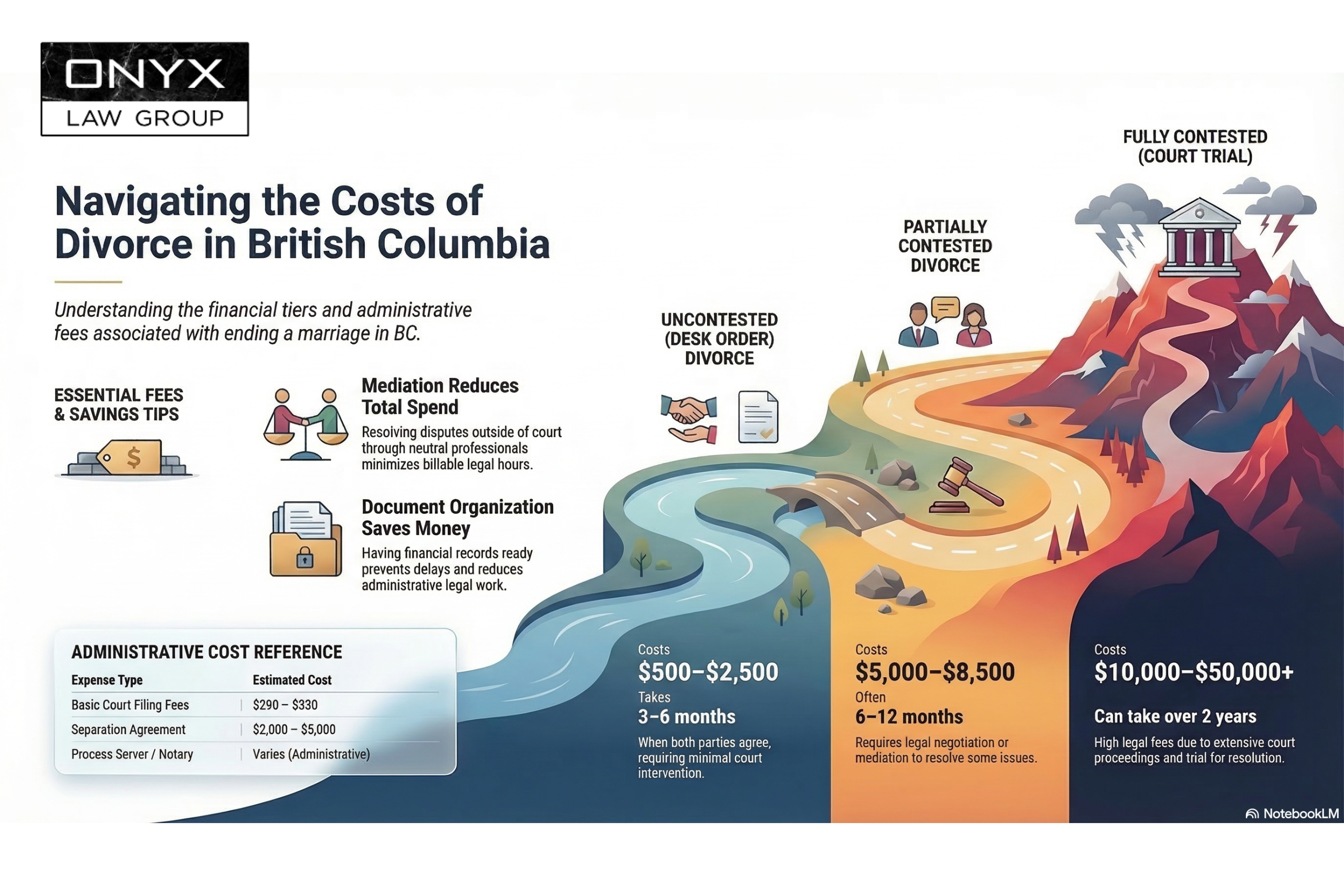
Statistics Canada reveals that Canada granted nearly 43,000 divorces in 2020, marking the lowest annual total in nearly 50 years. Depending on the steps involved and the need for legal help, divorce costs in British Columbia can vary.
Most people begin with basic court filing fees, which usually range from about $290 to $330 as part of the court process. If you hire a lawyer, legal fees often make up the largest portion of the total divorce cost. Some couples also choose mediation, which can cost several hundred to a few thousand dollars, depending on how much time is spent in sessions.
“Every divorce is unique, so the costs can vary widely. We work closely with our clients to give them a realistic picture of what to expect, so there are no surprises along the way.” – Onyx Law Group Team
There are also smaller administrative expenses that can add up during the process. For example, you may need to pay a process server to serve documents to your spouse or a notary to confirm affidavits sworn if you are filing paperwork yourself. Government filing fees remain fairly consistent across the province, but professional services such as lawyers, mediators, or document preparation can vary depending on the many factors involved in the complexity of the case.
Another key factor that affects the total cost is whether the divorce is uncontested or contested. An uncontested divorce, where both spouses agree on major issues, is often handled through a desk order divorce process and may cost roughly $500 to $2,500 if paperwork is handled efficiently. A contested divorce, however, can cost significantly more because of legal negotiations, court appearances, and extended timelines that may lead to an undefended divorce if one party does not respond. In these cases, total costs can range from around $5,000 to $8,500 or more, depending on how complex the situation becomes.
| Type of Divorce | Average Cost Range | Typical Duration | Legal Assistance Needed | Pros and Cons |
|---|---|---|---|---|
| Uncontested Divorce (Desk Order) | $500–$2,500 | About 3–6 months | Optional but often helpful for document review | Pros: Lower cost, faster process, less conflict.
Cons: Only works when both spouses agree on key issues like property, support, and parenting. |
| Divorce with Separation Agreement | $2,000–$5,000 | About 4–8 months | Usually involves a lawyer to negotiate and draft the agreement | Pros: Clear agreements before filing, reduces court involvement.
Cons: Legal drafting and negotiation can increase upfront costs. |
| Partially Contested Divorce | $5,000–$8,500 | About 6–12 months | Lawyers often need to resolve disputes through negotiation or mediation | Pros: Issues can still be settled without a full trial.
Cons: More time and legal work compared to an uncontested divorce. |
| Fully Contested Divorce (Court Trial) | $10,000–$50,000+ | 1–2 years or longer | Strongly recommended to have full legal representation | Pros: The Court resolves complex disputes if an agreement is impossible.
Cons: This is the most expensive and time-consuming option, resulting in higher stress and legal fees. |
Factors That Influence the Cost of Divorce in BC

The total cost of a divorce in British Columbia depends on many factors. One of the biggest factors is the complexity of the case. Divorces that involve property division, parenting arrangements, or spousal and child support usually take more time to resolve. If there are high-value assets, such as a family business or multiple properties, experts may be needed to assess their value, which can increase overall costs and may require additional documents to prove financial details.
Legal representation also plays a major role in the final price. Some family lawyers charge an hourly rate, while others offer flat fees for specific services like reviewing documents or preparing an uncontested divorce application. A do-it-yourself approach may seem cheaper at first. However, mistakes or missing paperwork can lead to delays and additional expenses later, especially if documents must be filed in person or corrected. Working with a lawyer often helps streamline the process and avoid costly errors.
The way disputes are handled can also impact how much you spend. Negotiation, mediation, and collaborative family law are often more affordable options than going to trial and can help couples pursue an amicable divorce. These methods focus on resolving disagreements outside of court. When couples can reach separation agreements early, they usually save both time and money while reducing stress.
Finally, the length of the divorce process can affect the overall cost. Cases that drag on due to disagreements or procedural delays often require more legal work and additional steps to obtain court approval. Location can also influence fees, as legal services may vary between larger cities and smaller communities across the province. Understanding these factors can help you better prepare for the financial side of a divorce.
How to Minimize Divorce Costs in BC
Divorce can be expensive, but there are practical ways to keep costs under control in British Columbia. Here are some actionable tips:
- Pursue an Uncontested Divorce: When both spouses agree on key issues like property division, parenting arrangements, and support, the process is usually faster and much less expensive. This may happen after spouses have been separated, which is often required before couples can be divorced under Canadian law. Fewer disputes mean less legal work and fewer court filings.
- Use Mediation and Alternative Dispute Resolution: We regularly advise our clients, “Choosing mediation or an uncontested divorce when possible can save both time and money.” Working through disagreements with a neutral professional can also help address separation issues before they escalate. Mediation sessions reduce stress, save time, and help couples reach practical solutions more quickly.
- Prepare and Organize Your Documents: Having financial records, property details, and other important documents ready can save hours of legal work. Keeping your documents organized not only streamlines your lawyer’s work but also reduces overall fees, facilitating the explanation of key details and preventing delays.
- Consider Self-Representation for Simple Cases: If your divorce is straightforward, with no children or significant assets, self-representation can cut legal costs. Even then, it’s wise to consult a lawyer if questions arise or if you need help addressing matters involving the other spouse.
- Maintain Clear Communication with Your Lawyer: Respond promptly, provide requested documents quickly, and focus on realistic solutions. Staying organized and cooperative keeps the process efficient and can prevent delays during the year immediately following separation.
Related Legal Costs: Wills and Probate in BC

After a divorce, it’s important to consider related legal costs like wills and probate in British Columbia. Making or updating a will usually involves lawyer fees, which can range from a few hundred to a couple of thousand dollars, depending on complexity. Probate, the process of validating a will after death, also comes with fees based on the value of the estate. Understanding these costs helps divorcees plan their finances and protect their assets.
Divorce can affect inheritance and estate planning. Former spouses may still have claims to your estate if you fail to update your will after a separation. These circumstances can lead to disputes, delays, and extra legal costs during probate. By planning and obtaining proper legal advice, you can ensure the distribution of your assets in accordance with your wishes and mitigate unexpected financial burdens.
What Is the Divorce Process in British Columbia?
Divorce is the only way to legally end a marriage. Assuming you are eligible to apply for divorce in BC, the process is governed by the Family Law Act and starts by filing specific court forms, paying court fees, and serving documents on your spouse.
An application to the Supreme Court of British Columbia is necessary even if you use the uncontested divorce process (contested and uncontested divorces are discussed in the next section). Divorce is uncontested when you and your spouse agree that you want to divorce and have settled all outstanding issues, such as parenting, support, property, and debt.
If one spouse does not want a divorce or you and your spouse can’t agree on the outstanding issues arising from your marriage, you’ll need to resolve those issues by negotiation, mediation, or a trial before you can get a divorce order.
Types of Divorce in British Columbia

There are two main types of divorce in British Columbia: uncontested and contested. Each has its own process and requirements depending on whether spouses agree on key issues.
- Uncontested Divorce
An uncontested divorce happens when both spouses agree on parenting, child support, spousal support, and property or debt division. It’s also called an undefended or desk order divorce. Most divorces in BC are uncontested, and the judge can issue the divorce order without either spouse appearing in court.
To start, file a Notice of Family Claim (F3) in the BC Supreme Court along with supporting documents, including a completed Registration of Divorce Proceedings form, such as your original marriage certificate, separation agreement, and any Court Orders. Documents must be served on your spouse unless you file a Notice of Joint Family Claim (F1). If your spouse doesn’t respond within 30 days, you continue by submitting affidavits, a Certificate of Pleadings, and a draft Divorce Order.
- Contested Divorce
A contested divorce occurs when spouses cannot agree on one or more issues, like determining the custody of a child, spousal support, or property division. This type is also called a defended divorce and involves more steps, time, and legal work.
The process begins the same way as an uncontested divorce by filing a Notice of Family Claim (F3). If your spouse disagrees, they file a Response to Family Claim (F4) within 30 days. Both parties submit Financial Statements, and unresolved issues may go to trial. Lawyers often negotiate or use alternative dispute resolution first. If settlement fails, a Judicial Case Conference (JCC) or court hearings may be necessary to set interim orders and move toward a trial.
The Role of Legal Advice in Divorce
Getting legal advice in British Columbia isn’t just about knowing your rights; it’s about protecting your future. Even in peaceful divorces, decisions about parenting time, support payments, and property division need careful thought. A family lawyer can help you understand the long-term impact of each choice, so you avoid costly mistakes.
“Our goal is always to help clients achieve a fair resolution and gain peace of mind, so they can confidently move forward with their lives.” – Onyx Law Group Team
Lawyers also provide guidance when emotions run high. Divorce can be stressful, and having someone grounded and strategic by your side makes the process smoother. You’re not just paying for paperwork, but you’re investing in peace of mind and a clearer path forward.
In one situation, a couple in British Columbia disagreed over property division and support. With guidance from their lawyers, they were able to reach a fair resolution through the court, including spousal and child support arrangements. Both parties left the process satisfied, allowing the family to move forward with stability and peace of mind.
Need a Good Divorce Lawyer in BC?
Divorce in British Columbia can cost anywhere from a few hundred to several thousand dollars, depending on factors like filing fees, legal advice, child custody issues, and whether the divorce is contested or uncontested. Furthermore, the cost largely depends on the uniqueness and complexity of your case. However, working with an experienced divorce lawyer can help you understand your options, manage costs effectively, and ensure your rights are protected throughout the process.
Whether you are just starting the process or are in the middle of a difficult separation, Onyx Law Group’s experienced Vancouver divorce and family law lawyers can help you navigate the legal system and craft the best solution for your specific circumstances. Our goal is to help you achieve a positive outcome that allows you to confidently move forward in your life. Contact us today!
Frequently Asked Questions
If you’re considering filing for a divorce in BC, you’re probably wondering what it’s all going to cost and where those costs come from. Below are direct, easy-to-understand answers to some of the most common questions about divorce costs.
How Much Does It Cost to File for Divorce in BC?
Filing for divorce in British Columbia typically costs about $290 to $330. This includes the Supreme Court filing fee and a small court registry fee. These costs are standard whether you’re filing on your own or with a lawyer, and they apply to both contested and uncontested divorces.
Can I get a divorce without a lawyer in BC?
Yes, you can file for divorce on your own if the case is simple and uncontested. However, getting legal advice can help you avoid mistakes and ensure your paperwork meets court requirements.
What Are the Hidden Costs of Divorce in BC?
Hidden costs can include document preparation, service fees, notarizing affidavits, and additional court filings. These expenses may add up over time, especially if the process becomes more complicated.
How Long Does It Take for a Divorce to Be Finalized in BC?
The timeline depends on how complex the case is and whether both spouses agree on major issues. In straightforward cases, a divorce can sometimes be finalized within a few months after the paperwork is submitted.
Are There Ways to Reduce My Divorce Expenses?
Yes, choosing mediation or an uncontested divorce can significantly reduce legal fees and court costs. Staying organized and resolving issues early also helps limit the time and money spent on the process.
How Much Does It Cost to Get a Divorce in BC?
In British Columbia, basic court fees for filing a divorce range from $290 to $330. Additional costs, like hiring a process server or a notary for affidavits, may apply if you’re not using a lawyer.
Disclaimer: The information provided on this blog is for general informational purposes only and does not constitute legal advice. Reading this content does not create an attorney-client relationship. Laws and regulations vary by jurisdiction and may change over time, so you should consult a qualified family lawyer directly for advice regarding your specific situation. Past examples, case studies, or hypothetical scenarios are illustrative only and do not guarantee similar results.