


International divorce in Canada can involve added legal issues when spouses live in different countries, are married abroad, or own assets outside Canada. In British Columbia, a court can generally grant a divorce if either spouse has been habitually resident in the province for at least one year before starting the proceeding. Cross-border divorces may also raise issues involving property division, child custody and parenting, support, and whether Canadian orders or divorces will be recognized in another country.
Cross-border divorces often turn on which country’s court takes jurisdiction first, and that single question shapes everything that follows about property and support. Judith Janzen leads family law at Onyx Law Group, has appeared in reported decisions at both the BC Supreme Court and the Court of Appeal, and received the CBA BC branch’s President’s Medal in 2009. If your marriage crosses borders and you’re not sure where to file, contact us today for an initial consultation.
Today’s article will explain how international divorce works in Canada, including BC jurisdiction rules, overseas marriages, foreign assets, parenting issues, support, and recognition of divorce orders in other countries.
How Does International Divorce in Canada Work?

In our province, the family law system is governed by two main laws: the British Columbia Family Law Act and the federal Divorce Act. Both laws contain rules and procedures that may apply to your divorce proceedings. Depending on the issues at stake in your divorce, the Hague Convention and foreign divorce laws (laws from another country) may need to be considered.
Other BC laws may also apply (e.g., the Court Order Enforcement Act and the Interjurisdictional Support Orders Act). You should contact a lawyer specializing in international divorce for advice on which laws apply in your specific situation.
What Are the Legal Considerations for Expats and Non-Residents?
If you live outside Canada or your spouse is a non-resident, you may still be able to get a divorce in Canada. However, eligibility depends on factors such as where you and your spouse live and whether a Canadian court has jurisdiction over your divorce. Understanding these rules first can help you avoid delays and determine whether Canada is the right place to start your divorce.
Statistics Canada reports that 29.0% of British Columbia’s population was foreign-born in the 2021 Census, representing about 1.43 million people. This makes cross-border family-law issues particularly relevant in a province with a large immigrant population.
Foreign Marriages and Their Validity in Canada
A marriage that was legally performed in another country is usually accepted as valid in Canada, though there are exceptions, for example, due to the young age of a spouse at the time of marriage. If your marriage wasn’t a legal marriage ceremony or is deemed not to be legal in accordance with Canadian law, you may not need a divorce order to end it.
If your foreign marriage is recognized as legally valid in Canada and you meet BC’s eligibility requirements, you can use the BC court to get a divorce.
Do You Already Have a Valid Foreign Divorce?
A divorce order made in a foreign jurisdiction is typically recognized in Canada if either spouse is habitually resident in the jurisdiction that made the order (the wording the Divorce Act used before the 2021 amendments was “ordinarily resident”). If at least one spouse resides in the country that made the divorce order for at least one year before divorce proceedings were started in that country (see s. 22 of the federal Divorce Act), they are considered “habitually resident” there, and the divorce order made in that country will be given effect in this province.
If the residency requirement is not met, the divorce order may still be recognized in Canada if the spouse who obtained the foreign divorce can show a real and substantial connection with that country at the time the divorce order was granted. A real and substantial connection can be shown by factors such as citizenship or ownership of property in that country.
There are exceptions to recognition of foreign divorces in Canada. For example, if the other country’s divorce laws contravene Canadian public policy or one spouse didn’t receive notice of the foreign divorce proceedings, Canadian courts may not recognize a divorce decree issued abroad.
What Are the Challenges in International Divorce in Canada?
There are many potential challenges in international divorce cases. In addition to language differences and differences in culture, policy, and religion, there are also logistical issues (for example, service of divorce papers on an overseas spouse) and practical difficulties (for example, locating and valuing foreign property or assets).
You will need to navigate foreign court rules and procedures, as well as divorce laws that may differ from Canadian divorce laws. The laws that apply in your case can have a very significant impact on the outcome. A prenuptial agreement or separation agreement signed in one country may not be recognized in Canada.
Property rights, such as the right to division of net family property, and spousal support entitlement can differ widely from country to country. It’s so important to understand the laws of the countries involved, as they can have very significant financial implications.
Child custody and child support are more complex in international divorces. Issues such as who the children will live with, relocation to another country, and enforcement of child support orders in another country may arise. Matters such as international child abduction and attempts by one parent to unilaterally change a child’s country of residence should be handled by a family lawyer with expertise in handling international divorce cases.
Which Approach Is Best for an International Divorce?
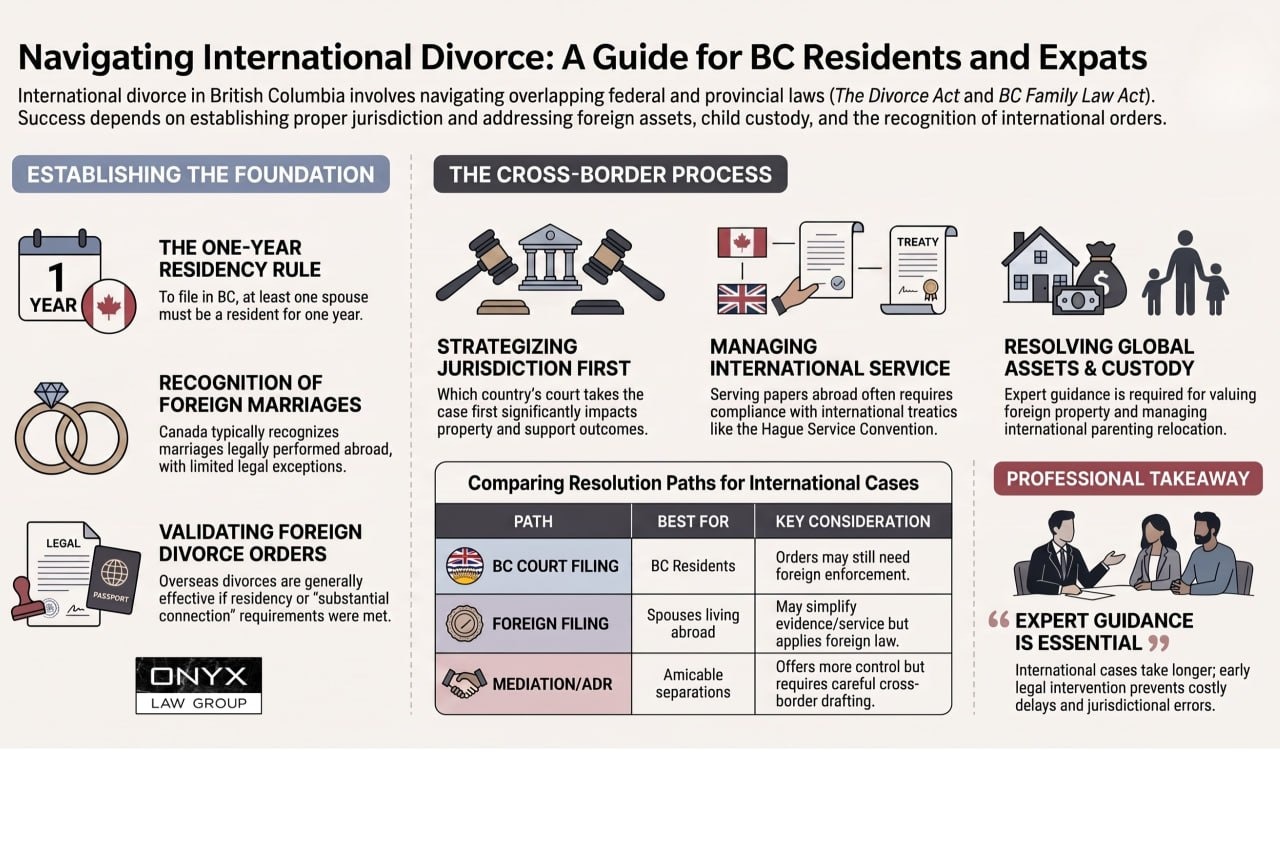
When a divorce involves more than one country, the choice of where and how to proceed can affect your time, costs, and legal rights. The right option depends on factors such as residency, foreign assets, children, and whether you and your spouse can reach an agreement.
|
Option |
Potential Benefits |
Potential Trade-Offs |
|---|---|---|
|
Divorce in BC |
A BC court can address divorce and related issues when its jurisdictional requirements are met. This may be convenient if you or your spouse has established residence in BC. |
A BC divorce may still need to be recognized or enforced in another country, particularly where foreign property, support, or parenting issues are involved. |
|
Divorce in another country |
Filing where your spouse lives or where you have significant ties may make service, evidence, or enforcement easier in some circumstances. |
Foreign law may provide different rules for property, support, or parenting. You may also need to take additional steps to have the foreign divorce recognized in Canada. |
|
Negotiation or mediation |
Reaching an agreement can reduce the need for court proceedings and give both spouses more control over the outcome. |
Cross-border agreements may need careful drafting to ensure they are valid and enforceable in the countries involved. |
|
Court proceedings |
A court can make binding orders when spouses cannot agree and can address disputed property, support, or parenting issues. |
Litigation can take longer and cost more, especially when evidence, assets, or a spouse is located outside Canada. |
How Can International Divorce Lawyers Help With Complex Cases

The engagement of multiple legal systems can present major problems. There may be conflicting laws in the other country involved, or there may be laws that deviate substantially from the rights and obligations in Canadian family law.
When it comes to issues such as international property division, child custody, and relocation issues, for example, you need to know those differences so you can protect yourself, your children, and your assets. An experienced international divorce lawyer can help you understand the differences and provide a legal opinion on the best jurisdiction in your specific situation.
In addition to explaining differences in the laws and helping you decide which country to divorce in, a lawyer with expertise in handling international divorce cases can advise you on alternative dispute resolution options. Court proceedings are always available, but you may want to explore alternatives to court, such as mediation and arbitration, that may save time, money, and stress.
There are other complexities that an international divorce lawyer can assist you with, such as providing a legal opinion on the validity of a foreign divorce order. A caution is warranted here: if a valid divorce order was made in another country, it can significantly impact important matters such as your entitlement to spousal support and property division rights in Canada. It’s strongly recommended that you contact a seasoned family lawyer in BC for advice as soon as possible.
Who Can File for Divorce in Canada?
Regardless of where your marriage took place, Canadian courts can’t hear or determine divorce proceedings unless they have jurisdiction. Jurisdiction depends on at least one spouse being habitually resident in a Canadian province or territory.
To be eligible for divorce in British Columbia, you or your spouse must have been living in BC for at least one year or more and must still be living in the province when the divorce application is filed. If that is not true for one or both of you, you are not eligible to apply to the BC court.
How to Get an International Divorce
Getting an international divorce can be more complicated when spouses live in different countries or have ties to more than one legal system. The process depends on where you and your spouse live, where you were married, and whether another country will recognize the divorce. Here are the key steps to follow when seeking an international divorce.
Step 1. Hire an International Divorce Lawyer
An international divorce can involve the laws of more than one country, especially when spouses live in different countries. Outside Canada the same role is often advertised as an international divorce attorney; in British Columbia the professional you are looking for is a lawyer. A lawyer can help you understand where to file, what rules apply, and how to handle cross-border issues. You can apply for divorce without a lawyer in BC, but legal advice may help you avoid costly delays or mistakes.
Step 2. Determine Jurisdiction
Before starting a divorce in BC, you need to confirm that the BC court has jurisdiction. Under the federal Divorce Act, either spouse generally must have been habitually resident in BC for at least one year immediately before starting the divorce proceeding. You must also establish that the marriage has broken down, which can be shown by living separate and apart for at least one year, adultery, or physical or mental cruelty.
Step 3. File for Divorce and Serve Papers Internationally

In BC, a divorce proceeding is generally started by filing a Notice of Family Claim with the Supreme Court of British Columbia. If your spouse lives outside Canada, serving them can involve additional rules under BC law and the law of the country where they live. Depending on the country, an international service convention such as the Hague Service Convention may also apply, so getting the service process right from the start is important.
Step 4. Resolve Financial, Property, and Custody Issues
Once your spouse has been properly served, they can respond to the divorce proceeding. If there’s an agreement on issues such as property, spousal support, and parenting, you may be able to resolve them through negotiation or mediation rather than going to trial. Where there are children living outside Canada, jurisdiction can become more complicated because the Divorce Act has specific rules for parenting orders involving children who are habitually resident outside Canada.
How Long Does an International Divorce Take?
The timeline depends on several factors, including the complexity of your case, the countries involved, and whether you and your former spouse agree on the terms of your divorce. Mistakes in your divorce paperwork and failure to properly serve them on your overseas spouse will drag the timeline out.
Statistics Canada reports show a median divorce proceeding duration of 5.8 months in its latest available national divorce indicators. An international divorce may take longer when overseas service, foreign documents, multiple jurisdictions, or disputed property and parenting issues are involved.
An uncontested divorce application in BC that doesn’t involve a foreign jurisdiction typically takes about three to six months from the date of filing to the date the divorce order is issued by the court. An uncontested international divorce will take longer due to service requirements and coordination between the jurisdictions.
A contested divorce application will take longer. Depending on the complexity of issues, it can take six to 18 months, if not longer, to resolve issues pertaining to property, debt, support, and children in a divorce case that doesn’t involve a foreign country. You should expect a contested divorce with an international aspect to take at least that long as well, if not longer.
How to Get a Fast International Divorce Process
Working with an experienced international divorce lawyer can help keep your case moving. Your lawyer can identify the most efficient path, explain what needs to be done, and help prevent avoidable delays. They can also make sure your case stays on track when another country is involved.
A lawyer can help by gathering the documents and information you need early in the process. They can prepare your divorce paperwork accurately and make sure it is filed correctly. They can also coordinate service of the court documents on your spouse if they live outside Canada.
Another way to move your divorce forward is to try negotiation, mediation, or arbitration. If you and your spouse reach an agreement, you may be able to avoid a lengthy court dispute. This can save time, reduce legal costs, and give both of you more control over the outcome.
How Much Does International Divorce Cost?
Court fees for a BC divorce application range from $290 to $330 CDN. You’ll need to budget for other expenses such as obtaining your marriage certificate, translating documents, notarizing or authenticating documents, obtaining a court-certified copy of orders, the cost of hiring a skip tracer, document delivery fees, and travel costs.
Beyond those typically expected expenses, the cost will greatly depend on factors unique to your case. If you hire a lawyer, they will charge for their services at an hourly rate or a flat fee based on their level of experience. If there are issues with locating or valuing foreign property or assets such as bank accounts, it may be necessary to hire experts, which will increase the cost of the process.
Need an Experienced International Divorce Lawyer in Canada?
International divorces can be extremely challenging. Just figuring out where to begin can be overwhelming. All you need to do to start the process is reach out to a lawyer with expertise in international divorce proceedings.
Not sure which country should handle your divorce? The experienced lawyers at Onyx Law Group in Vancouver are here to provide you with advice and support, whatever legal issues you may be facing in your divorce. Judith Janzen leads family law at Onyx Law Group, has appeared in reported decisions before the BC Supreme Court and Court of Appeal, and received the CBA BC Branch President’s Medal in 2009. If your marriage involves more than one country, contact us for an initial consultation about your options.
Frequently Asked Questions
Divorce in Canada is governed by federal law, while provincial and territorial courts handle divorce proceedings. The Divorce Act sets the federal rules, but the legal process and court procedures can vary by jurisdiction.
What Is the Quickest Way to Get a Divorce in Canada?
An uncontested divorce is generally the simplest option when both you and your spouse agree on the major issues. The process can still vary depending on the parties’ circumstances, including whether a spouse lives abroad and whether there are support claims or other unresolved issues.
How Many Years Do You Have to Be Separated to Be Legally Divorced in Canada?
The Divorce Act sets one year of separation as the usual basis for establishing marriage breakdown. Generally, one spouse must have been habitually resident in the province for at least a year immediately preceding the divorce proceeding.
Will My Foreign Divorce Be Recognized in Canada?
A foreign divorce may be recognized in Canada if the legal requirements under the Divorce Act are met, including the applicable ordinary residence requirement. For many divorces, either former spouse must have been habitually resident in the foreign country or subdivision for at least one year immediately before the divorce proceedings began, although other recognition rules may apply.
How Much Does It Cost to Have a Divorce in Canada?
Divorce costs vary by province or territory and depend on factors such as court fees, legal fees, and whether the divorce is contested. For example, an Ontario Superior Court divorce involves prescribed court fees, while hiring a family law lawyer can add legal costs based on the complexity of the case.
Disclaimer: The information on this page is general legal information about British Columbia law, not legal advice for any specific situation. Reading this page does not create a solicitor-client relationship. BC law changes, and the procedure that applies to a specific situation depends on facts not covered here. For advice on your situation, consult a qualified British Columbia estate lawyer directly. Past results, illustrative scenarios, and reference to typical fact patterns do not guarantee similar outcomes in any specific case.