


In British Columbia, a separated spouse generally loses the right to inherit from their spouse’s estate as soon as they separate, even if they never divorce. Under the Wills, Estates and Succession Act, separation automatically cancels gifts to a spouse in a will and ends their right to inherit if there’s no will, while the Family Law Act gives each spouse a half share of family property from the date of separation. An inheritance you receive is usually excluded property that stays yours, but separated spouses can still bring a family property claim against each other’s estate, so both sets of rules matter until everything is settled.
Separation puts your inheritance under two different sets of rules at once, and missing either one can cost you. Onyx Law Group is a boutique Vancouver firm built around exactly that overlap, with lawyers who focus on family law alongside an estates and trusts litigation practice led by Candace Cho, KC. Cho has practised in this area since being called to the BC bar in 2009 and was appointed King’s Counsel in 2025. If you’re separated but not divorced and want to know where your inheritance stands, book a free 30-minute consultation with us today.
In today’s blog post, we’ll discuss how inheritance laws in British Columbia apply to separated but not divorced couples and some of the issues you should consider when going through separation or divorce.
How Does Inheritance Get Split in Divorce?

The general rule in British Columbia is that family property and family debt are divided 50/50 between spouses, unless that would be significantly unfair. So what does “family property” actually mean? For family law purposes, property falls into two categories: family property, which is shared, and excluded property, which generally stays with the spouse who brought it into the relationship.
Most people assume an inheritance is safe, and usually it is. Under the Family Law Act, inheritance money received by one spouse is generally classified as excluded property, which means it isn’t shared if you separate or divorce. But there’s a catch. Any increase in the value of that inheritance during the relationship is family property, and that growth is subject to equal division.
If you want to protect an inheritance, a marriage agreement can help. That might be a prenuptial agreement, signed before the marriage, or a postnuptial agreement, signed after. Even with an agreement in place, you still need to keep inherited assets separate from family assets. An inheritance can lose its excluded status if you gift it to your spouse, mix it with family property, or use it to buy property in both your names.
Who Is Responsible for Proving Inherited Money or Assets Should Not Be Split?
The spouse claiming that an inheritance is excluded property is responsible for proving that the property is excluded property. The Family Law Act was recently amended to include a provision (section 85(3)) that may make it easier for a separating spouse to argue that inherited money or property remains excluded even if legal or beneficial ownership was transferred from that spouse to the other spouse.
Section 85(3) is new, so you should continue to be very cautious when it comes to transferring inherited property or money to your spouse or using your inheritance to purchase property in joint names. Your safest bet is to consult with a family lawyer if you anticipate receiving an inheritance or want to know how to protect an inheritance you’ve already received.
What Happens to Our Wills When We Separate?

It’s very common for spouses to leave their estates to each other in their wills. It’s also very common for spouses to want to change their existing wills after separation. What many separated couples don’t know is that the Wills, Estates and Succession Act may help them out in this regard.
When married spouses or common-law spouses cease to be spouses, s. 56(2) of the Wills, Estates and Succession Act automatically revokes testamentary gifts to one’s former spouse. The effect of s. 56(2) is that an ex-spouse is disinherited. The other effect of s. 56(2) is that the appointment of your former spouse as executor or trustee in your will is revoked.
What if you want your ex-spouse to continue to inherit from your estate after separation? Or, what if you still want your ex-spouse to be your executor? The best course of action is to reach out to a wills and estate planning lawyer to execute a new will or a codicil affirming your testamentary intentions.
If such formal steps aren’t taken and one of the spouses dies, the surviving spouse who was accidentally disinherited by operation of s. 56(2) may still have recourse: WESA s. 58 gives BC judges discretion to make a court order reviving the gifts in an existing will. There has to be clear evidence of the deceased spouse’s intention that their former spouse inherits despite the separation (see here the case of Jacobson Estate (Re), 2020 BCSC 1280 where the ex-spouse succeeded in making that argument).
What Happens to Beneficiary Designations After Separation?

Life insurance policies, pensions, and certain types of investments allow for beneficiary designations. Unlike gifts in an existing will, beneficiary designations in life insurance policies, pensions, and investments are not automatically revoked when spouses separate. It’s highly recommended that you review all such beneficiary designations after separation to ensure they are in line with your current wishes. Failure to update a beneficiary designation after a separation or divorce may leave grieving loved ones in for an unpleasant surprise.
For example, in the case of Knowles v. LeBlanc, 2021 BCSC 482, a long-term common-law spouse received quite a shock when she found out that her partner had never changed his beneficiary designations. His $100,000 life insurance payout went to his first wife, whom he had been divorced from for 30 years. His surviving common-law spouse was forced to take legal action. She succeeded in obtaining a court order imposing a constructive trust over the insurance proceeds—but she had strong evidence to prove what her deceased common-law spouse intended, and she was able to rely on unjust enrichment principles to support her claim.
What Steps Should You Take to Protect Your Inheritance Rights After Separation?
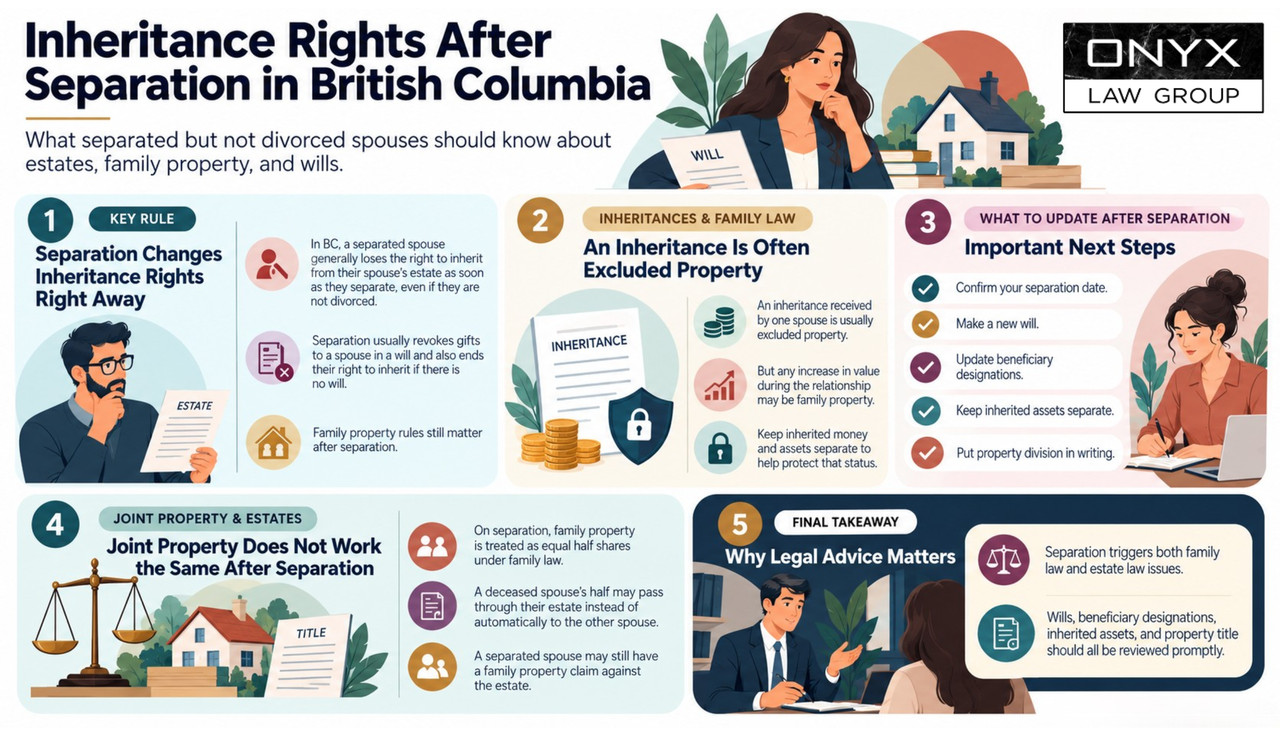
Separation changes your inheritance rights the moment it happens, often before either of you has spoken to a lawyer. A few practical moves early on can keep an inheritance from being split and make sure your estate goes where you want it to. Here are the steps we recommend to separated spouses in BC.
Step 1: Confirm Your Date of Separation
Your separation date is when family property is valued and when a married spouse stops being a “spouse” for inheritance purposes. Write it down and keep proof, like a message telling your spouse you intend to separate permanently.
Step 2: Keep Inherited Money and Assets Separate
Put any inheritance into an account in your name alone, and don’t use it to pay down joint debts or buy property in both names. Keep the will, estate statements, and bank records, because the burden is on you to prove the inheritance is excluded property.
Step 3: Make a New Will
Separation automatically cancels gifts to your spouse and their appointment as executor, but anything else in your old will stays in place. A new will lets you decide who inherits and who manages your estate, rather than relying on backup clauses you wrote years ago.
Step 4: Update Your Beneficiary Designations
Life insurance, pensions, RRSPs, and TFSAs aren’t changed by separation, so your spouse may still be named on them. Contact each plan or insurer to update them, and check first whether any designation is irrevocable.
Step 5: Check How Your Property Is Held on Title
Under the Family Law Act, separation turns joint ownership of family property into equal half shares, but the land title records may still show you as joint tenants. Ask a lawyer whether you should take further steps to protect your half.
Step 6: Put Property Division in Writing
A separation agreement or court order settles who gets what, which avoids a fight with an estate if one of you dies. Watch the deadlines: common-law spouses have two years from separation to make a family property claim, and married spouses have two years from the divorce order.
Step 7: Speak With a Family and Estate Lawyer
Separation involves family law and estate law at the same time, and the rules don’t always line up. A lawyer who works in both areas can catch problems early, before they turn into a claim against an estate.
How Do Your Inheritance Rights Change From Married to Separated to Divorced?
Most people expect their rights to change when the divorce is final, but in BC, most of the change actually happens the day you separate. The table below compares where you stand while you’re together, once you’ve separated, and after a divorce.
|
Issue |
Married and Living Together |
Separated but Not Divorced |
Divorced |
|---|---|---|---|
|
Spouse under WESA |
Yes |
No, status ends at separation |
No |
|
Gifts to your spouse in your will |
Stay in effect |
Automatically revoked unless your will says otherwise |
Revoked |
|
Your spouse as executor |
Stays in effect |
Automatically revoked unless your will says otherwise |
Revoked |
|
Inheriting if there’s no will |
Your spouse inherits a share |
Your spouse doesn’t inherit |
Your ex-spouse doesn’t inherit |
|
Wills variation claim |
Your spouse can apply |
Not available |
Not available |
|
Property held in joint tenancy |
Passes to the surviving spouse |
Family property becomes equal half shares, so the deceased’s half goes to their estate |
Held in half shares unless title has been changed |
|
Family property claim against an estate |
Not applicable while together |
Still available against the estate |
Available within two years of the divorce order |
|
Life insurance, pension and RRSP beneficiaries |
Stay as named |
Stay as named until you change them |
Stay as named until you change them |
|
Inheritance you receive |
Usually excluded property, but any growth in value is shared |
Usually excluded, and one received after separation isn’t family property |
Yours |
What Happens to a Family Law Claim if One Spouse Dies?

As discussed above, BC’s Family Law Act states that, upon separation, each spouse has a right to an undivided half interest in all family property and is equally responsible for family debt. What happens if a spouse dies after separation but before family property issues have been settled? Does the right to make a claim for division of family property die with them?
The answer is no. Certain types of claims can be annulled by reason of a person’s death, but BC law clearly preserves causes of action for property division notwithstanding the death of one or both separated spouses. Section 150(2) of WESA clearly states that it is not necessary that the claim has already been commenced in order to survive death.
Furthermore, section 3 of the FLA allows former spouses to bring claims under the FLA for family property division. So, even if you haven’t yet started your family law claim when your spouse dies, you can still bring the claim against their estate within 2 years of the separation for common-law spouses, and for married spouses the two-year limit only starts running from a divorce order. Conversely, if you die, your separated spouse can make the same claims against your estate.
What Happens to Jointly Owned Property if One Spouse Dies Post-Separation?

Joint assets pass outside of an estate to the surviving joint owner. However, in BC, separation can change what happens to jointly owned family property. Let’s look at an example to show how the law works for still-married spouses: you and your spouse purchase property and hold title as joint tenants; if one of you dies while you’re still together, title to the property passes to the surviving spouse because of the right of survivorship.
However, on separation, each spouse has a right to an undivided half interest in all family property as a tenant in common and is equally responsible for family debt. This is by operation of s. 81(b) of the Family Law Act. So, if one spouse dies after separation but before property division has been resolved by way of a court order or valid separation agreement, the jointly held property does not automatically pass to the surviving (but separated) spouse. Instead, the deceased spouse’s half interest in that property forms part of their estate, to be disbursed according to that spouse’s will.
What Happens if My Separated Spouse Dies Without a Will?

If one spouse dies after separation but before property division has been resolved by way of a court order or separation agreement, can the surviving spouse make a claim for a share of the deceased spouse’s estate under the rules of intestate succession? The answer is no.
The definition of “spouse” in WESA includes people who are married to each other and people who have lived with each other in a marriage-like relationship for at least 2 years at the relevant time (see WESA s. 2). If you have separated from your married spouse or terminated your common-law relationship when your spouse dies, you no longer meet the definition of a spouse in this context and therefore lose the right to inherit from the intestate estate. (Note, however, that you continue to have the right to bring a family law claim for the division of assets and debt, as discussed above).
Protect Yourself and Your Inheritance Rights After Separation
There are a lot of unknowns during the transition from being married to separated to divorced. A skilled lawyer can guide you through the transition, ensuring you and your assets are protected. Our team of family lawyers and wills and estate lawyers is uniquely positioned to advise you on your legal rights and options. Our estates and trusts litigation practice is led by Candace Cho, KC, who has practised in this area since being called to the BC bar in 2009 and was appointed King’s Counsel in 2025. Contact us today for trusted legal advice and customized solutions.
Frequently Asked Questions
Separation raises a lot of questions about who inherits what, and the answers under BC law aren’t always what people expect. Here are the questions we hear most often from spouses who are separated but not yet divorced.
Can My Separated Spouse Challenge or Vary My Will in BC?
No. Once you separate, your spouse no longer counts as a “spouse” under section 2(2) of the Wills, Estates and Succession Act, so they lose the right to bring a wills variation claim under section 60.
If I Receive an Inheritance After We Separate but Before We Divorce, Does My Spouse Get a Share?
Generally, no. Family property is set at the date of separation under section 84 of the Family Law Act, and inheritances are excluded property under section 85, although mixing that money into shared assets can complicate things.
Do We Have to Be Separated for Two Years Before My Spouse Loses Inheritance Rights in BC?
No, there’s no waiting period. A married spouse stops being a spouse for inheritance purposes on the date of separation, and a common-law spouse stops once either person ends the relationship.
If We Get Back Together After Separating, Does My Old Will Start Working Again?
Not on its own. Moving back in to reconcile within a year and living together for at least 90 days restores your status as spouses, but any gifts or executor appointments your separation cancelled stay cancelled, so you’ll need a new will or a codicil.
Can We Be Separated in BC if We Still Live in the Same House?
Yes. Under section 3(4) of the Family Law Act, you can be separated under the same roof, and a court will look at whether one of you told the other you intended to separate permanently and acted on it.
Disclaimer: The information on this page is general legal information about British Columbia law, not legal advice for any specific situation. Reading this page does not create a solicitor-client relationship. BC law changes, and the procedure that applies to a specific situation depends on facts not covered here. For advice on your situation, consult a qualified British Columbia estate lawyer directly. Past results, illustrative scenarios, and reference to typical fact patterns do not guarantee similar outcomes in any specific case.