


The tort of family violence gives survivors a way to seek financial compensation for abuse through the civil courts. In 2026, Canadian law took an important step by recognizing that patterns of family violence can support a legal claim beyond criminal or family court proceedings. If you or someone you love is experiencing abuse, understanding these legal rights can help you make informed decisions about your next steps.
At Onyx Law Group, our family law practice is led by co-founder Judith A. Janzen, a Principal who has been a member of the BC bar since 2000 and who has appeared in many reported cases before the BC Supreme Court and the BC Court of Appeal. Judith’s work has been recognized by her peers, including the Canadian Bar Association BC Branch President’s Medal in 2009 and the President’s Citation in 2008. Our boutique Vancouver firm, founded in 2012, focuses on family and estate litigation, serves clients across BC, and brings a multilingual team to sensitive files like these. If you are dealing with abuse in your relationship, book a free 30-minute consultation with us today.
In this guide, we will explain what the tort of family violence is, how the landmark Ahluwalia v. Ahluwalia decision reshaped it, and what remedies and support are available to survivors in BC.
Legal Framework of Tort of Family Violence
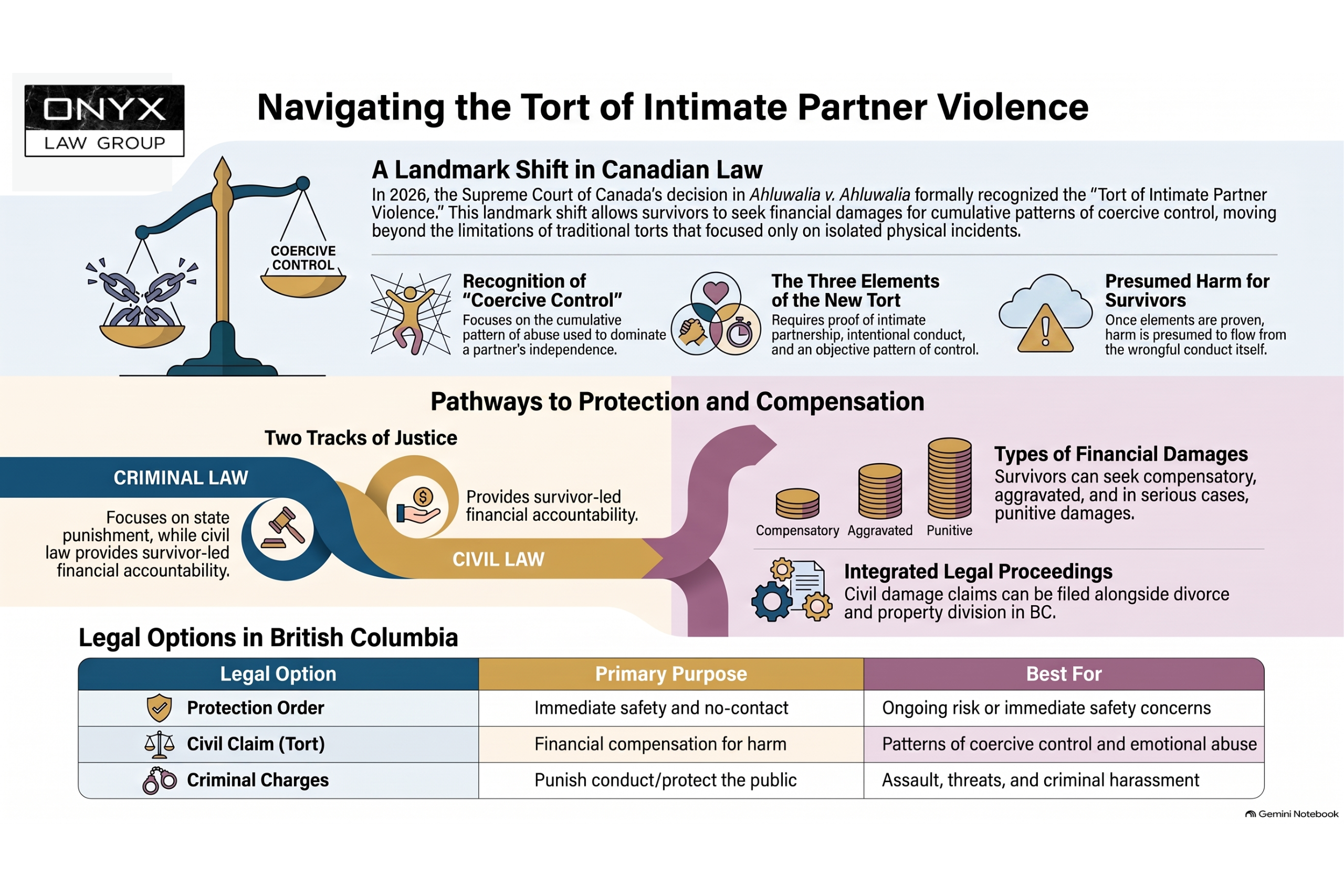
Section 1 of the Family Law Act defines family violence to include physical abuse, sexual abuse, attempts at either, psychological or emotional abuse such as intimidation, harassment, coercion and threats, unreasonable restrictions on a person’s financial or personal autonomy, and stalking. It’s deliberately broad, and it reaches the financial control and economic abuse that older laws tended to overlook. That definition shapes how BC courts handle parenting, guardianship, and protection orders but on its own, it doesn’t give you a right to sue for damages.
For years, the civil side of family violence in Canada ran through established torts. If you wanted compensation, you framed the abuse as assault, battery, or intentional infliction of emotional distress, and the court assessed damages the way it would for any other intentional wrong. That worked well enough for a discrete incident, a specific assault on a specific date, but it strained against the slow, cumulative pattern abuse usually follows.
The piece the courts kept circling back to was coercive control: the steady use of physical violence, psychological abuse, sexual coercion, and financial abuse to dominate a partner and wear down their independence. A single punch fits neatly into battery. A decade of intimidation, monitoring, and controlling behaviour doesn’t. That gap between how abuse actually works and how tort law described it is what set the stage for the most influential family violence case Canada has seen.
That case was Ahluwalia, and it climbed through three levels of court before the law finally settled. The trial judge tried to fill the gap by creating a brand-new tort of family violence. The Ontario Court of Appeal disagreed. The Supreme Court of Canada then had the final word, and its answer reshaped tort law across the country, BC included.
Case Analysis of Ahluwalia v. Ahluwalia
The dispute began as an ordinary family law proceeding. After a 16-year marriage marked by physical, emotional, and financial abuse, the wife sought a divorce along with support and property relief and she also asked for damages for the abuse itself. In Ahluwalia v. Ahluwalia, 2022 ONSC 1303, Justice Renu Mandhane of the Ontario Superior Court of Justice recognized a novel tort of family violence and awarded $150,000, split evenly between compensatory, aggravated, and punitive damages.
The key legal issue was whether the common law needed a new tort at all. The husband appealed, and in Ahluwalia v. Ahluwalia, 2023 ONCA 476, the Ontario Court of Appeal said no. It didn’t doubt that the abuse was real and serious, and it held that the existing torts, assault, battery, and intentional infliction of emotional distress, were flexible enough to cover it. The court declined to create a new tort of family violence or coercive control, and it trimmed the award to $100,000 by cutting the punitive portion.
Then came the Supreme Court of Canada. In Ahluwalia v. Ahluwalia, 2026 SCC 16, released on May 15, 2026, a majority written by Justice Kasirer allowed the appeal in part and, in a genuine landmark decision, held that Canada recognizes a new tort, not the trial judge’s broad “family violence,” but a narrower tort of intimate partner violence.
The majority set out three elements a plaintiff must prove to establish liability: first, the abusive conduct arose within an intimate partnership or its aftermath; second, the defendant intentionally engaged in that conduct; and third, viewed objectively and cumulatively, the conduct amounted to coercive control. Justice Jamal, joined by Justices Côté and Rowe, dissented, taking the view that the plaintiff had already been fully compensated under the existing torts and that no new category was needed.
What the decision changed and what it left alone both matter. It confirmed that the common law can grow a new tort, one incremental step at a time, when the existing ones leave a real gap. Here, that gap was the cumulative harm of coercive control.
On damages, the majority held that once those three elements are proven, the harm flows from the wrongful conduct itself. A survivor doesn’t have to separately prove a specific consequential injury to be compensated. The dissent would have gone the other way, leaving the plaintiff to her recovery under the existing torts and treating her as already made whole.
For litigants and their lawyers, that shifts the strategy. A survivor can now plead the tort of intimate partner violence head-on, while defendants will train their attention on whether the conduct actually clears the coercive-control bar or is really just a set of discrete, isolated incidents.
What Is the Impact of Family Violence on Legal Outcomes?
The legal consequences of family violence now run on two tracks. Criminal charges such as assault, sexual assault, uttering threats, and criminal harassment can bring penalties up to and including jail, and they are prosecuted by the Crown.
The civil track is separate and belongs to the survivor: a lawsuit for damages, where the goal is compensation and accountability rather than punishment by the state. Since Ahluwalia, that track now includes the standalone tort of intimate partner violence.
The harm rarely stops at the courtroom door. Survivors often carry lasting psychological injury, and financial abuse can gut someone’s credit, savings, and earning power for years. Some experience long stretches of anxiety, depression, or worse, and the professional fallout, including lost work, interrupted careers, and relocation, compounds the personal cost. Courts increasingly understand that this consequential harm is real and measurable.
For remedies, survivors in BC have more than one lane. They can seek protection orders under the Family Law Act, and they can pursue damages in a civil claim, whether framed as assault, battery, intentional infliction of emotional distress, or the new intimate partner violence tort. Those claims can travel alongside the family law file, so a single proceeding can address the divorce, the money, and the abuse together.
Family violence also weighs heavily on parenting, divorce, and property decisions. Under the Family Law Act, every parenting decision comes down to the best interests of the child, and section 37 specifically requires courts to weigh how family violence affects the child’s safety and a parent’s ability to care for them. In practice, credible evidence of abuse can shape parenting time, decision-making responsibility, and the terms of a protection order, and it can factor into how a court approaches spousal support and, in some cases, the division of family property.
Beyond individual families, abuse carries a community cost in health care, policing, lost productivity, and the intergenerational effects on children who witness it. The legal system cannot undo that harm, but it can respond to it: by naming the conduct, protecting the people at risk, and putting a price on the wrong. The Ahluwalia line of cases is the courts’ doing exactly that and doing it in a way lower courts across the country, BC included, must now follow.
What Are the Legal Remedies and Support Systems for Family Violence?

The most immediate civil remedy is protection. Under the Family Law Act, a person at risk can apply for a protection order that restrains contact and communication and can require the other party to stay away from a home, workplace, or school. Alongside protection, survivors can seek compensation like damages assessed as compensatory, aggravated, and, in serious cases, punitive, through a civil claim built on established torts or the tort of intimate partner violence.
Mediation and counselling have a place, but not in every file. For separating couples who can bargain safely, mediation often settles parenting and property issues faster and with less conflict. Where there has been serious family violence or coercive control, mediation is often inappropriate because the power imbalance makes genuinely voluntary agreement impossible, and BC’s family dispute resolution rules require screening for exactly that risk. A good lawyer will tell you when the table isn’t a safe place to sit.
Cost should not be the reason a survivor stays silent. Legal Aid BC provides family law services and can help those who qualify, and VictimLinkBC is a free, confidential, multilingual line available 24/7 by phone or text. It connects callers to crisis support, safety planning, and referrals in up to 150 languages which counts for a lot in a province as diverse as BC.
Community resources fill the gaps that courts can’t. Transition houses and safe homes provide emergency shelter, second-stage housing helps survivors rebuild toward living independently, and specialized gender-based violence crisis lines offer trauma-informed support, including culturally safe services for Indigenous survivors.
Local victim services programs, many run through police departments and community agencies, help with safety plans and court accompaniment. Nobody should have to pull that network together alone.
Comparing Your Legal Remedies After Family Violence
Understanding your legal rights is only part of the process. Depending on your circumstances, you may have more than one legal option available, and each serves a different purpose. The comparison below provides a quick overview to help you understand which legal path may be appropriate for your situation before exploring each remedy in more detail.
| Legal Option | Primary Purpose | Who Starts the Process? | Possible Outcome | Best For |
|---|---|---|---|---|
| Criminal Charges | Punish criminal conduct and protect the public | Police and Crown prosecutors | Criminal penalties, probation, or jail | Assault, threats, sexual assault, criminal harassment |
| Protection Order (Family Law Act) | Provide immediate safety and prevent further abuse | Survivor applies through family court | No-contact orders, restrictions, removal from the home | Ongoing risk or immediate safety concerns |
| Family Law Proceeding | Resolve family-related legal issues | Either spouse or parent | Parenting orders, support, property division | Separation, divorce, or parenting disputes involving family violence |
| Civil Claim (Tort of Intimate Partner Violence) | Seek financial compensation for the harm caused by abuse | Survivor files a lawsuit | Compensatory, aggravated, and potentially punitive damages | Patterns of coercive control, financial abuse, emotional abuse, and other intimate partner violence |
How Can a Lawyer Help if You Face Family Violence?
A family lawyer does a lot more than file paperwork. In BC family violence cases, the work usually starts with safety, and this includes protection orders, exclusive occupation of the home, and secure parenting arrangements. It then moves to the longer game of support, property, and, where appropriate, a damages claim. A lawyer who understands how coercive control gets proven can gather the right evidence, pull a scattered history of abuse into one coherent record, and go after the remedies that actually match your situation.
“In these files, our first job is to make sure a client is safe, and only then do we build the case for accountability,” says Judith Janzen, Family Law Practice Leader at Onyx Law Group. The Supreme Court’s recognition of intimate partner violence as a tort gives survivors a clearer path to compensation, but the strategy still has to be tailored, starting with a protection order, the parenting plan, and a damages claim, with each needing its own careful proof. That kind of judgment, built over decades of BC courtroom experience, is what turns a difficult situation into a workable plan.
Have You Faced Family Violence in BC?

Understanding the law is not an academic exercise when your safety is on the line. The Ahluwalia decisions confirm that the courts take coercive control seriously, that survivors have real civil remedies, and that BC’s Family Law Act already gives you tools such as protection orders, best-interests parenting analysis, and now a recognized tort claim to protect yourself and your children. Knowing that these options exist is the first step toward using them.
You do not have to figure this out alone. The family lawyers at Onyx Law Group serve clients throughout British Columbia and bring a multilingual, litigation-focused team led by Judith Janzen to some of the most sensitive files a family can face. If you have experienced family violence, contact us to talk through your options with a BC family lawyer who has been in these courtrooms before.
Frequently Asked Questions
If you’ve experienced family violence, you may be wondering whether you can take legal action beyond the criminal or family court process. These frequently asked questions explain the tort of family violence and how it may allow victims to seek compensation.
What Are the Elements of the Tort of Family Violence?
A claimant must generally prove coercive and controlling conduct within an intimate relationship, resulting in harm. This new tort of intimate partner violence has been court-recognized as a civil cause of action.
How Is Family Violence Defined in Tort Law?
Family violence includes domestic violence, physical abuse, emotional abuse, financial abuse, threats, and other coercive and controlling conduct. Courts may also consider conduct that leads to self-harm or other serious psychological injuries.
What Remedies Are Available for Victims of Family Violence?
Victims may seek financial compensation, including compensatory and aggravated damages, as well as other remedies the court considers appropriate. In some cases, the court may also order other forms of relief.
What Types of Acts Are Considered Family Violence Under This Tort?
Acts may include physical assaults, sexual abuse, intimidation, stalking, isolation, financial control, and other forms of coercive and controlling conduct in an intimate relationship.
Who Can Bring a Claim for the Tort of Family Violence?
A person who has experienced family violence in an intimate relationship may be able to bring a civil claim. The landmark case arose from allegations that Ahluwalia’s conduct controlled many aspects of the plaintiff’s life, leading the court to recognize this new cause of action.
What Are the Potential Legal Remedies Available in a Tort of Family Violence Case?
Depending on the facts, the court may award financial compensation, including compensatory and aggravated damages. In the leading case, Justice Mandhane awarded damages after recognizing the harm caused by family violence.
Is There a Statute of Limitations for Filing a Claim for the Tort of Family Violence?
Time limits may apply depending on the circumstances and the applicable law. Issues under the Divorce Act, such as child support, may proceed separately from a civil claim for damages, so it is important to obtain legal advice promptly.
Disclaimer: This article provides general information only and is not legal advice. Reading it does not create a solicitor-client relationship with Onyx Law Group. Laws change and vary by province, and the outcome of any case depends on its specific facts. If you are dealing with family violence in British Columbia, please consult a qualified BC family lawyer about your situation.