


The Family Law Act is the main piece of provincial legislation that governs family matters in British Columbia, from how separating couples divide property and debt to how they arrange parenting and support. Canada does not have a single national family law statute; instead, each province has its own, and the federal Divorce Act handles the divorce itself for married couples. In BC, the Family Law Act has been the cornerstone of family legislation since 2013.
If you need to handle matters surrounding divorce, child custody, support payments or property division, it is strongly recommended to speak to someone well versed in the legal profession. The family lawyers at Onyx Law Group have a deep understanding of the legal issues surrounding separation and well-honed expertise in how the Family Law Act works. Reach out to us today for a consultation.
This guide explains what the Family Law Act is in the Canadian context, its key provisions and recent updates, the common issues it governs, and how it shapes divorce and separation in BC.
Understanding the Family Law Act in Canada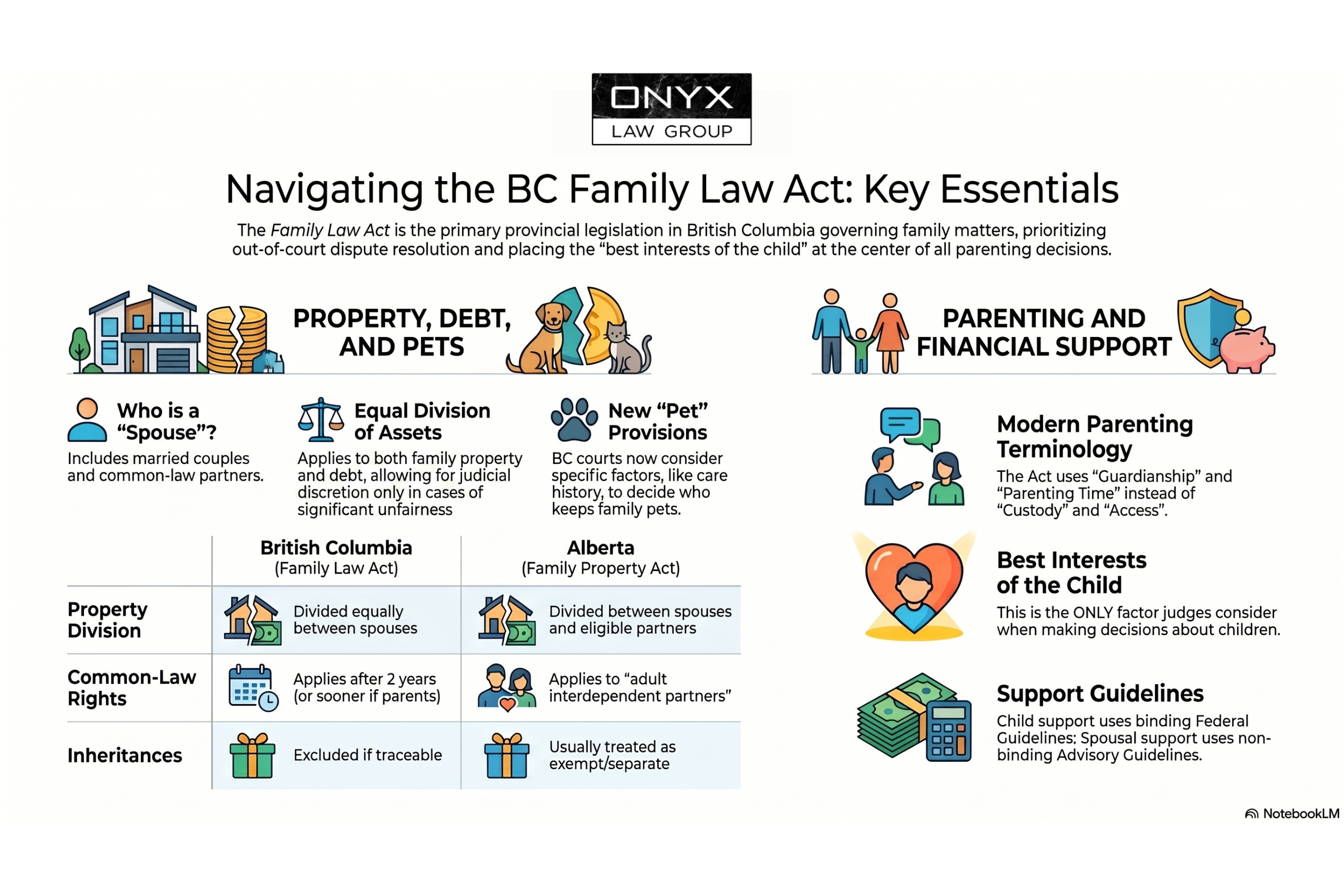
In Canada, “family law” is split between two levels of government. The federal Divorce Act applies only to married couples seeking a divorce, while each province has its own statute that covers everything else: property and debt division, parenting, support, and family violence. That is what the Family Law Act does in British Columbia. It came into force on March 18, 2013, replacing the older Family Relations Act, and it applies to married spouses and common-law partners alike.
The Act was designed to support an orderly and equitable settlement of family disputes and define mutual obligations and other mutual obligations between family members for family law purposes. The scope of the Act is broad. It sets the rules for:
- Dividing family property and family debt occurs when a relationship ends.
- Guardianship, parental responsibilities, and parenting time for children.
- Child support and spousal support.
- Family violence, including protection orders.
- Resolving disputes out of court through mediation, arbitration, and collaborative processes that encourage an equitable settlement.
Because family law is provincial, the rules differ across the country. British Columbia uses the Family Law Act, while Alberta, for example, divides property under its Family Property Act. The Canadian approach also differs from family law in other countries, so a “Family Law Act” in Australia or a US state statute will not reflect how things work here. The table below shows how BC and Alberta compare.
| Aspect | British Columbia | Alberta |
|---|---|---|
| Main family law statute | Family Law Act | Family Property Act |
| Property division rules | Family property is generally divided equally between spouses | Family property is divided between spouses and eligible partners |
| Rights for common-law couples | Property rights usually apply after living together for 2 years, or sooner if the couple has a child together | Property rights apply to adult interdependent partners |
| Parenting terminology | Uses terms such as guardianship, parental responsibilities, and parenting time | Uses parenting orders, with federal parenting terms often applied in divorce cases |
| Treatment of inheritances and gifts | Considered excluded property if they can still be traced separately |
|
Core Principles and Objectives of the Family Law Act

As mentioned, the new Family Law Act changed the way we approach family law matters. The new law does this by:
- Encouraging people to resolve disputes outside of court;
- Promoting the use of negotiation, mediation, arbitration, and collaborative processes;
- Putting the safety and best interest of the child first when families are going through separation;
- Clarifying parental responsibilities;
- Providing new ways to protect people who are at risk of family violence (e.g., emotional abuse, sexual abuse, physical abuse);
- Making financial disclosure mandatory, even outside of court, and
- Ushering in a new way of dividing property and debt that promotes equitable sharing and helps place parties in a more equal position.
The Family Law Act also makes written family law agreements more difficult to change, as long as they are fairly negotiated, which further promotes out-of-court dispute resolution of family law disputes. In some situations, a court directs a different outcome where a reasonable alternative method is necessary to avoid unfairness or where a party may suffer substantial prejudice.
What Are the Recent Amendments to the Family Law Act?
Recent amendments to the Family Law Act came through Bill 17, the Family Law Amendment Act, 2023, which received Royal Assent on May 11, 2023. One of the biggest changes involved companion animals. British Columbia became the first province to create specific legal rules for deciding who keeps a family pet after separation. Courts can now consider factors such as who primarily cared for the animal, any history of family violence, the relationship between a child and the pet, and each spouse’s ability to meet the animal’s needs.
The amendments also clarified several property and financial issues that previously caused confusion in family disputes. The law now confirms that excluded property, such as inheritances or assets owned before the relationship, can remain excluded even if ownership is transferred to the other spouse during the relationship.
Older common law presumptions involving resulting trusts and advancement were also removed to simplify ownership disputes between spouses. In addition, the legislation modernized pension division rules by clarifying how pensions, locked-in retirement accounts (LIRAs), life income funds (LIFs), and annuities are divided after separation. These updates also affect certain pension plans, a variable benefit account, and situations where a pension plan imputed value may apply under an interim or final order. The amendments also help ensure e-laws currency date guidance reflects current legal standards.
Whom Does the BC Family Law Act Apply to?

British Columbia’s Family Law Act applies to married spouses and to unmarried spouses (i.e., people in a “common-law” relationship). It also applies to people who have a child together, whether they have dated or not.
Issues involving a former spouse, surviving spouse, or circumstances where spouses separate can also affect legal rights, including a surviving spouse’s entitlement in certain situations. Because it deals with orders about children, the Act also applies to anyone who wants guardianship of a child or contact with someone else’s child, such as a grandparent.
What About the Divorce Act?
Canada’s Divorce Act only applies to married spouses. There’s a lot of overlap between the federal Divorce Act and the provincial Family Law Act: both deal with child support, spousal support, and raising and spending time with children. But, of the two laws, only the Family Law Act deals with the division of property, debt, and getting protection orders to address family violence. Certain concepts involving net family properties divorce, two net family properties, and how net family properties divided may arise in broader discussions involving family property rights.
Most couples, whether they were married or not, use the Family Law Act to resolve their family disputes. That being said, if you are married and want to get a divorce, you must apply under the Divorce Act to the Supreme Court of British Columbia. Only the Supreme Court can make a divorce order to legally end a marriage. Separate legal issues can also arise if a spouse dies, leaving unresolved matters after a first spouse’s death.
Common Issues Addressed Under the Family Law Act
The Family Law Act deals with many of the issues families face after a separation. In most cases, this includes dividing family property and debt, making parenting arrangements, and determining support obligations. Family property and debt are generally divided equally, while excluded property, such as inheritances or certain gifts, usually remains separate.
When children are involved, the law focuses on what is in the child’s best interests above everything else, including parenting time, guardianship, and important decision-making responsibilities. Courts may also consider family relationships, the other spouse’s interests, spouse debts, and the other spouse’s debts when assessing certain issues.
The Act also addresses financial support between family members. Child support is typically calculated using the Federal Child Support Guidelines and depends on factors such as income and parenting arrangements.
We regularly remind clients, “Every family situation is different.” Spousal support may also be available depending on the length of the relationship, each person’s financial situation, and the roles they held during the relationship. In addition, the Act recognizes and enforces legal agreements such as marriage agreements, cohabitation agreements, and separation agreements, helping couples create clear expectations and avoid future disputes.
Family Law Guide
Whether you’re facing the complexities of divorce, seeking to understand child custody arrangements, or exploring your rights in matters of support and property division, there are factors that need to be taken into consideration so that you can assess your legal rights. Because only a person involved in a legal matter may have standing to make certain claims, understanding how the law applies to particular property and family circumstances can be important.
Are You a Spouse?
Section 3 of the Family Law Act defines who a spouse is. It includes legally married spouses, as well as unmarried couples who have lived together in a marriage-like relationship for a continuous period of at least two years. The definition may also become important in matters involving either the deceased spouse or her spouse, particularly where questions arise about rights after death.
If you are a spouse as defined in the Act, you are entitled to make a claim for division of property and debt. You are also entitled to make a claim for spousal support. These rights may affect property that a spouse owned during the relationship.
On the latter issue, it is important to note that the definition of “spouse” in the Act also includes people who have lived together for less than two years and have a child together, but only for the purpose of claiming spousal support. There is no entitlement to a claim for division of property or debt in that situation. This distinction may also affect a spouse surviving after the relationship ends or after a death-related dispute arises.
Are You a Parent or Person Who Wants Contact With a Child?
If you are a parent, the Family Law Act sections dealing with spousal support, child support, and parenting arrangements apply even if you don’t meet the definition of a “spouse”. In some circumstances, financial matters may involve a spouse’s pay obligation, a lump-sum payment, or a lump-sum payment provided under an agreement or court order, regardless of an-other spouse’s remarriage.
That being said, the Act uses different terms to describe parenting issues that may be unfamiliar. Here are the key terms to be aware of:
- Guardian: the person or people who are responsible for caring for a child are called guardians under the Act. While a child’s parents are living together and after the child’s parents separate, each parent of the child is the child’s guardian. A parent who has never lived with the child is not a child’s guardian unless they have regularly cared for the child, or they’re made a guardian by agreement or a court order.
- Parenting arrangements: only a guardian can have parental responsibilities and parenting time with respect to a child. Parenting arrangements are the plans made in a written agreement or court order for sharing or dividing parental responsibilities and parenting time.
- Parental responsibilities: these are the responsibilities each guardian has for making day-to-day decisions and more significant decisions about a child’s life, including decisions about where the child will live, the child’s school, healthcare, religious upbringing, and extracurricular activities. Parental responsibilities can be shared by guardians or divided so that the right to make some or all decisions falls to one guardian.
- Parenting time: parenting time is the time that a child spends with a guardian. It’s allotted under an agreement between the parties or by court order. During a guardian’s parenting time, that guardian is responsible for care of the child and has the right to make day-to-day decisions with respect to the child.
- Contact with a child: this is the time that a person who is not a child’s guardian spends with the child. Parents who are not guardians, relatives of the child, and non-relatives of the child can have contact with the child by written agreement or court order. During contact time, the person with contact does not have the right to make day-to-day decisions respecting the child.
Best Interest of the Child – Family Law Act
BC’s Family Law Act is clear that the best interests of the child are the only consideration for parents and judges when making decisions about guardianship, parental responsibilities, parenting time, and contact with a child. An agreement or order is in the best interests of the child if it protects the child’s physical, psychological, and emotional safety, security, and well-being. Courts may also prohibit reasonable advances by limiting conduct or interactions that could negatively affect a child’s welfare.
Section 37 of the Act sets out a list of factors to be considered when determining what agreement or order is in a child’s best interests. Judges and parents must consider all of the needs and circumstances of the child, as well as factors including the child’s health, the history of the child’s care, and the views of the child, where appropriate.
If family violence is an issue, there are additional factors set out in section 38 of the Act that must be considered to assess the impact of family violence on the child and determine what is in the child’s best interests.
Family Law Act: Child Support and Spousal Support
The Family Law Act deals with two types of financial support:
- Child support is money paid by one parent to the other (usually the parent with whom the child lives most or all of the time) as financial support for the child. Child support amounts are determined using the Federal Child Support Guidelines. Calculating child support requires the paying parent’s income, the number of children, and the province of residence.
The issue of child support becomes complicated if the paying parent is self-employed, earns corporate income, earns over $150,000 per year, or is underemployed. The parenting arrangements and factors unique to the child (e.g., a child over the age of 19 who is in post-secondary school; a child with a disability that leaves them financially dependent as an adult) also make the issue of child support more complicated. You do not have to be a “spouse” to make a claim for child support.
- Spousal support, which is money paid by one spouse to the other spouse as financial support. The Spousal Support Advisory Guidelines are used to provide a range of spousal support to help spouses figure out how much spousal support they will receive and for how long, but the guidelines are not binding in the way that the child support guidelines are.
In most cases, spouses will need help from a family lawyer to figure out their entitlement and the amount of spousal support. Financial issues can also involve periodic financial statements, a spouse’s transfer, a spouse’s pension, or a variable benefit account, depending on the circumstances. Remember that you are only entitled to claim spousal support if you meet the definition of “spouse” in the Act, as discussed above.
How Are Family Property and Family Debt Divided Under the Family Law Act?

The basic rule in the Family Law Act is that property and debt are split equally between spouses on separation. The presumption of equal division of property and debt can be overridden by a written agreement between the spouses to divide assets and debt in a different way. The court can also decide to divide property and debt unequally if it is satisfied that equal division would be “significantly unfair.”
Generally speaking, family property is what you and your spouse bought or accumulated during your cohabitation or marriage. It includes all assets and property owned by either one or both spouses at the time of separation and any asset or property that one spouse has a beneficial interest in at separation.
Examples include your family home, other real estate (cottages, investment properties, condos, etc.), RRSPs, RRIFs, TFSAs, bank accounts, investments, insurance policies, pensions, businesses, and certain types of property held in trust. Family property may include real or personal property and forms part of a spouse’s property for division purposes.
Family debt includes all financial obligations incurred by one spouse or both spouses during their relationship. It also includes debts taken on after separation if you incurred the debt to maintain family property. BC’s Family Law Act says spouses must equally share family debt even if one spouse’s name isn’t on the debt. Common examples of family debt include mortgages, loans, lines of credit, and credit cards. In some cases, calculations involving a spouse’s net family property may include one-half the difference where the value of a deceased spouse exceeds the value of the other spouse’s property.
Keep in mind that only legally married spouses and unmarried spouses are entitled to division of property and debt on separation, and that only the Supreme Court (not the Provincial Court) can make orders dealing with property and debt on separation.
Is Any Property Exempt From Equal Division on Separation?
Spouses can enter into a marriage agreement or other type of written contract to specify who owns what if they separate in the future. They can also enter into a separation agreement to divide family property and debt in a way they see fit.
Beyond that, it’s important to understand the concept of excluded property, which is built into the Family Law Act. Excluded property is property brought into the marriage or cohabitation by one spouse, inheritances received by one spouse, gifts to one spouse from a third party, settlement or damage awards to a spouse as compensation for injury or loss, insurance proceeds (other than a policy respecting property), and one spouse’s beneficial interest in property held in a discretionary trust. Excluded property is presumed to remain the property of the spouse who owns it, but any gain in the value of excluded property over the course of the relationship is subject to equal division on separation. Excluded property can also include personal property, and courts may consider a spouse’s interest when determining how assets are characterised.
The Family Law Act was recently amended to strengthen and clarify the rules respecting excluded property. The 2023 amendments make it clear that the property exclusion will still apply even if the property’s legal or beneficial ownership was transferred from one spouse to another. For example, if one spouse receives an inheritance and uses it to purchase real estate in both spouses’ names, its excluded character will not be lost if the spouses later separate. The inheritance can be traced back to the excluded property of one spouse, although applicable contingent tax liabilities or a contingent tax liability may still affect the overall value of certain assets.
What Is the Importance of Legal Representation in Family Law Act Cases?
Legal representation can make a major difference in family law matters. Separation, parenting disputes, support claims, and property division are often emotional and stressful. A family lawyer can help you understand your rights under BC’s Family Law Act and avoid mistakes that could affect your future. They can also explain your options clearly and help you make informed decisions during a difficult time.
An experienced lawyer can help gather financial information, negotiate fair agreements, and represent you in court if needed. This is especially important in high-conflict cases involving children, hidden assets, or family violence. Mediation or settlement discussions can also resolve many disputes instead of a long court battle. Working with a trusted law firm like Onyx Law Group can help you feel more confident and supported throughout the process.
For example, a Vancouver couple separated after a long common-law relationship. One partner had used an inheritance to help buy the family home, and the other later claimed it should be divided equally. After consulting the family lawyers at Onyx Law Group, the client learned the inheritance could still qualify as excluded property under BC’s Family Law Act. With legal guidance and proper financial records, they were able to protect the inherited funds and reach a fair settlement without going through a lengthy trial.
Ready to Speak to a Family Lawyer?
Understanding BC family law rules is essential for individuals navigating separation, divorce, and other family-related issues. If you have questions about your rights and entitlements under BC’s Family Law Act, including matters involving a domestic contract dealing with property rights, a surviving spouse’s election, a deceased spouse’s personal representative, a statutory declaration disclosing particulars, or filings with the proper land registry office, speak with a family lawyer to help.
At Onyx Law Group, our family lawyers in Vancouver have the expertise and knowledge to guide you through the process and answer any questions you may have. and assist you in even the most high-conflict or complex family law matters. Contact us today to schedule an initial consultation and take the first step toward a positive and successful outcome.
Frequently Asked Questions About the Family Law Act
Here are clear answers to the questions people ask most about the Family Law Act.
What Is the Purpose of the Family Law Act?
The purpose of the Family Law Act is to set out fair, predictable rules for families when a relationship ends. It governs how property and debt are divided, how parenting is arranged in a child’s best interests, and how support is determined, while encouraging families to resolve disputes out of court.
Is the Family Law Act Changing in 2026?
BC’s Family Law Act is a current, in-force law, and the most significant recent changes were the 2023 amendments to property, pension, and pet provisions. Family law procedures continue to evolve, so if you are starting a matter, it is worth confirming the current rules with a lawyer rather than relying on older information.
What Should You Not Do in Family Court?
Avoid hiding income or assets, breaching court orders, or making unilateral decisions about children or shared finances while a case is open. Keep your focus on the children’s best interests, disclose fully, and get legal advice before taking big steps.
What Is the “New” Family Law in BC?
When people refer to the “new” family law, they usually mean the Family Law Act that replaced the Family Relations Act in 2013, along with its later updates. It shifted the language away from custody and access and toward guardianship and parenting time and put children’s best interests at the center of every parenting decision.
Disclaimer: This article is for general information only and does not constitute legal advice. Reading it or contacting Onyx Law Group does not create a solicitor-client relationship. Family law in British Columbia depends on the specific facts of each case and can change over time. Consult a qualified BC family lawyer for advice about your own situation.