


In British Columbia, a will must meet specific legal requirements, including rules about how it is witnessed. Generally, a will should be witnessed by two people who are at least 19 years old and are not beneficiaries or otherwise entitled to a gift under the will. Choosing the right witnesses matters because improper witnessing can create legal issues, including disputes over gifts, delays, and estate litigation.
Get the witnessing wrong, and the will can be challenged years later, which is why validity-of-wills disputes are a core part of Onyx Law Group’s estate litigation practice. Candace Cho, KC, chairs the Trial Lawyers Association of BC’s estate committee and has built her entire practice on estate and trust disputes. If you are signing a will and want it done properly, or you believe someone else’s was witnessed improperly, contact us today for a consultation.
Today’s post contains a deep dive into the legal requirements for witnessing a will, how to ensure your will is properly witnessed, and the consequences of invalid witnessing.
Who Can and Cannot Witness a Will in BC?

Under BC’s Wills, Estates and Succession Act (WESA), a will-maker’s signature must be witnessed by at least two people who are 19 or older. The witnesses must sign the will in the presence of the will-maker, and the will-maker must sign or acknowledge their signature while both witnesses are present. The witnesses do not generally need to read the will, but they should be able to properly witness and later confirm the signing if necessary.
There is an important point to keep in mind about who can act as a witness. BC law does not say that a beneficiary, executor, guardian, or their spouse is automatically disqualified from witnessing a will. In fact, section 40 of WESA allows a person to witness a will even if they receive a gift under it. However, choosing someone who benefits from the will can create a serious problem with that gift.
Under section 43 of WESA, a gift to a witness or to the witness’s spouse is generally void unless the court later declares that the gift should take effect. The court can make that order if it is satisfied that the will-maker intended to make the gift despite the person acting as a witness. For that reason, it is usually much safer to choose independent witnesses who have no financial interest in the estate.
So, who should you choose? The safest option is two independent adults who are at least 19 and have no connection to the gifts in your will. Avoid using a beneficiary or the beneficiary’s spouse as a witness whenever possible. This simple step can help reduce questions about the will later and make the estate administration process smoother.
What Are the Legal Requirements for Witnessing a Will in BC?

In British Columbia, a valid will must meet the formal requirements set out in the Wills, Estates and Succession Act (WESA) Section 37. The will must be in writing, although BC law also recognizes electronic wills. The will-maker must sign at the end of the will, or acknowledge their signature, while at least two witnesses are present at the same time.
The two witnesses must then sign the will in the presence of the will-maker. Under section 40 of WESA, each signing witness must be 19 years of age or older. The witnesses do not have to read the will or know what it says. Their role is to properly witness the will-maker’s signature or acknowledgment and then sign as witnesses.
The signing process can also take place electronically in BC. WESA allows people to be in each other’s electronic presence and permits electronic signatures for wills. This means the law is not limited to the traditional situation where everyone signs the same paper document in the same room.
It is important to follow these requirements carefully because a will that does not meet them may be invalid. However, the court can sometimes cure deficiencies and order that a will be effective under section 58 of WESA. For that reason, if you are making or updating a will, getting legal advice can help ensure the document is properly signed, witnessed, and prepared to reflect your wishes.
Is Notarization Necessary for Wills in BC?
In BC, a will does not need to be notarized to be valid. The lawyer who prepared your will, a commissioner, a notary, and/or their staff may act as a witness, but it is not mandatory.
That being said, notarization isn’t completely futile. For example, if one of the witnesses signs an affidavit of execution in front of a notary public or commissioner, that document can be submitted to the probate court as evidence. This can smooth things out if questions arise later. But from a legal standpoint, a notarized will isn’t more “official” than one that simply follows the proper witnessing rules. If your goal is to ensure your wishes are followed exactly, focus on getting the formalities right, not the stamp.
Why Is Witnessing a Will Important?
Estate planning is particularly relevant in an aging province. Statistics Canada reported that more than 1 million British Columbians, or 20.3% of the population, were aged 65 or older in 2021. This makes having a properly prepared and witnessed will an important consideration for many BC families.
Your last will and testament doesn’t come into effect until after you’ve passed away. You are no longer around to confirm that you signed the document and that you did so voluntarily. When the formal requirements are met by having two or more witnesses physically present to watch you sign, it provides assurance that your will reflects your testamentary intent and that your signature is authentic
A properly executed will also gives rise to the presumption that you had the appropriate mental capacity to make a valid will and that you knew and approved of the will’s contents. The presumption can be challenged after your death, but the person or people who challenge your will must provide proof of suspicious circumstances (lack of capacity to form testamentary intent, fraud, coercion, etc.).
If your will has to go through the probate process or the validity of your will is called into question after your death, your witnesses can provide valuable evidence to defend your will. An affidavit of execution from one of the witnesses, sworn in front of a commissioner or notary public, can be submitted to the probate court. That document attests to the fact that the witnesses were present and observed you signing your will.
Do All Wills Have to Be Witnessed?
Holographic wills don’t have to be witnessed (but it’s helpful if they are). A holographic will is one that is written out in the will-maker’s handwriting and signed by the will-maker. These types of wills are not effective in British Columbia without obtaining a court order “curing” the failure to conform with formal requirements.
Handwritten wills are susceptible to disputes and legal challenges. We recommend avoiding them whenever possible. The Wills, Estates, and Succession Act also contains an exception to witnessing requirements for members of Canadian military forces while placed on active service.
What Is the Safest Way to Witness a Will in BC?
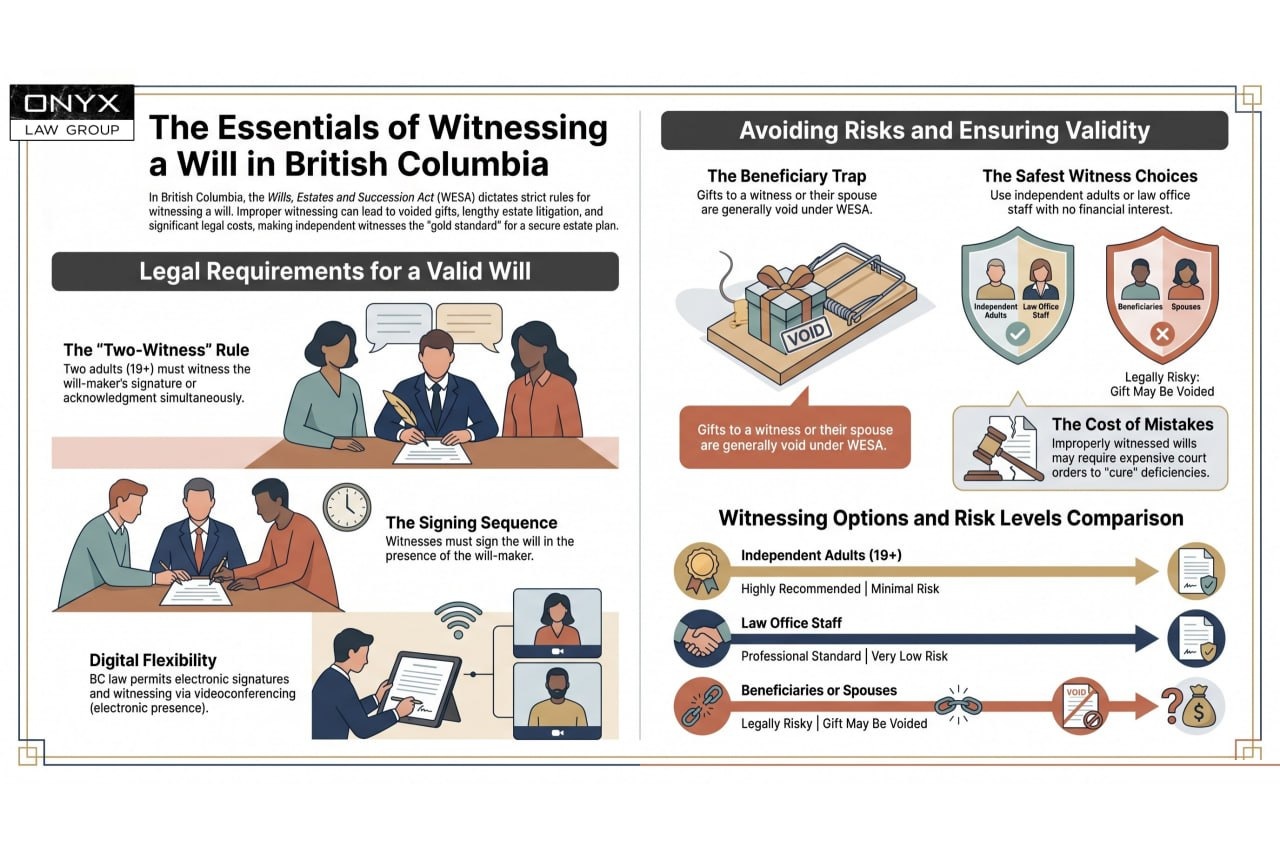
The person you choose as a witness can affect how smoothly your estate is handled later. While some people can legally witness a will, choosing an independent witness is usually the safer option.
|
Witnessing Option |
Is It Allowed? |
Potential Benefit |
Potential Risk |
Safer Choice? |
|---|---|---|---|---|
|
Two independent adults, 19+ |
Yes |
Keeps the witnessing process simple and avoids conflicts of interest. |
Very little risk when all formal requirements are followed. |
Yes, preferred |
|
Beneficiary as a witness |
Yes, but risky |
Convenient if a beneficiary happens to be present. |
The beneficiary’s gift may be void unless the court later orders it to take effect. |
No |
|
Spouse of a beneficiary as a witness |
Yes, but risky |
May be convenient when family members are present. |
A gift to the beneficiary may be affected and could require a court application. |
No |
|
Lawyer or law office staff as witnesses |
Yes |
Provides a more controlled signing process and proper documentation. |
Usually no major concern if the witnesses have no interest in the estate. |
Yes |
|
Electronic witnessing |
Yes |
Allows the signing to take place remotely when BC’s requirements are followed. |
Additional rules must be followed for electronic presence and signatures. |
Yes, if done correctly |
|
Handwritten or unwitnessed will |
May require court involvement |
Can record a person’s final wishes when formal signing requirements were not followed. |
May need a court order to be recognized and can create greater uncertainty. |
Generally no |
|
Notarized will |
Not required |
An affidavit of execution can help provide evidence of proper signing. |
Notarization itself does not make an improperly witnessed will valid. |
Optional |
Common Mistakes to Avoid When Choosing Witnesses
One of the biggest mistakes is choosing a beneficiary or a beneficiary’s spouse to serve as a witness WESA section 43 states that a gift to a witness or the spouse of a witness is void unless a court order is obtained declaring the gift is to take effect.
In other words, if a beneficiary named in your will or their spouse acts as a witness when your will is signed, they won’t receive their inheritance without applying to the court and proving that you intended to make the gift, despite the conflict of interest. For the same reason, it is also a mistake to choose anyone who may potentially inherit from your estate, such as the child or children or named beneficiaries.
Choosing witnesses who can’t be physically present can also be a mistake. The physical presence of two or more witnesses who signed at the same time as the will-maker used to be a requirement. In the digital age, electronic presence is permissible, but there are specific requirements that must be met, or the electronic witnessing won’t be valid (see section 35.2 of the Wills, Estate and Succession Act).
Are Electronic Wills Valid in BC?
Now that we’ve discussed electronic witnessing, you’re probably wondering about electronic wills. On December 1, 2021, British Columbia estate law was updated to permit electronic wills.
For an E-Will to be legally valid, it must be properly witnessed by two or more witnesses who are in each other’s electronic presence and the electronic presence of the will-maker at the same time (e.g., videoconferencing via Zoom or Skype). Electronic signatures can be used for wills in electronic form.
What Happens if a Will Is Witnessed Incorrectly?
There can be serious, negative consequences when a will is improperly witnessed. Your surviving loved ones and the executor of your estate may face stress and delay that could have been avoided. Legal disputes and court intervention are very likely, which means more stress, delay, and increased costs.
As we already mentioned, a gift in a will is forfeited if a beneficiary, their spouse, or anyone who may potentially benefit under your will acts as a witness. If any of those persons act as witnesses, it voids any gift in your will to that person, unless they can prove to the court that you intended to make the gift to them. Extrinsic evidence of your intention will be needed. A court application costs time and money, and it may not ultimately be successful in convincing the court of your intention. The safer bet is to avoid having any beneficiary, potential beneficiary, or their spouse serve as a witness.
Your will is very susceptible to legal challenge after your death if there are issues with the way it was witnessed. An interested party can apply to the Supreme Court for an order deeming your will to be of no force and effect.
If your will doesn’t meet the formal witnessing requirements, it’s invalid. Even if no one challenges it, someone (e.g., your executor) will have to apply to the Supreme Court to obtain an order curing the deficiencies under WESA, section 58. The person seeking the court order curing your will must prove that the document is an authentic record of your final wishes for the court to exercise its power.
If the court isn’t satisfied (i.e., the application isn’t successful), your next most recent valid will (if any) governs how your estate is distributed. If there is no other valid will to fall back on, your estate assets must be distributed in accordance with the rules of intestacy, as if you died without a will.
How to Ensure Your Will Is Properly Witnessed
Getting your will properly witnessed is an important part of making sure your wishes are respected after your death. A few simple steps can help you avoid common mistakes and reduce the risk of problems during estate administration. Here’s a straightforward process to help you make sure your will is properly prepared, signed, and witnessed in BC.
Step 1: Review Your Estate Planning Needs
Start by looking at your wishes, family situation, and assets. A lawyer can help identify issues that could affect how your will should be prepared or witnessed.
Step 2: Prepare the Will Correctly
Make sure your will meets the formal requirements under BC’s Wills, Estates and Succession Act (WESA). This includes the required signatures and witnessing process, with electronic wills also recognized under BC law.
Step 3: Choose Suitable Witnesses
Choose two witnesses who are at least 19 years old and, ideally, have no personal interest in your estate. A beneficiary can legally act as a witness, but the gift to that witness or their spouse may be void unless the court later orders otherwise.
Step 4: Complete the Signing Process Properly
The will-maker must sign or acknowledge their signature while both witnesses are present, and the witnesses must then sign in the will-maker’s presence. Following the process carefully can help avoid questions about whether the will was properly executed.
Step 5: Consider Getting Legal Help
If your estate or family situation is complicated, professional guidance can make the process much easier. An estate lawyer can prepare the will, arrange the signing, and help ensure your wishes are properly documented.
When Should You Consult a Lawyer About Witnessing a Will?

It is a good idea to speak with an estate lawyer when you make or update your will, especially if your situation is not straightforward. A lawyer can review your wishes, identify potential problems, and make sure the will is properly prepared and witnessed. This can be especially helpful when there are complex family relationships, a major change from an earlier will, concerns about capacity or undue influence, or difficulty signing the document.
For example, imagine a man who wanted to update his will after a major change in his family. He was concerned about how to properly sign and witness the new will and wanted to avoid a future dispute. He reached out to Onyx Law Group for help, and their estate lawyers reviewed his wishes, explained the potential risks, and guided him through the signing and witnessing process so his intentions were clearly documented.
The goal is to make your wishes clear and reduce the risk of problems later. A lawyer can also help when someone cannot physically sign a will, including situations where the will is signed at the person’s direction. While hiring a lawyer is not required for every will in BC, professional advice can provide valuable peace of mind when there are legal or family issues that could make the will more likely to be challenged.
Need to Consult a Lawyer About Witnessing a Will?
If you’re unsure of how to write a valid will or properly witness a will in BC, reach out for trusted advice. A will is a legal document, and it’s important that you consult with a lawyer when creating any legal document.
The wills and estate planning team at Onyx Law Group in Vancouver can ensure that your estate is in order, which will alleviate any stress you and your family might be facing and put your collective minds at ease. We have the knowledge and experience required to craft a will that reflects your wishes. Candace Cho, KC, chairs the Trial Lawyers Association of BC’s estate committee and has built her entire practice on estate and trust disputes. Reach out to us today for a consultation to discuss the preparation of your will.
Frequently Asked Questions
A valid will in BC generally requires the person making the will to be mentally capable and to follow specific signing and witnessing requirements. Understanding these rules can help BC residents avoid problems during the probate process.
Can a Beneficiary Witness a Will?
Yes, a beneficiary can witness a will, but a gift to that beneficiary may be void under WESA. The court can allow the specific gift if it determines that the will-maker intended to make it.
Can My Parents Witness My Will?
Yes, your parents can generally witness your will if they meet the legal requirements. However, if a parent receives specific gifts under the will, those gifts may be affected by the rules governing gifts to witnesses.
What Makes a Will Invalid in BC?
A formal will generally must be a physical or electronic will signed by the person making it in the presence of two adults who are at least 19, with two witnesses signing in the will-maker’s presence. The will-maker must also be mentally capable, although the court can cure certain defects in specific circumstances.
Can a Family Member Witness a Signature?
Yes, a family member or co-worker can generally act as a witness if they meet the legal requirements. As a best practice, however, it is strongly recommended to use independent witnesses who are not receiving gifts under the will.
Who Can Be a Witness to the Will?
Witnesses must generally be at least 19 years old and sign in the presence of the will-maker. BC also permits remote witnessing and electronic signatures when the applicable requirements are met, so witnesses do not always have to be physically present.
What Happens if a Will Has Not Been Witnessed?
A will with only one witness or no witnesses may fail the usual formal requirements, but it is not necessarily invalid. Under WESA, the court can validate a will document or other record in specific circumstances if it represents the deceased’s testamentary intentions.
Disclaimer: The information on this page is general legal information about British Columbia law, not legal advice for any specific situation. Reading this page does not create a solicitor-client relationship. BC law changes, and the procedure that applies to a specific situation depends on facts not covered here. For advice on your situation, consult a qualified British Columbia estate lawyer directly. Past results, illustrative scenarios, and reference to typical fact patterns do not guarantee similar outcomes in any specific case.