


If you leave the marital home in British Columbia, you do not automatically lose your legal rights to the property or your ability to make a claim during property division. However, moving out can affect practical issues such as parenting arrangements, child support, and the steps you should take to protect your financial interests. Understanding your rights before you leave can help you avoid costly mistakes and make informed decisions during separation.
Worried that moving out means losing your share of the home? In BC, it usually doesn’t, as leaving the family home doesn’t erase your rights to family property. Onyx Law Group’s family law team, led by Judith Janzen, helps separating spouses protect what they’re owed. Contact us today for a free 30-minute consultation before you make your next move.
Today’s article is all about rights to the family residence, including factors to consider when deciding whether to leave the matrimonial home and steps you may need to take to protect your rights.
What Are Your Rights and Responsibilities When Leaving the Marital Home in British Columbia?

Leaving the marital home does not automatically change your legal rights. Under British Columbia’s Family Law Act, the family home is generally treated as family property if it was acquired during the relationship, regardless of whose name appears on the title. In many cases, both spouses have important legal rights connected to the home after separation. Understanding those rights before you move out can help you avoid unnecessary disputes.
One of the most important things to know is that moving out does not mean you have given up your ownership interest or your right to seek a share of the home’s value. Likewise, staying in the home does not automatically give one spouse a greater claim to the property. The law separates where you live from your rights to property division, so your decision to leave should not, on its own, determine the outcome of your financial claims.
After separation, both spouses may continue to have the right to occupy the family home. One spouse cannot simply force the other to leave or change the locks without legal authority. If living together is no longer practical or safe, either spouse can ask the court for an exclusive occupation order under Section 90 of the Family Law Act. If granted, this order gives one spouse the temporary right to live in the home while preventing the other from entering for a specified period.
Property division follows a different set of rules. As a general rule, family property and family debt are divided equally after separation unless the spouses have agreed otherwise in a marriage agreement, cohabitation agreement, or separation agreement. Family property generally includes assets acquired during the relationship, while family debt includes financial obligations incurred during the relationship and, in some cases, debts taken on after separation to preserve family property.
Not every asset is divided equally. Property that one spouse owned before the relationship is usually considered excluded property. However, any increase in the value of that excluded property during the relationship is generally family property that may be divided equally. For example, if your spouse owned the home before you married, you may have a claim to half of the increase in its value during the relationship, even if you are not entitled to share in its original pre-relationship value.
Leaving the marital home also comes with practical responsibilities. Continue to meet any legal or financial obligations that apply to you, such as mortgage payments, property taxes, or other shared expenses, unless you and your spouse reach a different arrangement or the court makes an order.
Before moving out, it is often wise to document the home’s contents, gather important financial records, and obtain legal advice. Taking these steps can help protect your rights while making the separation process easier to manage.
Division of Property and Debts After Leaving the Marital Home
Leaving the marital home does not affect your right to a share of family property or your responsibility for family debt. In British Columbia, the Family Law Act generally provides that family property and family debt are divided equally between spouses after separation unless they have a valid marriage agreement, cohabitation agreement, separation agreement, or the court orders a different result. Family property typically includes assets acquired during the relationship, while family debt generally includes debts incurred during the relationship and, in some cases, debts taken on after separation to preserve family property.
Moving out of the family home does not mean you have given up your claim to it. Even if your spouse continues living in the home after separation, you may still have the right to seek a share of its value if it forms part of the family property. Likewise, leaving the home does not automatically relieve you of responsibility for family debts. Your legal rights and obligations are determined by the law and the facts of your case, not by which spouse remained in the residence.
It is also important to be aware of the time limits for bringing a property division claim. For married spouses, an application to divide family property or family debt generally must be started within two years of the divorce order. For unmarried spouses, the claim must generally be brought within two years of the date the marriage-like relationship ended. Missing these limitation periods can affect your ability to ask the court for a division of property or debt.
Not all assets are shared equally. Property that one spouse owned before the relationship, as well as certain inheritances, gifts from third parties, and other categories of excluded property, generally remain with the original owner.
However, any increase in the value of excluded property during the relationship is generally considered family property and may be divided equally. Because identifying and valuing excluded property can be complex, it is often helpful to obtain legal advice early in the separation process.
Understanding Family Property vs. Separate Property
When a relationship ends in British Columbia, not every asset is divided the same way. The Family Law Act distinguishes between family property, which is generally divided equally between spouses, and separate property, which usually remains with the spouse who owns it. Knowing the difference can help you understand what you may be entitled to after separation.
Family property generally includes assets acquired during the relationship, regardless of whose name they are in. Separate property includes certain assets that one spouse owned before the relationship or received individually during the relationship. However, even when an asset qualifies as separate property, any increase in its value during the relationship is generally considered family property and may be divided equally.
| Family Property | Separate Property |
|---|---|
| Usually divided equally between spouses after separation. | Generally remains with the spouse who owns it. |
| Property purchased during the marriage or marriage-like relationship. | Property owned before the relationship began. |
| Income earned and savings accumulated during the relationship. | Inheritances received by one spouse. |
| Investments or real estate acquired during the relationship. | Gifts given specifically to one spouse by a third party. |
| Increase in value of separate property during the relationship. | Personal injury or certain insurance awards paid to one spouse (subject to exceptions). |
For example, if one spouse owned a home before the relationship, the home’s value at the start of the relationship is generally separate property. However, if the home increased in value while the spouses were together, that increase in value is generally considered family property and may be shared equally unless the spouses have a valid agreement or a court orders a different division.
What Is the Impact of Leaving the Marital Home on Child Custody and Support in BC?

Leaving the marital home does not, by itself, affect your parental rights. A parent does not lose the right to spend time with their child simply because they moved out after separation.
In British Columbia, parenting decisions are based on the best interests of the child, not on which parent remains in the family home. That said, the arrangements you put in place after separation can influence how parenting responsibilities develop over time, so it is important to act thoughtfully.
If you are planning to leave, try to establish a parenting schedule as early as possible. Parents can negotiate an arrangement that works for their family, or they can formalize it in a written agreement. If they cannot reach an agreement, either parent can ask the court to make parenting orders that set out parenting time, decision-making responsibilities, and other important issues based on the child’s best interests.
Moving out also does not end your financial responsibilities. Parents remain legally responsible for supporting their children after separation. Child support is generally determined under the applicable child support guidelines and depends on factors such as parenting arrangements and income. In some cases, one spouse may also have an obligation to pay spousal support, depending on the circumstances of the relationship and the financial positions of the parties.
One issue to keep in mind is that the routine established after separation can become important over time. If one parent has been caring for the children under a consistent arrangement, a court may consider that existing pattern when deciding future parenting orders, provided it serves the child’s best interests.
For that reason, it is often helpful to put temporary parenting and support arrangements in writing or obtain a temporary court order if you and the other parent cannot agree. Doing so provides greater clarity and helps reduce conflict while longer-term issues are being resolved.
What Is Considered the “Marital Home” in British Columbia?
In British Columbia, the legal term is family residence, although many people still refer to it as the marital home or matrimonial home. Under BC’s Family Law Act, a family residence is the ordinary place where spouses lived together during their relationship. It can be owned or rented, and it may be held in the name of one spouse, both spouses, or even one spouse and a third party, provided it served as the couple’s usual home.
For the purposes of BC family law, the term spouse includes both legally married couples and unmarried couples who have lived together in a marriage-like relationship for at least two continuous years. As a result, many of the legal rights and obligations relating to the family residence apply to both married and qualifying common-law spouses.
Can I Lose My Rights by Leaving the Marital Home?
Moving out does not forfeit your legal claim to the property or surrender ownership rights. Physical presence in the family residence is not required to maintain your right to equalization of family property (see below for more on dividing property in the separation process).
If you and your spouse own or lease the family residence in both of your names, you have the right to return after you’ve moved out. Your spouse is not legally entitled to lock you out or change the locks. Each spouse has the right to be in the home until a court decides otherwise, or you come to a mutual agreement with your spouse.
If only one spouse owns or leases the family residence, your rights will depend on your unique circumstances. Factors such as whether the property was brought into the marriage and whether you made any contributions to the home while living there can impact rights to stay in or return to the home. You should speak to a family lawyer before making a decision so you are clear on your rights.
After separating from her husband, Sarah moved out of the family home because the conflict had become too stressful. She worried that leaving meant she had forfeited her right to a share of the property’s value, so she contacted Onyx Law Group for advice. The family law team explained that moving out did not automatically affect her legal interest in the home, helped her protect her claim while negotiating a separation agreement, and gave her the confidence to move forward knowing her property rights remained protected.
What if It’s Necessary to Leave the Marital Home?
If you are at risk of harm due to abuse or domestic violence, it may be necessary for you to move out. Your safety and the safety of your children are the top priorities. There are many resources available to help you plan a safe exit if family violence is a concern. If family violence is a concern, seeking help early can make a difference. British Columbia’s Family Justice Services delivered nearly 96,000 services in 2025, helping families access safety planning, parenting resources, mediation, and legal information during separation.
“If your safety is at risk, protecting yourself should always come first. Your legal rights can be addressed once you’re safe,” says Rupinder Shoker, a family lawyer at Onyx Law Group. An experienced family lawyer is a great resource for a spouse experiencing family violence. Your lawyer can explain legal options, including protection orders and the possibility of a court order for exclusive occupancy
Section 90 of the BC Family Law Act gives the court the power to make a temporary order giving exclusive possession of the family residence to one spouse. The spouse seeking the order for exclusive occupancy must show that:
- Continued shared use of the family residence is a practical impossibility; and
- It’s more convenient for the spouse seeking the order to continue to live there.
The court can also consider the interests of the children who normally reside in the home when deciding whether a spouse should have exclusive possession for a specified period of time.
What Are the Financial Consequences of Moving Out?
We just discussed child support obligations, which depend on parenting arrangements. There are other financial consequences to consider in deciding whether you leave the matrimonial home.
First, your ability to move out may not be financially possible. It’s important to understand that you can be separated from your spouse while living under the same roof. For some spouses, that is not a workable or safe arrangement due to domestic violence or heightened conflict.
Getting spousal support and/or child support arrangements in place as early as possible can help ease the financial burden. Talk to an experienced support lawyer about your options, which may also include claiming occupancy rent from the spouse who remains in the family residence.
Second, you’ll need to consider responsibility for paying the rent/mortgage, property taxes, insurance, utilities, etc. to maintain your family residence. Property division is only one part of many separations. According to Statistics Canada, 45% of active family law cases in Canada during 2024/2025 involved divorce applications, highlighting how frequently separating couples also deal with issues such as parenting, support, and property.
Generally speaking, the spouse who stays in the home should be prepared to pay the household expenses, but the spouses can agree otherwise. The court also has the power to order that one or both of you make payments.
Legal Tips to Consider Before Moving Out of the Marital Home
The decision to stay or move out can have a significant impact on your well-being, your relationship with your children, and your finances. Before deciding, you should consider consulting a family lawyer. An experienced lawyer can explain your options, rights, and obligations; help you navigate parenting, property, and support issues; and ensure you avoid unintended consequences or unintended relinquishment of rights.
Your lawyer can help you negotiate a written agreement with your spouse so you are protected before you move out. Alternatively, your lawyer can commence a family court application on your behalf, seek protective orders, and/or register your interest in the family residence. That can be done by filing an entry under the Land (Spouse Protection) Act with the Land Title and Survey Authority, or by filing a Certificate of Pending Litigation under the BC Land Title Act with the Land Title and Survey Authority. Those filings prevent your spouse from selling, transferring, or borrowing against the family residence without your knowledge and approval.
What to Do Before and After Leaving the Marital Home in BC
There are many factors to consider during the separation process. Here are some tips and steps to take when a spouse leaves the family residence.
Before Leaving the Marital Home
- Seek legal advice: Consult a family lawyer to understand your rights, obligations, and ways to protect yourself before moving out.
- Document your departure: Keep records of when and why you leave and notify your spouse (in writing if necessary for safety or other reasons).
- Preserve important records: Gather financial information and documents such as property deeds, bank statements, mortgage statements, and any legal paperwork related to your family residence and other assets and debts.
- Plan your next steps: Arrange alternative housing, consider child care or support needs, and prepare financially for the transition.
Immediately After Leaving
- Register your interest in the property and seek protective orders (if necessary).
- Notify relevant parties: Inform landlords, mortgage lenders, creditors, and utility companies about your change in residence.
- Start the separation process: Begin negotiations for a separation agreement (either temporary or final); consider mediation to address custody, support, and property issues amicably; or initiate family court proceedings.
Longer-Term Considerations
- Negotiate property division: Work toward a fair division of family property either through agreement or court application under BC’s Family Law Act.
- Finalize support and parenting arrangements: Establish permanent parenting arrangements and decision-making responsibility, and finalize other family law matters such as spousal support and/or child support.
What Are the Common Mistakes to Avoid When Leaving the Marital Home in BC?
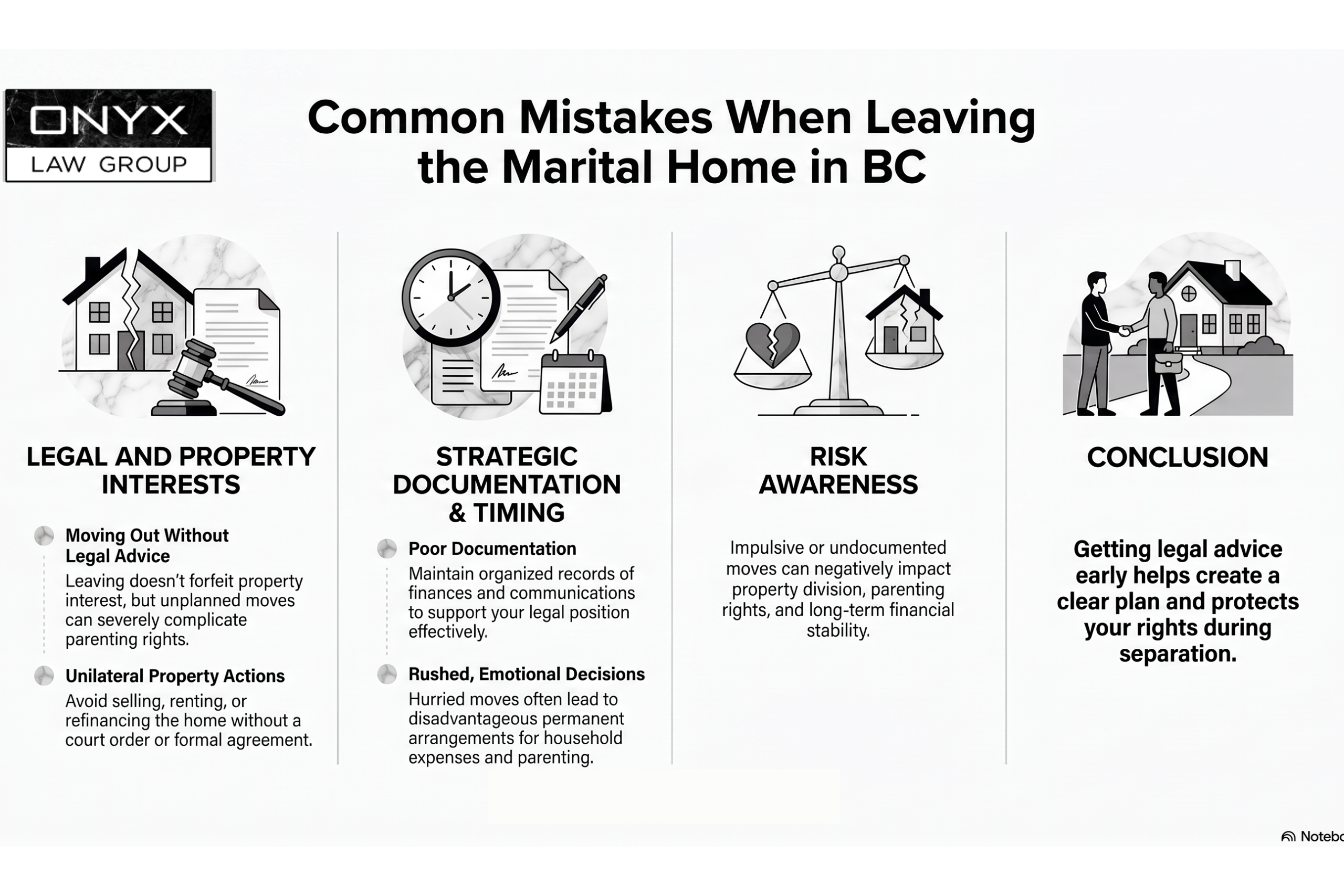
One of the biggest mistakes is moving out without understanding your legal rights. Leaving the family home does not automatically give up your interest in the property, but making permanent decisions without legal advice can create unnecessary complications. Before you leave, take time to understand how your decision could affect property division, parenting arrangements, and support.
Another common mistake is making major decisions about the home without your spouse’s agreement or a court order. Do not try to sell, rent out, refinance, or dispose of the family home on your own unless you have the legal authority to do so.
It is also a good idea to keep copies of important documents, including financial records, property information, written agreements, emails, text messages, and other communications about the separation. Clear records can help resolve disputes if they arise later.
Finally, avoid making rushed decisions simply because emotions are running high. A hurried move can make it harder to negotiate practical issues such as parenting schedules, temporary financial arrangements, or responsibility for household expenses.
While moving out does not automatically affect your claim to the home or your right to seek support, the choices you make during the early stages of separation can have lasting consequences. Taking the time to get legal advice and create a clear plan can help protect your rights and put you in a stronger position as your separation moves forward.
Need a Family Lawyer in BC?
It’s a myth that you will lose the right to make a legal claim or lose your interest in the marital home if you move out. Knowing that helps, but it can still be very difficult to decide who will move out of the family residence. It’s worrying to not know how these important decisions may affect you, your finances, and your children.
Leaving the marital home doesn’t mean leaving your rights behind. In BC, your interest in family property stays intact even after you move out. Onyx Law Group’s family lawyers, led by Judith Janzen, guide separating spouses through property division and the next steps. Our experienced family law lawyers in BC can help protect your legal interests and answer any questions you may have. Book a free 30-minute consultation with us today.
Frequently Asked Questions
If you’re thinking about leaving the marital home, you may be wondering how it could affect your legal rights. These frequently asked questions explain what leaving the family home may mean under British Columbia law and what to consider before making a decision.
Can a Spouse Kick You Out of the House in BC?
If you both own the family residence or are both listed on the lease/rental agreement, your spouse can’t kick you out. You have the right to be there.
Can I Return to My Home After Leaving?
Yes, if you still have a legal right to occupy the home and no court order says otherwise. Before returning, consider your safety, your living arrangements, and whether doing so could create additional family law issues or increase the risk of family violence.
What Happens if My Spouse Changes the Locks After I Leave?
Your other spouse generally cannot change the locks without your consent if you both have legal rights to share possession of the home. If you are locked out, seek legal help from a family lawyer to understand the legal steps available to you.
Does Leaving the Marital Home Impact the Division of Pensions or Rrsps?
No. Family property includes pensions and RRSPs, and they are generally divided under BC law regardless of who leaves the home first unless an unequal division is ordered.
Can I Force My Spouse to Leave the Home Instead?
Usually not without a court order. A judge will apply the appropriate legal test and may grant exclusive possession if it would be significantly unfair for either you or the other spouse to remain in the home together.
What if neither Spouse Can Afford to Stay In the Home?
Selling the family home may be the best option if neither spouse can afford it after separation. If you cannot agree, the court may decide the preferred occupant during the proceedings or order that the property be sold.
Why Is Moving Out the Biggest Mistake in a Divorce?
Moving out is not always a mistake, but it can affect parenting arrangements and other practical issues after separation. Before leaving, get legal advice to avoid unintended consequences based on your family’s circumstances and how your relationship started.
Do I Legally Have to Support My Wife if We Are Separated in BC?
Possibly. Your financial obligations depend on factors such as the length of the continuous period you lived together, your relationship, and each person’s financial circumstances.
What Happens When One Spouse Leaves the Marital Home?
Leaving the home does not automatically change ownership or property rights, even if the property is in one spouse’s name. The court can still decide whether property should be divided unequally based on the facts of the case.
What Not to Do During Marriage Separation?
Avoid hiding assets, making major financial decisions without advice, or arguing over companion animals and other shared property. These disputes can complicate your case and make it harder to reach a fair resolution.
Disclaimer: The information on this page is general legal information about British Columbia law, not legal advice for any specific situation. Reading this page does not create a solicitor-client relationship. BC law changes, and the procedure that applies to a specific situation depends on facts not covered here. For advice on your situation, consult a qualified British Columbia estate lawyer directly. Past results, illustrative scenarios, and reference to typical fact patterns do not guarantee similar outcomes in any specific case.