


In BC, an inheritance to one spouse starts out as excluded property, so it is not shared when the relationship ends. Some parts of it can still be shared with your spouse, but only in very limited ways. Those routes are growth in its value, mixing it beyond tracing, an agreement that includes it, or a rare court order.
At Onyx Law Group, our lawyers bring more than 20 years of experience to property division and estate matters across British Columbia. We trace inherited funds through bank records, land titles, and estate documents before advising on what stays excluded. If you have inherited money and your relationship is changing, talk to our team before you move it.
This article explains when an inheritance stays yours in a BC separation, when it becomes family property, and how to protect it.
Key Takeaways
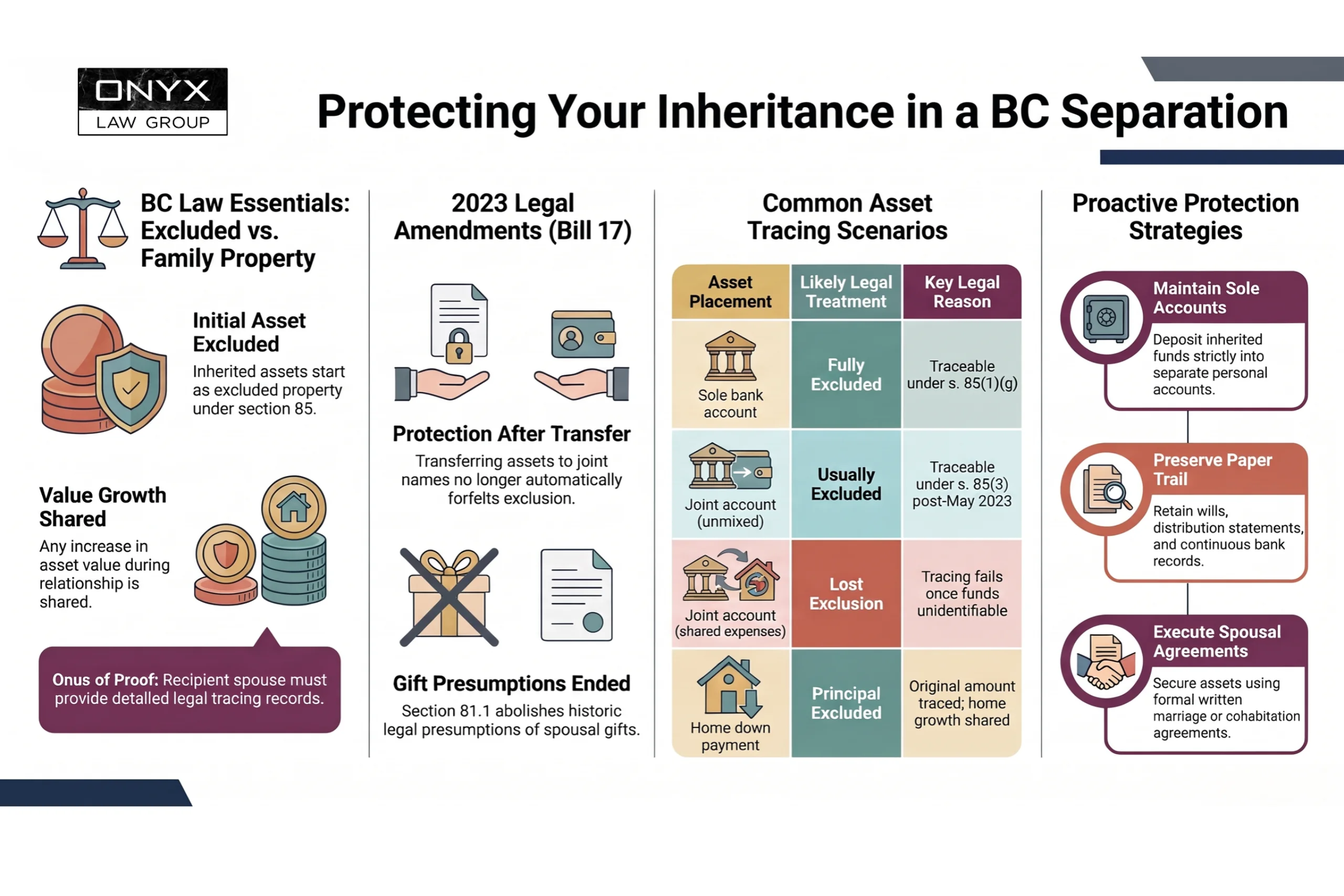
An inheritance to one spouse is excluded property under section 85(1)(b) of BC’s Family Law Act. Any increase in its value during the relationship is family property and is normally shared with your spouse. The spouse who says property is excluded has to prove it, so records matter more than intentions. For proceedings started on or after May 11, 2023, putting an inheritance in joint names does not end its exclusion by itself. The biggest practical risk is mixing inherited money with family money until nobody can trace it.
Understanding Inheritance and Marital Property

An inheritance is property you receive when someone dies, under their will or under BC’s intestacy rules. It can come as money, a house, stock of a company, or other types of assets that pass on through an estate. When spouses split up, under BC law they distinguish between family property and excluded property. Family property is separated during divorce, but excluded property usually goes to the spouse who received it.
Most assets either spouse owns at separation are family property, so an exclusion needs proof. That is why the source of each inheritance received during the relationship matters so much in a property division case. Checks from an estate and a bonus at work can look alike in your bank account but the law handles them differently.
What BC Law Calls Marital Property
People often ask “is my inheritance considered marital property” or “when does inheritance become marital property” because American sites use that language. BC’s Family Law Act uses different words: family property and excluded property. What a US site calls separate property or non-marital property is closest to what BC calls excluded property.
US courts that divide marital property talk about the marital estate, and BC calls that pool family property. In some places, couples have community property laws, which means that most of the stuff you acquire together during your marriage is considered jointly owned. Other areas use something called equitable distribution instead. In community property states, inherited money is typically considered separate property too, though the details vary from state to state. Neither system is BC law, so US answers about separate or marital property can mislead.
Someone asks if inheritance is marital property in Canada gets different answers depending on which province they’re in, because property division laws vary by province. In BC, the list of exclusions sits in section 85 of the Family Law Act, SBC 2011, c 25, on BC Laws.
What Counts as Excluded Property
Section 85(1) lists the property kept out of the shared pool, and an inheritance to a spouse sits in paragraph (b). This list includes property that people own from before their relationship began, gifts given to one partner by someone else, and certain kinds of awards related to personal injuries. Paragraph (g) adds anything derived from that property, so a house bought with inherited money can carry the exclusion forward.
Family Law in BC, a site for legal information from Legal Aid BC, describes the exclusion as covering “inheritances to only one spouse.” That wording matters when a parent leaves money to a couple, because a joint bequest is not an inheritance to one spouse.
So if US states generally consider inheritance as separate property, the (BC) version is excluded property that can be traced as separate property too. An inheritance considered separate on day one can lose that protection in practice if the paper trail disappears.
When an Inheritance Can Become Family Property
Starting with BC, when speaking of a spouse receiving an inheritance, it belongs exclusively to that particular spouse. In daily terms, there are four main ways that inheritances become part of family property. The first point is growth: any increase in its value during the relationship is considered family property under section 84(2)(g).
The second is mixing, where inherited money is blended with family money until it looks like any other family asset. The third is making an agreement: couples can sign a marriage contract which makes certain things that were previously private property into joint family property. The fourth is also an order from court under section 96 that is quite rare.
Spending an inheritance on groceries or a holiday does not convert it into family property in BC. The money is gone, and nobody can claim an exclusion over money that no longer exists. That leaves the inheritance subject to division only because the proof has failed, not because the law changed its label.
Legal Framework Governing Inheritance and Marital Property

Upon separation, Part 5 of the Family Law Act manages property and debts. Under section 81, each former spouse gets an undivided half interest in all family property when separation occurs. Assets that are excluded sit outside of this pool; therefore, labels attached to each asset decide who owns them. Whether an asset is excluded depends on several factors, starting with where it came from and how it was held. Effective in 2023, the Family Law Amendment Act revised important parts of its rules that apply to cases that began on or after May 11, 2023.
Who Counts as a Spouse in BC
Section 3 of the Family Law Act treats you as a spouse through marriage or else through a marriage-like relationship of at least two continuous years. Having a child together is enough for some parts of the Act, but not for property division under Part 5. That means common-law partners who split before the two-year mark are not spouses for Part 5 property division.
Under section 3(4), spouses can be separated even while they still live under the same roof. This is important because the separation date decides what assets count as family property and also sets the timeline for growth in that value.
Who Has to Prove an Inheritance Is Excluded
It falls on the spouse who is claiming an exclusion under section 85(2) to prove it. When courts decide cases, detailed records matter more than people’s memories about events that happened long ago.
Some important evidence includes the will, letters from the executor, statements about distribution of the estate, and the check or wire transfer that delivered the money. After that come bank statements showing the initial deposit and every transfer after it, ideally from the day the money arrived. If a trail takes a break for a few years, things left behind become harder to follow.
How Growth in Value Is Shared
Under section 84(2)(g) law, any rise in value of property that was excluded from being part of joint assets during the marriage belongs to family property. The increase is measured from the later of two dates: the start of the relationship or the day you acquired the asset. This section doesn’t follow the distinction between active appreciation and passive appreciation; normal market growth is included too.
For instance, suppose you inherit a rental property worth $600,000, and its value goes to $750,000 at the time of separation. The $600,000 stays excluded if you can prove it, while the $150,000 increase is family property that is normally shared. Legal Aid BC’s guidance simplifies this by saying that an increase of $100,000 means $50,000 goes to each person.
In a long relationship, the growth in an inherited asset’s value can become a large part of what is divided. The increase in these amounts over time is noteworthy.
When a Court Can Divide Excluded Property
Section 96 lets a court divide excluded property only in two narrow situations, and both are hard to meet. The first is when family assets or debts outside of BC can’t be split practically. The second is when not dividing it would be extremely unfair because of the duration of the relationship and at least one of the listed factors.
The listed factors involve direct work done by a spouse that preserves, maintains, or improves the property and the terms of any agreements. The third factor comes into play if unfairness under section 95 cannot be resolved by giving unequal shares of family property. Section 95 is another kind of test that lets a court divide family property unequally when an equal split would be significantly unfair.
In the event of a divorce, excluded property normally stays with the spouse who owns it. Even when section 96 applies, nothing in the Act says excluded property must be split 50/50 or necessarily equally at all. Handling divorces is complicated, and results vary greatly depending on the specifics of each family.
What If Your Inheritance Is in a Joint Account?
Money in a bank account is family property under section 84(2)(d) unless proved excluded. Putting inherited money into a joint bank account doesn’t change where the money comes from, but it makes it harder to track. People often search for a “joint checking account,” and in BC the same problem arises with any joint chequing account.
When that joint bank account pays for both salaries and covers the mortgage payments, groceries, and other shared expenses, problems begin. If inheritance money is used along with marital funds for living expenses, it becomes very hard to distinguish which dollars belong to which. A court asks what portion of the original deposit remains identifiable after separation.
An account in both spouses’ names holding joint funds is jointly owned, but that alone does not settle whether money is excluded. Since 2023, section 81.1 has barred the presumptions of advancement and resulting trust between spouses; hence, neither direction of intention is presumed anymore. The older rules on joint bank accounts were based heavily on those presumptions, which no longer hold true for newer proceedings.
The same inheritance can land in quite different places depending on where the money went after it arrived. Below is a table that shows likely treatments for different common situations; every case depends on its specific evidence.
|
Where the Inheritance Went |
Likely BC Treatment |
Why |
|---|---|---|
|
Account in your name only, never mixed. |
Excluded |
Traceable under s 85(1)(g) |
|
Joint account, still identifiable |
Usually still excluded if traced, with the burden on you |
s 85(2), and s 85(3) since May 11, 2023 |
|
Joint account, used for shared living expenses. |
Little or nothing left to exclude. |
Nothing left to trace |
|
Down payment on the family home |
The traced portion may remain excluded; growth is considered family property. |
s 85(1)(g) and s 84(2)(g) |
|
Title moved to your spouse’s name or joint names |
Exclusion usually survives transfer in new proceedings. |
s 85(3) and s 81.1 |
|
Any of the above, the proceeding started before May 11, 2023 |
Old rules apply, and a gift to a spouse can end the exclusion. |
Bill 17 s 24 and V.J.F. v. S.K.W. |
What the 2023 Amendments Changed
Bill 17, the Family Law Amendment Act, 2023, received Royal Assent on May 11, 2023, and changed three rules that matter here. New section 85(3) says the exclusion applies regardless of any transfer of legal ownership rights or beneficial interest from one spouse to the other. Section 81.1, also new, ends the old presumptions that a transfer between spouses was a gift or was held in trust.
Section 96 has been reenacted as well, and its grounds for separating out assets include terms of agreement and connection to Section 95. An inheritance remains separate even after you add your spouse to the title, as long as you can trace and prove it.
Old rules still apply for divorce proceedings on properties that started before May 11, 2023, unless both parties agree differently. In older cases, section 81.1 doesn’t apply anymore, and the earlier versions of sections 85 and 96 continue to be relevant. So whether inherited property remains separate after a transfer depends on when the court case started, not when the transfer happened.
A BC Case Study on When an Inheritance Becomes Marital Property

The BC Court of Appeal dealt with this exact question in V.J.F. v. S.K.W., 2016 BCCA 186, decided on April 28, 2016. The husband received a $2 million estate distribution, which the trial judge treated as a gift by way of inheritance. He used inherited money to buy real estate and registered it solely in his wife’s name to protect against creditors.
The trial judge ruled that the money is no longer considered excluded property, and the Court of Appeal dismissed his appeal. The court’s published summary says that once the husband gifted the property to his wife, the exclusion was lost. Because he received nothing back for the transfer, the court found that the tracing rule in section 85(1)(g) did not help him. The court also found that dividing the $2 million equally was not significantly unfair.
How the 2023 Amendments Change This Result
If the same facts arise in any proceedings that start on or after May 11, 2023, section 85(3) changes the result. Transferring the property to the wife would likely not end the exclusion by itself, and Section 81.1 would block any presumption of gift. The husband still has to go through and prove the $2 million exists.
Under section 84(2)(g), growth in value of property that occurs during the marriage stays family property. Old sections still apply to cases that were initiated before May 11, 2023. If a case has already started before that date, reasoning from 2016 can still determine whether a gift given to a spouse is excluded property.
How Excluded Property and Family Property Compare
The two categories work differently once spouses separate, and the gap shows up most in who has to prove what. Where US sites mention marital debts, BC law speaks of family debt under section 86. Below is a side-by-side comparison of these two categories with BC terms listed first.
|
Question |
Excluded Property |
Family Property |
|---|---|---|
|
What it includes |
Pre-relationship assets, inheritances and third-party gifts to one spouse, and property traced to them |
All property owned by each spouse at separation, plus any growth in excluded property |
|
Who proves it? |
The spouse claiming the exclusion |
No exclusion to prove; ownership at separation is sufficient. |
|
How it is divided |
Not divided, except in narrow s 96 cases |
Equal shares, unless that would be significantly unfair under s 95 |
|
Debts |
Debt from before the relationship usually stays with the original spouse. |
Family debt under s 86 is shared. |
|
Can an agreement change it? |
Yes, under s 92. |
Yes, under s 92. |
Protecting Your Inheritance

Protecting an inheritance involves proving things and also dealing with practical matters. Taking these proactive steps upfront is cheap and will save you from having long arguments later over bank records.
Keep Inherited Money in an Account in Your Name Alone
First, open a separate bank account in your name only and deposit the inheritance there as soon as it arrives. Keep your pay out of it, so the separate account holds only the inheritance. If you want to help with a renovation or a trip, move only the amount you choose to share and note why. Separating inheritance like this makes tracing it much easier many years from now. Having a savings or investment account solely in your name works the same. Any interest it earns may count as growth in value, so keep the statements showing it.
Save the Paper Trail From the Estate
Keep every document that the estate sends you and begin by looking at the will or the letter explaining your share. Make sure to keep copies of the executor’s statement of distributions, the check or confirmation of wire transfers, and the first bank statement showing that money has been deposited. Download your statements every year, because old online records can vanish when an account closes.
This information is important for proving your case against your spouse if they challenge the exclusion in section 85(2). Ask the executor for a copy of the estate accounts if you haven’t received one yet. It’s fine to have paper copies, but having a scan sent to your email is easier to keep track of.
Think Before You Spend It on the Family Home
Think carefully before investing inherited money in the family home because that’s also where it becomes most difficult to trace. A traced down payment can stay excluded, but growth in the home’s value during the relationship is family property. If the title is in both parties’ names, section 85(3) helps in newer cases, though you still need to prove the amount. Years of mortgage payments using joint income can obscure how much of the inherited portion is in the jointly owned house. When you use the money, please write down exactly how much was used and the date in a note or a written agreement. A brief letter signed by both of them is much stronger evidence than relying on anyone’s memory.
Put It in a Marriage Agreement or Cohabitation Agreement
After that, consider a written agreement with your spouse that confirms the inheritance and its growth stay excluded. In BC, a prenuptial agreement or postnuptial agreement is called a marriage agreement or cohabitation agreement, made under section 92. For the full protection of section 93, a prenuptial agreement in BC must be written and have each signature witnessed.
A court can set an agreement aside if a spouse hid significant property or debts or took improper advantage of the other. It can also step in if a spouse did not understand the agreement or if the terms are significantly unfair now. Having full disclosure of finances and separate legal advice for each spouse makes these agreements harder to contest. Questions about the enforceability of a marriage agreement usually revolve around what each person knew when they signed something.
Get Advice Before You Separate or Sign
Before separating, signing an agreement, or putting larger inheritances into joint names, you should speak to a family lawyer. Readers searching for an experienced family law attorney in BC are looking for what Canadians call a family lawyer. Deadlines are strict under section 198 of the Family Law Act, so timing matters as much as the paperwork.
Married spouses get two years from the divorce order, and unmarried spouses two years from separating. While you are working with a family dispute resolution professional like a mediator, this clock stops ticking. Knowing how long you have to claim assets after separation helps you avoid losing a claim just because you waited. Advice on inheritance and divorce is most useful before the money moves, not after a separation is underway.
Ready to Protect Your Inheritance in a BC Separation?
An inheritance starts protected, and it generally stays that way if you can trace it and prove where it went. Value growth and loss of paper trails both lead to losing ground, and both risks have practical solutions available. Talking to a lawyer sooner rather than later would be simpler if you’ve inherited some money and your relationship has changed.
Our family and estate lawyers in Kerrisdale, downtown Vancouver, and New Westminster handle property division claims that involve an inheritance. We start by reviewing the will, the estate distribution records, and every account the inheritance passed through. Contact us today for a consultation about protecting your inheritance.
Frequently Asked Questions
Onyx Law deals with family law and also litigates over estates. So we get inheritance issues from both the estate file and the divorce file. These are the questions clients ask most often when inherited money and a relationship breakdown overlap.
Is an Inheritance Marital Property in BC?
No, an inheritance to one spouse is excluded property under section 85(1)(b) of the Family Law Act. Growth in its value during the relationship is family property, though, and untraceable money cannot be excluded.
Does an Inheritance Received During Marriage Get Split in BC?
Usually this is not the case because, from the beginning, it is treated as excluded property, regardless of when it arrives during a marriage. Only the increase in value, or untraceable money mixed into family accounts, normally ends up being divided.
Is the Growth on My Inheritance Shared With My Spouse?
Yes, value that has increased after either when the relationship started or the date you received something is considered family property. The Act does not draw the US distinction between active and passive growth.
Does Putting an Inheritance in a Joint Account Make It Family Property?
It becomes harder to track inheritance when joint funds go into the same account. It doesn’t happen automatically, though. You still carry the burden of showing what part of the balance came from the inheritance.
What Happens If I Used My Inheritance on the Family Home?
The traced amount you put in can stay excluded, while growth in the home’s value during the relationship is family property. Having mixed payments for years based on combined income can make tracing that much harder.
Does Adding My Spouse to the Title Change Anything?
If proceedings began on or after May 11, 2023, section 85(3) keeps the inheritance excluded despite the transfer. Older proceedings still follow the pre-2023 rules, where a gift to a spouse could end the exclusion.
Do the Same Rules Apply to Common-Law Partners?
If you have lived together as spouses for at least two years, then you are eligible for property division. Having a child together does not make you a spouse under Part 5 if you fall short of two years.
Who Has to Prove an Inheritance Is Excluded?
The spouse claiming the exclusion has to prove that under section 85(2). Wills, estate distribution statements, and bank records are the usual evidence a court looks at.
Can a BC Court Divide My Inheritance Anyway?
Only in very rare cases under section 96, where there is clear significant unfair treatment related to length of the relationship and other factors that have been specified. Even then, nothing in the Act requires the excluded property to be split equally.
Is a Prenuptial Agreement Valid in BC?
Yes, in BC, this is known as a marriage agreement, and section 93 applies when it is documented in writing and both parties have their signatures witnessed. Courts can still set it aside if they find that the reasons listed in the Act apply.
Can a Marriage Agreement Be Set Aside?
Yes, for undisclosed property or debts, improper advantage, a spouse not understanding it, or significant unfairness under section 93. A claim to set one aside generally has a two-year limit from discovering the grounds.
What If an Inheritance Is Left to Both of Us?
Bequeathing something to both spouses does not mean that one of them inherits it directly because the section 85(1)(b) exclusion doesn’t work this way neatly. Both how the will is phrased and what happens to the money once the estate has settled are important here.
What If My Spouse Inherits After We Separate?
Family property is measured at the separation date, so an inheritance received after that date is not in the pool. It would also be excluded property in any case as an inheritance to one spouse.
How Long Do I Have to Make a Property Claim After Separation?
Married spouses have two years from the divorce order, and unmarried spouses have two years from the date they separated. Working with a family dispute resolution professional like a mediator suspends the two-year limit.
Does BC Use Community Property Rules?
No, community property is a US system, and BC uses its own family property and excluded property scheme. Each partner gets an equal share of family assets unless this results in something that is significantly unfair.
Disclaimer: The information in this article is for general informational purposes only and does not constitute legal advice. Reading this content does not create a lawyer-client relationship with Onyx Law Group. Laws do change and each case has its unique facts, so you should get direct advice from a qualified family lawyer regarding your specific situation. Past examples, case studies, or hypothetical scenarios are illustrative only and do not guarantee similar results.