


In most cases, an inheritance is not considered marital property in Canada and is generally excluded from property division after separation or divorce, although the rules vary by province. In British Columbia, inherited property is usually excluded from division, but any increase in its value during the relationship may be considered family property and shared.
Worried a separation could put your inheritance on the table? Onyx Law Group’s family law team, led by Judith Janzen, can offer valuable guidance on safeguarding your inheritance money and understanding what happens to inherited money in a divorce within British Columbia. Whether you seek clarity on how your inheritance may be impacted during divorce proceedings or wish to proactively protect it before or during your marriage, contact us today for expert assistance
This guide explains how inheritance is treated across Canada, the exceptions to the general rule, and how to protect inherited assets.
Is an Inheritance Considered Marital Property in BC?

In most cases, an inheritance is not considered marital property in Canada. An inheritance includes money, real estate, investments, personal belongings, or other assets received from a deceased person’s estate through a will or the laws of intestacy. Under Canadian family law, marital property generally refers to assets that spouses acquire or build together during the relationship. However, the rules for dividing property are governed by each province and territory.
The general rule across Canada is that an inheritance received by one spouse is treated as separate or excluded property and is usually not divided if the relationship ends. This protection often depends on the inheritance remaining separate from family assets. If inherited funds are mixed with joint accounts, used to purchase shared property, or otherwise commingled with marital assets, some or all of the inheritance may become subject to division.
Although the basic principles are similar across the country, the laws differ from one province to another. In British Columbia, inheritances are generally excluded property, but any increase in their value during the relationship is typically family property that may be divided.
Ontario also treats inheritances as excluded property in many cases, while Alberta has similar protections under its family property laws. Quebec follows a different legal system, with its own rules governing family patrimony and the division of property.
Keeping clear records is one of the best ways to protect an inheritance. Bank statements, estate documents, gift letters, and other financial records can help prove that inherited assets were kept separate. Understanding when an inheritance can become marital property is important, especially if you receive an inheritance before or during a marriage or common-law relationship.
When Does an Inheritance Become Marital Property in Canada?
An inheritance can become marital property if it loses its status as separate property. This most often happens when inherited assets are mixed with family property or used in a way that benefits both spouses. Once that line becomes blurred, it can be much harder to show that the inheritance should remain excluded if the relationship ends.
One of the most common examples is commingling. This happens when inheritance money is deposited into a joint bank account or combined with other shared funds. It can also occur if inherited investments are transferred into joint ownership. In these situations, a court may decide that some or all of the inheritance has become marital property, depending on the province and the surrounding circumstances.
An inheritance may also lose its protected status when it is used for joint family purposes. For example, using inherited money to buy the family home, renovate a jointly owned property, pay down a shared mortgage, or invest in a family business can affect how the asset is treated. While the outcome varies across Canada, these types of decisions often make it more difficult to claim that the inheritance belongs to only one spouse.
Clear documentation can make a significant difference. Keeping inheritance funds in a separate account, maintaining estate records, and avoiding joint ownership can help preserve their excluded status. In some cases, a prenuptial or cohabitation agreement can also confirm how an inheritance will be treated if the relationship ends, providing greater certainty for both spouses.
For example, if someone in British Columbia inherits $200,000 and keeps it in a separate investment account, the original inheritance will generally remain excluded property. However, if the money is used as the down payment on a jointly owned home or deposited into a joint account, part or all of it may become subject to property division. Similar principles apply in provinces such as Ontario and Alberta, although the legal rules and outcomes can differ depending on the jurisdiction and the specific facts of the case.
| Province | Is Inheritance Considered Marital Property? | Conditions for Becoming Marital Property | Protection Tips |
|---|---|---|---|
| British Columbia (BC) | Generally no. An inheritance is usually treated as excluded property under the Family Law Act. However, any increase in its value during the relationship is generally considered family property. | The inheritance may lose its excluded status if it is deposited into a joint account, used to purchase or improve jointly owned property, gifted to a spouse, or otherwise commingled with family assets. | Keep inherited funds in a separate account, retain estate documents and financial records, avoid adding your spouse’s name to inherited assets, and consider a cohabitation or marriage agreement. |
| Ontario | Generally no. Inheritances are typically excluded from the equalization of net family property if they are kept separate. | Protection may be lost if inherited funds are mixed with joint assets or used to purchase the matrimonial home, which is subject to special property rules in Ontario. | Maintain separate accounts, avoid using inherited funds for the matrimonial home without legal advice, and keep clear documentation showing the source of the inheritance. |
| Quebec | Generally no. Inheritances are usually excluded from the division of property, but Quebec’s civil law system and family patrimony rules differ from other provinces. | An inheritance may be affected if it is used to acquire or improve assets that form part of the family patrimony or if it is intentionally shared with a spouse. | Keep inherited assets separate, maintain detailed records, and seek legal advice before using inherited funds for family property. |
| Alberta | Generally no. Inheritances are often exempt from division under Alberta’s family property laws if they remain separate. | An inheritance may become divisible if it is mixed with family assets, placed in joint ownership, or used for shared investments or family expenses. | Preserve separate ownership, keep inheritance funds in a dedicated account, maintain documentation, and consider a domestic agreement to clarify property rights. |
How to Protect Your Inheritance From Becoming Marital Property in Canada
Protecting an inheritance starts with keeping it separate from your family finances. In most provinces, an inheritance is treated as separate or excluded property, but that protection can be lost if the assets become mixed with marital property. Taking a few simple steps early on can help preserve your inheritance if your relationship later ends.
Step 1: Keep Your Inheritance in a Separate Account
One of the best ways to protect an inheritance is to deposit it into a bank or investment account that is only in your name. Avoid transferring inherited money into a joint account or using it to pay shared household expenses unless you understand the legal consequences. If you need to use part of the inheritance for family purposes, consider transferring only the amount you need instead of combining the entire inheritance with joint funds.
Step 2: Keep Clear Records and Documentation
Good record-keeping can make a significant difference if your inheritance is ever disputed. Keep copies of the will, estate distribution documents, bank statements, investment records, and any paperwork showing where the inherited assets came from. These documents can help demonstrate that the inheritance remained separate throughout the relationship.
Step 3: Consider a Marriage or Cohabitation Agreement
A marriage agreement, prenuptial agreement, cohabitation agreement, or postnuptial agreement can provide additional protection for inherited assets. These agreements allow spouses to decide how an inheritance will be treated if they separate or divorce. Having a written agreement before disputes arise can reduce uncertainty and help avoid costly litigation later.
Step 4: Understand the Rules in Your Province
Inheritance laws are not identical across Canada. In British Columbia, an inheritance is generally excluded property, although any increase in its value during the relationship may be divided. Ontario also protects inheritances in many situations, but different rules can apply to the matrimonial home. Quebec follows a civil law system with its own property regime, while Alberta has separate legislation governing family property. Because the rules vary, obtaining legal advice before using or transferring inherited assets can help you make informed decisions and better protect your inheritance.
How Does Inheritance Relate to Marital Property?

Understanding the legal framework that governs the division of net family property on separation is the key to understanding what happens to an inheritance in a divorce.
What Law Governs Inheritance and Marital Property in BC?
In British Columbia, the Family Law Act governs the division of property and debt on separation. It also governs the treatment of an inheritance received during the marriage, should spouses later divorce. The property division and inheritance rules in the Family Law Act apply whether the couple are legally married spouses or common-law spouses (a couple who have cohabited in a marriage-like relationship for a minimum of two years).
How Is Property Divided in a Divorce?
The general rule is that net family property is subject to division 50/50 between spouses unless a court finds that it is significantly unfair to do so or the spouses mutually agree to divide assets in a different manner. Net family property is calculated by determining the value of each spouse’s family property minus family debt on the date of separation.
Family property encompasses all assets owned by either spouse individually or jointly at the time of separation, irrespective of ownership titles. Examples of family property include the family home, RRSPs, TFSAs, investments, pensions, and other assets, whether jointly owned or in only one spouse’s name. “Family debt” encompasses all debts, whether joint debt or in only one spouse’s name.
Keeping Inheritance Separate From Spouse May Be Easier in BC
In the context of divorce, the spouse claiming that property is excluded property is responsible for demonstrating that the property is excluded. That hurdle may now be easier to clear due to a recent change to the Family Law Act.
The law was amended to include a provision (section 85(3)), which provides that an inheritance received by one spouse retains its excluded character even if legal or beneficial ownership was transferred from that spouse to the other spouse (for example, transferred into a joint account). The increase in value of that inherited property must still be evenly shared, even if the original funds are traced back to the excluded property of one spouse.
Section 85(3) is relatively new, so you should continue to be very cautious when it comes to transferring inherited property or money to your spouse or using your inheritance to purchase property in joint names. Your safest bet is to consult with a family lawyer if you anticipate receiving an inheritance or want to know how to protect an inheritance you’ve already received.
Tips for Keeping Inheritance Separate From Spouse
Keeping an inheritance separate from marital property requires careful planning and good financial habits. Here are some practical steps you can take to help protect your inheritance.
- Prepare a cohabitation agreement, a prenuptial agreement (before marriage), or a postnuptial agreement (after marriage). We strongly recommend that you contact a family lawyer to assist you in preparing these types of agreements.
- Keep inherited funds or other investments in accounts separate from your spouse.
- Maintain a separate bank account for the inheritance, only accessible by you, and another bank account that is used for marital expenses.
- Avoid commingling inherited money with your employment earnings in the same account, even if it’s solely under your name.
- Don’t use your inheritance to pay joint debts or renovate/improve shared assets.
- Be cautious if considering gifting inherited money or inherited property to your spouse. Section 85(3) of the Family Law Act may maintain the exclusion for you if you do, but legal advice is recommended to ensure you are protected.
- Document everything relating to the inheritance (e.g., acquisition date, source, value, bank statements) so that you can substantiate its exclusion from marital assets in the event of a divorce.
When navigating the complexities of an inheritance and divorce, it’s crucial to seek personalized advice and strategies from a qualified family law lawyer. Each situation is unique and requires a keen and detailed eye to ensure that all assets are protected and handled fairly.
Case Study: When Is Inheritance Marital Property in Canada?
After separating from his spouse, Michael contacted Onyx Law Group because he was concerned that the inheritance he had received from his late mother would be divided during the property settlement. Our lawyers reviewed his financial records and traced how the inheritance had been used throughout the marriage.
While some funds had been applied to renovations on the family home, a significant portion had remained separate and qualified as excluded property. Armed with this evidence, we negotiated a fair settlement that protected the part of Michael’s inheritance that remained legally excluded, allowing him to resolve the matter efficiently without a lengthy court dispute.
What Do Canadian Spouses Need to Know About Inheritance and Divorce?
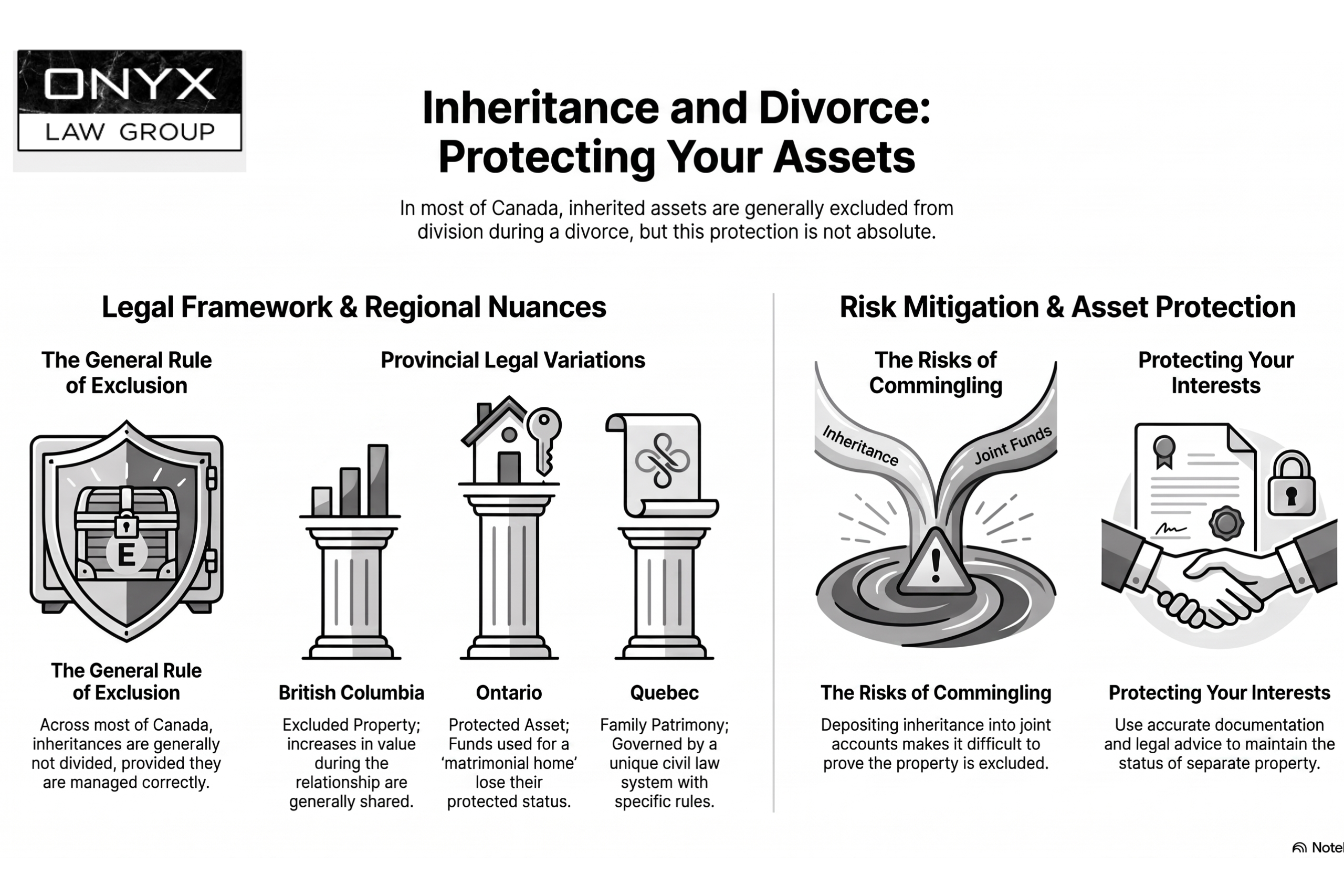
Inheritance and divorce do not always go hand in hand. In most parts of Canada, an inheritance received by one spouse is generally not divided when a marriage or common-law relationship ends. However, whether an inheritance remains protected depends on how it was managed during the relationship and the family property laws in the province where you live.
The rules are not the same across Canada. In British Columbia, an inheritance is usually treated as excluded property, although any increase in its value during the relationship is generally shared. Ontario also protects inheritances in many situations, but inherited funds used to purchase or pay down the matrimonial home can be treated differently. Quebec follows a civil law system with its own family patrimony rules, which means the treatment of inherited assets may not be the same as in other provinces.
Receiving an inheritance during your marriage does not automatically make it marital property. Many spouses inherit money, real estate, or investments while they are married and still keep those assets separate. Problems often arise when inherited funds are deposited into a joint account, used to buy shared property, or mixed with family finances, making it more difficult to prove they should remain excluded.
If an inheritance becomes a point of disagreement during a divorce, legal advice is important. An inheritance lawyer can review financial records, estate documents, and the circumstances surrounding the inheritance to determine how it may be treated under provincial law. If the spouses cannot reach an agreement, the court can decide whether the inheritance remains separate property or should be included in the division of assets.
Need Advice on Keeping Inheritance Separate From Spouse?
If not properly handled, your valuable inheritance and any growth in its worth may have to be shared in divorce. If you’ve combined your inheritance with marital funds in a joint account or used your inheritance to buy marital assets, reclaiming it during divorce proceedings can be complex, often involving intricate court procedures.
There are steps you can take to protect yourself and safeguard your inheritance, either before or during your marriage. It’s not too late! Onyx Law Group’s team of experienced family law professionals in BC offers unparalleled expertise and insight. We can help you explore effective legal options and strategies to protect your inheritance in the case of a divorce. Contact us today to arrange a consultation with a family lawyer today!
Frequently Asked Questions
If you’ve received or expect to receive an inheritance, you may be wondering whether it counts as marital property in Canada. These frequently asked questions explain how inheritances are generally treated and when they may be divided after a separation or divorce.
Is Inheritance Marital Property in Canada?
It depends on the province or territory where you live, as family property laws vary across Canada. In British Columbia, an inheritance is typically considered separate property, although certain exceptions may apply.
Is My Spouse Entitled to My Inheritance in Canada?
Generally, your spouse is not entitled to your inheritance. However, they may have a claim to certain assets if the inheritance becomes part of the family’s matrimonial property or increases in value.
Do I Have to Share My Inheritance With My Spouse?
Not usually, because an inheritance is generally considered separate property. However, using it for joint expenses or shared expenses may affect how it is treated during property division.
Is My Husband Entitled to Half My Inheritance if We Divorce?
Generally, no. Your husband is not entitled to half of your inheritance. The same rule applies regardless of which spouse receives the inheritance, although any increase in value may be subject to equal division.
Do Inheritances Get Split in a Divorce in Canada?
Not automatically, because inherited property acquired by one spouse is often treated differently from family property. Whether it is divided depends on provincial law, any legal agreements, and how the inheritance was handled during the marriage.
Can My Wife Get Half of My Inheritance?
Generally, your wife cannot automatically claim half of your inheritance. However, inherited assets may lose their sole ownership status if they are mixed with family property or used for shared purposes.
How Can I Keep My Inheritance Separate From Marital Property?
Keep inherited assets separate from family finances and avoid mixing them with shared property. A legal contract can explicitly outline that the inheritance will remain separate property, and a legal professional can help prepare the agreement.
Disclaimer: The information on this page is general legal information about British Columbia law, not legal advice for any specific situation. Reading this page does not create a solicitor-client relationship. BC law changes, and the procedure that applies to a specific situation depends on facts not covered here. For advice on your situation, consult a qualified British Columbia estate lawyer directly. Past results, illustrative scenarios, and reference to typical fact patterns do not guarantee similar outcomes in any specific case.