


In British Columbia, an inheritance received by one spouse is generally excluded from family property and is not divided when the couple separates. However, any increase in the inheritance’s value during the relationship is generally treated as family property and may be divided. Keeping the inheritance separate and maintaining clear records can help protect the excluded property and make it easier to prove its value.
At Onyx Law Group, our knowledgeable family law lawyers can provide you with valuable insight as to how an inheritance is affected by divorce in British Columbia and how to protect inheritances received by a spouse. Judith Janzen has been untangling these property fights since her call to the bar in 2000, and Onyx acted in Zhang v. Chen, which produced one of BC’s largest interim support awards. If you want to know more about how an inheritance will be affected during a separation or divorce, or how to safeguard an inheritance before or during marriage, contact us today.
In this blog, we provide you with information about inherited property, what happens when a spouse receives an inheritance, and how to protect inherited assets.
What Is Inheritance Law?

With nearly 1 million married couples in British Columbia, according to Statistics Canada’s 2021 Census, understanding how inherited property is treated during a separation can be important for many families.
Inheritance law governs how a deceased person’s assets are transferred to the people entitled to receive them. This may happen under a valid will or under the intestacy rules that apply when someone dies without a will. An inheritance can include money and savings, real estate, personal belongings, investments, and other property that forms part of the estate. The exact rules depend on the province or territory where the estate is being administered.
In British Columbia, for example, the Wills, Estates and Succession Act (WESA) sets out many of the rules that apply when someone dies with or without a will. If there is no will, the estate is distributed according to the statutory intestacy rules. These rules determine who may inherit and how much they may receive, including the shares available to a surviving spouse and descendants.
What Happens When Your Spouse Receives an Inheritance?
When your spouse receives an inheritance, it is generally treated as excluded property under British Columbia’s Family Law Act. This means the inheritance itself usually does not have to be divided if you later separate, even if it was received during the relationship.
However, the rules can become more complicated if the inheritance increases in value during the relationship or is mixed with other property. In limited circumstances, a court may also order a division of excluded property if it would be significantly unfair not to do so.
The issue is not limited to married couples. Statistics Canada counted more than 213,000 common-law couples in B.C. in 2021, making it important to understand how family-property rules apply to different types of relationships.
Understanding Separate vs. Marital Property
The basic rule in the Family Law Act is that property and debt are split equally between spouses on separation. In other words, when spouses separate, net family property is subject to division 50/50 between spouses, unless a mutual agreement states otherwise, or the court finds that equal division would be significantly unjust.
Under the Family Law Act, property is divided into two categories: family property and excluded property. British Columbia has no category called marital property or separate property — those are American terms, and the ones that decide your case here are the two in the statute. Family property encompasses all assets owned by either spouse at the time of separation, irrespective of ownership titles. Examples of family property include separately purchased assets, joint property, the matrimonial home, RRSPs, investments, bank accounts, and other assets, regardless of whether the assets are jointly owned or owned by only one spouse.
Separate or excluded property is not subject to equal division in the event of a divorce. An inheritance received by one spouse is normally categorized as excluded property. Property brought into the marriage by one spouse and gifts received by one spouse from a third party are also typically excluded property. In the context of divorce, the spouse claiming that property is excluded property is responsible for demonstrating that the property is indeed excluded property.
How Is an Inheritance Treated in Different Situations?
According to Veronica Manski, Associate Counsel and probate and estate administration practice leader at Onyx Law Group, “An inheritance can be easy to protect when you plan ahead but much harder to untangle after it has been mixed with family finances.” How an inheritance is handled can affect how it is treated if spouses later separate. While the inheritance itself is generally excluded property in B.C., what happens to it afterward can make the situation more complicated. The table below highlights some common situations and what to keep in mind.
Situation | General treatment in B.C. | What to keep in mind |
|---|---|---|
Inheritance kept separate | The inheritance is generally excluded property. | Keep records showing the source and value of the inheritance. |
Inheritance increases in value | The increase in value is generally family property. | The increase may be subject to equal division when spouses separate. |
Inheritance is mixed with other assets | Tracing the excluded property can become more complicated. | Keep detailed financial records to establish where the inheritance went. |
Inheritance used for the family home | The treatment can become more complicated, particularly when inherited funds are used for a shared asset. | Get legal advice before using a significant inheritance toward the family home. |
Inheritance covered by a family-law agreement | The spouses can agree on how certain property will be treated, subject to B.C. law. | A properly prepared agreement can provide greater certainty about the inheritance and its treatment. |
Does an Inheritance Need to Be Split in a Divorce?

While excluded property is presumed to remain the property of the spouse who owns it, sections 84 and 85 of BC’s Family Law Act make it clear that the increase in value of the excluded property is subject to equal division on separation. That means any increase in the value of inherited property over the course of the relationship is subject to equal division during divorce proceedings (subject to the applicability of any of the exceptions discussed below).
Imagine your spouse inherits a home worth $1 million either before or during your marriage. The home is worth $1.5 million when you separate. The original inheritance value of $1 million is excluded property, but the $500,000 increase in value is subject to division 50/50.
When Does Inheritance Become Marital Property?
It’s possible for the full value of an inheritance received by one partner to lose its exclusion and become marital property. For example, if an inheritance during the marriage is co-mingled with family property or used to purchase property in joint ownership with your spouse, the inheritance can become marital property subject to equal division if you separate.
Using the Inheritance for Marital Expenses
Inherited funds stay excluded property as long as they are kept separate during the marriage. If an inheritance received by one partner is used to pay off joint debt or deposited into a joint bank account (making it available for both spouses to use), the inheritance loses its character as excluded property.
Similarly, if inherited funds are used to purchase a family home that both spouses live in, or inheritance money is used to pay for the mortgage, repairs, and upkeep of the matrimonial home, BC courts have generally held that the exclusion is lost so that the spouse who received the inheritance doesn’t get to claim it back if the spouses later divorce.
What Are the Legal Protections for Inheritances?

The Family Law Act was amended in 2023 to clarify how excluded property is treated between spouses. The changes provide that the exclusion can still apply even if legal or beneficial ownership of the property is transferred from one spouse to the other. For example, if you use an inheritance to buy real estate in both spouses’ names, the inheritance may still be traced back to the excluded property of the spouse who originally received it.
These changes may provide greater protection for inherited assets during a divorce, but the rules are still relatively new. It is not yet clear how they will affect every situation where inherited funds are used or transferred. If you receive an inheritance before or during your marriage, taking steps to document and protect it can make things much clearer if you separate later.
How to Protect Your Inheritance from a Spouse
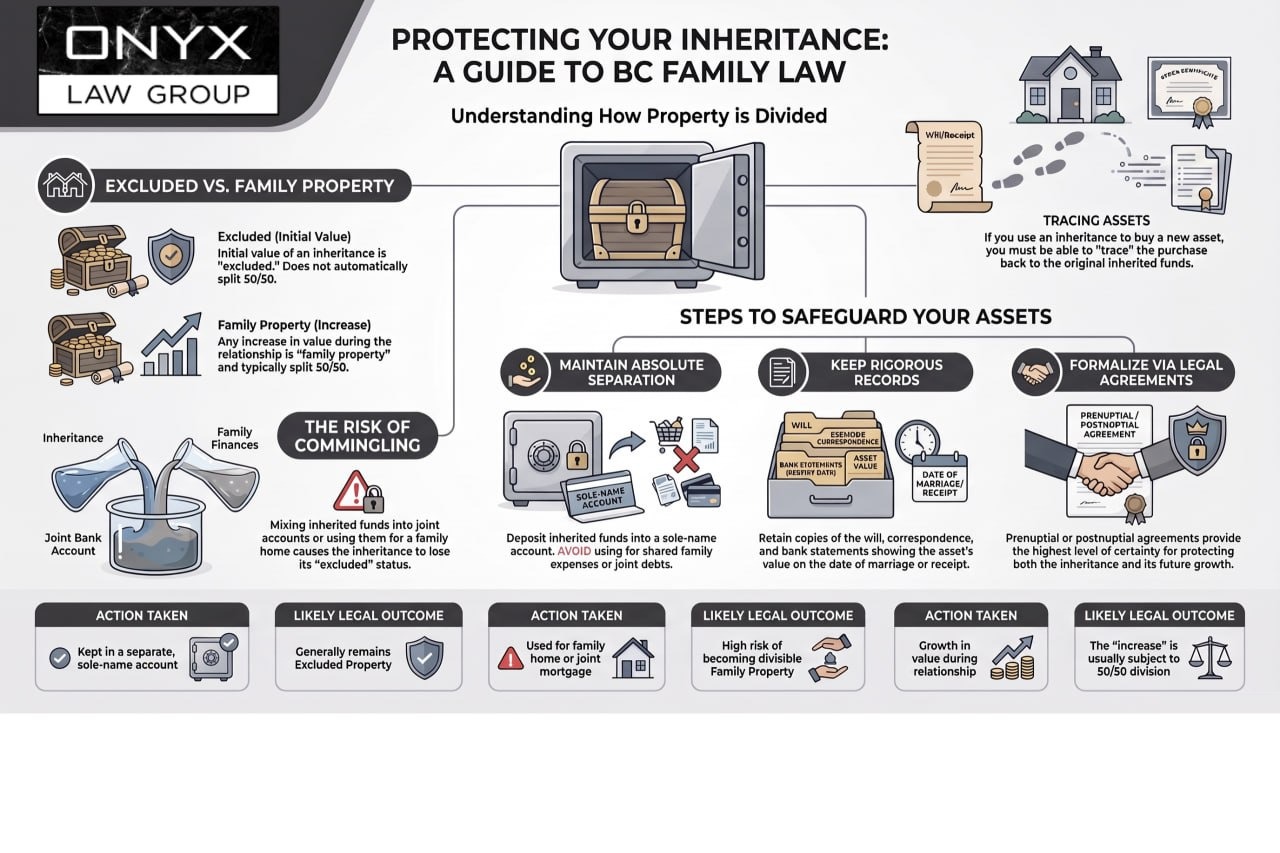
An inheritance can be an important financial asset, so it is worth taking steps to keep it separate from marital property. How you manage and use the inheritance may affect whether your spouse can claim an interest in it during a divorce. Here are the key steps we recommend taking to help protect your inheritance.
Step 1: Maintain Clear Documentation
According to Candace Cho, KC, principal lawyer at Onyx Law Group, “Good records can make a big difference when you need to show that an asset came from an inheritance.” Keep proof that you received an inheritance (such as a copy of the will and correspondence from the executor setting out the inheritance) and proof of the value of the inheritance at key dates, including the date of marriage.
Step 2: Understand the Terms of the Will
Read the will carefully. The will-maker may have expressly stated in the will that if the inheritance generates income, that income or interest is excluded from the beneficiary’s net family property.
Step 3: Keep the Inheritance Separate
Open a separate account in your sole name to deposit inheritance funds and interest income earned from it. If you inherit property or other assets, keep them in your sole name. Avoid using the inheritance for shared expenses or things like family vacations.
Step 4: Avoid Commingling of Inherited Funds With Family Property
If you buy property with inheritance money or sell inherited property and use the proceeds to purchase other property, keep it in your sole name. Keep documents to prove what you purchased and that you purchased it using inherited funds.
Step 5: Don’t Use Inherited Money for the Matrimonial Home
Do not use inherited funds as a down payment or to buy a home that you live in with your spouse. Do not use inheritance money to pay off the mortgage on the family home or to pay off any joint debt, and don’t use your inheritance to renovate or improve the matrimonial home.
Step 6: Consider a Contract
A written agreement can be prepared and signed by both spouses, either before or during the marriage, to safeguard an inheritance. These agreements are discussed in more detail below.
Step 7: Consult a Professional Lawyer on How to Protect Your Inheritance
Every situation is unique. Legal advice from an experienced family lawyer customized to your circumstances is the best way to safeguard an inheritance and preserve its status as excluded property in the event of a separation.
The Power of Prenuptial and Postnuptial Agreements

When speaking on this matter, Candace Cho, KC, principal lawyer at Onyx Law Group, said, “You do not need to wait until separation to think about protecting an inheritance.” Written contracts can be prepared to protect assets, including inheritances received and/or anticipated inheritances. If you are planning to get married, speak to a family lawyer about a prenuptial agreement (before marriage). If you are already married, a postnuptial agreement (after marriage) can be prepared by a family law lawyer to detail how assets will be divided should a divorce occur.
The prenuptial agreement or postnuptial agreement can be customized to your needs, wishes, and what you and your spouse agree is fair. For example, the agreement may stipulate that one spouse’s inheritance is excluded, the increase in value is excluded, and if the inheritance generates income or interest, that is excluded as well.
Alternatively, the spouse who received the inheritance may want some flexibility. They may want to use some or all the inheritance funds to buy a home with their spouse, improve a home that is jointly owned with their spouse, or invest in a family business, for example. A prenuptial agreement or postnuptial agreement is very highly recommended to preserve inheritance funds as excluded property despite commingling or investing in joint property.
Is My Spouse Entitled to My Inheritance When I Die?
Your spouse may get some or all of your inheritance after your death, depending on several factors, including what is specified in your will. If a spouse attempts to disinherit their spouse or fails to make adequate provision for their spouse in their will, the surviving spouse can bring a wills variation claim or elect to instead have a division of net family property under the Family Law Act after their spouse’s death.
If the deceased spouse died without a will, the surviving spouse will automatically inherit as first in line under British Columbia’s laws of intestacy. The amount the surviving spouse receives depends on whether the deceased had dependents.
What Else Should You Consider When Receiving an Inheritance?

Receiving an inheritance can bring up difficult emotions, especially if you and your spouse have different ideas about how the money should be used. Open communication can help prevent misunderstandings and disputes. If the inheritance is causing tension in your relationship, counselling or legal advice may help you work through the issue before it becomes a larger conflict.
It is also helpful to keep clear records of the inheritance. In B.C., an inheritance received by one spouse is generally excluded property under the Family Law Act. However, the increase in its value during the relationship is generally family property. Keeping the inheritance separate and maintaining records can make it easier to show what was inherited and how it was used.
There may also be tax considerations when you receive or use an inheritance. An inheritance itself is generally not reported as taxable income by the beneficiary in Canada. However, the estate may have tax obligations before assets are distributed, and income or gains earned from inherited assets after you receive them may be taxable.
Before using a significant inheritance to buy property, invest, or transfer assets into joint ownership, consider getting legal and financial advice. These decisions can affect how the assets are treated under B.C. family law and may make it harder to trace the original inheritance later. A lawyer can help you understand your options and put appropriate protections in place.
Need to Consult a Family Law Lawyer?
No one wants to think about divorce at the beginning of a marriage or during a marriage, but it is important to consider how your assets or an inheritance could be impacted should a divorce occur. There are ways to protect your assets or inheritance, such as with a prenuptial or postnuptial agreement.
Onyx Law Group’s team of experienced family law lawyers in Vancouver offers hands-on estate and family law experience. With extensive experience in navigating the complexities of inheritance law and divorce proceedings, we ensure the effective protection of your inheritance in case of divorce. We welcome you to contact us today for trusted legal advice and customized solutions.
Frequently Asked Questions
Inheritance and spousal property rights vary under provincial and territorial laws. Various factors can affect whether inherited property remains separate, including how it was used and whether it was placed in a joint account.
Can My Wife Take Half of My Inheritance?
Not necessarily, as inherited property may be treated differently from other property in the family property pool. In BC, an inheritance is generally excluded property, although increases in value may be divisible.
How Does Inheritance Work?
When someone dies, their estate is distributed under their will or applicable intestacy laws. The probate process may involve estate debts, taxes, and other requirements before assets reach loved ones.
Can Your Spouse Go After Your Inheritance?
A spouse may make a claim depending on the law and how the inheritance was handled. Placing inherited funds in a joint account or mixing them with joint funds may affect how the property is treated.
How Do I Protect My Inheritance From My Spouse?
Keeping an inheritance in a separate bank account and maintaining records can help show it remains excluded property. A legal document, such as a marriage agreement, may also clarify property rights and help protect generational wealth.
Disclaimer: The information on this page is general legal information about British Columbia law, not legal advice for any specific situation. Reading this page does not create a solicitor-client relationship. BC law changes, and the procedure that applies to a specific situation depends on facts not covered here. For advice on your situation, consult a qualified British Columbia estate lawyer directly. Past results, illustrative scenarios, and reference to typical fact patterns do not guarantee similar outcomes in any specific case.