


When a loved one passes away, one of the first questions families ask is: “Is it necessary to go through probate if there is a will?” The short answer is that most often, yes. Having a last will and testament does not automatically mean you can avoid probate. In British Columbia, whether probate is required to administer a person’s estate depends on the nature and value of the assets, how they are titled, and what institutions or parties are involved. This guide will walk you through everything you need to know.
If you are in the difficult situation where a loved one has passed away, they left a will, and you don’t know what comes next, it is critical to have sound and caring legal advice. We welcome you to reach out to the probate and estate lawyers at Onyx Law Group. We regularly assist estate clients going through the probate process as well as helping clients plan their estate to avoid probate. Our skilled legal professionals are here to provide you with reliable guidance, ensuring that you understand your rights and what to expect. Contact us today to gain the clarity and confidence you need to protect your interests.
This post will cover what probate is, and whether it is necessary where a loved left a will, how one goes through probate and the challenges you might face, as well as the steps you can take to avoid probate entirely. Finally, the post will cover the important role of legal representation in assisting persons faced with the potential of probate.
What Is Probate And Its Necessity With A Will?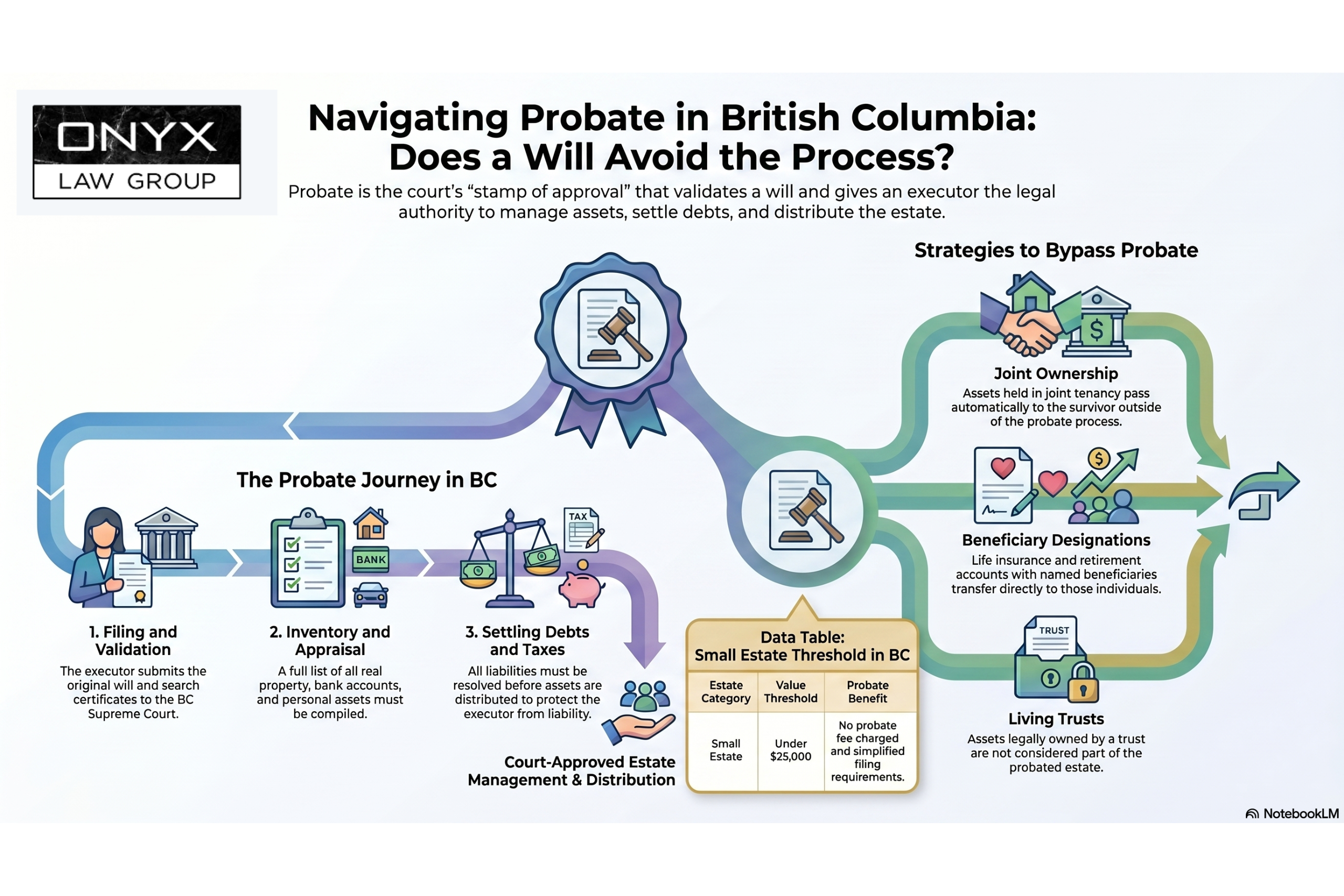
The probate process is the legal process by which the court validates a deceased person’s will and authorizes the executor named in the will (also called a personal representative in BC) to administer the estate. You can think of it as the court’s stamp of approval to deal with a deceased’s assets and debts. The Court will also take a supervisory role, to make sure that the terms of the will are followed and that the executor acts in good faith.
That means that, even when a valid will exists, formal probate serves several essential functions:
- It confirms the will is authentic and legally binding.
- It grants the personal representative the legal authority to collect and manage the decedent’s estate.
- It ensures the deceased’s debts and estate taxes are settled before distributing assets to beneficiaries.
- It provides a clear public record of how the decedent’s assets are handled, which protects all parties involved.
Without a grant of probate, many institutions will refuse to release funds to the executor or allow access to accounts like brokerage accounts or bank accounts. While by law the executor gets their authority from the will, banks still want the court’s approval. This is why even a well-drafted will often requires an executor still to go through probate.
For more on why wills enter the probate process, see our related article: Why Does A Will Go To Probate?
How Does The Probate Process Work With A Will?
The process by which one goes through probate in British Columbia is straightforward, however the personal representative must still navigate these steps carefully. Here is a step-by-step overview:
Step 1: Filing the Will with the Probate Court
The executor submits the original will, a Wills Notice search certificate, and a sworn Affidavit of Executor (in other jurisdictions, the state law may require different documents). The executor will also need to notify certain persons. With the formal probate case filed, the executor waits for the court to confirm the will’s validity.
Step 2: Notifying Beneficiaries and Creditors
Under BC’s Wills, Estates and Succession Act (WESA), beneficiaries and creditors must be formally notified, along with people who would have an interest in the estate if there was no will. This gives heirs the opportunity to review the estate, and creditors the chance to submit claims against the decedent’s debts before assets are distributed.
Step 3: Inventory and Appraisal of the Estate
The executor must, in the probate application, compile a full inventory of all assets. This includes things like real property, personal property, bank accounts, brokerage accounts. There may be appraisal costs associated with determining the value of this property.
Step 4: Settling Debts and Taxes
Before an executor can distribute assets, the executor must settle all debts and any applicable estate taxes. Distributing assets to beneficiaries before these are resolved can expose the executor to personal liability.
Step 5: Distributing the Remaining Estate
Then, the remaining assets are then distributed to the named beneficiaries according to the terms of the will.
For a more detailed walkthrough that is specific to British Columbia, visit: How To Probate A Will In BC
What Are Common Challenges In Probate With A Will?
Many families assume that a clear last will can eliminate interpersonal complications. Unfortunately, probate can be an expensive process and involve difficult disputes. Common challenges include:
- Disputes among beneficiaries: Family members might feel that the distribution of assets may not be fair or legally acceptable. In BC, it is possible to challenge the distribution of assets outlined in the will. They may also contest how the estate is being administered.
- Questions about the will’s validity: Even the best drafted will can be challenged, for instance on grounds of undue influence, lack of capacity at the time of signing, or improper execution.
- Delays from incomplete documentation: If there are missing account details, unclear beneficiary designations, or uncertain asset titles, this can also stall the process.
As you can see, many difficulties can arise, regardless of whether there is a will. Without proper legal guidance, a straightforward probate case can quickly turn into a costly ordeal for heirs and other family members alike.
If a will is being disputed, our article explains your options: How To Contest A Will In BC
How Can Probate Be Avoided Even With A Will?

It is possible to avoid probate altogether, even with a will — and doing can be an important part of proactive estate planning. There are strategies that allow assets to bypass probate, regardless of whether a will exists. These methods of estate planning work by ensuring assets “pass” outside of the estate. These strategies can even mean the entire process of probate is avoided.
1. Joint Ownership
Assets owned in joint tenancy, such as a home or bank account, pass automatically to the surviving joint owner upon death. Because title transfers by operation of law, these assets avoid the probate process.
2. Beneficiary Designations
Many accounts allow account owners to name beneficiaries. For instance, retirement accounts and life insurance policies are often non-probate assets, so long as they allow designating beneficiaries. Upon death, these accounts transfer directly to the beneficiaries without going through probate court, whether or not there is a will.
3. Living Trusts
By placing assets into a living trust, those assets are legally owned by the trust, and not by you personally, at the time of death. As a result, they also are not part of the probated estate. One further benefit of a living trust is that it can allow your estate to remain private, unlike the public record created by the probate process.
Small Estates
In BC, estates with only assets below a certain threshold (as of 2026, $25,000) may qualify for a simplified process under the small estate provisions of WESA, and no probate fee is charged. This can further reduce filing requirements and probate costs.
For a comprehensive guide to protecting your estate, see: How To Avoid Probate In BC
Why Is Legal Representation Important In Probate?

Probate in BC is governed by a combination of WESA, the Supreme Court Civil Rules, the Probate Fee Act, the Trustee Act, and various provincial filing requirements. Even just the list of applicable legislation can make your head spin! Navigating this legal process without professional guidance is both stressful and risky. Here is why having an estate planning attorney in your corner matters:
- Navigating complexity: a lawyer ensures nothing falls through the cracks, and that difficult legal documents are handled without causing you stress;
- Ensuring compliance: Every step of the probate process, from notifying creditors to distributing the decedent’s property, must comply with all of the above laws (or state laws that apply in other jurisdictions), each of which have very particular requirements.
- Reducing disputes and errors: Legal guidance reduces the likelihood that beneficiaries will challenge the process, and helps resolve disputes before they escalate into formal litigation, if a family member does want to challenge the process.
- Protecting beneficiaries: An attorney’s fees are typically a fraction of the costs that can arise from a contested will or improperly administered probate case.
To learn what happens once the probate required is granted, read: What Happens After Probate Is Granted In BC
What Are The Next Steps If Probate Is Required?
If probate is required, here’s how to move forward:
First, consult with an estate planning attorney. It is important to get legal advice early, because an experienced BC estate lawyer can assess what the most efficient path forward looks like for the personal representative.
Next, gather all necessary documents: This includes the original will, the death certificate, a full inventory of the estate’s assets, account statements for all accounts, and details of the decedent’s debts.
Then, file the initial probate petition: Your lawyer will help you prepare and file the required documents with the BC Supreme Court to formally open the probate case.
After that, you will need to notify all required parties: Beneficiaries and creditors must be notified in accordance with WESA’s timelines.
Finally, manage and distribute the estate: for this, as the personal representative you will work with your lawyer to properly manage assets, settle debts, and distribute the remaining assets to the decedent’s heirs.
Curious how long this takes? Read: How Long Does It Take To Receive Inheritance From A Will?
Navigating the Role of Probate in Estate Planning
Having a will is an essential first step, but more is needed. Whether probate is required depends on how your assets are titled, who is named on your accounts, and whether strategies like joint ownership, living trusts, or beneficiary designations have been put in place.
For most BC residents, a combination of a well-drafted will and strategic estate planning can minimize probate costs, protect the estate’s privacy, and ensure a faster distribution of assets to the people you care about. The key is understanding the difference between probate and non-probate assets, and planning accordingly.
If you are unsure, or if you are looking to structure your own financial situation to avoid the probate process, professional legal guidance from a local estate lawyer is invaluable. The team at Onyx Law is here to help, so contact us today!
Frequently Asked Questions
Here are a few questions that often come up when considering whether probate is necessary, and what it entails.
What Happens if There is a Will But No Formal Probate?
If probate is required but not obtained, financial institutions and other parties will likely refuse to recognize the personal representative’s authority. That means that assets in the decedent’s own name will not be transferred, meaning beneficiaries may be unable to access funds or transfer real estate.
Is Probate Always Required if There is a Will?
Not always. Probate is only required for assets the decedent owns. However, a jointly held account or a life insurance policy with named beneficiaries passes outside the estate and does not require probate.
How Long Does it Take to Go Through Probate With a Will?
The probate process in BC typically takes somewhere between several months and a year, depending on the estate’s complexity, whether the will is contested, and court processing times. Straightforward or small estates will move faster.
Can One Avoid Probate With a Will?
Yes. Strategies such as designating beneficiaries on financial accounts, placing assets in a living trust, holding property under joint tenancy, or using a beneficiary deed for real estate can all allow assets to bypass probate, even if a will exists.
What Assets Are Exempt From Probate With a Will?
Non-probate assets include: life insurance policies with named beneficiaries, retirement accounts with beneficiary designations, bank accounts and investment accounts designated as payable on death, assets held in a living trust, and any asset held in joint tenancy with a surviving owner.