


Contesting an executor of a will in British Columbia usually comes down to concerns like misconduct, conflict of interest, incapacity, or a breach of fiduciary duty. If an executor is mismanaging the estate or not acting in the best interests of the beneficiaries, the court can step in. If you are considering a challenge, it is important to consult an experienced lawyer in BC to understand your rights and guide you through the process.
At Onyx Law Group, our legal team has extensive experience handling estate disputes across British Columbia, including cases involving contested executors and complex probate matters. We understand how sensitive these situations can be, and we focus on providing clear guidance grounded in BC law and the Wills, Estates and Succession Act. Our approach is practical, strategic, and tailored to protect your interests throughout every stage of the process. If you are concerned about an executor’s conduct, contact us to speak with an experienced estate lawyer who can help you understand your legal right to challenge misconduct and review your next steps.
In this blog, we will explain how to contest an executor of a will in British Columbia, including valid legal grounds, the court process, and what evidence is needed to challenge their appointment or conduct.
What Are the Grounds for Contesting an Executor of a Will in BC?

Contesting an executor of a will in British Columbia is not about disagreement or personality issues. It is about legal grounds recognized by the courts. Under BC law, the main focus is whether the executor can properly carry out their fiduciary duties under the Wills, Estates and Succession Act (WESA). Courts will only intervene when there is a real risk to the estate or the beneficiaries. There may be several grounds for asking the court to step in.
One common ground is a conflict of interest. This occurs when the executor’s personal interests interfere with their obligation to act in the best interest of the estate. Another is incapacity, where the executor is mentally or physically unable to manage estate responsibilities.
Misconduct is also a strong ground, such as hiding assets, failing to communicate, or mismanaging estate funds. Claims may also involve undue influence, suspicious circumstances, testamentary capacity, or concerns about the will maker’s mental capability and capacity when decisions were made, including potential undue influence.
A key legal standard in BC is breach of fiduciary duty. Executors are legally required to act honestly, avoid self-dealing, and treat beneficiaries fairly. Under WESA and the court’s inherent jurisdiction, BC courts can remove an executor if their actions put the estate at risk or undermine trust.
Cases in BC courts often emphasize that even the appearance of impropriety can be enough to justify review, especially where estate assets are being mismanaged or delayed. Applicants must also show proper legal standing before seeking relief.
Evidence is critical in these cases. The court will not remove an executor based on suspicion alone. Documents, financial records, witness statements, and patterns of behavior involving the will’s validity, a previous will, the will maker, or a wills variation claim all matter.
The stronger the evidence of conflict, incapacity, misconduct, or clear evidence of wrongdoing, the more likely a BC Supreme Court is to step in and appoint a replacement executor to protect the estate. Evidence may also include whether the will was properly signed before two witnesses.
What Is the Legal Process for Contesting an Executor of a Will in BC?
Contesting an executor of a will in British Columbia follows a formal court process. It usually begins by filing an application or petition with the BC Supreme Court under the Wills, Estates, and Succession Act (WESA). This document explains why the executor should be removed, supervised, or face a related civil claim. It must clearly set out the legal grounds and supporting facts.
Once the application is filed, the court process begins. The executor is notified and given a chance to respond. Beneficiaries may also file affidavits supporting or opposing the claim. Timelines can vary, but these matters often take several months or longer, depending on complexity and whether urgent relief is requested. Interim orders can sometimes be made if there is a risk to the estate. It can be a complex process for families already dealing with estate issues.
Each party has a defined role in the process. The executor must defend their actions and show they are acting in the best interest of the estate. Beneficiaries act as interested parties, often providing evidence of concerns or harm. The court acts as the neutral decision-maker and will focus on protecting the estate and ensuring proper administration under British Columbia law.
Before a full hearing, the court often encourages mediation or alternative dispute resolution. This is especially common in estate disputes, where family relationships are involved. Mediation can help parties reach a fair settlement without a lengthy trial. It can also lead to a compromise, such as appointing a neutral third-party administrator.
The possible outcomes vary. The court may dismiss the application and allow the executor to continue. It may also remove the executor and appoint a replacement or impose conditions on how the estate is managed. In serious cases involving misconduct, the court can also order a passing of accounts or financial penalties. The outcome may depend on the court’s discretion.
Filing the Petition
The process starts by filing a petition or application with the Supreme Court of British Columbia. This paperwork sets out your reasons for contesting the executor. You will need supporting documents like the will, death certificate, financial records, and any evidence of misconduct or conflict. Gathering all the evidence early can strengthen your position. Court fees also apply, and they vary depending on the type of application and possible legal costs involved.
Court Hearings and Evidence
After filing, the case moves toward a hearing where both sides present their arguments. The executor responds to the allegations, and beneficiaries or applicants submit sworn affidavits as evidence. The court may also hear witness testimony and review financial records or estate documents.
Judges focus heavily on written evidence in estate cases, especially proof of mismanagement or the executor’s actions. Everything must be supported by clear, credible documentation, not just verbal claims or assumptions. The court’s interpretation of the evidence may affect its decision.
Possible Outcomes and Appeals
The court can reach several outcomes depending on the evidence. It may dismiss the application and allow the executor to continue administering the estate. It may also remove the executor and appoint a new one, such as a trust company or alternate executor.
In some cases, the court may impose conditions or require regular reporting through a court order. In some matters, a will may be declared invalid. If a party believes the decision is incorrect, they may appeal to the British Columbia Court of Appeal, but appeals are limited and may be time-consuming.
What Is an Executor?

Estates have an individual tasked with distributing and managing the estate or trust. If a person dies with a will, then the will appoints someone to administer that person’s estate, known as an executor.
If a person dies without a will, only the spouse, child, adopted children, family member, or third party can apply to the probate court to be appointed the administrator of that person’s estate. This may occur when no executor named in the Will can act. In some cases, only a spouse or a partner in a marriage-like relationship may be involved.
Regardless of whether a person is an Executor or Administrator, that person owes a fiduciary duty to the deceased person’s estate or trust beneficiaries to act in the best interests of the estate, not act in a conflict of interest, and to meet their legal obligation with scrupulous good faith.
An Executor or an Administrator who does not meet this fiduciary duty can be subject to legal action by the estate’s beneficiaries or other interested parties, such as creditors. A Trustee is the individual appointed under a trust indenture or who possesses trust property to administer on behalf of trust beneficiaries. Trustees also owe a fiduciary duty to the beneficiaries of the trust that they administer.
Executor Fees and Compensation in BC
Executor fees in British Columbia are the compensation paid to a person for managing and distributing a deceased person’s estate. These fees are not fixed by law in exact amounts. Instead, they are usually calculated based on a percentage of the estate’s value, the complexity of the work, and the time involved. In BC, a common guideline is around 1% to 5% of the estate value, but courts ultimately decide what is fair under the circumstances.
Executor fees can be challenged if they appear unreasonable or if there is evidence of misconduct. For example, if an executor overcharges, delays the estate unnecessarily, or fails to properly account for funds, beneficiaries can ask the court to review and reduce compensation. The court may order a passing of accounts to examine exactly how the executor handled the estate before approving any payment. This can include reviewing records from financial institutions.
It is also important to understand the difference between executor fees and probate fees. Executor fees are compensation for the work of administering the estate. Probate fees, on the other hand, are government charges paid to the BC court system to validate the will and authorize the executor to act. Probate fees are set by law, but executor fees are discretionary and can be changed by the court if unreasonable.
What Are Some Examples of Executor Misconduct?
An executor is expected to act in the best interests of the estate and its beneficiaries, but that does not always happen. In some cases, misconduct can occur and impact how an estate is managed or distributed. Below are some common examples of executor misconduct to watch out for. Examples of executor misconduct that can lead to challenging their appointment as executor of a will can include:
- Mismanagement of estate assets: This can include using estate funds for personal gain, co-mingling estate funds with personal funds, failing to properly invest assets, or misappropriating funds.
- Failing to distribute assets: An executor may fail to distribute assets to the beneficiaries as required by the will or the law.
- Failing to provide a proper accounting: The executor has a duty to keep accurate records and provide a detailed accounting of all estate transactions to the beneficiaries.
- Conflict of interest: An executor may have a personal interest in the outcome of the estate that conflicts with their duties as executor.
- Failing to manage estate debts: An executor has a duty to pay estate debts and liabilities, but they may fail to do so, which can result in a challenge to their appointment.
- Breaching fiduciary duty: An executor has a fiduciary duty to act in the best interests of the estate and its beneficiaries and may breach this duty by engaging in self-dealing or other unethical behavior.
Executor Responsibilities vs. Executor Rights in BC
Many estate disputes in BC arise from confusion regarding the actual responsibilities and permissible actions of an executor. When those lines are clear, it becomes easier to understand where problems might arise. The table below lays out executor responsibilities alongside their corresponding rights, so you can quickly see how the role is meant to function under BC law.
| Responsibility | Right | Explanation |
|---|---|---|
| Asset management | Right to access estate assets | Executors must collect, safeguard, and manage all estate property, including bank accounts, real estate, and investments, while having the legal authority to access them. |
| Fiduciary duties | Right to act in the estate’s best interest without personal liability when acting properly | Executors must act honestly, avoid conflicts of interest, and treat all beneficiaries fairly under BC law, mainly guided by the Wills, Estates and Succession Act (WESA). |
| Estate administration | Right to be compensated for reasonable work | Executors are responsible for distributing assets, paying debts, and handling paperwork, and they are entitled to fair fees approved by the court or beneficiaries. |
| Dispute resolution | Right to defend decisions in court | Executors must respond to challenges from beneficiaries, but they also have the right to defend their actions and seek court guidance when disputes arise. |
How Long Do You Have to Sue an Executor in BC?
In British Columbia, the statute of limitations for suing an executor is two years from the date of the grant of probate or letters of administration. This means that if you wish to bring a claim against an executor, you must do so within two years of the grant of probate or letters of administration.
However, it is important to note that there may be exceptions to this general rule, such as if the executor concealed information or committed fraud, or if there was improper execution. in which case the limitation period may be extended.
We highly recommend a free consultation with one of our attorneys as soon as possible if you are considering suing an executor, as the specific time limits and requirements for bringing a claim can vary depending on the circumstances of the case.
How to Protect Your Interests When Contesting an Executor
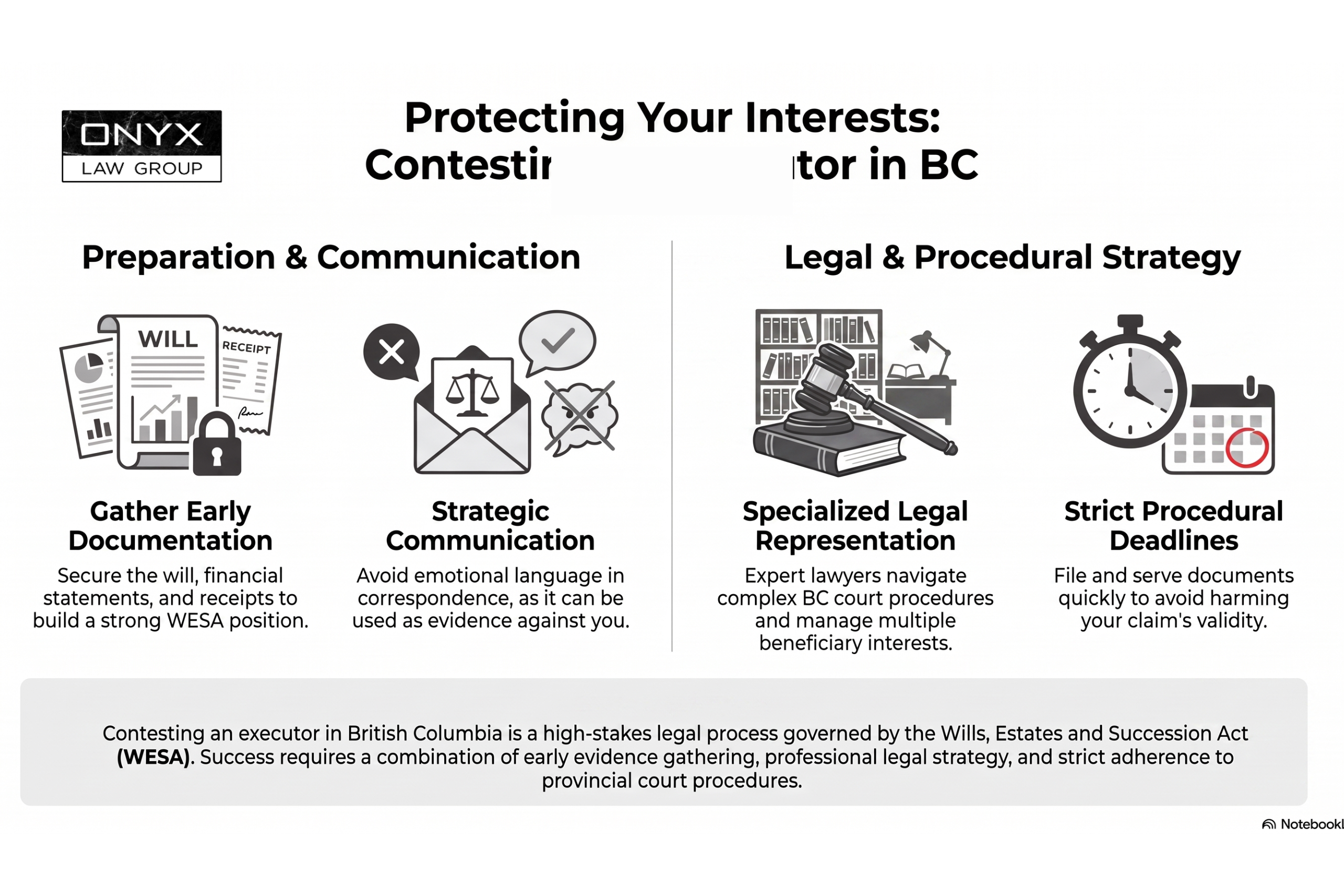
Protecting your interests when contesting an executor in British Columbia starts with strong documentation. You should gather all relevant records early. This includes the will, financial statements, emails, receipts, and any communication with the executor.
Keep everything organized and dated. The clearer and more detailed your evidence is, the stronger your position will be if the matter goes before a BC court under the Wills, Estates, and Succession Act (WESA). This is especially important in estate litigation matters.
Legal representation is also very important in these cases. Estate disputes can quickly become complex, especially when multiple beneficiaries are involved. A lawyer can help you understand whether you have valid grounds, prepare court documents, and present your case properly. They can also help you avoid mistakes that could weaken your claim or delay the process. A deep understanding of BC procedure can make a difference.
Communication with other beneficiaries should be handled carefully. In some cases, it helps to share concerns and see if others have similar issues with the executor. This can strengthen your position. However, it is important to stay professional and avoid emotional or accusatory language. Anything written or said could potentially be used as evidence in court.
Finally, deadlines and court rules matter a great deal. BC courts have strict procedures for filing applications, serving documents, and responding to motions. Missing a deadline can seriously harm your case. It is important to act quickly, follow court instructions closely, and keep track of all required steps throughout the process.
Ready to Challenge an Executor of a Will in BC?
Contesting an executor of a will in British Columbia is a legal process that focuses on protecting the proper administration of an estate. It is not about personal disagreements. It is about whether the executor has acted within their legal duties to protect a beneficiary’s fair share and met any moral duty owed under the WESA. Common grounds include conflict of interest, misconduct, incapacity, variation claims, separate wills variation matters, or breach of fiduciary duty. The process involves filing a court application, presenting evidence, and possibly going through hearings or mediation before a decision is made.
Because estate disputes can be complex and emotionally charged, it is important to approach them carefully and with the right support. Evidence, timelines, and proper legal procedures all play a major role in the outcome. If you believe an executor is not acting appropriately, it is a good idea to consult an experienced estate lawyer in BC. They can help you understand your rights, evaluate your case, and guide you through each step of the process.
Worried that an executor may not be handling a will properly in British Columbia? At Onyx Law Group, we have extensive experience with contested estate matters and holding executors accountable under BC law. Our team of estate lawyers in BC provides clear, strategic advice to help you understand your rights and take action when needed. Reach out to us today to speak with an experienced estate lawyer who can guide you through your next steps with confidence.
Frequently Asked Questions
Many people have questions about contesting an executor of a will in British Columbia and what the process involves. These simple answers can help you better understand your rights and next steps.
How Long Do I Have to Contest an Executor?
The time to contest an executor depends on the reason for the claim and the court process in British Columbia. It is best to act quickly so you do not miss important deadlines.
Can an Executor Be Removed Without Contesting the Will?
Yes, an executor can sometimes be removed without challenging the will itself. A court may remove them if there is misconduct, conflict, or failure to do their duties.
What Happens if an Executor Is Found Guilty of Misconduct?
The court may remove the executor and appoint someone else to manage the estate. They may also be ordered to repay lost estate funds in some cases.
How Much Does It Cost to Contest an Executor in BC?
The cost depends on how complex the dispute is and how long the case takes. Some matters cost less if settled early, while court cases can be more expensive.
Disclaimer: The information provided on this blog is for general informational purposes only and does not constitute legal advice. Reading this content does not create an attorney-client relationship. Laws and regulations vary by jurisdiction and may change over time, so you should consult a qualified estates and trusts attorney directly for advice regarding your specific situation. Past examples, case studies, or hypothetical scenarios are illustrative only and do not guarantee similar results.
Frequently Asked Questions
On what grounds can you contest an executor in BC?
The recognized grounds include a conflict of interest, misconduct such as mismanaging or misusing estate assets, incapacity, and breach of the fiduciary duties an executor owes to the beneficiaries. A court will not act on disagreement alone. It intervenes where there is a real risk to the estate or to the people entitled to it.
Can a court remove an executor?
Yes. Under WESA and the Trustee Act, the court can remove or replace an executor and can appoint someone else, such as another beneficiary or a neutral administrator. Removal is a serious step, so the court usually needs clear evidence that the executor’s conduct endangers the estate rather than mere friction among beneficiaries.
What evidence helps in a challenge to an executor?
Records that show the problem: estate accounts, bank statements, correspondence, and anything documenting delay, missing assets, self-dealing, or refusal to communicate with beneficiaries. An executor has duties to account and to act even-handedly, so evidence of a failure to keep proper records or to distribute fairly is often central.
Can beneficiaries force an executor to account for the estate?
Yes. Executors must keep proper accounts and can be required to pass them before the court. Beneficiaries who suspect mismanagement can seek an order that the executor account. If the accounts reveal losses caused by a breach of duty, the executor can be held personally responsible.