


A codicil is a legal document that allows an individual to make changes or additions to their existing will without having to completely rewrite it. In British Columbia, codicils play an important role in the estate planning process, providing flexibility and convenience for those who need to make updates to their existing will. Understanding the rules and procedures for creating a valid codicil is crucial for anyone wishing to make changes to their will in BC.
The estate lawyers at Onyx Law Group help British Columbians update their wills the right way, so a minor change does not turn into a probate dispute years later. If you are weighing a codicil against a full rewrite, book a consultation, and we will tell you which path actually fits your situation.
In this guide, we will explain what a codicil is under BC law, how to write one that is valid, the mistakes that most often void them, what it costs, and how to tell when you should make a new will instead.
What Is a Codicil to a Will in British Columbia?
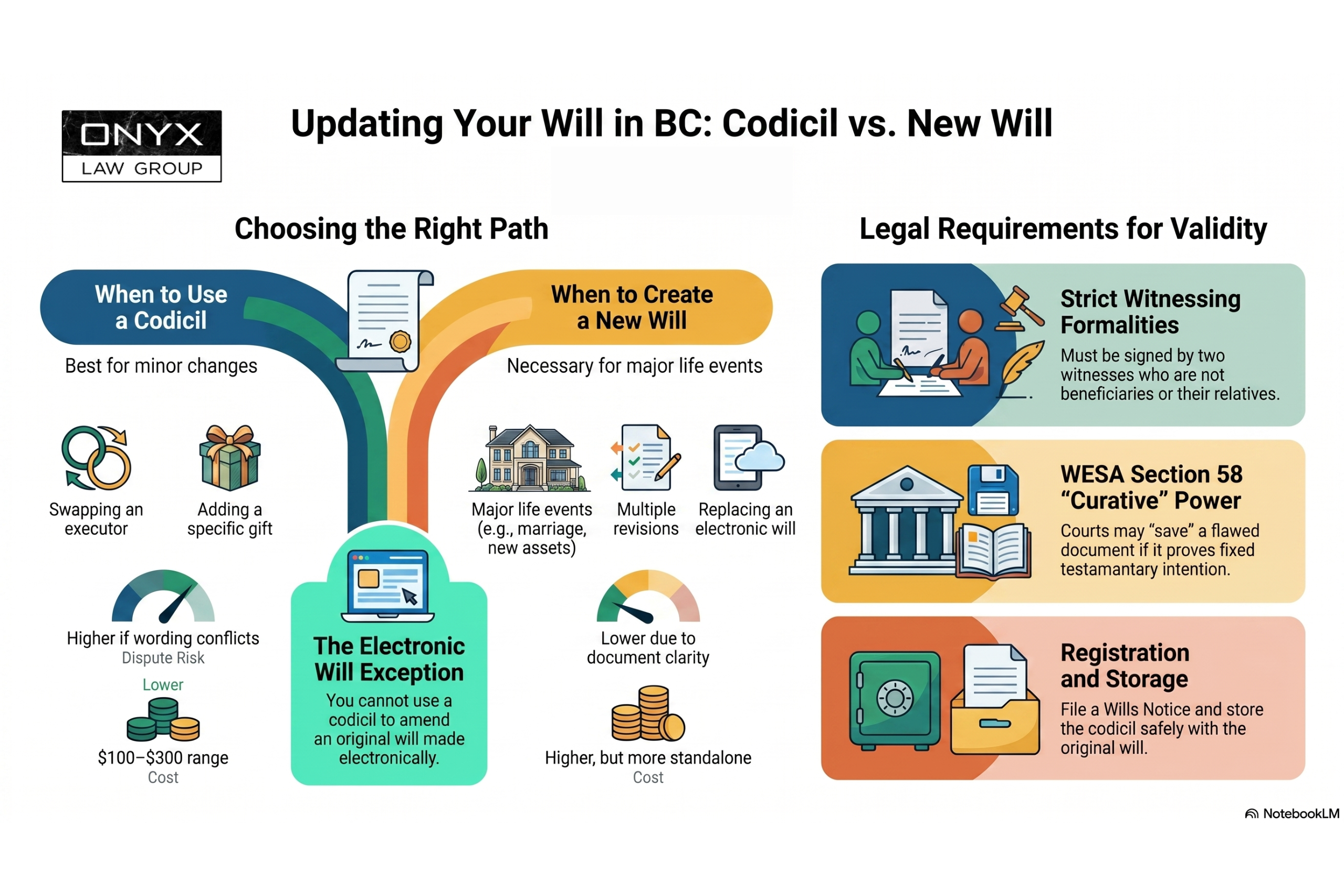
A codicil is a separate document that amends an existing paper will rather than rewriting it. Under WESA, a codicil is treated as part of your will, so it carries the same legal weight as the original once it is properly signed and witnessed. The old will stays in force, and the codicil simply layers your changes on top of it.
The difference between a codicil and a new will comes down to scope. A codicil is built for minor changes: swapping an executor, updating a specific gift, adding a beneficiary, or correcting a small detail. A new will replaces the entire document and is the better choice when you are making major changes or several changes at once. One practical catch worth knowing early: if your original will was made as an electronic will, you cannot amend it with a codicil. You have to create a new electronic will instead.
People reach for a codicil because it is quick and inexpensive for the right kind of update. Common examples include naming a different executor after a falling-out, increasing or removing a specific bequest, adjusting who receives a particular asset, or fixing a clerical error. If the change is small and self-contained, a codicil is usually sufficient.
How to Write a Codicil to a Will in British Columbia

Writing a codicil is straightforward, but the formalities are strict. A codicil that ignores them can be thrown out, which can leave your estate following an outdated will. The steps below walk through how to do it properly under WESA.
Step 1: Drafting the Codicil Document
Start by clearly stating what you want to change and reference the original will by its date. Identify the exact clause being updated and use clear, simple language to avoid confusion. End by confirming the date and noting that all other terms of the will remain the same.
Step 2: Witnessing Requirements in British Columbia
A codicil must be signed in front of two witnesses at the same time, as required under WESA. Neither witness should be a beneficiary or closely related to one. Since 2021, it can also be signed and witnessed electronically through video if done properly.
Step 3: Registering Your Codicil
Registration is not required, but it helps ensure your codicil is found and followed. You should store it safely with your original will. Filing a Wills Notice and informing your executor helps prevent it from being overlooked.
Codicil vs. Creating a New Will in British Columbia
Choosing between a codicil and a new will depends on how big the changes are. It also depends on how clear and simple you want your estate plan to be. Small updates can often be handled with a codicil. Larger changes usually call for a new will.
|
Aspect |
Codicil |
New Will |
|---|---|---|
|
When to use |
Small, simple changes like one or two updates |
Major changes or multiple revisions |
|
Cost |
Usually lower and more affordable |
Higher, but still typically reasonable |
|
Legal complexity |
Must strictly follow WESA rules |
Replaces the entire will for clarity |
|
Risk of disputes |
Higher if it conflicts with the original will |
Lower due to a single clear document |
|
Document clarity |
Original will still needs to be read alongside it |
Standalone and easier to interpret |
A codicil works best when the change is minor and very specific. It keeps the original will in place, which means both documents must be read together. That can sometimes create confusion if there are multiple updates.
A new will is usually the cleaner option when changes start stacking up. It replaces everything in one document. This reduces the chance of misinterpretation and makes things much easier for your executor later on.
Can a Handwritten Document Alter an Earlier Will?

A handwritten document can be effective as a will or codicil to a will if the court is satisfied that the document is a deliberate and final expression of the deceased’s intention as to the disposal of property upon death. Testamentary intention means more than an expression of how a person would like their property to be disposed of after death. The key question is whether the document in question records a “deliberate or fixed and final expression of intention as to the disposal of the deceased’s property on death” at the material time. Such findings are highly fact-specific. A person may also use a codicil as a formal amendment to modify an original will rather than creating a completely new document.
In a recent estate litigation case, Henderson v. Myler, 2021 BCSC 1649, a BC woman left an undated, unsigned note in a lockbox with her last will and testament. While the note did concern the disposition of her property on death, the court ultimately concluded that the note did not reflect the woman’s fixed and final intention to change her earlier will and declined to give it effect as a codicil or alteration to her existing will. As a result, the note was not treated as a codicil or alteration to the existing document and was not given legal effect.
How Much Does a Codicil Cost in British Columbia?
A codicil is usually cheaper than a new will. A lawyer-drafted codicil in BC commonly runs from around a hundred dollars to a few hundred, depending on how complex the change is. A do-it-yourself codicil costs little more than your time, but the savings disappear fast if a formality is missed and the document is challenged. For most people, paying a modest fee for a codicil that is drafted and witnessed correctly is cheaper than the litigation a flawed one can cause.
Circumstances leading to Henderson v. Myler estate litigation
Eleena Murray died on October 4, 2017, at 99 years of age, leaving a $1.85 million estate. She did not have children and was predeceased by her husband. She had no immediate family. Ms. Murray left a will dated January 25, 2013 (the “2013 Will”), prepared by a notary, which provided specific cash gifts to members of her extended family totalling about $500,000. The “rest and residue” of her estate was to go to the BC Society for the Prevention of Cruelty to Animals (“SPCA”).
After Ms. Murray’s death, the 2013 Will was found in a lockbox with a handwritten note (the “Note”), which, among other things, purported to increase specific amounts payable to certain family members named in the 2013 Will, delete gifts to other family members, and change the gift to the SPCA from the remainder of the residue, estimated to be $1.4 million, to a cash gift of $100,000. The Note also created complex changes that raised questions about the will’s validity, including unclear wording, altered gift amounts, and potential challenges involving what appeared to be multiple codicils or revisions.
The “rest and residue” of her estate was to go to the BC Society for the Prevention of Cruelty to Animals (“SPCA”). After Ms. Murray’s death, the 2013 Will was found in a lockbox with a handwritten note (the “Note”), which, among other things, purported to increase specific amounts payable to certain family members named in the 2013 Will; delete gifts to other family members; and change the gift to the SPCA from the remainder of the residue, estimated to be $1.4 million, to a cash gift of $100,000.
What Are the Requirements for a Valid Will or Codicil in BC
The requirements for making a valid will or codicil are set out in section 37 of the Wills, Estates and Succession Act, S.B.C. 2009, c. 13 (“WESA”).
A valid will or codicil must be:
-
In writing: The will or codicil must be written on paper or another durable medium. Wills and codicils must satisfy the same legal requirements and legal standards to be considered legally valid.
-
Signed by the testator: The testator must sign the will or codicil in the presence of two witnesses, who must also sign the document. A standard electronic signature generally may not satisfy the same requirements under WESA.
-
Signed by witnesses: The witnesses must sign the will or codicil in the presence of the testator and each other. This process helps create a legally binding document.
-
Made voluntarily: The will or codicil must be made voluntarily and without undue influence. A will writer or another person should not pressure the testator when preparing the document.
-
Testator’s capacity: The testator must have mental capacity to make a will or codicil at the time of signing.
These legal requirements must be satisfied for a will or codicil to be considered valid under WESA. Any deviation may create risk that the entire document or specific provisions could be found invalid and affect beneficiaries, other beneficiaries, or the executor.
The formal requirements ensure there is reliable and permanent evidence of the will-maker’s testamentary intention and the terms of the will. They also serve a cautionary function by emphasizing the importance of creating a valid final testament. For example, Ms Murray’s 2013 will was in writing, signed by Ms Murray, and signed at its end by two or more witnesses in her presence.
Common Mistakes When Creating a Codicil in British Columbia
Most issues with codicils in British Columbia come from a few simple but costly mistakes. They are usually avoidable. But they often show up when people try to make changes quickly or without guidance.
One common problem is improper witnessing. A codicil must be signed in front of two witnesses. If a beneficiary acts as a witness, it can invalidate the gift or even create challenges to the document itself. Another issue is unclear wording. If the language conflicts with the original will, it can lead to confusion and disputes about your true intentions.
Problems also arise when people try to modify an electronic will with a paper codicil. That is not allowed. A new electronic will is required in that case. Storage matters too. If the codicil is lost or not kept with the original will, it may never be found or applied. And if a Wills Notice is not filed, the change can easily be missed. In the end, these mistakes can result in the court relying on the old will instead of your updated wishes.
Closest Living Relatives Bring Claim Under Wesa S. 58
Ms. Murray had the requisite testamentary capacity at the time of the May 4, 2017 meeting and could have executed the Note as a codicil to the 2013 Will. However, it was not clear on the facts that Ms. Murray reviewed and approved the version of the Note, and there was no evidence that she appreciated the effect of the Note on the disposition of her estate. Both friends who met with Ms. Murray on her 99th birthday said they did not discuss the residue of her estate. They all understood there was more work to be done and discussed that Ms. Murray needed to see a legal professional to execute a formal will or possibly prepare a new will.
DIY Codicils vs. Using a Lawyer
A do-it-yourself codicil can work for a very simple change if you follow the WESA formalities to the letter. The trade-off is risk. A template will not flag a conflicting clause, a witness problem, or the fact that your situation actually calls for a new will.
A lawyer catches those issues before they become an estate dispute. As a rule of thumb, handle only the smallest, clearest changes yourself, and get professional help whenever the change affects multiple gifts, large assets, or anything that could be contested.
When to Update Your Will or Codicil
A will is only as current as your life. Major life events are the signal to review it and, where needed, add a codicil or draft a new will. Marriage, separation or divorce, the birth or adoption of a child, the death of a beneficiary or executor, and a significant change in your assets all warrant a fresh look. Reviewing your estate plan after these moments keeps it aligned with what you actually want.
Is a Codicil Legally Binding in British Columbia?

Yes. A codicil is legally binding in British Columbia as long as it meets the WESA execution requirements: it is in writing, signed by you, and witnessed by two qualified people. Once those boxes are checked, a court reads the codicil together with the original will as a single, valid set of instructions.
If a codicil falls short of the formalities, it is not automatically dead. Section 58 of WESA gives BC courts a curative power to recognize a document that does not strictly comply, provided the court is satisfied it captures your fixed and final intentions. That said, relying on a judge to rescue a flawed codicil is expensive and uncertain, which is exactly why getting the formalities right the first time matters.
Legal Advice for “Curing” Wills or Codicils
Not every expression made by a person, whether orally or in writing, concerning the disposition of property on death, embodies testamentary intention. BC Courts have the power under WESA s. 58 to “cure” a document that does not meet formal requirements, giving it effect as a valid will or codicil. The key question is whether it records a deliberate or fixed and final expression of intention as to the disposal of the deceased’s property on death.
The greater the departure from formal requirements, the harder it may be for a court to ascertain testamentary intention. This can become more complicated when people make small changes, making minor updates to specific sections, or create several codicils instead of choosing to create a new will for major changes. While codicils may help with minor changes, multiple revisions can create confusion with previous wills and will notice records. Working with a law firm can help determine the right solution for a particular situation.
If you need any clarification about intestacy, wills, or any estate law matter, contact our team of experienced estate litigators.
Frequently Asked Questions
These are the questions BC residents ask most often about amending a will with a codicil.
Is a Codicil Legally Binding in BC?
Yes, as long as it follows the same WESA formalities as a will: in writing, signed by you, and witnessed by two qualified adults who are not beneficiaries. A properly executed codicil is read together with your original will.
How Do I Write a Codicil to a Will in British Columbia?
Put your change in writing, reference the original will by date, use clear language, then sign it in front of two witnesses who also sign. Store it with your will and file a Wills Notice with the BC Vital Statistics Agency.
Can I Make a Codicil to My Will Without a Lawyer?
You can, if the change is simple and you follow the WESA rules exactly. For anything involving multiple gifts, large assets, or potential family conflict, a lawyer is the safer choice because a small error can void the codicil.
What Are Common Codicil Mistakes?
The frequent ones are improper witnessing, using a beneficiary as a witness, unclear or conflicting wording, trying to amend an electronic will, and failing to store or register the codicil so it can be found.
What Happens if a Codicil Is Not Properly Witnessed?
It may be invalid, and your estate could be distributed under the older will terms. A BC court can sometimes save it under section 58 of WESA, but that process is costly and not guaranteed.
Disclaimer: This article is for general information only and does not constitute legal advice. Reading it or contacting Onyx Law Group does not create a solicitor-client relationship. Estate law in British Columbia depends on the specific facts of your situation and can change over time. Consult a qualified BC estate lawyer for advice about your own circumstances.