


Quick answer: You cannot simply refuse court-ordered spousal support, but there are lawful ways an obligation may be reduced or ended. The starting point is entitlement: if the person asking cannot show a compensatory, needs-based, or contractual basis for support, none is owed. Where support is ordered or agreed, it can be varied or ended if there is a material change in circumstances — for example the recipient becoming self-sufficient or re-partnering. A properly negotiated separation agreement with full financial disclosure can also limit or waive support. Ignoring an existing order is not an option and carries enforcement consequences.
Spousal support is often one of the most debated issues in a divorce, with one spouse seeking support and the other wanting to minimize or avoid payments. In Canada, spousal support is not automatic as the spouse claiming it must prove entitlement. To not pay or reduce spousal support legally, you can negotiate an agreement, demonstrate financial hardship, or apply to the court for a variation based on changed circumstances.
Get expert legal guidance on spousal support and how to avoid paying it with Onyx Law Group. Our experienced spousal support attorneys will provide you with the trusted advice you need to navigate the complex world of spousal support. Contact us today to arrange a consultation. We can help you achieve a fair outcome, whatever family law matters you are facing.
In this blog, we will talk about what spousal support is, who is entitled to receive spousal support, and how to avoid spousal support or minimize a spousal support obligation.
What are the Legal Grounds to Avoid Paying Spousal Support in Canada?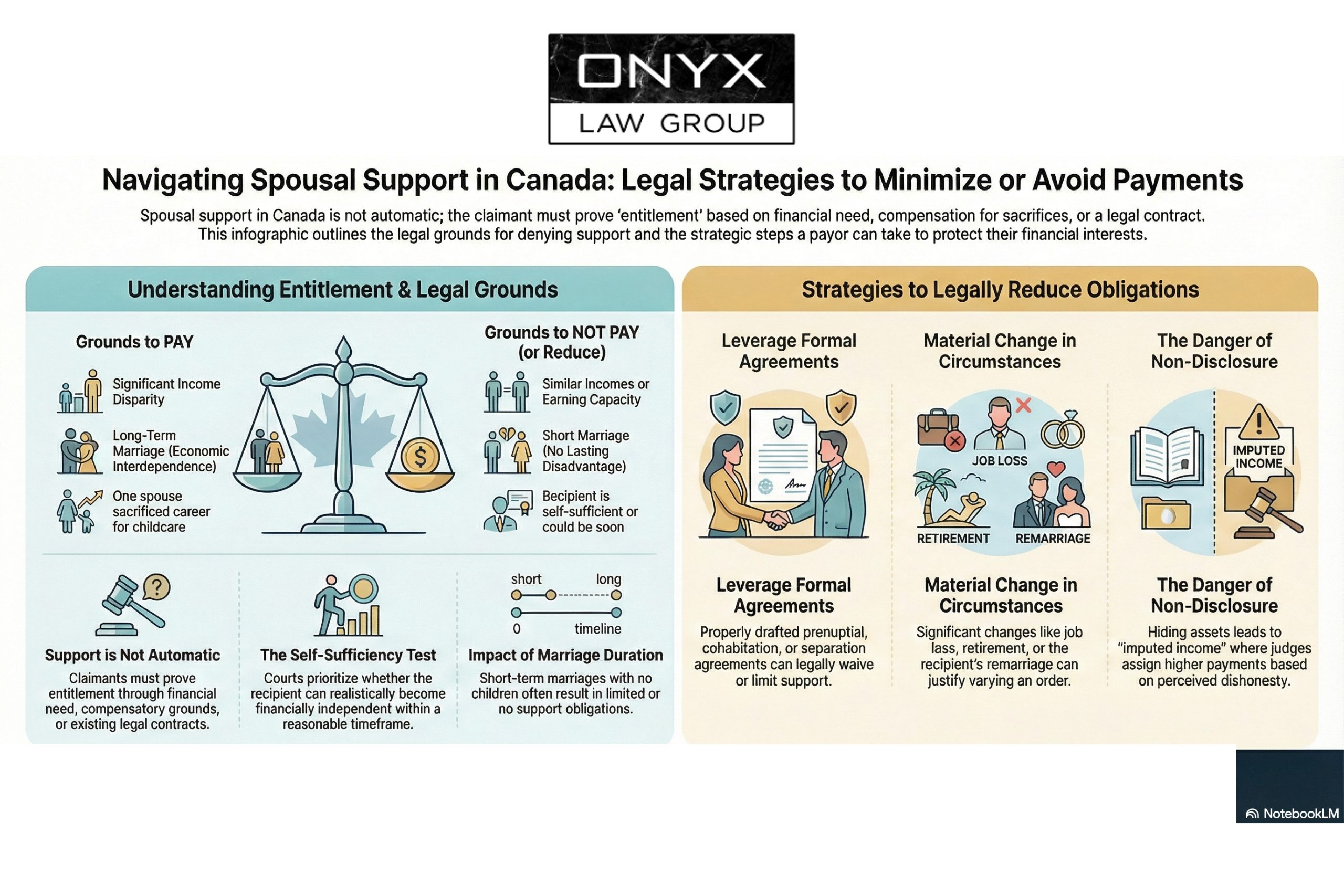
Spousal support is money paid by one former spouse to the other after separation or divorce. It is usually paid by the higher-income spouse to the lower-income spouse to help cover living expenses based on employment income and ease the financial consequences of the relationship ending. The goal is not to punish either person. It aims to create fairness in situations of economic imbalance through spousal maintenance.
Under Canada’s Divorce Act and provincial family laws, courts look at clear legal criteria when determining spousal support and whether support should be paid, reduced, or even denied. Spousal support is meant to prevent unfair economic hardship, share the financial effects of raising children, and compensate a spouse receiving support who gave up opportunities during the relationship. But support is not automatic. The court carefully reviews the facts before making any order regarding the amount of spousal support.
Judges assess several key factors, including financial need, each spouse’s ability to pay, the length of the marriage, and the roles each person had during the relationship. For example, if one spouse stepped away from their career to raise children or support the other’s career growth, that sacrifice matters most in relation to child support obligations. On the other hand, if both spouses remain financially self-sufficient, support may be limited or unnecessary.
Self-sufficiency is a major consideration. Courts often ask whether the lower-income spouse can reasonably become financially independent within a certain period of time. The duration of the marriage also plays a role in whether the spousal support set remains appropriate. Shorter marriages may result in shorter or no support obligations, while long-term marriages often carry stronger claims. In some cases, financial misconduct or failure to make reasonable efforts toward employment can also influence the outcome.
At its core, spousal support exists to address economic inequality created by the relationship. It helps soften financial hardship and, where appropriate, compensates a spouse for choices made during the marriage that had lasting financial effects through spousal maintenance. But every case turns on its own facts. The court’s focus is always on fairness, balance, and what is reasonable in the circumstances.
Key Factors Courts Consider
When deciding spousal support, courts look at several key factors. One of the most important is the length of the marriage. Longer marriages often lead to stronger claims for support, especially if one spouse became financially dependent over time. Short marriages may result in limited or no support, particularly if both spouses remain financially independent.
Courts also examine the roles each spouse played during the relationship. If one person paused their career to raise children or support the other’s professional growth, that sacrifice carries weight. Judges assess each party’s financial means, including income, earning capacity, assets, and debts. A large income gap can justify support, while similar earning power may reduce or eliminate the need.
Another major factor is the recipient’s ability to become self-sufficient. Courts ask whether the person seeking support can realistically re-enter the workforce or increase their income within a reasonable period. For example, a spouse who has been out of the workforce for 15 years may need longer-term support. A person with current skills and a stable job, on the other hand, might get temporary or transitional assistance. Each decision depends on fairness and the specific facts of the case.
What are the Steps to Legally Challenge or Avoid Spousal Support Payments?

If you want to legally challenge or avoid spousal support, there are clear steps to follow. Start with negotiating a separation agreement. You can agree to waive support or limit the amount and duration. A written agreement protects both parties. Make sure both spouses get independent legal advice before signing.
Mediation or arbitration is another option. A neutral third party can help resolve disputes. Mediation is flexible and collaborative. Arbitration results in a binding decision, similar to a court. Both methods can save time and reduce conflict.
If talks fail or circumstances change, you can apply to the court to review or vary an existing support order. Courts usually require proof of a material change, like a job loss, lower income, or the recipient becoming self-sufficient. Keep detailed documentation of finances and expenses. Always get advice from a family lawyer to protect your rights.
Common Mistakes to Avoid When Trying Not to Pay Spousal Support
When trying to avoid paying spousal support, the biggest mistake is hiding income or assets tied to taxable income. Some people think moving money to another account or underreporting earnings will help their case, especially when attempting to calculate spousal support differently. It won’t. Courts take financial disclosure very seriously when assessing child support obligations. If a judge believes you were dishonest, it can damage your credibility and lead to a higher support order involving the recipient spouse.
Another common mistake is ignoring court orders or deadlines that affect the payor spouse. Failing to provide full financial disclosure can backfire quickly. Judges rely on accurate income information to make fair decisions. If you refuse to cooperate, the court can impute income to you. This simply means that they will assign an income amount based on what they believe you should be earning with guidance from a family law professional.
Non-compliance also carries serious consequences in divorce settlements. Unpaid support can lead to wage garnishment, frozen bank accounts, suspension of your driver’s license, or other enforcement actions affecting how much support is owed. In some cases, continued refusal to pay can result in court penalties or contempt findings that may impact your ability to get spousal support in future matters. These outcomes are stressful and expensive to fix.
The best approach is transparency and preparation. Provide complete financial documents. Follow court orders while your case is ongoing. If your income changes, apply to vary the order instead of simply stopping payments. Protect your rights by working within the legal system, not against it.
Who Is Eligible for Spousal Support?
When a relationship ends, a person is eligible to claim spousal support if they and their partner were:
(1) legally married,
(2) lived together as a couple for at least two years in a marriage-like relationship, or
(3) in a relationship of some permanence for any length of time, and had a child together.
That means both married spouses and partners in a common law relationship can be eligible to claim spousal support, whether they are opposite sex or same sex. Spouses who were in a common law relationship and couples who had a child together must apply under British Columbia’s Family Law Act. Legally married spouses can apply under the Family Law Act or Canada’s Divorce Act.
How to Avoid Spousal Support in Canada

There are legitimate ways to reduce or avoid spousal support, such as negotiating with your spouse or demonstrating significant financial hardship or changes in circumstances to the court. Seeking legal advice to understand your rights and obligations is crucial in these situations.
“Avoiding spousal support isn’t just a legal matter because it can affect relationships and long-term finances. Planning carefully is crucial,” says Candace Cho, our principal lawyer at Onyx Law Group. Before discussing how to avoid spousal support further, it is crucial to emphasize some important don’ts:
1. Don’t hide income or assets in an attempt to defeat a support claim.
2. Don’t withhold income information that you are legally required to produce to your ex-spouse.
3. Don’t improperly manipulate income (for example, postponing corporate income/dividends, inflating business expense deductions, hiding trust income).
4. Don’t be deliberately unemployed or underemployed.
5. Don’t unilaterally decide to stop paying spousal support if there is a court order or support agreement in place.
BC courts do not look favourably on these types of misconduct. The court can impute income to you if you do any of these things intentionally to undermine your former spouse’s claim or to avoid paying spousal support. You will be ordered to pay support based on that imputed income level.
Can I Refuse to Pay Spousal Support as Agreed or Ordered?
If you are legally required to pay spousal support under a court order or agreement, you must continue making payments until the order ends or the agreement is officially changed. Ignoring this obligation can lead to serious consequences, including enforcement actions, fines, or even jail time, so it’s important to stay compliant while exploring your options.
If circumstances change, either yours or your former spouse’s, you should still make payments, but contact a divorce lawyer right away. A divorce lawyer can help you renegotiate the agreement or apply to the court to vary or terminate the support order, ensuring any changes are done legally and fairly.
When Is Spousal Support Denied?
As mentioned above, spousal support is denied when the spouse claiming support fails to prove entitlement. Let’s look at how entitlement is demonstrated.
No Entitlement to Spousal Support
An eligible spouse is not automatically entitled to spousal support, and a difference in income on its own is not enough to prove entitlement. The spouse making the support claim must first demonstrate their entitlement to support on one or more of the following grounds:
- Compensatory: to offset disadvantages or loss of opportunity experienced by one spouse during the relationship or because of the relationship’s breakdown (for example, child care responsibilities that prevented one spouse from building their career).
- Non-compensatory: one spouse needs financial support, and the other spouse has enough income to pay.
- Contractual: a legal agreement saying they are entitled to support on separation or divorce.
The court can also consider factors such as income, age, health, and childcare requirements in determining entitlement to support.
Entitlement to spousal support is a threshold issue. If that legal threshold isn’t met, spousal support is denied, and the claim goes no further (see below for more on spousal support amount and duration, which are the steps that follow in a claim, but only if entitlement has been established).
How to Fight Spousal Support
If you are wondering how to fight spousal support, the key is understanding that support is not automatic. Courts look at entitlement, financial need, and fairness under the Divorce Act and provincial family laws. Below are practical, legally recognized strategies that can help you avoid spousal support, reduce spousal support obligations, or vary ongoing payments.
1. Argue Against Entitlement to Spousal Support: Spousal support must first be justified. If your former spouse cannot prove financial need, economic disadvantage, or a compensatory basis for support, the court may deny the claim altogether.
2. Rely on a Cohabitation or Prenuptial Agreement: A properly drafted cohabitation agreement, marriage agreement, or prenuptial agreement can limit or fully waive spousal support. These agreements are strongest when both parties receive independent legal advice before signing.
3. Negotiate a Separation Agreement with a Waiver: Spousal support can be waived in a separation agreement, unlike child support. You can also agree to time-limited support or a lump sum payment instead of ongoing monthly obligations.
4. Demonstrate the Other Spouse’s Self-Sufficiency: Courts strongly consider whether the recipient can become financially independent within a reasonable time. If your ex has education, work experience, or earning capacity, the courts can significantly reduce or eliminate support.
5. Highlight a Short Duration of Marriage: The length of the relationship matters. Short marriages often result in shorter support periods or no support at all, especially if there was no long-term financial dependence.
6. Show Delay in Seeking Spousal Support: The court may question the need for support if your former spouse waited a long time before claiming it. Delay can weaken entitlement, particularly in shorter relationships.
7. Avoid Creating Financial Dependence During the Relationship: Support is meant to address economic inequality created during the marriage. When both spouses remain employed and financially stable, there may be little basis for ongoing support.
8. Consider Property Division as a Trade-Off: Spousal support and division of family property are closely connected. A larger equalization payment or asset transfer can reduce financial need and support a waiver of ongoing payments.
9. Prove a Material Change in Circumstances: If you are already paying support, you may apply to vary or terminate it if there has been a significant change. Job loss, reduced income, retirement, illness, or an increase in the recipient’s income can justify revisiting the order.
10. Act Strategically and Stay Compliant: Never ignore a support order or stop paying without court approval. The best way to fight spousal support is through proper legal channels, full financial disclosure, and a well-prepared case focused on fairness and evidence.
Legal Grounds to Pay vs. Not Pay Spousal Support in Canada
When it comes to spousal support in Canada, not every separated spouse is automatically entitled to receive it. Courts carefully weigh several factors to determine whether support is justified. The table below breaks down the most common grounds to pay versus grounds to not pay or reduce spousal support, helping you quickly understand how eligibility is assessed.
| Grounds to Pay Spousal Support | Grounds to Not Pay (or Reduce) Spousal Support |
|---|---|
| Financial Need—The lower-income spouse cannot meet reasonable living expenses after separation. | Self-Sufficiency—The recipient can support themselves or become financially independent within a reasonable time. |
| Compensatory Claim—One spouse sacrificed career growth to raise children or support the other’s career. | Short Marriage—The relationship was brief, with no lasting financial disadvantage created. |
| Significant Income Disparity—There is a large gap in earning capacity between spouses. | Similar Incomes—Both spouses earn comparable incomes or have similar earning capacity. |
| Long-Term Marriage—Extended marriages often create economic interdependence. | No Economic Disadvantage—The claimant did not suffer financial hardship due to the relationship. |
| Childcare Responsibilities—One spouse continues to bear primary childcare duties, affecting income potential. | Delay in Seeking Support—A long delay in applying may suggest support is unnecessary. |
| Health or Age Limitations—Illness, disability, or age limits the recipient’s ability to earn income. | Material Change in Circumstances – Payor loses job, retires, or income significantly decreases. |
| Contractual Obligation—No valid agreement limiting or waiving support exists. | Valid Agreement in Place—A cohabitation, prenuptial, or separation agreement waives or limits support (with independent legal advice). |
How Much Spousal Support Should Be Paid and for How Long?
Determining how much spousal support should be paid and for how long only comes after entitlement is established. Former spouses can negotiate the amount and duration as part of a separation agreement. If they can’t agree, a judge will decide entitlement, the payment amount, and how long support should continue.
Calculating spousal support is a detailed process. Courts consider factors such as the length of the marriage, each spouse’s role during the relationship, whether there are children, and both spouses’ income. The Spousal Support Advisory Guidelines (SSAGs) provide formulas to estimate payments with or without child support. These guidelines give low, mid, and high-range estimates based on income and marriage length, but they serve only as a starting point and are not legally binding like the Child Support Guidelines.
The duration of spousal support also depends on these factors. Shorter marriages typically result in shorter support periods, while longer marriages can lead to longer-term or even indefinite support. Even indefinite support is not permanent; it can be reviewed or varied if circumstances change over time. This approach ensures fairness while balancing the needs and financial realities of both spouses.
Financial and Emotional Considerations When Avoiding Spousal Support
Avoiding spousal support isn’t just a legal decision, but it can take an emotional toll too. Conflicts over money can strain relationships and create stress for both spouses. It’s important to consider feelings, fairness, and the impact on any children involved.
Financially, refusing or reducing support can have long-term consequences for both parties. Consulting a financial advisor alongside a lawyer helps you understand the full picture. Taking a balanced approach ensures you meet legal obligations while making decisions that are fair and ethical.
Need Trusted Legal Advice on Spousal Support Payments in Canada?
Avoiding spousal support in Canada is possible, but it must be done legally and carefully. Spousal support is not automatic, and the spouse claiming it must prove entitlement. You can reduce or avoid payments by negotiating a separation agreement, using a cohabitation or prenuptial agreement, demonstrating the other spouse’s self-sufficiency, or applying to the court for a variation if circumstances change. Transparency, full financial disclosure, and following court orders are essential to stay on the right side of the law.
The process also involves emotional and financial considerations. Avoiding support can impact relationships and long-term finances, so it’s important to plan carefully. Consulting a family lawyer and, if needed, a financial advisor helps protect your rights and ensures fairness. With proper guidance, you can navigate spousal support disputes confidently and make decisions that are both legal and ethical.
Are you concerned about ways to avoid paying spousal support in Canada? At Onyx Law Group, our experienced family lawyers in Vancouver guide clients through legal strategies to minimize or avoid spousal support while staying fully compliant with the law. We combine deep knowledge of the Divorce Act and provincial family laws with practical advice tailored to your situation. Contact us today to discuss your options and protect your rights with confidence.
Frequently Asked Questions
Navigating spousal support in Canada can be complex, especially if you want to understand how to not pay spousal support in Canada. This FAQ section answers common questions and explains practical strategies for minimizing or avoiding spousal support obligations legally.
What Are the Tax Rules for Support Payments?
Spousal support may be tax-deductible for the person paying it and taxable for the person receiving it if certain conditions are met. However, lump sum payments usually are not tax-deductible or taxable, while monthly support payments often are.
What if My Ex-Husband Refuses to Pay Spousal Support?
Not paying spousal support required under an agreement or court order is a breach, and the unpaid amounts are called arrears. The receiving spouse can enforce payment through court action or by registering with the BC Family Maintenance Agency, which has strong powers to collect ongoing support.
Can I Refuse to Pay Spousal Support in Canada?
You cannot simply refuse if there is an existing order for spousal support in place. However, if a separation or spousal support agreement exists, it may define different spousal support arrangements based on the couple’s situation.
What Happens if I Don’t Pay Court-Ordered Spousal Support?
Failing to follow an order for spousal support can result in enforcement action. In some cases, you may still be required to continue paying support until the order is formally changed.
How Is Spousal Support Calculated in Canada?
Courts rely on structured guidelines and consider each party’s circumstances. The outcome may depend on income levels, roles during the relationship, and other circumstances affecting fairness.
Can Spousal Support Orders Be Changed or Cancelled?
Yes, courts may vary or cancel an order for spousal support if there is a major change in circumstances. Updated spousal support arrangements can reflect changes in income, employment, or living situations.
Do Separation Agreements Always Waive Spousal Support?
Not always. A separation or spousal support agreement may limit support, but courts still review fairness. The agreement must show that both parties understood the terms and accepted them freely.
Disclaimer: The information provided on this blog is for general informational purposes only and does not constitute legal advice. Reading this content does not create an attorney-client relationship. Laws and regulations vary by jurisdiction and may change over time, so you should consult a qualified family lawyer for advice regarding your specific situation. Past examples, case studies, or hypothetical scenarios are illustrative only and do not guarantee similar results.