


After probate is granted in British Columbia, the executor gains the legal authority to administer the estate. They collect and protect estate assets, pay debts, taxes, and other outstanding obligations, then distribute the remaining assets to beneficiaries once all legal requirements have been met. The entire process usually takes several months, depending on the complexity of the estate.
Getting the grant of probate is really just the starting line as the executor still has to inventory the assets, clear debts and taxes, and distribute the estate correctly, and that’s exactly where things tend to go wrong. Onyx Law Group has handled BC probate and estate administration since 2012, with a practice group led by Veronica Manski that focuses on guiding executors through everything that comes after the grant. When the administration goes sideways, our estate litigators, led by Candace Cho, KC, step in. Book a free 30-minute consultation with us to keep the estate on track.
In this guide, we will explain what happens after probate is granted in BC, including the executor’s legal responsibilities, the estate administration process, key waiting periods, and when beneficiaries can expect to receive their inheritance.
What Happens Immediately After Probate Is Granted in BC?

Once probate is granted in British Columbia, the executor can officially begin managing the estate. The probate grant confirms that the will is valid and gives the executor the legal authority to act on behalf of the estate. Financial institutions, government agencies, and other organizations can now recognize the executor’s authority and deal directly with them.
From that point, the executor can take control of estate assets. They can access bank accounts, collect investments, transfer or sell real estate when needed, and manage other property belonging to the deceased. If an asset requires proof of legal authority before it can be released or transferred, the probate grant usually provides that proof.
The executor’s next responsibility is to gather and protect everything that forms part of the estate. They must identify all assets, secure valuable property, notify financial institutions, and keep accurate records of every transaction. They are also responsible for ensuring estate assets are properly managed until they can be distributed.
Before beneficiaries receive their inheritance, the executor must settle the estate’s financial obligations. This includes paying outstanding debts, filing the deceased’s final tax returns, and resolving any taxes or expenses owed by the estate. These steps help protect the executor from personal liability and ensure the estate is administered according to BC law.
Once debts, taxes, and other legal obligations have been paid, the executor can distribute the remaining assets to the beneficiaries named in the will. Every estate is different, so the timeline can vary depending on its size and complexity. Keeping beneficiaries informed and staying organized throughout the process helps make estate administration smoother for everyone involved.
The 6-Month Waiting Period After Probate in British Columbia
Many people are surprised to learn that probate does not always mean beneficiaries receive their inheritance right away. In British Columbia, executors are often advised to wait before making final distributions. This waiting period exists to protect both the estate and the executor from legal claims that could arise after probate is granted.
One of the main reasons for the 6-month waiting period is to allow time for certain legal claims to be made against the estate. Eligible spouses or children may have the right to challenge the distribution of the estate under BC’s estate laws if they believe they were not adequately provided for in the will. During this time, executors should also ensure that any required notices have been given and that outstanding creditor claims have been identified and addressed.
While waiting, the executor’s work does not stop. They can continue gathering estate assets, securing property, paying valid debts, filing tax returns, communicating with financial institutions, and handling the day-to-day administration of the estate. However, they should generally avoid making final distributions to beneficiaries until the waiting period has passed or they have received appropriate legal advice confirming it is safe to do so.
Distributing estate assets too early can create serious problems. If a successful claim is made after beneficiaries have already received their inheritance, the executor may have to recover those funds or could even become personally responsible for any shortfall. Waiting until the appropriate time helps reduce these risks and gives everyone greater confidence that the estate can be distributed fairly and in accordance with British Columbia law.
How Long After Probate Can Funds Be Distributed in BC?
There is no fixed date when funds must be distributed after probate is granted in British Columbia. In many estates, beneficiaries may wait several months before receiving their inheritance because the executor must first collect estate assets, pay outstanding debts, file the deceased’s final tax returns, and complete the estate administration process. Executors also commonly wait at least six months from the probate grant before making a final distribution to reduce the risk of legal claims against the estate, particularly claims by eligible spouses or children.
The timeline can be shorter for a simple estate with few assets and no disputes, while larger or more complex estates often take a year or longer to settle. Delays may occur if the estate includes real estate that must be sold, tax issues need to be resolved, creditors make claims, or beneficiaries challenge the will. Once all debts, taxes, expenses, and any legal claims have been addressed, the executor can safely distribute the remaining funds to the beneficiaries in accordance with the will or, if there is no will, under British Columbia’s intestacy laws.
| Estate Administration Step | Typical Timeline | Notes/Considerations |
|---|---|---|
| Asset Collection | First few weeks to several months after probate | The executor gathers bank accounts, investments, real estate, and other estate assets. Complex estates or difficult-to-locate assets can take longer. |
| Debt and Tax Payment | 2–6 months or longer | All outstanding debts, estate expenses, and final income taxes should be paid before beneficiaries receive their inheritance. Delays are common if tax issues or creditor claims arise. |
| Waiting Period | Up to 6 months after probate | Executors often wait at least six months before making a final distribution to allow time for eligible estate claims and to reduce the risk of personal liability. |
| Final Distribution of Funds | Usually 6–12 months after probate | Once debts, taxes, legal claims, and estate administration are complete, the executor can distribute the remaining funds. Larger estates, property sales, or beneficiary disputes may extend the timeline beyond a year. |
What Are the Responsibilities of the Executor After Probate Is Granted?
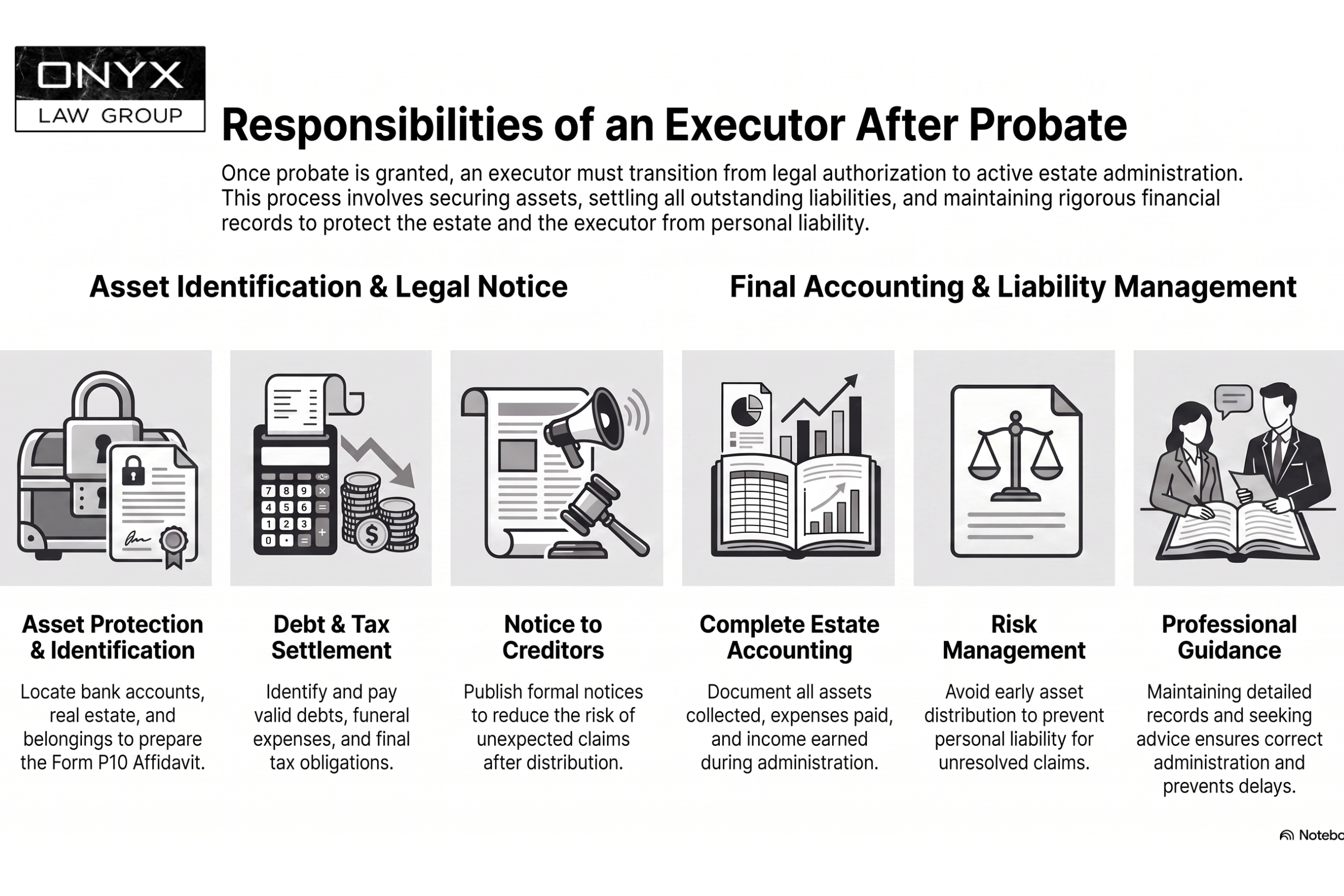
Once probate is granted, the executor is responsible for administering the estate from start to finish. They must act in the best interests of the estate, follow the instructions in the will, and carry out their duties with honesty and care. One of their first tasks is to locate and protect all estate assets, including bank accounts, investments, real estate, vehicles, and personal belongings.
Executors should also keep accurate records of every financial transaction made on behalf of the estate. As an executor, you must also prepare Form P10, the affidavit of assets and liabilities, listing all property and outstanding debts, because probate fees are based on those values.
The executor must identify and pay all valid debts before distributing any inheritance. This includes outstanding bills, loans, funeral expenses, and any taxes owed by the estate. In some cases, publishing a Notice to Creditors is a sensible step. It gives creditors an opportunity to come forward with valid claims and helps reduce the risk of unexpected debts appearing after the estate has been distributed. Depending on the circumstances, the executor may also need to provide other notices required under BC law.
As the administration progresses, the executor is responsible for preparing a complete accounting of the estate assets. This involves documenting the assets collected, the debts and expenses paid, and any income earned during the administration period. They must also complete the deceased’s final tax obligations and ensure the estate has met its legal and financial responsibilities before any remaining assets are passed to the beneficiaries.
Good organization can help an executor avoid many common mistakes. Keeping detailed records, communicating regularly with beneficiaries, and responding promptly to legal and financial matters can prevent unnecessary delays. Executors should also avoid distributing estate assets too early, as unresolved debts or legal claims could create personal liability. When complex issues arise, seeking professional advice can help ensure the estate is administered correctly.
What Are Some of the Key Terms in the Probate Process?
Here are some important terms that will help you understand the probate process:
- When a person dies leaving a will, the executor named in the will is the estate trustee responsible for carrying out the administration of the estate. That includes managing the estate assets and carrying out the instructions in the will.
- The executor is typically required to obtain an estate grant (called a Grant of Probate) from the Supreme Court of British Columbia, which gives the executor the legal authority to take over the deceased’s assets and convert the ownership of those assets (e.g., real estate and bank accounts) from the deceased’s name to the name of the estate.
- When a person dies without a will, the spouse or other family member of the deceased, or other person(s), must apply to the BC Supreme Court to be appointed the administrator of the estate. An administrator has the same responsibilities as an executor. If the application is successful, the Court will issue an estate grant called a Grant of Administration.
- A person named in a will who is to benefit from the deceased’s estate is called a beneficiary. When a deceased person dies without leaving a valid will, known as dying intestate, it results in the deceased person’s estate being distributed to intestate successors according to the priorities set out in BC’s Wills, Estates and Succession Act, S.B.C. 2009, c. 13 (WESA).
How Are Probate Fees Calculated and Paid in BC?

In British Columbia, probate fees are the court fees paid to process an estate through probate. They are based on the gross value of the estate assets that pass through the will. The fee structure works in tiers. There is no fee on the first $25,000. The estate pays $6 for every $1,000 between $25,000 and $50,000, and $14 for every $1,000 over $50,000. These fees are calculated using the values listed in the executor’s affidavit of assets and liabilities filed with the Supreme Court of British Columbia.
Probate fees are paid at the time the probate application is submitted. The court will not issue the estate grant until the correct fee is paid. The money comes from the estate, not the executor personally. If asset values change or are reported incorrectly, adjustments may need to be made. Accuracy matters because underreporting can cause delays or legal issues later.
According to Veronica Manski, a probate and estate administrator at Onyx Law Group, “Understanding how probate fees are calculated and planning accordingly can prevent surprises and help you manage estate costs effectively.”
There are limited but lawful ways to minimize probate fees. Proper estate planning, such as joint ownership or named beneficiaries on certain accounts, can reduce the value that passes through probate.
In some cases, the reported value of an asset can be reviewed or corrected if it was overstated. However, fees cannot simply be avoided once probate is required. Executors should also be aware of additional costs, such as legal fees, accounting fees, property appraisals, and potential disputes. These expenses can add up, so planning always helps.
In fact, understanding exactly how probate fees are calculated can make it easier to anticipate costs. See the table below for a clear breakdown of estate value brackets and the corresponding probate fees.
| Estate Value Range | Probate Fee Amount | Notes |
|---|---|---|
| $0–$25,000 | $0 | There is no fee on estates up to $25,000. |
| $25,001–$50,000 | $6 per $1,000 | This only applies to the portion above $25,000. |
| Over $50,000 | $14 per $1,000 | Applies only to the portion over $50,000; the fee is capped only by estate value. |
Is Probate Required?
Not all wills need to go through the probate process. The type of assets owned by the deceased person and how they owned them at the time of their death are two of the main factors that determine whether probate is required. The estate representatives often find out that a probate application is necessary when they try to deal with the deceased’s registered property, such as bank accounts, real property, or vehicles.
Third parties such as financial institutions, the Land Title Office, ICBC, and the Canada Revenue Agency have strict rules in place to ensure that a deceased person’s property is not transferred contrary to the law. A court-certified copy of the estate grant is recognized by these third parties and tells them that the executor or administrator has the authority to act on behalf of the estate (to sell or transfer real property, transfer money, close bank accounts, etc.).
How Long Does Probate Take In BC?
The rough timeline for obtaining an estate grant from the Supreme Court is typically about 6 months, though it can take more or less time depending on factors such as the complexity of the estate and the executor’s experience.
Because each estate is different, there is no rigid deadline or time limit that applies after probate is granted. The estate settlement process can take longer if the estate has complex assets or if issues arise (e.g., a challenge to the validity of the will or a wills variation claim by a disappointed beneficiary).
While there is no strict deadline, there is a general rule of thumb. In BC, an estate trustee has one year to gather the estate assets and settle the affairs of the estate. This is known as the “executor’s year.” The Executor’s Year generally runs from the date of death, although estates requiring probate or involving complex administration often take longer.
When to Consult a Probate Lawyer in BC After Probate Is Granted

After probate is granted in British Columbia, many executors assume the hardest part is over. Sometimes it is, but not always. You should consider speaking with a probate lawyer if the will becomes contested, if new assets or debts surface, or if beneficiaries begin to disagree. Complex estates with multiple properties, business interests, foreign assets, or tax complications can quickly become overwhelming. Even one dispute among beneficiaries can delay distribution and create personal liability for the executor.
Hiring a probate lawyer after probate is granted can protect you from costly mistakes. Executors have strict legal duties. You must act in the best interest of the estate and follow provincial law. A lawyer helps you interpret the will correctly, respond to formal objections, and manage creditor claims properly. This support can reduce stress, prevent litigation, and keep the administration process moving forward.
A probate lawyer also helps ensure full legal compliance. They can guide you on estate accounting, tax clearance, timelines for distribution, and communication with beneficiaries. If conflicts arise, they can step in early before matters escalate. Acting as an executor is a serious responsibility. Getting legal advice is not a sign of failure. It is a smart step to protect yourself and honor the wishes of the person who passed.
Need Legal Advice From a British Columbia Probate Lawyer?
Once probate is granted in British Columbia, the executor takes on a range of legal and financial duties. These duties range from securing and managing estate assets to paying debts, filing taxes, and eventually distributing what remains to beneficiaries. The process can be complex and time-consuming, but understanding each step helps make sure the estate is properly handled and closed with care and compliance.
Curious about what happens after probate is granted in British Columbia? At Onyx Law Group, our experienced probate lawyers in BC have guided BC executors and beneficiaries through estate administration since 2012, and when a passing of accounts or a problem executor gets messy, estate litigator Candace Cho, KC, and our team step in. Contact us today for a free 30-minute consultation.
Frequently Asked Questions
Once probate is granted in British Columbia, many executors wonder what steps come next. This FAQ section breaks down the key actions and responsibilities that follow so you can navigate the process with confidence.
How Long After Probate Can Funds Be Distributed in BC?
After probate is granted, the executor can begin debt settlement, pay taxes, and transfer assets to the beneficiaries. The timing depends on when all the assets have been collected and the estate is ready for asset distribution.
Can an Executor Be Removed After Probate?
Yes. A court may remove an executor who fails to fulfill their duties, maintain detailed records, or acts against the interests of the beneficiaries and other interested parties.
How Are Probate Fees Calculated in BC?
Probate fees are based on the value of the estate assets that require probate. Executors should also budget for legal and accounting fees, which are separate from probate fees.
What Happens if No Will Is Found After Death?
If the deceased died without a valid will, the estate is distributed under British Columbia’s intestacy laws. The court appoints an administrator, who files the necessary court documents through the probate registry.
When Should I Hire a Probate Lawyer?
Consider hiring a probate lawyer if the estate includes disputes, real estate transfers, or plans to sell property. Legal guidance can also help with complex estate administration and reasonable expenses.
What Are the Next Steps After Probate Is Granted in British Columbia?
The executor gathers all the assets, reviews bank statements, secures property deeds, and pays debts before making the final asset distribution. They should also maintain detailed records and obtain a clearance certificate before closing the estate.
Why Do You Have to Wait 6 Months After Probate?
Waiting gives potential creditors and other interested parties time to bring legal claims against the estate. It also helps protect the executor before the residual estate is distributed.
How Long Does Probate Usually Take In BC?
The timeline depends on the size of the estate, credit card balances, tax obligations, and whether additional estate records are needed. Estates involving complex assets or disputes often take longer to complete.
Disclaimer: The information provided on this blog is for general informational purposes only and does not constitute legal advice. Reading this content does not create an attorney-client relationship. Laws and regulations vary by jurisdiction and may change over time, so you should consult a qualified estates and trust attorney for advice regarding your specific situation. Past examples, case studies, or hypothetical scenarios are illustrative only and do not guarantee similar results.