


If you received an inheritance and your relationship is ending, the good news is that BC law usually keeps it out of the split. Under the Family Law Act, an inheritance to one spouse is excluded property, which means it is generally not divided when a couple separates. The catch is that this protection depends on how the money was handled, and the increase in its value during the relationship can still be shared.
Onyx Law Group has years of experience helping countless clients navigate inheritance and divorce matters in British Columbia. Our knowledgeable family law lawyers understand how BC family law treats excluded property, commingling, and asset division. We focus on clear advice and strong legal support to protect what matters to you. If you are dealing with inheritance concerns during a divorce or a family law claim, contact us for a free consultation today.
In this blog, we will explain how your divorce can affect your inheritance funds and how you can protect the inheritance you received both before and during your marriage.
How Is Inheritance Treated During Divorce in BC?
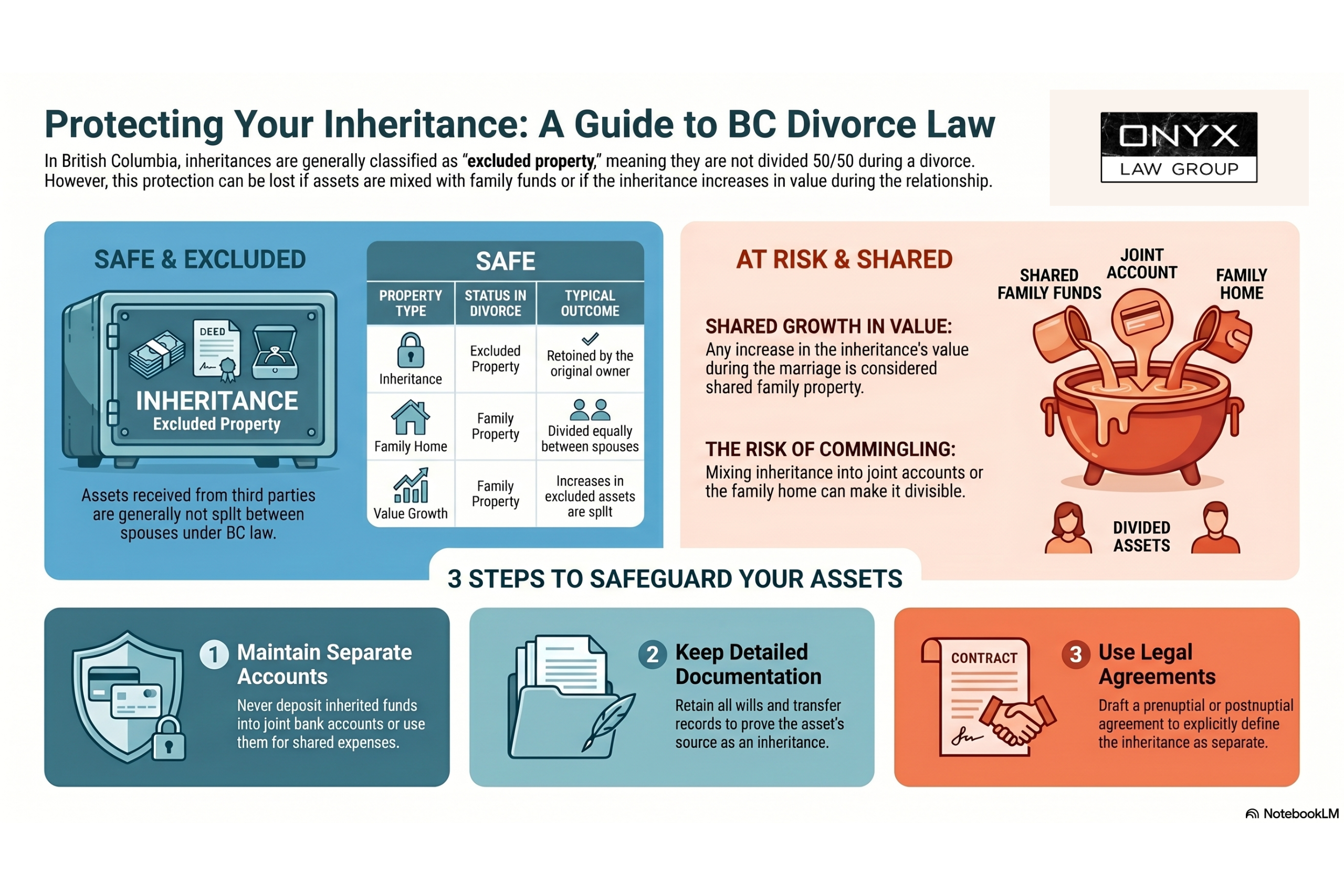
In British Columbia, inheritance is generally treated as excluded property during a divorce. This means it is usually not divided between spouses under the Family Law Act. The law typically excludes inheritances received from third parties, even if they are received during the marriage. This inheritance exclusion often helps keep an inheritance protected from the division of property. However, there are important exceptions that can change how the inheritance is treated.
Inheritance can become divisible if it is mixed with family property or used for shared benefit. For instance, if money that was inherited is put into a joint account or used to buy the family home, it may no longer be considered separate property. This principle is especially true if it is in joint names.
Also, family property includes any increase in the value of inherited assets during the relationship. For example, if you inherited $200,000 and it grew to $260,000 while you were together, the original $200,000 stays yours, and the $60,000 of growth is treated as family property. In these cases, courts look closely at how the asset was handled and whether it became part of the shared financial life or was treated as personal property.
Family courts in BC focus on fairness when they divide family property. They apply legal tests to decide whether inheritance should stay excluded or be shared. Common situations include inherited funds used for renovations, investments, or family expenses.
If you are receiving or disputing an inheritance during a divorce, it is important to keep clear records and avoid mixing funds. Speaking with a family lawyer early can help protect your rights and prevent costly disputes.
What Can Cause You to Lose Your Inheritance?
In British Columbia, rules for dividing property apply to married spouses, unmarried couples, and common law spouses who have lived together in a common law relationship for at least two years. The law separates assets into two categories: family property and excluded property.
Family property includes things like the family home, joint bank accounts, investments, RRSPs, and other property and holdings, which may encompass companion animals owned by either spouse at the time of separation. This type of property is usually divided equally, though it can sometimes be divided unequally if that would be significantly unfair. Family property can also involve joint debt in certain circumstances.
Excluded property is generally what one spouse owned before the relationship, as well as gifts and inheritances received during the relationship. In most cases, this rule means your inheritance is protected and not shared in a divorce. However, there is an important exception. If the inheritance increases in value during the relationship, that growth may be treated as family property and divided, even if one spouse who originally received the inheritance kept it separate.
It is also important to remember that rules can vary depending on where you live. In BC, inheritances are usually excluded property, but such is not the case in other provinces. Due to these differences, it’s wise to consult a local family lawyer if you’re unsure how your inheritance will be handled.
A 2023 change to the Family Law Act helped here. As of May 11, 2023, an inheritance keeps its excluded status even if it is transferred into the other spouse’s name or into joint names, so using inherited funds to buy a home together no longer automatically gives half of it away. The practical risk that remains is tracing. Once inherited money is mixed into a joint account or a shared asset and the paper trail goes cold, proving the excluded portion becomes difficult. Keeping the inheritance separate and documented is still the safest approach.
Examples of Inheritance Becoming Joint Property
Inheritance is often meant to stay distinct, but certain choices can change how it is treated in a divorce. A common example is using inheritance money to buy property or pay down the family house to create increased equity.
Even if the funds came from one spouse, the home may be considered shared property. Another example is depositing an inheritance into a joint bank account or mixing it with marital funds. Mixing the money with shared funds complicates tracing and may lead to its classification as belonging to both spouses.
Courts look closely at how the inheritance was used during the relationship, which may lead them to review whether one spouse moved investments or used inherited money for business interests. If the couple regularly used it for family expenses, renovations, or joint investments, the court may view it as a family asset.
The intention behind using the funds also matters. If it appears that the inheritance was meant to benefit both partners, that can influence the outcome. In these situations, what started as separate property with an excluded character can gradually take on the character of joint property.
What Is the Impact of Divorce on Inheritance Rights and Wills in BC?

Divorce can have a big impact on your inheritance rights and your will in British Columbia. Under BC law, once a divorce is finalized, any gifts left to a former spouse in a will are generally revoked. This often becomes important during a British Columbia divorce or after spouses separate. The same often applies to naming a former spouse as an executor. This means your will is interpreted as if your ex-spouse is no longer included. While this approach offers some protection, it can also create gaps or confusion if your will is not updated.
This is why estate planning after divorce is so important. Your intentions may have changed, and your documents should reflect that. Updating your will ensures that your investments go to the people you choose, whether that is children, other family members, or trusted individuals. It also gives you a chance to appoint a new executor who can manage your estate properly. Without these updates, your estate plan may not work the way you expect.
It is also important to think about how divorce affects others, especially children or dependents. BC law protects spouses and children who may have been unfairly left out of a will. Similar concerns may also arise in a marriage-like relationship. At the same time, disputes can arise if someone believes a will was changed under pressure or undue influence after a divorce. These situations can lead to contested wills and added stress for your loved ones. Keeping your estate plan clear, fair, and up to date can help avoid these issues.
Inheritance as Separate vs. Family Property in BC Divorce
Understanding how inheritance is classified can make a big difference during a divorce in BC. The line between separate and family property is not always clear. Small decisions, like how you use or store an inheritance, can change how it is treated. The table below breaks down the key differences in net family property treatment to help you see how each type of property may impact your situation.
| Criteria | Separate Property | Family Property | Implications of Divorce |
|---|---|---|---|
| Definition | Assets owned by one spouse, including inheritance | Assets acquired or used during the relationship | Determines what is divided between spouses |
| Inheritance Status | Usually remains separate if kept intact | Can become family property if shared or used jointly | May be excluded or included in division |
| Use of Funds | Kept in individual accounts and not shared | Used for family expenses or joint purchases | Shared use increases risk of division |
| Commingling | Not mixed with joint assets | Mixed with shared accounts or investments | Makes it harder to prove it is separate |
| Property Examples | Inherited cash kept separate, gifts, pre-marriage assets | Family home, joint savings, shared investments | Family assets are typically divided equally |
| Court Consideration | Clear proof keeps it separate | Usage and intent can change classification | Courts assess fairness and contribution |
| Financial Outcome | Typically retained by original owner | Usually split between spouses | Impacts overall settlement and asset division |
What Are the Costs and Taxes Related to Inheritance and Divorce in BC?

Understanding the costs and taxes related to inheritance and divorce in British Columbia can help you make better decisions during a difficult time. Both situations can carry financial pressure. Spouses are not always equally responsible for every cost. When they overlap, things can get even more complex. Knowing what to expect helps reduce surprises and stress.
In a divorce, there are usually several direct costs. Legal fees are often the most significant expense. These depend on how complex the case is and how long it takes to resolve. Court filing fees and other administrative costs can also accumulate. If disputes arise over inherited holdings or other assets, the process can become longer and pricier. That often increases the total cost significantly.
When it comes to inheritance in BC, there is no provincial inheritance tax. Canada does not have a direct inheritance tax either. However, there can still be federal tax implications that may also affect insurance proceeds in some estates.
For example, when someone passes away, the estate may face “deemed disposition” rulesThis implies that certain investments may incur capital gains tax before they are transferred. Transferring inherited property during divorce can also trigger tax consequences, depending on the timing and method of the transfer.
There are ways to reduce financial strain in these situations. Clear documentation of inherited holdings is essential. Keeping inheritance separate from shared marital property can also help. Seeking early legal and tax advice can prevent costly mistakes.
Many people wrongly believe that inheritance is always fully tax-free and untouched in divorce. In reality, while there is no inheritance tax in BC, how investments are used, transferred, or mixed during marriage can still create tax and legal obligations.
Steps to Protect Your Inheritance During a Divorce in BC

Divorce can raise difficult questions about what belongs to each spouse, especially when inheritance is involved. In British Columbia, inherited holdings typically qualify as separate property, but failing to take the appropriate steps can weaken that protection. The good news is that there are practical ways to safeguard what you have received. Here are the key steps we recommend following to protect your inheritance during a divorce in BC.
- Keep clear documentation of your inheritance
Make sure you have records showing where the inheritance came from, such as a will, estate documents, or transfer records. This provides clear evidence that the asset is separate property and not part of shared marital assets. - Keep inherited assets in separate accounts
Avoid mixing inherited money or property with joint accounts or shared finances. Once assets are commingled, it becomes harder to prove they are solely yours during divorce proceedings. - Use legal agreements for protection
A prenuptial agreement, postnuptial agreement, or separation agreement can clearly outline how inheritance will be treated. These legal tools help prevent disputes and provide clarity if a marriage breaks down. - Speak with legal and estate professionals early
A family lawyer and estate planning professional can guide you on how to structure and protect your inheritance properly. Early advice can prevent costly mistakes that are difficult to fix later. - Address inheritance disputes through negotiation or mediation
If disagreements arise, attempt to resolve them through negotiation or mediation before going to court. This approach is often faster, less stressful, and more cost-effective for both parties.
Inheritance as Separate Property
The following is a non-exhaustive list of excluded property, as per section 85 of the Family Law Act:
- Property acquired by only one spouse before the relationship started between the spouses began;
- Inheritances to a spouse; and
- A spouse may also receive gifts from a third party.
It is important to note that section 85 of the Family Law Act also states that if the property is excluded from family property, the exclusion applies despite any transfer of legal or beneficial ownership of the property from a spouse to the other spouse.
In the context of divorce, a spouse claiming that property is excluded must demonstrate that it is indeed excluded property. Sometimes, excluded property and inheritances can be treated as family property. Examples include:
- Any increase in the value of the excluded property during the relationship is considered family property and is subject to equal division.
- When family property is located outside British Columbia and is difficult to divide, excluded property might be divided to ensure a fair outcome to support unequal division for both spouses; or
- When one spouse gifts their inheritance to their partner.
What Is the Role of Legal Professionals in Inheritance and Divorce?
Navigating inheritance and divorce demands careful consideration and expert guidance, making consultation with family law lawyers, well-versed in the Family Law Act, critical. In these complex situations and other family law cases, lawyers offer invaluable insights into the intricacies of asset division, ensuring that inherited assets are protected and fairly accounted for during divorce proceedings.
No one wants to think about divorce at the start of a marriage, but it’s vital to consider how your assets or inheritance might be affected. There are ways to protect your assets or inheritance, such as a prenuptial or postnuptial agreement. By engaging with experienced family law lawyers, individuals can navigate the emotionally charged landscape of divorce and inheritance with clarity, confidence, and legal integrity.
Ready to Protect Your Inheritance in BC?
Inheritance and divorce in BC can be complicated, especially when people mix assets or use them for family purposes. In general, inheritance is treated as separate property, but it can become divisible in certain situations. Things like commingling funds or using inheritance for shared expenses can change how it is viewed in court. Understanding these rules helps you better protect what is rightfully yours.
Every case is different, and small details can significantly affect the outcome. That is why it is important to get legal advice early if you are going through a separation. A family lawyer can explain your rights and help you avoid costly mistakes. If you are dealing with inheritance and divorce in BC, consider speaking with an attorney to protect your interests and get clarity on your options.
Worried about what happens to your inheritance during a divorce in BC? Onyx Law Group helps clients understand their rights under British Columbia family law. Our fantastic family law lawyers in BC can guide you through property division, excluded assets, and complex financial situations. Reach out today for a free consultation and get clear answers for your situation.
Frequently Asked Questions
Questions about inheritance and divorce in BC are common, especially when property and family finances are involved. This FAQ section explains the key rules in simple terms so you can better understand your rights and options.
Can My Inheritance Be Divided During a Divorce in BC?
In British Columbia, inheritance is often treated as excluded property and may not be divided between spouses. However, any growth in value may mean a spouse entitled to a share could make a claim.
Does Divorce Automatically Revoke My Ex-Spouse’s Inheritance Rights?
Divorce can change inheritance rights, but it does not always remove an ex-spouse automatically. You should review your will and beneficiary documents after a divorce.
Are There Taxes on Inheritance Received During Divorce in BC?
British Columbia does not charge a direct inheritance tax. Taxes may still apply to income or gains earned from inherited assets.
Is My Husband Entitled to Half My Inheritance if We Divorce?
Generally no. An inheritance is excluded property under the Family Law Act, so the inherited amount itself is not divided. Your spouse may share in the increase in value during the relationship, and tracing problems can complicate things if the money was mixed into joint assets.
Is a Separated Spouse Entitled to Inheritance in BC?
A separated spouse is not entitled to the excluded inheritance itself, only to a share of its growth and of the family property. Note the timing: for married couples the two-year claim period runs from divorce, while for unmarried spouses it runs from the date of separation.
What Assets Cannot Be Touched in a Divorce?
Excluded property is shielded: inheritances, property owned before the relationship, third-party gifts, and certain injury awards and trust interests. They stay protected as long as they remain traceable, though any increase in their value during the relationship is divisible.
What Is a Wife Entitled to in a Divorce in BC?
BC family law is the same for either spouse. Each spouse is generally entitled to an equal share of family property and is equally responsible for family debt, while each keeps their own excluded property such as an inheritance. A court can adjust this if an equal division would be significantly unfair.
Disclaimer: The information provided on this blog is for general informational purposes only and does not constitute legal advice. Reading this content does not create an attorney-client relationship. Laws and regulations vary by jurisdiction and may change over time, so you should consult a qualified estates and trusts attorney directly for advice regarding your specific situation. Past examples, case studies, or hypothetical scenarios are illustrative only and do not guarantee similar results.