


When a parent passes away and the will doesn’t reflect what family members expected, a question inevitably comes up: can siblings actually contest the will or their parent’s estate? Yes, siblings can contest a will, but only under specific legal grounds and only if they have legal standing to bring a claim. While the process is straightforward, it is not stress-free.
If you lost a parent and you believe that the will does not reflect what your parent intended, or does not fairly provide for you, reach out to a lawyer with the experience you need to ensure your rights are protected, like the trusts and estates lawyers at Onyx Law Group. We assist clients facing an unfair distribution of an estate, and can provide you with reliable guidance, so that you can understand and protect your rights. Contact us today to make sure you protect your interests.
In this article, we will explain what siblings need to know before challenging a loved one’s will in Canada, the grounds for contesting a will, and the legal process and documentation required, as well as the challenges you might face in this situation.
What Are the Legal Rights of Siblings?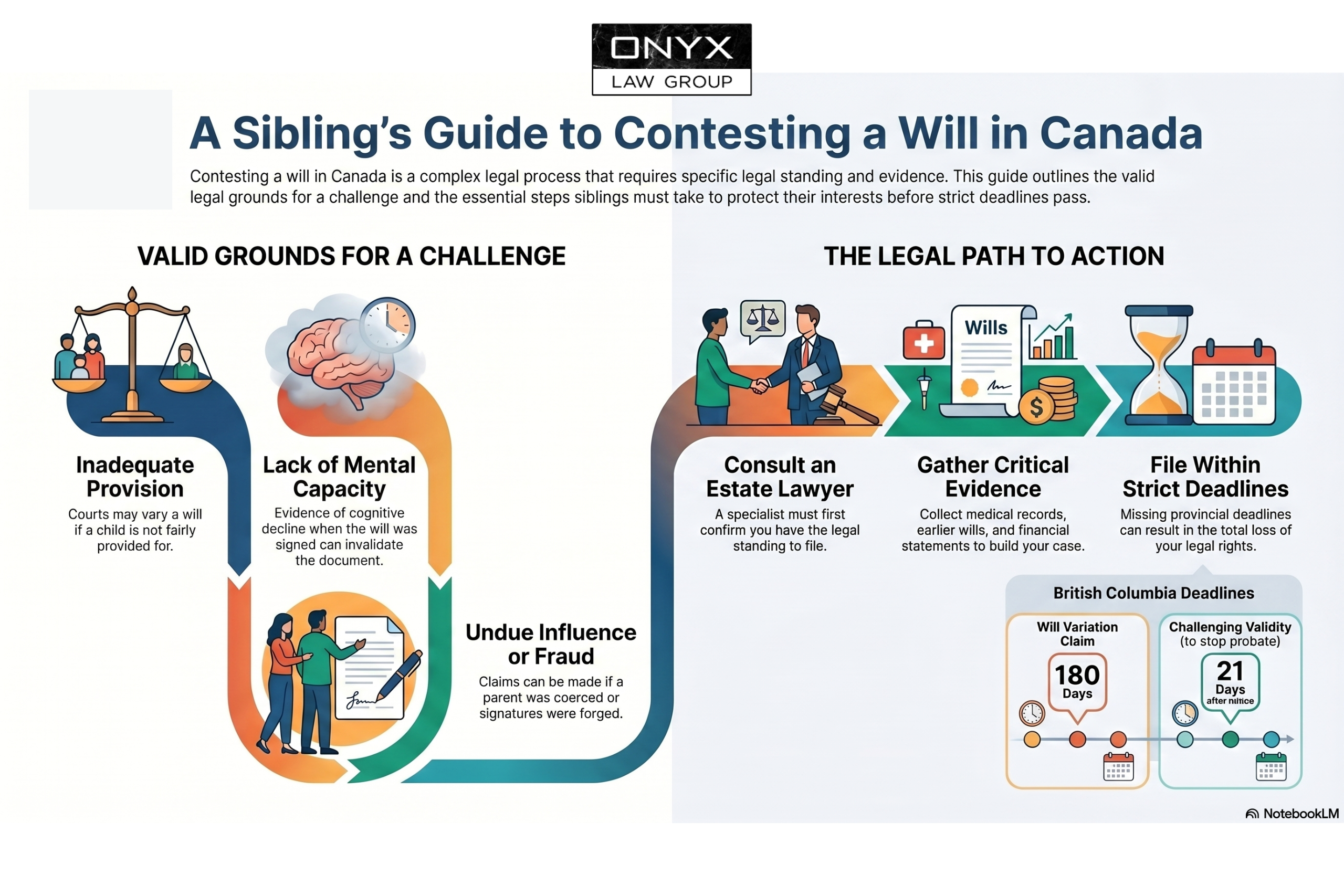
Before anything else, siblings need to understand whether they have the right to bring a court challenge. This right is called legal standing. Each jurisdiction will have its own rules about this. In BC, a spouse or child of the deceased has standing to challenge the distribution of a will. Also, a person can challenge the approval to begin probate if they would have been a beneficiary without a will or under a prior will.
Thus, if you have no connection to the estate whatsoever, a judge will likely dismiss your claim. This legal standing is only a threshold question. If you do meet the threshold, you still need to prove your claim. An estate planning attorney can assess your position quickly and tell you whether you have a viable path forward.
What Are the Legal Grounds for Contesting a Will?
Having legal standing to challenge the will only begins the process. Judges won’t overturn a will or change the distribution of an estate simply because siblings feel it is unfair. You need to demonstrate one of the following:
- Inadequate provision for spouse or child: will-makers have a legal and social duty to ensure adequate provision for their spouse and children in their estate planning. If the will fails to do so, the will’s terms can be varied.
- Lack of mental capacity. The person who made the will must have been mentally competent at the time it was signed. If your parent showed signs of cognitive decline, such evidence could be grounds for a challenge.
- Undue influence. If someone coerced your parent into changing their will, that might constitute undue influence.
- Fraud or forgery. If someone altered, forged, or signed the legal document under false pretenses, the new will may be invalid.
- Failure to meet technical requirements. A will must comply with provincial formalities to be valid. Errors in this process can render the entire will, or parts of it, invalid. However, judges can also rectify the will in order to correct these mistakes.
How Do Siblings Start the Legal Process?

If you believe you have grounds to contest a will, here’s how the process typically begins:
Step 1: Consult an estate planning attorney immediately: Before you do anything else, speak to an estate planning lawyer who handles estate litigation. They’ll assess your legal standing, evaluate the strength of your claim, and advise on the best approach.
Step 2: Collect evidence: A successful challenge of a will will almost certainly require strong evidence. Gather anything relevant, like medical records, communications suggesting undue influence, earlier wills, and records of the deceased parent’s wishes.
Step 3: File a claim in court: In BC, the process often begins with a Notice of dispute. This officially puts the personal representative and other beneficiaries on notice that someone is challenging the will.
Step 4: Time is critical: Deadlines in provincial probate courts can be strict, and missing them can mean losing your right to contest entirely.
What Documentation Is Required to Contest a Will?
To build a case, you’ll typically need the will itself, and any prior will, as well as medical documents about the deceased’s mental state around the time the will was signed.
You will also want financial records that may show unusual transfers or changes to the estate, any communications that could support claims of undue influence or fraud. As the matter moves along, you will also likely collect affidavits from witnesses who observed the deceased’s condition or circumstances around the signing of the will. The more evidence you can collect early, the better positioned you’ll be.
What Are the Timelines and Deadlines for Contesting a Will?
Timing matters more than most people expect. An executor often begins administering the estate shortly after the will-maker passes, so they may make decisions quickly. That means if you’re considering contesting a will, acting early can make a real difference in protecting your rights.
Many people find themselves caught off guard by the legal deadlines. In British Columbia, you generally have 180 days to file a will variation claim. But if you’re challenging the validity of a will and trying to stop probate, the executor may move forward just 21 days after giving notice. Missing these deadlines can mean losing your opportunity to make a claim, no matter how strong your case is.
Once a claim is started, the process usually unfolds in stages. It begins with filing and notifying the other parties, followed by exchanging documents and gathering evidence. Many cases are resolved through negotiation, but some proceed to court, where a judge makes the final decision. Depending on the complexity, the process can take anywhere from a few months to several years.
What Challenges Might Siblings Face?

Contesting a will can be more difficult than many expect. Before moving forward, it helps to understand both the legal hurdles and the personal impact. These cases are rarely simple, and if you prepare, it can significantly affect how you approach the situation.
From a legal standpoint, claims like undue influence or lack of testamentary capacity require solid evidence. The burden of proof falls on the person bringing the claim, and courts generally start with the assumption that a properly signed will is valid. This means you’ll need clear documentation, witness accounts, or expert opinions to support your position.
On a personal level, disputes between siblings over a parent’s estate can quickly become emotional. What starts as a legal issue often turns into a deeply personal conflict that strains or even breaks family relationships. While pursuing a valid claim is important, it’s worth considering options like mediation, which may help resolve matters more amicably and avoid the stress of full litigation.
What Are the Potential Outcomes?
If your case moves forward, there are a few different ways things can play out. Every situation is unique, and the outcome will depend on the facts, the evidence, and how the law applies. It helps to go in with a clear understanding that there isn’t just one possible result.
In some cases, the court may determine that the will is not valid at all. When that happens, the estate is distributed based on an earlier valid will, or under intestacy rules if no will exists. In other situations, the court may decide to vary the will, especially to ensure that a spouse or child is properly provided for.
There are also cases where only certain parts of the will are changed. A judge might remove or adjust specific provisions while leaving the rest intact. And not every case goes all the way to trial; many are resolved through negotiated settlements, where the parties agree on how to divide the estate without a final court ruling.
It’s important to remember that even a successful outcome can have emotional costs. Disputes over an estate can strain relationships in lasting ways. When possible, approaches like mediation can offer a more balanced path forward, helping families reach an agreement while reducing conflict and preserving important relationships.
What Are the Next Steps for Siblings?
If you’re worried about whether a will is valid or how an estate is being divided, your next step should be to speak with an estate litigation lawyer as soon as possible. Come prepared with any documents you have, and be ready to walk through family relationships, the deceased’s situation, and what feels off to you. That first conversation helps your lawyer understand the full picture and start building a clear path forward. From there, they can guide you on whether it makes sense to move ahead with litigation, try mediation, or explore another solution.
Once you’ve hired a lawyer and taken the first legal steps, staying involved really matters. Keep in touch with your legal team, respond quickly when they ask for information, and stay on top of deadlines and court dates. These cases can lose momentum if they’re not actively managed, so your participation is key. Being engaged not only keeps things moving but also helps your lawyer represent your interests as effectively as possible.
Why Is Professional Legal Representation Important When Contesting a Will?

Contesting a will can be both legally complex and emotionally draining, which is why having the right lawyer matters. Probate law is highly specialized, and an experienced estate litigation lawyer brings more than just knowledge. They understand how judges tend to approach these cases and which arguments are most effective.
While legal fees are an important consideration, they’re often outweighed by what’s at stake. A small mistake in procedure or timing could cost you your entire claim, so having professional guidance can make a meaningful difference.
When choosing a lawyer, it’s important to look beyond general legal experience and focus on someone with a strong background in estate litigation. Ask about their experience handling will disputes, how they approach cases like yours, and what results they’ve achieved in the past.
Just as important, find someone who takes the time to listen and understand your situation. You want a lawyer who not only knows the law but also makes you feel supported and confident throughout the process.
Need Help Contesting a Will?
In conclusion, contesting a will among siblings is a serious undertaking and a potentially years-long legal process. While the process can be difficult legally and emotionally, if you have a legitimate claim, you have real options.
Several factors are key to success: you need to act quickly, get proper legal advice, and approach the situation with a clear understanding of both the risks and the potential outcomes. A lawyer in your area with estate litigation experience can help protect your rights and obtain a successful outcome. Contact us today.
Frequently Asked Questions
Contesting a will raises many questions. Here are answers to the most common questions siblings ask most often.
Can Siblings Contest a Will if They Were Left Out?
Yes, being left out of a will does not automatically disqualify you. If you were named in an earlier will or are a dependent of the deceased, you may have legal standing to bring a claim.
How Can Siblings Prove Undue Influence in a Will Contest?
Proving that a will-maker was unduly influenced is proven through documentary evidence, which can show the deceased’s vulnerability and any suspicious changes in the will close to the time of death. Medical records, testimony from those who knew the deceased, and communications between parties all play a role.
Are There Time Limits for Siblings to Contest a Will?
Yes. Deadlines vary by province but are typically within 6 to 12 months of the grant of probate for challenging the terms of the will. Missing the deadline can mean forfeiting your right to contest, regardless of the merits of your claim.
What Happens if Siblings Cannot Agree on Contesting a Will?
Each sibling acts independently. One sibling may bring a claim while others do not. If only one sibling contests and succeeds, the outcome affects the entire estate, not just that sibling’s share.
Do Siblings Need a Lawyer to Contest a Will?
Technically, no, but practically, it is advisable. Attempting to navigate this without legal representation may reduce your chances of a successful challenge.
Disclaimer: The information provided on this blog is for general informational purposes only and does not constitute legal advice. Reading this content does not create an attorney-client relationship. Laws and regulations vary by jurisdiction and may change over time, so you should consult a qualified estate and trust attorney directly for advice regarding your specific situation. Past examples, case studies, or hypothetical scenarios are illustrative only and do not guarantee similar results.