


If you were left out of a loved one’s will, you may wonder whether you have any legal options. In British Columbia, certain people can contest a will even if they are not named in it. Whether you can challenge the will depends on your relationship to the deceased and the circumstances surrounding the will.
Have you been left out of a loved one’s will and do not know what to do? At Onyx Law Group, our skilled estate litigation and probate lawyers provide compassionate guidance, trusted advice, and proven strategies within these practice areas to resolve will disputes. Candace Cho, KC, leads our estate litigation team, was called to the British Columbia bar in 2009, and has co-chaired the Trial Lawyers Association of BC’s Estate Litigation Essentials course four times since 2020. Contact us today for a free consultation and take the first step toward protecting your rights.
In this post, we’ll talk about how to contest a will that doesn’t include you, how to start a will contest, and how the probate process may be affected.
What Is the Purpose of a Will?

A will is a legal document that leaves instructions about what a person wants done with their estate after they die, including what should happen to the estate before and after it begins entering probate. A person’s estate comprises the property and assets they owned at the time of their death, such as bank accounts, personal possessions, real estate, and investments.
According to BC Inheritance and Estate Laws, there are certain legal requirements to make a valid will: to be valid, a will must be (1) in writing, (2) signed at the end by the will-maker, and (3) signed in the presence of two independent witnesses. If a will does not meet those requirements, it may not be enforceable.
Who Is a Legal Beneficiary of a Will?
A beneficiary is a person or organization named in a will to receive all or part of an estate. A person with a beneficial interest in a trust created by a will is also a legal beneficiary (for example, a trust created in a will for the benefit of minor children or a disabled child of the deceased).
If a person dies without a will, the question “who can contest a will in Canada?” is answered by the rules of intestacy set out in the Wills, Estates, and Succession Act. Distribution of the estate will depend on the value of the deceased’s estate and the combination of relatives the deceased leaves behind.
For example, if a married person with children dies without a will, the rules state that their surviving spouse is the beneficiary of a preferential share of the deceased’s estate, with the deceased’s biological children being beneficiaries of what remains after the preferential share goes to the surviving spouse.
Who Can Contest a Will?

Not everyone is entitled to challenge a will; only those with what is known as “legal standing” are permitted to do so. An interested party must generally have a legally recognized interest in the estate to bring a claim. Typically, this group includes only individuals with a legally recognized interest, such as close family members, spouses, children, or others who were financially dependent on the deceased. One may also ask, “Can you contest a will if you are not named in it?” You can contest a will if you have a legal interest in the estate, even if you’re not named in it.
There are also specific ways to contest a will, such as proving a lack of testamentary capacity, demonstrating undue influence, identifying fraud, or establishing that it was not executed properly. Each ground requires strong evidence and often legal guidance to be successful. Because of the complexity of these cases, it’s important to seek advice from an experienced estate lawyer who can determine whether you have standing and the best way forward for challenging the will.
Can Someone Contest a Will if They Are Not in It?
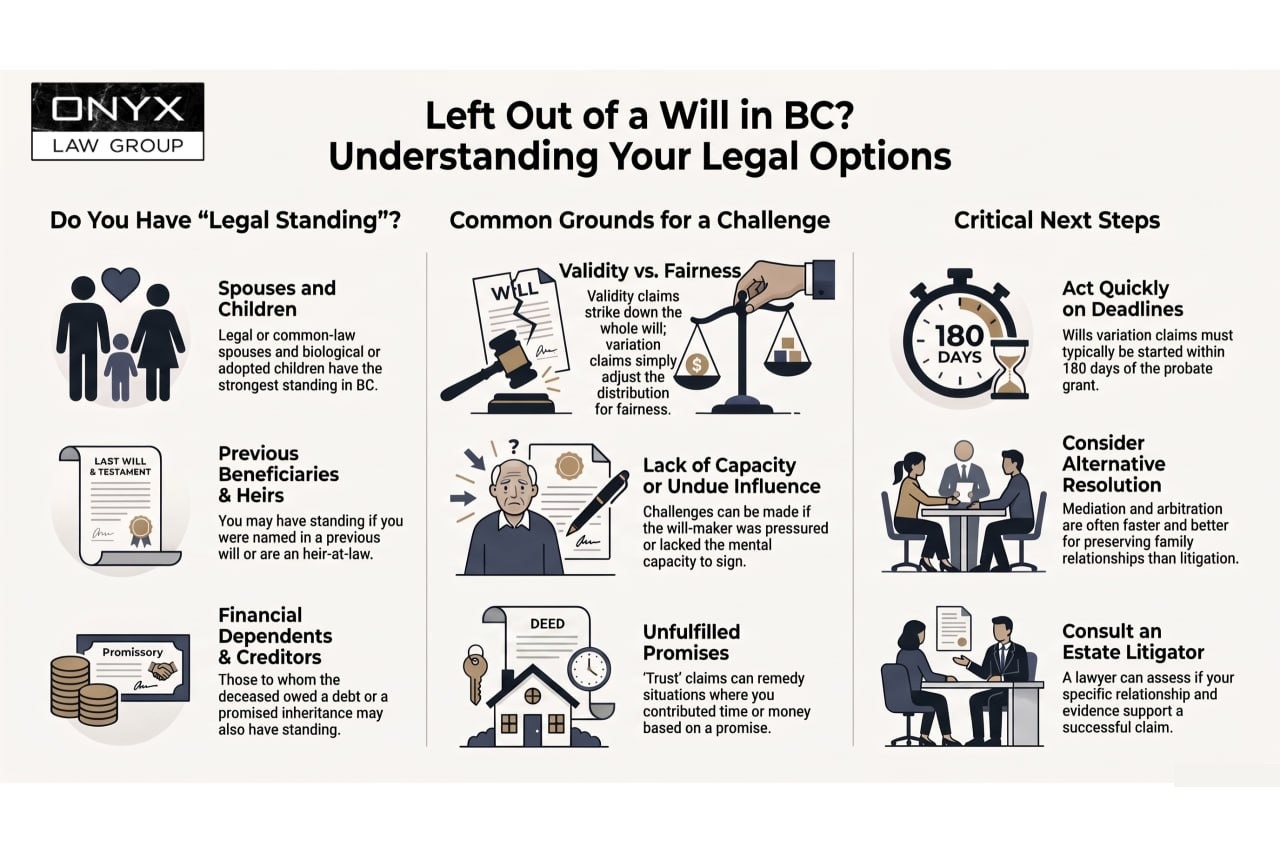
“Being left out of a will does not always mean you have no legal options,” says Susan Kim, an estates and trust lawyer at Onyx Law Group. In certain circumstances, a person can contest a will that doesn’t name them. But before that, it’s also important to know who can contest a will in Canada. The legal standing to contest a will depends on the type of claim you want to bring, how you were related to the deceased person, and whether you have an interest in the estate.
To bring legal action challenging the will’s validity on the grounds of lack of mental capacity or other reasons mentioned above, a person must have an interest in the estate. If you are not named as a beneficiary in the most recent will, you may still contest it if you were a beneficiary in a previous will or if you are an heir entitled to inherit under intestacy laws, provided the will is declared invalid.
The legal standing required to bring a will variation claim is more limited. Only the spouse or child of the deceased can bring a claim to vary the distribution of the estate in an otherwise valid will. The term ‘spouse’ refers to both legally married and common-law spouses, defined as individuals who lived in a marriage-like relationship with the deceased in their final days.
“Child” means biological child and includes adopted children of the deceased. The adult children of a deceased person can apply to vary their parents’ will. The stepchild of a deceased person does not have legal standing to bring a will variation claim.
How Can Promises Outside the Will Be Enforced?
Someone with a financial interest in the estate may also have legal standing to contest the will (e.g., a person to whom the estate owes a debt). In addition, a person promised an inheritance not reflected in the will may have justification to bring legal action to enforce that promise.
A “resulting trust” claim can be brought to enforce an unfulfilled promise to give a piece of property to another (Cowper-Smith v. Morgan, 2017 SCC 61, is a case in which a brother successfully sued to enforce his sister’s promise to give him her share of their mother’s house if he moved back in with their aging mother to care for her).
A “constructive trust” claim can also be made to remedy unjust enrichment. For example, if a person contributed their time and/or money to benefit another person’s property, they may be able to claim that they are entitled to some or all of it. The court can impose a constructive trust over the property in question to remedy the unfairness.
What Are the Reasons Non-Beneficiaries Might Contest a Will?

If you are not named in a BC will, you may still have grounds to challenge it. Common grounds include lack of testamentary capacity, undue influence, improper execution, or fraud. However, the right to challenge a will depends on the specific facts and your legal relationship to the will-maker.
Lack of testamentary capacity can be a reason to challenge a will. The issue is whether the will-maker understood what they were doing when they made the will and whether the document reflected the testator’s true intentions. Medical records may help provide evidence, but testamentary capacity is ultimately a legal test. A court will look at the circumstances surrounding the making and signing of the will.
Undue influence is another possible ground. This may apply when someone pressured or coerced the will-maker into making a will that did not reflect their true wishes. According to Louisa Ledesma, a family lawyer at Onyx Law Group, “Undue influence is about more than family pressure; you need evidence of improper influence.” The person challenging the will must provide evidence to support the claim. In BC, the Wills, Estates and Succession Act also contains specific rules about undue influence and the burden of proof in certain cases.
Improper execution or other validity issues may also provide grounds for a challenge. Section 37 of the Wills, Estates and Succession Act sets out the formal requirements for making a will. The court can also consider whether a will is invalid for other reasons, such as fraud or a lack of knowledge and approval. If a will is deemed invalid, an earlier valid will may govern the estate, or the estate may be distributed under BC’s intestacy rules if no valid will exists.
Unfairness is different from challenging the will’s validity. Under section 60 of the Wills, Estates and Succession Act, a spouse or child of the deceased may ask the court to vary a will if it fails to make adequate provision for them. The court considers the will-maker’s legal and moral obligations, the circumstances of the spouse or child, and the competing interests of other beneficiaries. A successful wills variation claim does not invalidate the will; instead, the court changes how the estate is distributed.
What Type of Will Challenge Is Right for You?
Not every will dispute works the same way. The right option depends on what you are challenging and your relationship with the deceased. This comparison can help you understand the key differences before deciding how to proceed.
| Option | When it may apply | What you are trying to achieve | Key trade-off |
|---|---|---|---|
|
Challenge for lack of capacity |
You believe the will-maker did not have testamentary capacity when the will was made. |
Have the will declared invalid. |
Medical evidence can help, but the legal test focuses on the will-maker’s capacity at the relevant time. |
|
Challenge for undue influence |
You believe someone pressured or coerced the will-maker. |
Have the affected will declared invalid. |
Strong evidence is usually needed to establish undue influence. |
|
Challenge validity or execution |
The will may not meet BC’s legal requirements or may be affected by another validity issue. |
Have the will declared invalid or otherwise denied effect. |
The outcome may depend on the wording of the will, the signing process, and the surrounding evidence. |
|
Wills variation claim |
You are the deceased’s spouse or child and believe the will does not make adequate provision for you. |
Have the court change how the estate is distributed. |
The will remains valid, but the court may adjust the distribution. |
Steps to Contest a Will in BC if You Are Not Named

Being left out of a will does not always mean you have no legal options. A contested will may be challenged when there are recognized legal grounds and sufficient evidence to support the claim. The right approach depends on your relationship to the deceased and the reason you believe the will should be challenged. Here are the key steps to take if you believe you have a valid claim:
Step 1: Determine if You Have Legal Grounds
Start by looking at why you were left out of the will. Your options may depend on issues such as testamentary capacity, undue influence, improper execution, or whether you qualify to make a wills variation claim.
Step 2: Gather Relevant Evidence
Notify all interested parties of the will contest as required, particularly where court rules or estate procedures require notice to affected beneficiaries or other parties.
Step 3: Find Out Which Will Applies
Check whether the deceased left an earlier valid will. If the current will is successfully challenged, an earlier valid will may govern the estate, or BC intestacy rules may apply if there is no valid will. The probate court may need to determine which document governs the estate.
Step 4: Check Your Legal Deadline
Some estate claims have strict time limits in BC. For example, a wills variation claim generally must be started within 180 days after the representation grant is issued.
Step 5: Get Legal Advice
Estate disputes can become complicated quickly. A BC wills and estates lawyer can review your situation and help you decide what to do next.
Challenges and Considerations for Non-Beneficiaries
Can someone not named in a will contest it? One of the main challenges is that a will contest can give rise to significant financial and emotional costs. It’s important to consider what you hope to achieve and the potential outcomes before contesting a will.
For instance, if a challenge to a will based on undue influence is successful, the court will declare the will invalid. The will-maker’s next, most recent, valid will governs how the estate is distributed. When there are no previous wills, the rules of intestacy determine how the estate must be distributed. Therefore, you must carefully consider whether you will be “better off” if a former will or the rules of intestacy take effect.
Limitation periods can also pose a challenge. There are strict deadlines that must be met to bring legal action. The deadline depends on the type of claim you are submitting. For instance, a two-year limitation period applies if you are contesting a will based on mental incapacity or undue influence.
The limitation period is different if you’re the deceased spouse or child of the will-maker applying to vary the will in your favor. In that situation, you must start your legal action within 180 days of the date the British Columbia Supreme Court issues a grant of probate.
Another important consideration is the cost. The average cost of contesting a will in British Columbia varies based on the type of law firm you choose and the number of legal issues. In some cases, legal fees from contesting a will can exceed the estate’s value, particularly where the dispute is complex or prolonged. It also depends on the number of parties to the will dispute and the complexity of the case.
What Are the Alternatives to Contesting a Will?

Legal action is one way to resolve an estate dispute, but it isn’t the only way. Some estate disputes can be resolved informally between beneficiaries and executors, especially if they have an experienced lawyer advising them on their rights and the law. Mediation, arbitration, and other alternative dispute resolution methods can be very effective in resolving estate disputes. As an added benefit, non-litigious alternatives tend to be less costly, quicker, and better at preserving family relationships.
Do You Want to Know if You Can Contest a Will if You Are Not in It?
Being excluded from a loved one’s will can be shocking and unfair; however, in many cases, it is still possible to challenge the document. Can a non-beneficiary contest a will? While not everyone is entitled to do so, certain individuals, such as spouses, children, or financial dependents, may have legal standing to bring a claim even if they are not named as beneficiaries.
There are several legal reasons to contest a will, including undue influence, lack of mental competence, fraud, or failure to meet legal requirements. Because the process can be complex and emotionally challenging, seeking advice from an experienced estate lawyer is the best step to understand your rights, assess the strength of your case, and make informed decisions.
Can a family member contest a will if they are not in it? Our team at Onyx Law Group prioritizes providing our clients with competent and passionate legal advocacy. Candace Cho, KC, leads our estate litigation team, was called to the British Columbia bar in 2009, and has co-chaired the Trial Lawyers Association of BC’s Estate Litigation Essentials course four times since 2020. Our experienced estate and probate lawyers seek equitable solutions for you, and we stand by you throughout the process. Contact us today for a complimentary consultation.
Frequently Asked Questions
Being left out of a will does not automatically give someone a legal right to challenge it. The legal process depends on the person’s relationship to the deceased, the nature of the legal challenge, and whether there is credible evidence supporting the claim.
Can a Sibling Contest a Will if They Are Left Out?
A sibling may be able to bring a legal challenge if there are valid grounds, such as fraud or forgery, undue influence, or concerns about the testator’s capacity. However, being an interested person or being excluded from the will does not by itself create a wills variation claim, which is generally available to qualifying spouses and children.
What Kind of Will Cannot Be Contested?
No will is completely protected from a legal challenge, although a will made by a person of sound mind and properly executed may be more difficult to invalidate. The court determines validity based on the evidence, including relevant documents, witness testimony, and other credible evidence about the testator’s capacity and the decedent’s intentions.
Can a Family Cut You Out of a Will?
A person can generally decide how to distribute their estate through estate planning, including leaving certain family members out of their will. However, a qualifying spouse or child may have a legal right to seek a variation under BC probate law if the will fails to make adequate provision for their proper maintenance and support.
What Are the Grounds for Contesting a Will?
Common grounds include lack of testamentary capacity, undue influence, fraud or forgery, and problems with how the will was executed. Evidence such as relevant documents, witness testimony, and other credible evidence may help the person contesting the will establish a successful challenge.
Can a Family Member Contest a Will if They Were Left Out?
A family member may have grounds for a legal challenge if they can present evidence that affects the will’s validity or otherwise establishes a legally recognized claim. Depending on the circumstances, the court may uphold the will, find the entire will or part of it considered invalid, or apply a prior will or other applicable rules to the estate assets.
Can a Lawyer Help Me Contest a Will if I’m Not Mentioned in It?
Yes, an experienced attorney or estate planning attorney can assess whether you have standing, identify relevant evidence, and explain the general process for bringing a claim. Legal counsel can also help you navigate the complex legal process, attend mediation where appropriate, and pursue a favorable outcome while considering legal fees and other estate matters.
Are There Time Limits for Contesting a Will if You’re Not in It?
There is no single deadline for every will challenge in BC, because the applicable limitation period depends on the type of claim. If you believe you have a legal challenge, act quickly and seek legal help so an experienced estate planning attorney or other qualified legal professional can determine which deadline applies.
Disclaimer: The information on this page is general legal information about British Columbia law, not legal advice for any specific situation. Reading this page does not create a solicitor-client relationship. BC law changes, and the procedure that applies to a specific situation depends on facts not covered here. For advice on your situation, consult a qualified British Columbia estate lawyer directly. Past results, illustrative scenarios, and reference to typical fact patterns do not guarantee similar outcomes in any specific case.