


If a sibling is stealing from an estate, document the missing assets, gather supporting evidence, and speak with an estate lawyer as soon as possible. Depending on the circumstances, you may be able to recover stolen assets through the courts and hold the responsible party accountable. Acting quickly can help protect the estate and your inheritance.
Onyx Law Group has litigated contested estates in Vancouver since 2012. Our estate litigation practice is led by Candace Cho, KC, who goes after executors and beneficiaries who take what isn’t theirs. We won a $400,000 unjust enrichment judgment for an estate in Sangha v. Sangha, and we routinely force dishonest executors to account for every dollar. If a sibling is stealing from your family’s estate, book a free 30-minute consultation with us.
In this blog, we will explain how estate theft by a sibling happens, the warning signs to watch for, and the legal options available to protect your inheritance and hold them accountable.
How to Prove Inheritance Theft in Canada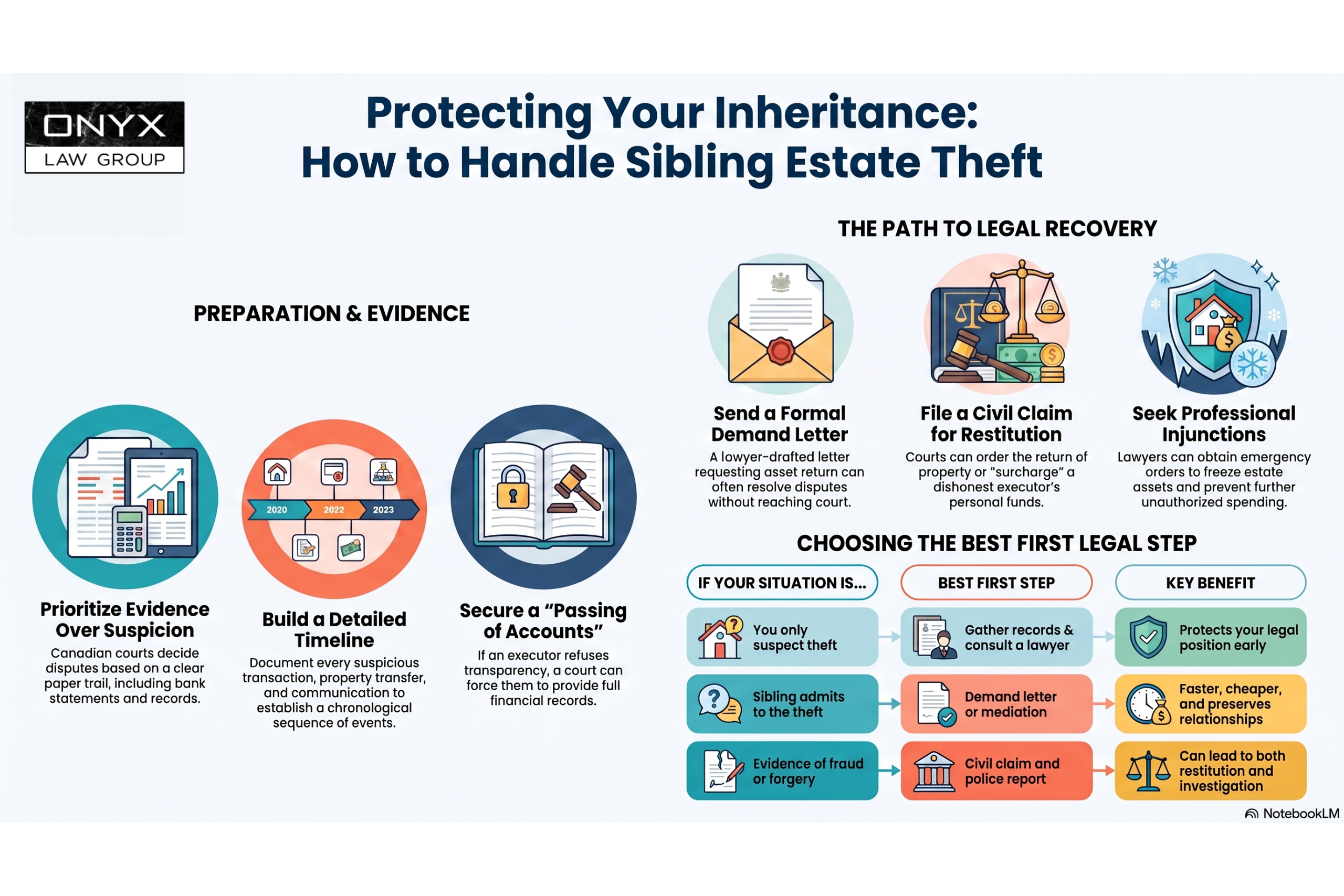
Every year, hundreds of thousands of Canadian families must administer a loved one’s estate. According to Statistics Canada, there were 326,571 deaths in Canada in 2023, meaning hundreds of thousands of estates required someone to manage assets, pay debts, and distribute inheritances. While most estates are settled without issue, disagreements can arise when beneficiaries believe estate assets have been mishandled or wrongfully taken.
Proving inheritance theft in Canada requires evidence, not suspicion. If you believe a sibling has taken money or property from your parent’s estate, you will need documents and facts that clearly show what happened. Canadian courts decide these disputes based on the available evidence, so building a strong paper trail is one of the most important steps you can take.
Start by gathering records that show how the estate’s assets were handled. Bank statements, credit card records, property records, investment account statements, and executor reports can reveal unauthorized withdrawals, missing assets, or unusual transfers.
Witness statements from family members, caregivers, financial advisors, or other people with firsthand knowledge can also help support your claim. Estate planning documents, including previous versions of the will, trusts, and powers of attorney, may also show suspicious changes that benefited one sibling.
As you review the records, document every suspicious transaction or concerning behavior. Keep a timeline of important events, including large withdrawals, property transfers, changes to beneficiary designations, or valuable items that disappeared from the estate. Save emails, text messages, letters, and any other communication that may help explain what happened. Small details can become important when viewed alongside other evidence.
Some cases also require professional assistance. A forensic accountant can trace missing funds, identify hidden assets, and analyze complex financial transactions that may not be obvious from bank statements alone. An estate lawyer can determine whether the evidence supports claims such as breach of fiduciary duty, fraud, undue influence, or executor misconduct and can advise on the best legal steps to recover estate assets.
It is equally important to preserve your evidence properly. Keep original documents whenever possible and make copies for your records. Save digital files in their original format, including emails, text messages, photographs, and financial records, without altering or deleting them. If you obtain electronic evidence, make sure it is collected lawfully so it can be used in court if necessary.
Inheritance disputes are often decided by the strength of the evidence rather than the seriousness of the allegations. The more organized and complete your documentation is, the stronger your position will be when challenging a sibling who may have taken estate assets. Taking action early can also help prevent further losses and improve your chances of recovering property that rightfully belongs to the estate.
What Are the Legal Remedies for Dealing With a Sibling Stealing From an Estate in Canada?

If you believe a sibling has taken estate assets without permission, you have several legal options. A lawyer may first send a demand letter. This is a formal letter that explains the problem, identifies the missing assets, and requests that they be returned within a set deadline.
If the sibling is the executor, you can also ask the court to order a passing of accounts, which requires the executor to provide a full record of the estate’s finances. If the executor has acted dishonestly or failed to perform their duties, the court may remove them and appoint someone else.
If the issue is not resolved, you may file a civil claim to recover the stolen assets or seek compensation for the estate’s losses. The court can order the return of money or property and reverse unauthorized transfers. If the sibling committed fraud, theft, or forgery, you may also report the matter to the police. Criminal proceedings are separate from a civil lawsuit and may result in criminal charges.
There are time limits for taking legal action. These limitation periods vary by province and depend on the type of claim and when the misconduct was discovered. Waiting too long could affect your ability to recover estate assets. Speaking with an experienced estate litigation lawyer as soon as possible can help protect your rights and determine the best course of action.
Which Option Is Right for Your Estate Dispute?
Every estate dispute is different. The best course of action depends on what has happened, how much evidence you have, and whether your sibling is willing to cooperate. The comparison below outlines the most common situations, the legal options available, and the key trade-offs to help you decide on the most appropriate next step.
| If Your Situation Is… | Best First Step | Benefits | Potential Drawbacks |
|---|---|---|---|
| You only suspect estate theft and have limited evidence | Gather financial records and consult an estate lawyer | Protects your legal position and helps determine whether misconduct occurred | May take time to collect evidence before action can be taken |
| The executor refuses to share financial information | Request a formal accounting (passing of accounts) | Forces transparency and may reveal missing assets | May require court involvement if the executor refuses to cooperate |
| Your sibling admits taking assets and is willing to negotiate | Demand letter or mediation | Faster, less expensive, and preserves family relationships where possible | Not appropriate if dishonesty or fraud continues |
| Your sibling transferred or sold estate assets without permission | File a civil claim to recover estate assets | Court can order assets returned or compensate the estate | Litigation can be costly and may take months or longer |
| The executor is abusing their position | Apply to remove and replace the executor | Protects the estate from further losses | Requires evidence that the executor breached their fiduciary duties |
| There is evidence of fraud, forgery, or theft | Speak with an estate lawyer and consider reporting the matter to police | May result in both civil remedies and criminal investigation | Criminal proceedings do not automatically recover estate assets |
| You are unsure whether your sibling’s actions are actually illegal | Obtain legal advice before confronting anyone | Helps avoid false accusations and protects your rights | Initial legal consultation may involve costs |
Common Mistakes to Avoid When Dealing With Sibling Inheritance Theft
One of the biggest mistakes is confronting your sibling before you have gathered the facts. While it is natural to want answers, making accusations without evidence can make the situation more difficult and may even give the other person time to hide or dispose of estate assets. Instead, collect relevant financial records, estate documents, and other evidence before raising your concerns. If an executor is involved, you may also have legal options to request information about how the estate is being administered.
Another common mistake is waiting too long to speak with an estate or probate lawyer. In British Columbia, inheritance disputes and claims involving executor misconduct or misappropriated estate assets can become more difficult if action is delayed. An experienced estate lawyer can explain your legal rights, help preserve important evidence, and determine the most effective way to protect the estate before additional assets are lost.
Many people also underestimate the importance of keeping detailed records. Save copies of emails, text messages, letters, financial statements, and estate documents that relate to the dispute. Keep a timeline of suspicious transactions, missing property, and conversations with your sibling, the executor, or other beneficiaries. Well-organized documentation can strengthen your position if the matter proceeds to court.
Finally, avoid relying on family mediation alone when there is evidence of serious inheritance theft. Mediation can be an effective way to resolve misunderstandings or disagreements, but it is not always appropriate where fraud, theft, or the deliberate misuse of estate assets is involved. If a sibling has taken property without authorization or an executor has breached their legal duties, legal advice should come first so you can understand your rights and the remedies available under British Columbia law.
What Are Your Legal Rights When a Sibling Steals From an Estate?

If you believe a sibling has taken money or property from a parent’s estate, you have legal rights to protect your inheritance. As a beneficiary, you can request information about how the estate is being managed. If your sibling is the executor, they have a fiduciary duty to act in the best interests of all beneficiaries and must not use estate assets for personal benefit.
You also have the right to ask the court to intervene if an executor is not fulfilling their legal duties. This may include requesting a formal accounting of the estate, seeking orders to recover misappropriated assets, or, in serious cases, asking the court to remove and replace the executor. These remedies are generally available only where there is evidence of misconduct or a breach of the executor’s duties.
If a sibling influenced your parent to transfer assets or change their will before their death, you may also be able to challenge those transactions. Claims involving undue influence, lack of mental capacity, or suspicious changes to estate planning documents can be reviewed by the court. An estate lawyer can assess the evidence, explain your legal options, and help you take the appropriate steps to protect the estate.
What Is the Legal Process for Handling Estate Theft?
If you believe a sibling has stolen from an estate, there is a legal process for recovering estate assets and protecting your inheritance. While the exact procedure depends on the province and the facts of the case, most estate theft claims follow a similar path. Acting early is important because delays can make it harder to preserve evidence, recover missing assets, or stop further losses.
Step 1: Gather Evidence and Investigate the Estate
The first step is to determine whether estate theft has actually occurred. Work with an estate lawyer to review the will, estate plan, trust documents, bank records, property records, and other financial information, while also speaking with anyone who may have relevant knowledge. Building a clear timeline and collecting supporting evidence is the foundation of any successful claim.
Step 2: Send a Demand Letter
If the evidence supports your concerns, your lawyer will often send a formal demand letter to the sibling or executor. The letter typically requests the return of estate assets, a full accounting of the estate, or an explanation of suspicious transactions, and in some cases this is enough to resolve the dispute without going to court.
Step 3: Start Court Proceedings if Necessary
If the matter cannot be resolved, your lawyer may begin a court proceeding by filing the appropriate petition or civil claim. Depending on the circumstances, the court may be asked to order a passing of accounts, recover estate assets, remove an executor, or address other breaches of fiduciary duty.
Step 4: Exchange Evidence Through Discovery
Once the case is before the court, both sides enter the discovery process and exchange evidence. This may include bank statements, financial records, medical records to assess mental capacity, emails, witness testimony, and expert opinions that help explain how the estate was managed and whether assets were improperly taken.
Step 5: Negotiate a Settlement or Proceed to Trial
Many estate disputes are resolved through negotiation or mediation before reaching trial, saving both time and legal costs. If no agreement can be reached, the case proceeds to trial, where a judge will decide the outcome based on the evidence presented and the applicable provincial law.
What Are the Potential Outcomes and Compensation in Estate Theft Cases?

Courts can order restitution, removal of executors, and repayment of legal costs. When legal action is successful, the probate court has several tools to make the victims whole. The goal is to return the estate assets to their rightful place. As a result, remedies can include:
- Restitution: The court will order the sibling to return the stolen money or property to the estate.
- Surcharge: If the sibling was the executor, the court can “surcharge” them. This means they must pay the estate back from their funds for any losses caused by their self-dealing.
- Varying the Will: If a sibling unduly influenced a parent to change the will, the court can change it back or even limit or exclude the sibling from inheriting.
- Criminal Complaint: While inheritance disputes are usually civil, if the theft is blatant, like forging checks, the Crown (in Canada) or a district attorney may file a complaint.
- Attorney’s Fees: Courts often order the stealing sibling to pay the attorney’s fees of the innocent beneficiaries, meaning your legal costs could be covered by the wrongdoer. If the sibling is the executor and has done wrong, they may have to pay their own legal fees, which can’t be charged to the estate.
How Can Professional Legal Representation Help in Estate Theft Cases?
Attempting to handle litigation on your own against multiple siblings or a manipulative adult child is risky and fraught with difficulties. Estate laws are complex, and family relationships can cloud judgment.
An experienced estate litigation attorney acts as your shield and sword. They understand the nuances of fiduciary duties owed by the sibling and know how to spot red flags in financial documents that a layperson might miss. A lawyer can negotiate from a strong position, often securing a settlement that recovers more money than you could achieve alone. Whether it involves challenging a will, removing a sibling executor, or pursuing a claim for undue influence, professional legal representation ensures your best interests are protected.
Take the case of Sarah, who became concerned after noticing unexplained withdrawals from her late mother’s bank account and the sudden disappearance of valuable jewelry from the estate. When her brother, who was acting as executor, refused to provide financial records or answer her questions, she contacted Onyx Law Group for advice. After reviewing the estate documents and financial records, the firm’s estate litigation lawyers identified several questionable transactions and sent a formal demand for a full accounting.
When the executor still failed to cooperate, Onyx Law Group commenced legal proceedings, obtained disclosure of the missing financial records, and successfully negotiated a settlement requiring the return of misappropriated estate assets and the appointment of an independent administrator to complete the estate. Instead of facing the dispute alone, Sarah had experienced legal advocates protecting her interests at every stage, giving her peace of mind and helping preserve her rightful inheritance.
What Are the Next Steps and Actions to Take In an Estate Theft Case?
If you believe a sibling is stealing from your parent’s estate, you must act quickly. Delays may lead to the depletion and permanent loss of assets. Here are some steps you can take:
- Please promptly collect copies of the will, trust documents, and any financial statements you have access to.
- Do Not Confront the Sibling Alone: Confronting siblings without legal backing often leads to them hiding or dissipating assets, and if there is already a sibling rivalry, it can only make matters worse. Ensure you have all the necessary documents and legal support before confronting your sibling.
- Consult a Professional: Contact a specialized estate attorney or estate litigation attorney.
- Freeze Assets: Your lawyer can help you seek an emergency injunction to freeze estate assets and to prevent the sibling from spending any more money.
- File a Police Report: If necessary, file a report with the local police to create an official record of the theft.
How to Settle an Estate With a Difficult Sibling in Canada
Settling an estate with a difficult sibling often requires a balance between protecting your legal rights and avoiding unnecessary conflict. In many Canadian estate disputes, mediation or negotiated settlements can help family members reach an agreement without the cost and delay of litigation.
The estate trustee has a legal duty to administer the estate fairly and in accordance with the will and applicable laws, while an attorney acting under a power of attorney may also be required to account for financial decisions made before the parent’s death. Clear communication, written documentation, and a willingness to focus on facts rather than emotions can often prevent disagreements from escalating further.
However, not every dispute can be resolved through negotiation alone. If a sibling refuses to cooperate, conceals information, misuses estate assets, or challenges the administration of the estate without valid grounds, it may be necessary to involve the courts. Before taking that step, parties will often benefit from obtaining legal advice and exploring alternative dispute resolution options such as mediation. An experienced estate lawyer can help assess the strength of your position, represent your interests during negotiations, and determine when court intervention is necessary to protect the estate and ensure a fair outcome.
Ready to Reclaim Your Inheritance?
Discovering that a sibling may be stealing from an estate can turn an already painful time into a deeply distressing experience. The good news is that you do not have to let sibling rivalry or fear of court proceedings cost you your rightful inheritance. You are entitled to a fair share of the assets your parents diligently worked to leave behind.
Because estate disputes involve strict timelines and complex legal obligations, early legal advice is critical. Consulting an experienced estate attorney can help you understand your rights, stop further losses, and pursue appropriate legal remedies with confidence.
Is your sibling stealing from an estate and putting your inheritance at risk? At Onyx Law Group, we bring over 13 years of experience handling complex estate disputes and helping beneficiaries protect what they are legally entitled to receive. Our estate litigation lawyers in your area understand the emotional and financial toll of sibling theft and provide clear, strategic guidance backed by proven legal knowledge and authority. Contact us for a confidential consultation and take decisive action to safeguard the estate and your rights.
Frequently Asked Questions
Estate disputes between siblings can be emotionally and financially challenging, especially if you suspect estate theft or believe a loved one’s wishes are not being followed. Here are answers to common questions about protecting your inheritance, preserving your family’s legacy, and resolving estate disputes.
How to Prevent a Sibling Stealing From Estate?
Encourage your parents to create a clear estate plan with legally valid legal documents that name trustworthy personal representatives or an independent professional. Regularly reviewing financial accounts, bank accounts, and other estate property can also help detect potential signs of wrongdoing early.
What Are the Legal Consequences of a Sibling Wrongly Taking Money From an Estate?
A sibling who takes estate assets for personal gain may be removed as executor or personal representative and ordered to repay the money taken. In serious cases, the court may also award damages, impose legal costs, or allow probate litigation to recover the stolen inheritance.
What Are the Potential Costs Associated With Dealing With a Sibling Stealing From the Estate?
Estate disputes can involve legal fees, court costs, and expert expenses such as forensic accounting to review financial accounts. Hiring a probate attorney early may reduce the overall cost by resolving issues before they become longer estate theft disputes.
What Are Some Common Mistakes Siblings Make When Dealing With Estate Theft, and How Can They Be Avoided?
Waiting too long to act, ignoring suspicious activity, or overlooking unexplained withdrawals from a bank account can make recovery more difficult. Gathering evidence, preserving financial records, and seeking legal advice as soon as you notice questionable circumstances can strengthen your case.
What to Do When a Sibling Steals Your Inheritance?
Collect evidence, including financial records and legal documents, and consult a probate attorney as soon as possible. If the court determines that a sibling improperly took estate assets, it may order the return of the stolen inheritance and protect your loved one’s legacy.
How Do You Settle an Estate With a Difficult Sibling?
Proper estate administration, open communication, and cooperation among other family members can often help resolve disagreements. If the dispute cannot be resolved, mediation or probate litigation may be necessary to carry out your loved one’s wishes.
What Are Common Mistakes Made With an Inheritance?
Common mistakes include distributing assets before debts are paid, failing to protect the family home, or ignoring sudden changes in estate records. Obtaining legal advice before making decisions can help preserve the estate and avoid unnecessary disputes.
Can Siblings Fight for Inheritance?
Yes, siblings can challenge an estate if they believe a will is invalid or there are questionable circumstances surrounding the administration of the estate. They may also bring a claim if they believe estate property has been misused or transferred improperly.
Disclaimer: The information on this page is general legal information about British Columbia law, not legal advice for any specific situation. Reading this page does not create a solicitor-client relationship. BC law changes, and the procedure that applies to a specific situation depends on facts not covered here. For advice on your situation, consult a qualified British Columbia estate lawyer directly. Past results, illustrative scenarios, and reference to typical fact patterns do not guarantee similar outcomes in any specific case.