


No, a spouse does not automatically inherit everything in British Columbia. Under the Wills, Estates and Succession Act (WESA), what a surviving spouse inherits depends on whether the deceased had a valid will, whether they had children (especially from a previous relationship), and whether the relationship was legally recognized. If there is no will, BC’s intestacy rules determine how the estate is divided, and the surviving spouse may have to share the estate with the deceased’s children.
In BC, whether a spouse inherits everything depends on the will, the intestacy rules under WESA, and whether the deceased had children. Onyx Law Group has focused on BC estate litigation since 2012, handling intestate estates, estate administration, and wills variation claims. Our estate practice is led by Candace Cho, KC, and the firm’s landmark results include Grewal v. Litt, a leading BC wills-variation decision. Contact us today for a free 30-minute consultation.
In this guide, we will explain whether a spouse automatically inherits everything in British Columbia, how BC inheritance laws work with and without a will, and what factors can affect a surviving spouse’s share of an estate.
What Are the Spousal Inheritance Rights in British Columbia?

Estate planning affects thousands of BC families every year. According to BC Vital Statistics, there were more than 39,000 deaths registered in British Columbia in 2023, meaning thousands of estates required administration under BC law, whether or not the deceased left a valid will.
The Wills, Estates and Succession Act (WESA) sets the rules for distributing a person’s estate after death in British Columbia. The starting point is always the same question: Was there a valid will? Spouses have real, enforceable rights under WESA, but those rights stop short of an automatic claim to the whole estate.
Where the deceased left a valid will (testate succession), the estate is distributed according to that will. A spouse who has been left out, or left with too little, is not necessarily stuck with the result. WESA lets a spouse ask the court to vary the will if it fails to make adequate provision for them, which is a meaningful check against being written out.
Where there is no will (intestate succession), WESA decides who inherits. A surviving spouse comes first in line, but “first in line” is not the same as “takes everything.” The spouse is entitled to a preferential share off the top of the estate, then a share of whatever remains. If the deceased left descendants, those descendants take a share too, whether or not they are also the spouse’s children. The one thing that shared children change is the size of the preferential share, not whether the children inherit at all.
These rules are meant to provide a fair framework, but they may not reflect what the deceased actually wanted. Every family is different, especially when there are blended families, common-law relationships, or children from previous relationships. A valid, current will remains the only reliable way to make sure your spouse and the rest of your family inherit the way you actually intend.
What Governs the BC Inheritance Laws Process?
In BC, the Wills, Estates, and Succession Act (WESA) is the legislation that governs how estates are distributed. It came into force on March 31, 2014, replacing the older Estate Administration Act. WESA covers the whole terrain: spousal entitlements, the rights of children and other relatives, probate, and the default scheme that applies when someone passes away without a will
If there is a valid will, the personal representative named in it administers the estate and distributes the assets as the will directs. If there is no will, the estate falls into WESA’s intestacy scheme, and the outcome may look nothing like what the deceased would have chosen.
Inheritance is rarely a clean transfer of the full estate value, either. Income tax on the final return, outstanding debts, and administration costs all come out before beneficiaries see anything. Planning ahead and knowing which of your assets pass inside the estate versus outside it is what keeps those costs from quietly eroding what you leave behind.
What Are the Rules of Intestacy Under BC Estate Law?
Under BC estate law, the scheme for distribution of assets depends on whether the deceased had a spouse and/or dependents. The rules of intestacy give priority to the surviving spouse, and as such, the question of who qualifies as a spouse has significant ramifications.
WESA defines a spouse in two ways. Two people are spouses if they were married to each other, or if they lived together in a marriage-like relationship for at least two years at the date of death. Those two years matter, and, as discussed below, the court sometimes has to decide precisely when a relationship crossed into being marriage-like.
What Happens When a Spouse Dies Without a Will in BC?
When someone dies without a valid will in British Columbia, their estate is distributed under WESA through intestate succession. Instead of following the deceased’s own wishes, the statute dictates who inherits and in what order. The surviving spouse is given priority, but does not simply collect the entire estate.
Under these rules, the surviving spouse usually receives a preferential share before the rest of the estate is divided. If all of the deceased’s children are also the children of the surviving spouse, the spouse generally inherits the entire estate. If the deceased had children from another relationship, the spouse receives the preferential share first, and the remaining estate is typically divided between the spouse and those children. This means the spouse may receive the first $150,000 or $300,000, depending on the family situation, plus a share of the remaining assets.
If there is no surviving spouse, the estate passes to the deceased’s next eligible relatives in the order set out by WESA. This usually begins with children and grandchildren, followed by parents, siblings, and more distant family members if necessary. If no eligible relatives can be found, the estate may ultimately pass to the Province of British Columbia. The estate may also need to go through probate, which can add time, costs, and stress for loved ones.
A lot of people assume that being married means a spouse inherits everything. It is true only in narrow circumstances. The outcome depends on whether there is a valid will, whether the deceased had descendants (and whether any of them are from another relationship), and whether the surviving partner actually meets WESA’s definition of a spouse. A long-term partner who falls outside that definition may inherit nothing on an intestacy.
The scheme is meant to be fair and predictable, but it cannot anticipate every family. Blended families, common-law partners, and tangled financial arrangements routinely produce results the drafters never had in mind.
| Family Situation | Who Inherits? | Preferential Share | What Happens to the Remaining Estate? |
|---|---|---|---|
| Surviving spouse only (no children or descendants) | The surviving spouse inherits the entire estate. | Not applicable, as the spouse receives everything. | No remaining estate is divided. |
| Surviving spouse and children from the same relationship | The surviving spouse generally inherits the entire estate. | $300,000 preferential share applies under WESA. | In practice, the spouse receives the whole estate when all children are shared. |
| Surviving spouse and children from a previous relationship | The surviving spouse and the deceased’s children both inherit. | $150,000 preferential share goes to the surviving spouse first. | The balance of the estate is typically divided 50% to the spouse and 50% to the deceased’s children. |
What Does “Intestate” Mean in BC?
The word “intestate” just means a person died without a valid will. When that happens, WESA’s rules distribute the estate. Those rules are rigid by design. They do not weigh emotional closeness, financial need, or anything the deceased said but never wrote down; they follow legal relationships and fixed timelines, full stop.
That rigidity is the whole argument for having a will. “A will gives you the opportunity to decide how your estate should be distributed,” says Judith Janzen, a principal lawyer at Onyx Law Group. Without one, the law makes those decisions for you, and the result may be a long way from what you would have chosen.
What Are the Spousal Rights to Property and Marital Assets After Death in BC?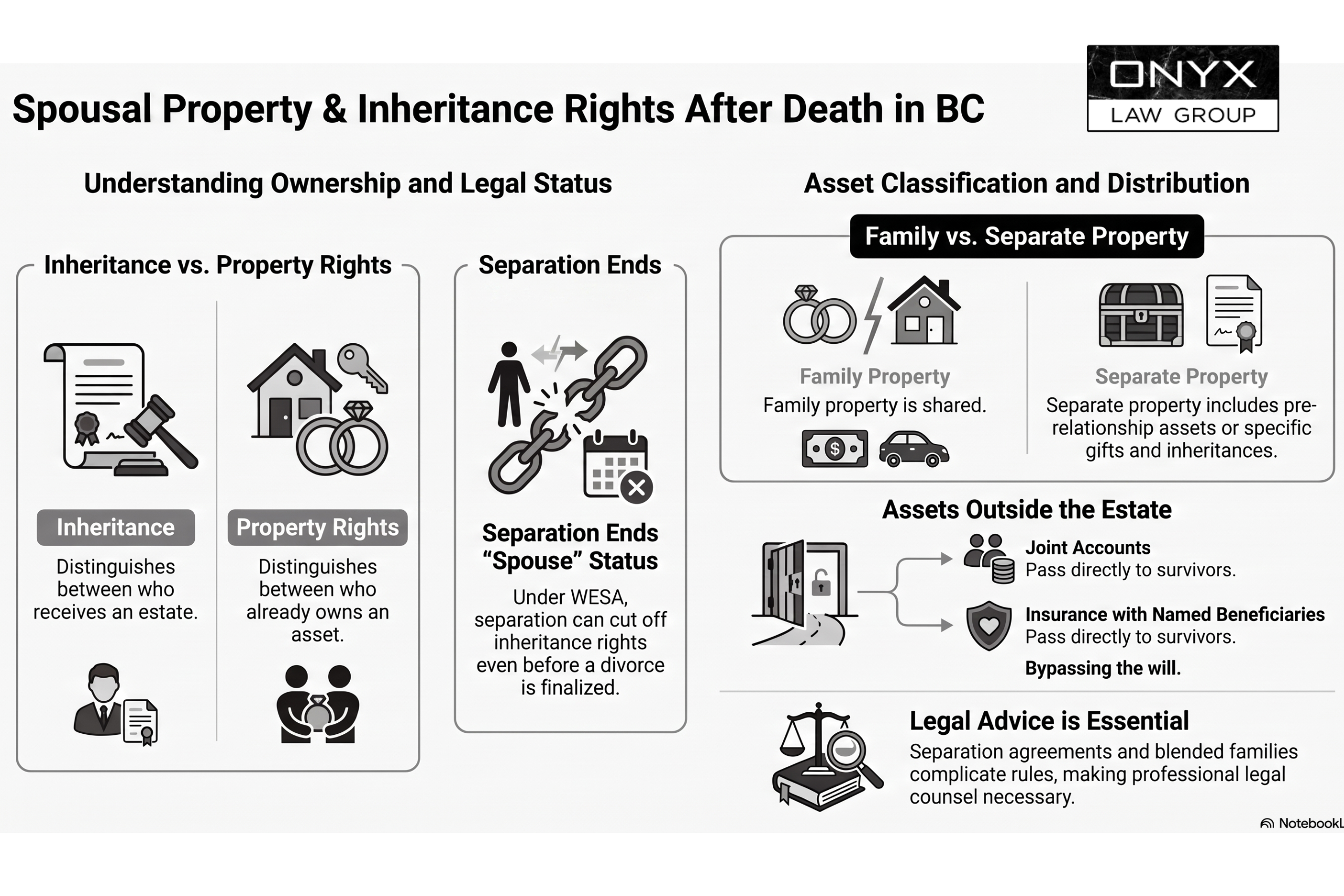
Inheritance rights and property rights are related but distinct. Inheritance decides who receives a deceased person’s estate; property rights decide who already owns an asset. Keeping the two straight prevents a lot of confusion when a spouse dies.
In British Columbia, matrimonial property generally refers to family property that spouses acquired during their relationship or shared while living together. Separate property usually includes assets one spouse owned before the relationship, as well as certain gifts and inheritances received during the relationship. Even though separate property belongs to one spouse, any increase in its value during the relationship may be treated differently under the law.
Some assets never touch the estate. A home held in joint tenancy, for instance, typically passes straight to the surviving joint owner by right of survivorship. The same goes for jointly held bank accounts and investments. Life insurance and registered accounts (RRSPs, RRIFs, TFSAs) with a named beneficiary are generally paid directly to that beneficiary, outside the will and outside the intestacy rules.
A spouse’s legal status at the date of death matters just as much. Separation and divorce can change the picture completely. Under WESA, two people stop being spouses once they separate, whether by ending a marriage-like relationship or by an event that triggers the division of family property in a marriage. That can cut off inheritance rights that would otherwise apply, and a divorce can also change how gifts to a former spouse in an existing will are read. Where a separation agreement or a blended family is in the mix, the details decide the result.
What Are a Common Law Partner’s Rights After Death in BC?
Things are more complicated for common-law partners. Under BC inheritance laws, a common-law spouse, someone in a marriage-like relationship for at least two years before the person’s death, has the same rights as a legally married spouse only if they qualify under WESA.
Meet the definition, and you inherit through intestate succession exactly as a married spouse would. Fall short of two years, or fail to show the relationship was genuinely marriage-like, and you may take nothing unless the will names you.
Living under the same roof is not, by itself, enough. Courts look at the substance of the relationship: how the couple organized their finances, whether they depended on each other, how they presented themselves to family and friends, and the degree of emotional and personal commitment. It is a fact-heavy assessment, and cohabitation alone rarely settles it.
What Is the Role of Probate in BC Inheritance Law?
Probate is the legal process that confirms a will is valid and gives the personal representative authority to manage the estate. In BC, not all estates require probate, but when they do, probate fees can reduce the value of the estate left for beneficiaries.
Probate can take several months or even longer, depending on the complexity of the estate, whether there’s a valid will, and whether any family members contest the distribution. Planning ahead through a valid will and a clear estate plan can significantly streamline this process and avoid disputes.
What Is the Time Needed to Qualify as a Spouse Under BC Estate Law?
To qualify as a common-law spouse for intestacy purposes under WESA, you generally need to have been in a marriage-like relationship for at least two years running immediately before the death.
Courts apply this two-year rule strictly. In the case of L.E. v. D.J., 2011 BCSC 671, the surviving partner had lived with the deceased for one year and 355 days, just ten days shy of the two-year mark. That wasn’t enough. The court denied her claim to the estate because the timeline under WESA is non-negotiable. No matter how long the couple was emotionally involved or how committed they felt, the law didn’t allow for any flexibility.
The Example of L.E. v. D.J.
The case of L.E. v. D.J. shows that simply being in a long-term relationship does not automatically make someone a spouse under BC law. Instead, the court looks at the overall relationship to decide whether it was truly “marriage-like” and when that relationship actually began. This determination can affect both entitlement to spousal support and inheritance rights, as each depends on meeting the legal definition of a spouse.
In this case, L.E. and B.F. had been together for several years, but the court found they were not in a committed, marriage-like relationship from the start. They kept their finances separate, were not exclusive, and B.F. did not publicly acknowledge L.E. as his partner. The court decided their relationship only became marriage-like after B.F. sent an email expressing his commitment to building a future together.
Although they remained in a marriage-like relationship until B.F.’s death, they fell just 10 days short of the two-year requirement under BC law. As a result, L.E. was not legally recognized as a spouse for estate purposes and could not make a claim against the estate. The decision highlights how strictly BC courts apply the legal definition of a spouse, even when the shortfall is only a matter of days.
How to Ensure Your Spouse Inherits as You Wish in BC
If you want your spouse to inherit t he way you intend, start with a valid BC will. A clear, current will cuts down on confusion, heads off family disputes, and puts your wishes on the record in a form the law will follow. Revisit it after the big events, too: marriage, separation, a new child, a major change in assets.
A will is only one part of a solid estate plan. Depending on your situation, trusts, beneficiary designations on life insurance and registered accounts, and joint ownership with a right of survivorship can move specific assets to your spouse directly, outside the estate. Each of those tools carries its own legal and tax consequences, so it is worth understanding how they fit together before you rearrange anything.
An experienced estate planning lawyer can help you create a plan that reflects your goals and complies with British Columbia law. That matters most when the picture is complicated: a blended family, children from an earlier relationship, a common-law partner. In those situations, a bit of deliberate planning now saves your family a great deal of difficulty later.
Need an Experienced Estate Lawyer in BC?
In summary, in BC, a spouse is entitled to the first $300,000 of the estate and half of the remaining estate if the deceased person was married at the time of death and did not have a will. But if the deceased person had children from a previous relationship and they did not have a will, the children will inherit a portion of the estate, and the spouse may not automatically inherit everything. Common-law partners have no inheritance rights under the laws of intestacy.
Furthermore, the intestacy rules apply to people who are married and also to those in common-law relationships. This is provided that the parties lived together in a marriage-like relationship for a period of at least two years immediately before the death of the other person.
Think your spouse automatically inherits everything in BC? Not always. Under WESA, an estate can be split between a surviving spouse and children, and even a will can be challenged. Onyx Law Group in BC has handled BC estate disputes since 2012, led by estate litigator Candace Cho, KC, with landmark results like Grewal v. Litt behind us. Book your free 30-minute consultation today.
Frequently Asked Questions
If you are wondering what happens to a person’s estate after they die, you are not alone. These questions cover how inheritance works for spouses in British Columbia and what the law actually says.
When a Husband Dies, What Is the Wife Entitled to in BC?
It depends on whether there is a legally valid will and the family’s circumstances. A surviving wife may inherit under the will or, if the deceased was dying intestate, under BC’s intestate laws, which may also protect financially dependent family members.
Does Inheritance Automatically Go to a Spouse?
Not always. Whether an estate passes to both a spouse and surviving children depends on the will or, if there is no will, the applicable intestate laws.
When a Husband Dies, What Does the Wife Inherit?
A wife may inherit the assets left to her in a legally valid will or receive a share of the estate under BC’s provincial laws. If there are surviving children, including legally adopted children, the estate may not always be divided equally.
Who Inherits When There Is No Will in BC?
When someone dies without a will, it is called dying intestate, and the estate is distributed under BC’s intestate laws. A surviving spouse or children, including legally adopted children, are generally first in line to inherit according to the legal requirements.
How Long Does an Executor Have to Settle an Estate in BC?
The person appointed as executor has a legal obligation to administer the estate and complete the probate process. While many estates are settled within about a year, complex inheritance matters involving capital gains or the Supreme Court can take longer.
Disclaimer: The information on this page is general legal information about British Columbia law, not legal advice for any specific situation. Reading this page does not create a solicitor-client relationship. BC law changes, and the procedure that applies to a specific situation depends on facts not covered here. For advice on your situation, consult a qualified British Columbia estate lawyer directly. Past results, illustrative scenarios, and reference to typical fact patterns do not guarantee similar outcomes in any specific case.