


Yes, child support in Canada is primarily based on the paying parent’s income. Courts use federal guidelines to determine how much should be paid, taking into account income, number of children, and custody arrangements. This approach helps ensure support payments are fair and reflect the parent’s ability to contribute to the child’s needs.
At Onyx Law Group, our experienced family lawyers help parents navigate child support calculations with clarity and confidence. We understand how income, custody arrangements, and special circumstances affect support obligations. Our team provides personalized guidance to ensure your child receives fair and accurate support. Contact us today to schedule a consultation and get expert advice tailored to your family’s situation.
In this blog, we explain how child support in Canada is calculated, focusing on the role of income, the guidelines courts follow, and what factors can affect the final amount.
How Does Child Support Work?
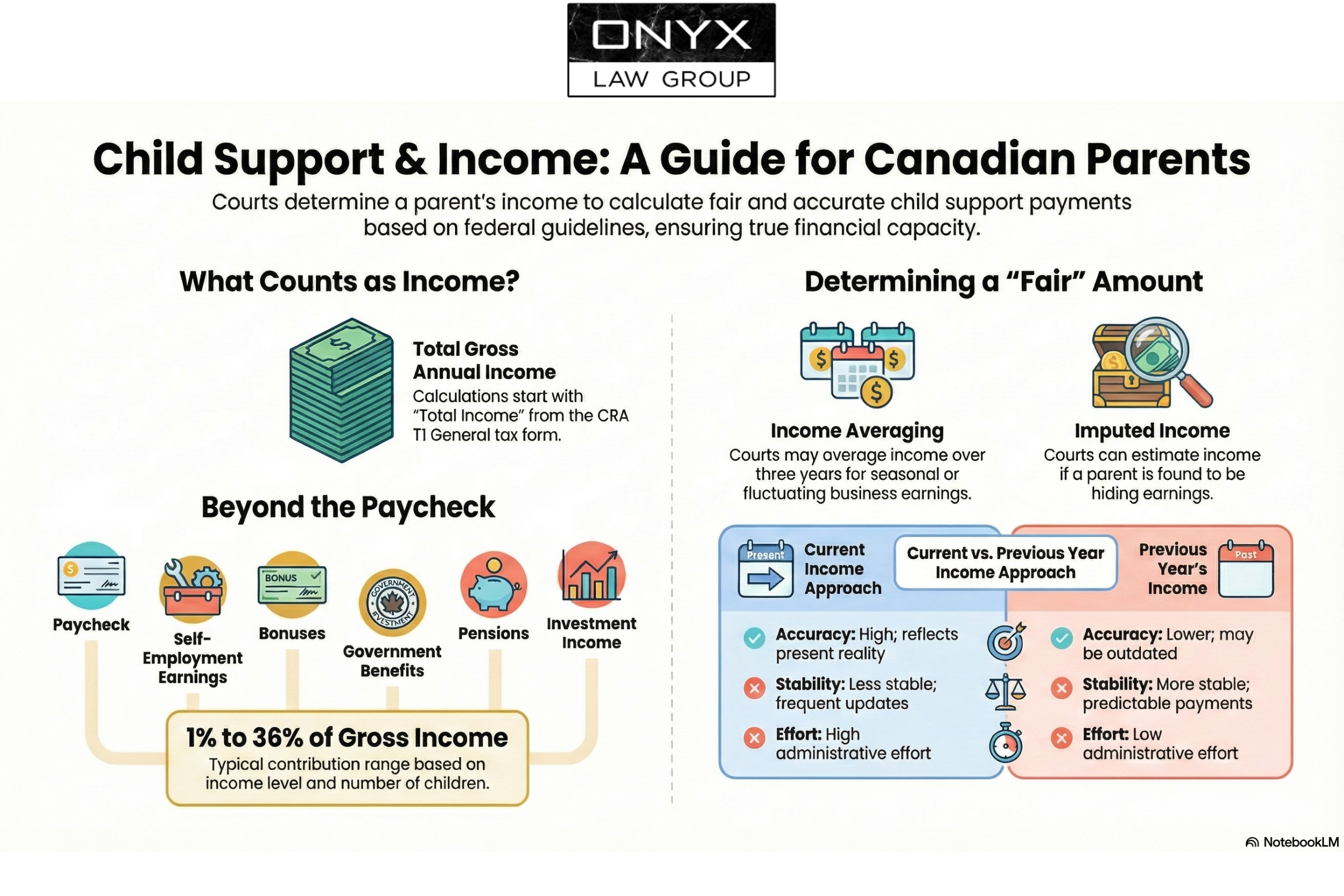
Child support works by looking at a parent’s income and deciding what amount of child support is fair for the child. Occasionally, that income is not steady. In those cases, the court takes a closer look at the full financial picture, including income information and the person’s income, instead of relying on a single year.
In Canada, child support amounts are directly linked to a parent’s income. According to the Government of Canada, paying parents typically contribute between 1 % and 36 % of their gross annual income toward child support, depending on the number of children they support. Higher-income earners can allocate up to 48% of their net income (after taxes) to ensure fair meeting of the child’s needs.
When income goes up and down regularly, averaging may be used. This is common for people with seasonal work or business owners with fluctuating business income. Looking at earnings over a few years helps create a more balanced and fair table amount.
However, averaging is not always the right choice. If a sudden drop or increase in income comes from a one-time event, it may be excluded. Child support is ultimately determined by what accurately represents the parent’s actual financial capacity and financial ability, based on reliable income information.
How Is Child Support Income Calculated in Canada?

Child support income in Canada is calculated using clear guidelines designed to keep things fair and consistent. Courts usually start with a parent’s gross annual income, often taken from tax returns or financial statements. The goal is simple: figure out how much a parent can reasonably contribute to their child’s needs.
Legally, income goes beyond just a paycheck. It can include employment earnings, self-employment income, bonuses, government benefits, and investment income. Courts may adjust the reported amount if it doesn’t reflect the parent’s true financial situation, especially in cases involving cash income, business deductions, or extraordinary expenses. Both the person paying child support and the other parent are considered when determining or calculating basic child support amounts.
In most cases, courts look at recent income, such as the previous year’s earnings, to guide their decision. However, they may also consider current income or annual gross income if there has been a significant change. To fairly set basic child support, the focus is always on getting an accurate and fair picture of what the person paying child support makes, including any unusual or extra costs.
Types of Income Considered for Child Support
When calculating child support, courts look at all sources of a parent’s income to ensure a fair and accurate assessment. This includes wages, business earnings, benefits, and investments.
Each type of income must be verified with proper documentation, such as income tax returns, pay stubs, or financial statements, to give the court a clear picture of what is available to support the child. When determining the child support amount, courts may also consider special or extraordinary expenses along with the person paying child support.
Employment Income
Employment income includes salaries, hourly wages, bonuses, and commissions from a job. Courts usually verify this income through recent pay stubs, T4 slips, or employer statements and may also review financial information or income tax returns. Accurate reporting of employment income ensures that the child support calculated reflects the person paying child support’s true earning capacity.
Self-Employment Income
Income from self-employment comes from running a business, freelancing, or contracting work. We frequently remind our clients, “Self-employed parents can confidently navigate child support calculations, provided they submit the appropriate documentation.” Parents must provide income tax returns, financial statements, or business records to show earnings. Courts examine these documents carefully, considering any special or extraordinary expenses, to ensure basic child support calculations are fair.
Government Benefits and Pensions
Certain government benefits, like employment insurance, disability payments, or pensions, can count as income. Parents are asked to provide official statements or notices of payment to verify these amounts. Including benefits and pensions helps create a complete picture of the parents’ ability to contribute to child support, including any paying support, the payer’s income, child care, school supplies, or private school costs.
Investment Income
Investment income includes interest, dividends, rental income, or capital gains from assets. Parents must provide bank statements, investment summaries, or tax records to prove these earnings. Courts use this information to ensure child support reflects all sources of financial resources available to the parent, including any special expenses, extraordinary expenses, or support issues that may affect the child support order.
Factors Affecting Child Support Amounts Beyond Income

While income is a key factor in calculating child support, it’s not the only one. Courts also consider how many children the support is for, since more children usually mean higher support obligations. The court also looks at parenting time, like who the kids live with and how much time they spend with each parent. In some cases, the final support amounts may be affected by a separation agreement or spousal support obligations.
“Child support isn’t just a number on a page. It’s about making sure your child’s needs are met fairly, no matter how your income changes.” — Mason Heller, Onyx Law Group Family Lawyer.
Children with special needs can require extra support. Expenses for medical care, therapy, or education may be added to the regular child support to ensure their needs are met. These adjustments help make sure the child’s well-being is properly supported, regardless of basic income calculations.
Shared custody arrangements can also affect support amounts. If children spend significant time with both parents, the court may reduce the amount one parent pays to reflect shared financial responsibility. This ensures that both parents contribute fairly based on time and resources, and may consider the payer parent or any basic amount adjustments.
Ultimately, income is just one part of a broader assessment. Courts look at the full picture to set an amount that is fair, reasonable, and tailored to the family’s situation. This includes children’s needs, living arrangements, and any separate situations involving parents or milestones reached by children that may affect support.
How Does Child Support Work If Income Is “Regular”?
Section 15 of the Guidelines stipulates that a parent’s annual income is to be determined in accordance with ss. 16-20. Accordingly, the starting point in the determination of income is s. 16, which reads as follows:
Subject to sections 17 to 20, a spouse’s annual income is determined using the sources of income set out under the heading “Total income” in the T1 General form issued by the Canada Revenue Agency and is adjusted in accordance with Schedule III.
How Does Child Support Work If Income Fluctuates?
In the event that annual income under Section 16 does not represent the “fairest” determination of income, the guidelines provide the court with the discretion to adjust income based on the preceding three years. Section 17(1) reads as follows:
If the court believes that determining a spouse’s annual income under section 16 would not be the fairest approach, it may consider the spouse’s income over the last three years and establish an amount that is fair and reasonable, taking into account any income patterns, fluctuations, or non-recurring amounts received during those years.
The test in s. 17(1) is what is considered “fair and reasonable,” taking into account the payer’s income over the preceding three years: Harras at para. 22.
When Is Income Averaging Appropriate?
Income averaging is not automatic. Courts can look at earnings from the past three years, but they don’t have to average them. The goal is fairness, not a rigid formula. Judges focus on what amount best reflects the income actually available to pay child support and may refer to simplified child support tables, consider the person paying support, or review any child support agreement in place.
Averaging is often used when income goes up and down. This is common with self-employed individuals or seasonal workers. If the parent has not shown a lasting drop in income, averaging can give a more balanced picture. It helps smooth out highs and lows over time and may consider child support tables, undue hardship, or imputed income in certain situations.
That said, averaging is not always the right choice. If a spike in income came from a one-time event, it’s unfair to include it. On the other hand, if fluctuations are expected, averaging makes more sense. Overall, it comes down to what fairly reflects the parent’s real earning capacity, taking into account any Canada Revenue Agency notices, lower support considerations, or tax rates that may apply.
Current Income vs Previous Year’s Income: Key Trade-Offs
Choosing how child support is calculated can make a big difference for both parents and the child. Some methods focus on what a parent earns right now, while others rely on past income. Each approach comes with its own benefits and challenges. Here’s a side-by-side look to help you understand the trade-offs.
| Factor | Current Income Approach | Previous Year’s Income Approach |
|---|---|---|
| How It Works | Uses the most recent income like salary, wages, or other earnings | Uses income earned in the previous year to calculate support |
| Accuracy | High. Reflects the parent’s current financial situation | Lower. May not match the present financial reality |
| Flexibility | Very flexible. Adjusts to income increases or decreases | Less flexible. Based on past data, not current changes |
| Stability | Less stable due to job changes or income fluctuations | More stable. Relies on fixed past income data |
| Handling Income Changes | Easily accounts for raises, job loss, or new income sources | Does not reflect recent financial changes |
| Planning & Predictability | Harder to plan due to frequent adjustments | Easier to plan with predictable payment expectations |
| Administrative Effort | High. Requires frequent updates and recalculations | Low. Fewer updates are needed once set |
| Risk of Inaccuracy | Can be unclear if income fluctuates often (e.g., seasonal work) | Can be outdated and misaligned with current finances |
| Impact on Child’s Needs | Better aligned with current needs and realities | May not fully meet current needs if income has changed |
| Unexpected Situations | Can adjust to sudden life changes like job loss | Does not account for unexpected events |
Legal Resources and Guidance on Child Support in British Columbia

The Federal Child Support Guidelines are applied directly, meaning the same federal tables and rules determine child support amounts. Provincial authorities handle some procedural matters, but the calculation method remains unchanged. This ensures consistency across Canada while still considering the unique circumstances of families in BC.
Legal advice is often necessary when situations are complex. For example, disputes over income, shared custody, or a child’s special needs can complicate calculations. A family lawyer can help protect your rights and ensure the child receives fair support.
Child support laws can differ across Canada, but in BC, courts follow both federal guidelines and provincial rules. This ensures that support is calculated fairly and takes into account the unique circumstances of families in the province. Accessing local resources and legal guidance makes navigating these rules much clearer and less stressful.
Facing Issues Related to Child Support in BC?
Courts use federal guidelines to calculate the amount, considering factors like gross income, employment type, self-employment earnings, and government benefits. The number of children, parenting arrangements, and any special needs can also affect the final amount. In some cases, courts may look at current income or the previous year’s income, depending on which provides a fair picture of what the parent can reasonably pay.
It’s important to remember that every family’s situation is unique. When incomes fluctuate or when special circumstances arise, child support calculations can become complicated. Consulting a family lawyer can help ensure the amount is fair and reflects your real financial situation. Getting professional guidance also makes the process smoother and less stressful for both parents and children.
Wondering if your child support payments are calculated fairly? At Onyx Law Group, our family lawyers guide parents through every step of determining child support based on income and other key factors. Our family lawyers in BC help you understand your rights, account for special circumstances, and ensure your child’s needs are met. Reach out today for a consultation and get personalized legal advice you can trust.
Frequently Asked Questions
Here are some frequently asked questions about whether child support is based on income. These answers will help you understand how child support is calculated and what factors are considered.
Is Child Support in Canada Based on Gross or Net Income?
In Canada, child support is based on the annual gross income of the paying parent. The number of children the paying parent has to support is also a factor to consider.
Do You Have to Pay Child Support if You’re Unemployed in Canada?
Yes, you still have to pay child support. If you lose your job or earn less, your payments will also decrease. Child support is calculated based on how much you earn and the number of children you’re supporting.
What Happens if a Father Doesn’t Pay Child Support in Canada?
There will be a fine against you if you do not pay child support in Canada. You even run the risk of going to jail in some cases.
How Is Income Defined for Child Support Purposes in BC?
Income includes all money a parent earns, like wages, bonuses, business earnings, and government benefits. Courts look at this total to determine how much a parent can fairly contribute.
Can Child Support Amounts Change if My Income Changes?
Yes, child support can be adjusted if your income goes up or down significantly. Courts review your earnings to make sure the support amount stays fair.
What Happens if a Parent Hides Income?
If a parent hides income, the court can impute it, which means they estimate what the parent should be earning. This ensures the child still receives the support they need.
Are Government Benefits Included in Child Support Calculations?
Yes, certain government benefits, like employment insurance or disability payments, are counted as income. They help courts get a complete picture of the parents’ ability to pay.
How Do Courts Handle Self-Employed Income for Child Support?
Courts carefully examine tax returns, financial statements, and business records for self-employed parents. They account for business expenses to determine the true income available for support.
Disclaimer: The information provided on this blog is for general informational purposes only and does not constitute legal advice. Reading this content does not create an attorney-client relationship. Laws and regulations vary by jurisdiction and may change over time, so you should consult a qualified family lawyer for advice regarding your specific situation. Past examples, case studies, or hypothetical scenarios are illustrative only and do not guarantee similar results.