


If a beneficiary does not claim an inheritance in British Columbia, what happens to the assets depends on why they remain unclaimed. The outcome can differ if the beneficiary cannot be located, dies before the will-maker, or refuses or fails to accept the inheritance. Legal advice can help determine what happens to the unclaimed estate and protect the beneficiary’s rights.
At Onyx Law Group, our expert estate law lawyers and inheritance lawyers with over 20 years of experience have the knowledge necessary to assist you. Candace Cho, KC, leads our estate litigation team, was called to the British Columbia bar in 2009, and has co-chaired the Trial Lawyers Association of BC’s Estate Litigation Essentials course four times since 2020. Whether you need help claiming your inheritance, or you want guidance preparing a will that decreases the likelihood of unclaimed accounts by your beneficiaries after your passing, we welcome you to reach out to us today to find out more.
This blog will discuss unclaimed inheritances and what happens when an inheritance goes unclaimed.
What Happens if a Beneficiary Does Not Claim Their Inheritance?

Unclaimed money can remain outstanding for years. The Bank of Canada reported $1.60 billion in unclaimed bank balances covering 3.6 million accounts as of December 31, 2025. In 2025, about $20 million was returned through 1,937 claims.
What happens if a beneficiary doesn’t claim an inheritance depends on several factors. “An unclaimed inheritance does not necessarily mean a beneficiary has lost their right to the money or property,” says Sandy Abley, an estate and trust lawyer at Onyx Law Group.
First off, an executor has legal duties that include notifying beneficiaries of their entitlement under an estate. BC law requires the executor to make reasonable efforts to locate each named beneficiary. A proper search takes time, and there will be costs associated with it (for instance, it may be necessary for the executor to take steps such as arranging a trace to locate the beneficiary or posting ads in the newspaper and online).
If the executor is unable to locate a beneficiary, BC law allows the executor to discharge their duties by obtaining a court order permitting the missing beneficiary’s share to be paid into court. If the funds remain in court after five years, the funds are considered unclaimed property. When funds become unclaimed property, the court transfers the money to BC Unclaimed, which is our province’s unclaimed property administrator.
If the inheritance in question is a specific gift of property and the executor can’t locate the beneficiary within 12 months of the grant of probate from the BC probate court, the executor can sell the property, deduct costs related to storage, transportation, and sale of the property, and hold the net proceeds in trust (see s. 147 of the Wills, Estates and Succession Law Act).
If, on the other hand, the beneficiary has been located but refuses or neglects to collect the property within 180 days of receiving notice, the executor can sell the property, deduct costs related to storage, transportation, and sale of the property, and send the net proceeds to the beneficiary (or hold the net proceeds in trust if the beneficiary refuses to accept the funds).
The executor also has the option of transferring net proceeds to the Public Guardian and Trustee of British Columbia to hold in trust for the beneficiary. Alternatively, the executor may make an application to pay the net proceeds into court after deducting the costs of doing so.
Other Potential Outcomes of a Beneficiary Not Claiming Inheritance
There are other possible outcomes, depending on the circumstances. For example, if it turns out that a primary beneficiary predeceased the will-maker, the unclaimed inheritance may go to an alternate beneficiary if one was named in the will. If the will doesn’t name alternate beneficiaries, what the deceased beneficiary was meant to inherit must be distributed to heirs in accordance with BC inheritance laws. The same process applies if a beneficiary is located but refuses to accept the inheritance.
In such cases, it may be necessary for the executor to apply for a court order seeking directions on how to handle an unclaimed inheritance or missing beneficiary.
What Does It Mean to Not Claim an Inheritance?

When a person passes away, everything they owned is referred to as their estate. Ideally, that person will have prepared a valid will during their lifetime that provides instructions for what they want to happen to their estate. After the will-maker’s death, the estate assets are transferred to the named beneficiary or beneficiaries in accordance with the terms of their will.
An unclaimed inheritance refers to unclaimed assets or unclaimed property left behind by a deceased individual that is not transferred to the named beneficiaries. It may include specific assets such as a bank account, stocks, investments, or real estate, for example, or it may be the “residue” of the estate that goes unclaimed (what is left after the outstanding debts of the estate have been paid out).
Uncollected Inheritance vs. Unclaimed Inheritance
There is a difference between an inheritance that is uncollected because the beneficiary is unaware and an inheritance that a beneficiary is refusing. In the case of uncollected inheritance, the beneficiary fails to claim the inheritance because they aren’t aware or can’t be found.
For unclaimed inheritance, the beneficiary is notified but disclaims the inheritance (i.e. formally refuses to accept it). To disclaim an inheritance, the beneficiary should submit a written legal document to the estate executor in a timely fashion, and the beneficiary must not have received part of the inheritance or some benefit from it—disclaiming is all or nothing.
A beneficiary who refuses the gift, money, or property does not get to decide who receives it. The inheritance instead will pass to the next beneficiary named in the will. If there is no secondary or residuary beneficiary, BC’s intestacy rules may determine whether it passes to distant relatives. If there is no applicable beneficiary, BC’s intestacy rules may determine whether the property passes to more distant relatives. If there is no secondary beneficiary or residuary beneficiary, the disclaimed inheritance must be distributed to certain family members in accordance with the rules of intestacy (the surviving spouse has special inheritance rights, the children of the deceased person are the next priority, followed by other heirs).
How to Handle an Unclaimed Inheritance in BC
When an inheritance goes unclaimed, knowing what to do next can make the process much easier. These steps can help you determine where the inheritance is, why it remains unclaimed, and how to recover it.
1. Confirm Your Right to the Inheritance
Start by confirming that you are named as a beneficiary in the will or otherwise entitled to the estate. Gather the will, death certificate, detailed records, and any other documents that support your claim.
2. Find the Executor or Estate Representative
Contact the executor to find out whether the estate has been administered and what happened to your share. Ask whether the funds were paid into court, held in trust, or transferred to another organization.
3. Search for Unclaimed Property
Search BC Unclaimed and other relevant databases for money held in your name. If the estate involved federally regulated bank accounts, you may also need to search the Bank of Canada’s unclaimed balances database.
4. Gather Supporting Documents
You may need identification and documents proving your connection to the deceased or your entitlement to the estate. Having these documents ready can help avoid unnecessary delays.
5. Check for Applicable Time Limits
Do not assume you can wait indefinitely to claim an inheritance. The applicable deadline can depend on where the property is held and how the inheritance was handled.
6. Get Legal Advice if the Claim Is Complicated
Consider speaking with an estate lawyer if the beneficiary cannot be located, the executor refuses to cooperate, or the funds have been paid into court. Legal representation may be especially helpful when a court application is required. Legal advice can help you understand your options and avoid missing an important deadline.
What Are the Different Types of Beneficiaries That Can Receive Inheritance?
A primary beneficiary is the will-maker’s first choice and has the first claim to the property or assets in question. A contingent beneficiary is the next in line; also known as a secondary beneficiary, they only receive an inheritance if the primary beneficiary dies before inheriting, disclaims the inheritance, or can’t be found.
Another type of beneficiary is a residuary beneficiary. This is a person who receives what is not specifically left to a primary or secondary beneficiary of a will or trust. For example, the will may provide for a charitable donation of $10,000, with the “residue” of the estate going to the residuary beneficiary.
A residuary beneficiary may also receive assets after they’ve already been given to the primary beneficiary. For instance, property can be held in a trust or a life estate in favor of a primary beneficiary; once the trust is fulfilled, or the primary beneficiary dies, what is left over goes to the residuary beneficiary.
Common Reasons Beneficiaries Don’t Claim Their Inheritance
There are several reasons why a beneficiary may not claim an inheritance. Occasionally, they may not even know they are entitled to one. This can happen if the executor has not been able to locate them, has not communicated with beneficiaries, or has overlooked an estate asset such as a bank account.
A beneficiary may also be difficult to reach. They may have moved, changed their contact information, or passed away. Immediate family members may sometimes have information that helps the executor locate them. In other cases, the beneficiary knows about the inheritance but chooses not to accept it. Family conflict, estrangement, or circumstances involving a previous relationship can sometimes play a role in that decision.
Financial concerns can also make an inheritance less appealing. Canada does not have an inheritance tax, but inherited assets can still create financial obligations. For example, a property may have a mortgage, debts, or other tax consequences that the beneficiary does not want to take on. TJ Garcha, an estates and trust litigation lawyer at Onyx Law Group, often advises clients, “Keeping your contact information current can make it much easier for an executor to locate you after a loved one passes away.”
Finally, some estates are simply complicated. Real estate, business interests, or assets involved in a legal dispute can take time and effort to deal with. In these situations, a beneficiary may decide that accepting the inheritance is not worth the trouble.
Is There a Time Limit on Claiming an Inheritance?

The time limit will depend on several factors, including the type of property, where the property is located, whether the beneficiary is unaware or refusing, and whether the deceased person died without a valid will, leaving an intestate estate.
If left for too long, an unclaimed inheritance may be turned over to the government or unclaimed property administrators. For example, federally regulated banks in Canada will consider the balance of a dormant bank account to be unclaimed funds after 10 years. They will transfer the unclaimed funds to the Bank of Canada. Unclaimed balances are held by the Bank of Canada for 30 years if the amount is less than $1,000 and for 100 years if the amount is $1,000 or over. At the end of the prescribed period, the balance is transferred to the Receiver General of Canada.
Can a Designated Beneficiary Claim Their Inheritance After It’s Unclaimed?
Unless a beneficiary formally disclaims the inheritance, that beneficiary’s entitlement to receive an unclaimed inheritance continues to exist even if the funds are put in trust, paid into court, or transferred to the Public Guardian and Trustee.
Once the unclaimed funds are paid into court or held in trust by the Public Guardian and Trustee of British Columbia, the beneficiary cannot receive the funds unless they apply to the court, allowing the funds to be released to them. This can be a lengthy and complicated process, and we strongly suggest retaining an estate lawyer when applying to obtain such funds. If the unclaimed inheritance is being held by the Bank of Canada and is under $5,000, the beneficiary can submit claim documentation on their website.
A beneficiary trying to locate unclaimed property in British Columbia specifically can use the British Columbia Unclaimed Property Society search engine. Once the claim is submitted, BC Unclaimed will reach out by email requesting further information, should the claim be valid.
The longer a beneficiary waits, the more difficult it can be to prove they are the rightful owner. There may also be limitation periods that apply to certain types of unclaimed property; if the limitation period is missed, the claim is lost. Time limits vary depending on factors such as where the unclaimed property is located.
The process and documentation required to retrieve unclaimed property are extensive and sometimes complicated. It’s highly recommended that you consult with an inheritance lawyer so you don’t miss any applicable time limit and to get help preparing your claim to retrieve your unclaimed inheritance.
What Happens to an Unclaimed Inheritance in BC?
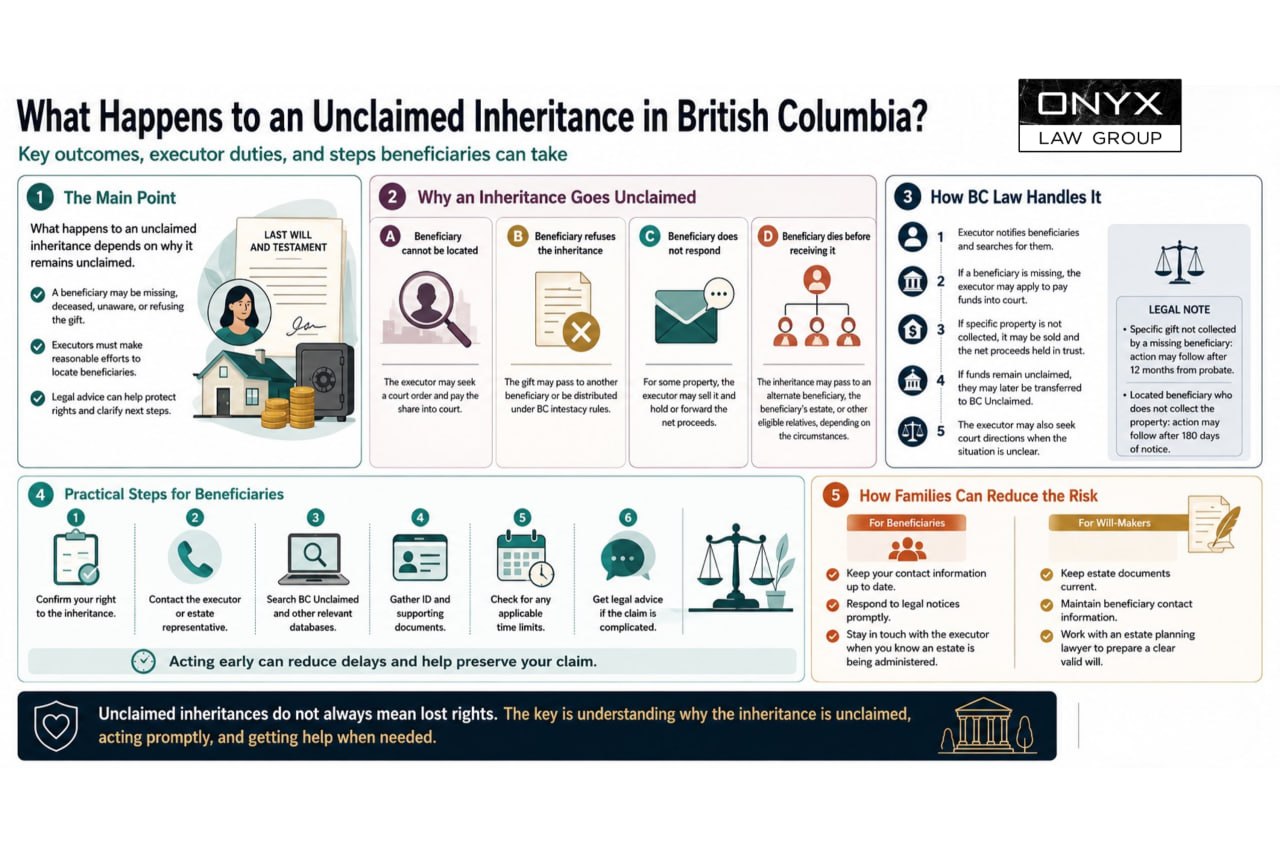
The outcome depends largely on why the inheritance remains unclaimed. The table below compares the most common situations and what may happen next.
| Situation | What May Happen | What the Beneficiary Should Do |
|---|---|---|
| Beneficiary cannot be located | The executor may pay the beneficiary’s share into court or take other steps allowed by BC law. | Contact the executor and search BC Unclaimed for funds held in your name. |
| Beneficiary refuses the inheritance | The gift may pass to another beneficiary or be distributed under BC’s intestacy rules. | Get legal advice before formally disclaiming an inheritance. |
| Beneficiary does not respond to notice | The executor may sell certain property and send or hold the proceeds for the beneficiary. | Respond to the executor as soon as possible and confirm how you want to receive the inheritance. |
| Beneficiary died before receiving the inheritance | The inheritance may pass to an alternate beneficiary, the deceased beneficiary’s estate, or other eligible relatives, depending on the circumstances. | Determine whether the will names an alternate beneficiary and whether the beneficiary’s estate has a claim. |
| Funds are paid into court | The beneficiary may need to apply to the court to have the funds released. | Obtain legal advice and determine what documents are required to make the application. |
| Funds become unclaimed property | The funds may eventually be transferred to BC Unclaimed or another applicable administrator. | Search the relevant unclaimed-property database and submit the required claim documents. |
How to Avoid Missing Out on Inheritance?

There are various ways to avoid missing out on an inheritance. If you are a beneficiary who wants to avoid missing out on an inheritance, you should keep your contact information updated and notify your financial institution, family members, or friends when you move or change your contact info. If a will-maker has told you about a potential inheritance, you should stay in communication with the executor and respond to all legal notifications. You may also want to search through BC Unclaimed or other sources (e.g. a U.S. state government site or national association if the property is in another jurisdiction).
If you are a will-maker, you can avoid unclaimed inheritances by working with an estate planning lawyer to ensure you have a valid will. It’s also important to maintain updated estate documents and beneficiary contact information. You can also communicate with your beneficiaries regarding their potential inheritance so they are aware and can reach out to the executor after your death.
Need an Inheritance Lawyer?
You should not hesitate to seek professional advice if you have concerns about an inheritance going unclaimed. For those who suspect they may have unclaimed money or inheritance, taking action with an inheritance lawyer is essential in protecting your rights and interests. A skilled lawyer can provide guidance and expertise in navigating the complexities of inheritance law and estate administration.
For those who want to get an estate plan in place to prevent the possibility of an unclaimed inheritance, reach out to estate and trust lawyers. A well-written will is the first step in making sure your assets are distributed according to your wishes. By clearly outlining your beneficiaries and specifying how assets should be divided, a will can provide legal clarity and minimize the risk of disputes and unclaimed assets.
What happens if you never claim an inheritance in British Columbia? At Onyx Law Group, our estate lawyers in BC have more than 20 years of experience helping clients navigate inheritance and estate disputes. Candace Cho, KC, leads our estate litigation team, was called to the BC bar in 2009, and has co-chaired the Trial Lawyers Association of BC’s Estate Litigation Essentials course four times since 2020. Whether you are trying to claim an inheritance or planning a will to help prevent assets from going unclaimed, contact us today to discuss your options.
Frequently Asked Questions
BC inheritance laws govern how an estate is administered, including how beneficiaries may inherit property and how estate distribution takes place. Understanding the probate process, legal requirements, and the wishes expressed in a valid will can help families navigate estate affairs and prevent disputes.
What Happens if a Beneficiary of a Will Does Not Respond?
If a beneficiary cannot be located after reasonable efforts, BC’s legal framework allows the personal representative to take specific steps regarding the gift after 12 months from the grant of probate or administration with will annexed. If a beneficiary has been located but does not arrange to receive a specific gift within 180 days after being notified, the personal representative may sell the property and send the proceeds to the beneficiary, subject to the requirements of the Wills, Estates and Succession Act.
Is There a Time Limit on Claiming Your Inheritance?
There is no single deadline for every inheritance claim, as the applicable legal process depends on the type of estate matter and the legal rights involved. Beneficiaries should seek legal advice about any applicable limitation periods, probate fees, estate debts, and legal requirements before attempting to transfer assets or claim a share of the remaining estate.
What Happens if a Beneficiary Dies Before They Receive Their Inheritance?
The outcome depends on the wording of the will, the type of gift, and whether the beneficiary survived the will-maker by the required period under BC law. If a gift cannot take effect, WESA may direct it to an alternative beneficiary, certain descendants, or surviving residuary beneficiaries, depending on the circumstances and any contrary wishes expressed in the will.
What Happens if a Beneficiary Does Not Want Their Inheritance?
A beneficiary who does not want to inherit property should seek legal advice before refusing or transferring the gift, particularly where the estate involves joint tenancy, significant estate funds, or other beneficiaries. A legal professional can explain the available options under provincial laws and help address issues involving the entire estate, estate debts, family maintenance claims, or concerns about undue influence and the will’s validity.
Disclaimer: The information on this page is general legal information about British Columbia law, not legal advice for any specific situation. Reading this page does not create a solicitor-client relationship. BC law changes, and the procedure that applies to a specific situation depends on facts not covered here. For advice on your situation, consult a qualified British Columbia estate lawyer directly. Past results, illustrative scenarios, and reference to typical fact patterns do not guarantee similar outcomes in any specific case.