


Quick answer: To file for divorce in BC, at least one spouse must have lived in the province for a full year, and you must show the marriage has broken down — usually by living separate and apart for one year. You start by filing a Notice of Family Claim (Form F3) in the Supreme Court of British Columbia. Divorce runs under the federal Divorce Act; property, support, and parenting are dealt with under BC’s Family Law Act. An uncontested divorce, where everything is agreed, can often be completed as a desk-order application without a court appearance.
To get a divorce in BC, you must meet the residency requirements, show that your marriage has broken down, and file the required court forms with the BC Supreme Court. The process usually involves starting with a Notice of Family Claim, addressing key issues like property, support, and parenting, and waiting for the court to issue a final divorce order. While it can feel overwhelming at first, understanding the basic steps makes the process much easier to navigate.
You don’t have to navigate the divorce process on your own. The Vancouver divorce lawyers at Onyx Law Group have the expertise to answer any questions you may have regarding divorce in BC. Contact us today for an initial consultation and let us handle the legal complexities, so you can move forward confidently towards a fresh start.
In this blog, we will walk you through the legal requirements, filing process, and key steps involved in getting a divorce in British Columbia from start to finish.
What Is Divorce in BC?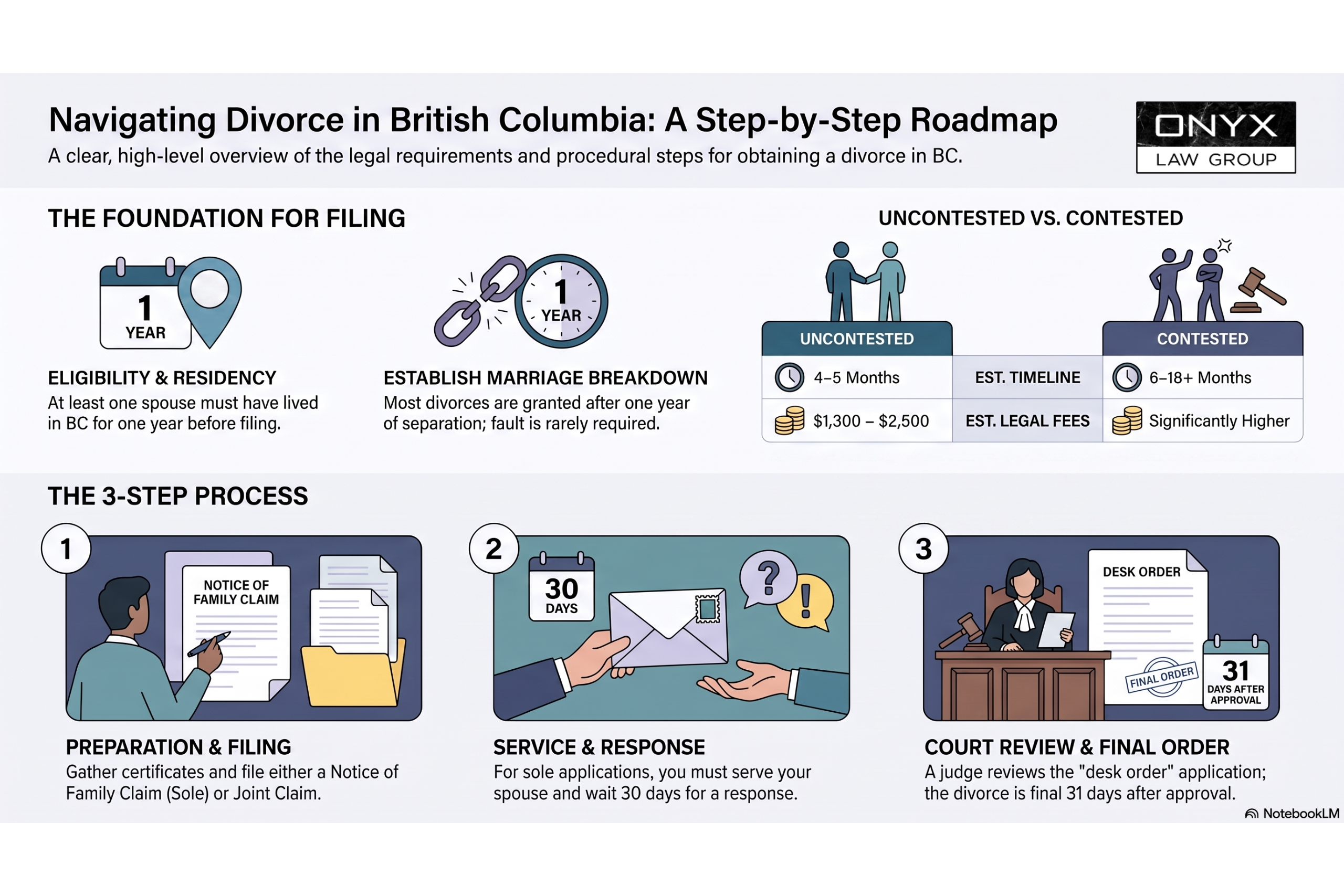
Divorce in British Columbia is the legal process used to formally end a marriage under Canada’s Divorce Act. In BC, divorce applications are handled by the BC Supreme Court, which reviews the case and issues a final divorce order once all legal requirements are met. This order is what officially dissolves the marriage in the Canadian province of British Columbia.
Before a divorce can be granted, spouses generally must show that the marriage has broken down. In most cases, this is proven through at least one year of separation, although adultery or cruelty can also be grounds for divorce. Separation simply means living apart with the intention that the relationship is over, and it often serves as the first step before filing for divorce.
To file for divorce in BC, at least one spouse must meet basic eligibility requirements. This includes being legally married and having lived in British Columbia for at least one year before starting the court application. The process begins by filing a Notice of Family Claim in the BC Supreme Court Registry. This residency requirement applies regardless of where in the country the marriage took place.
It is also important to understand that divorces can be either uncontested or contested. An uncontested divorce happens when both spouses agree on all key issues, such as property division and parenting arrangements, making the process more straightforward. A contested divorce arises when there are disagreements that require the court to intervene and make decisions.
Only legally married couples can get divorced. A divorce order is not needed to end a common-law relationship. Overall, understanding the difference between separation and divorce, along with the basic filing requirements and types of divorce, helps clarify what to expect when starting the divorce process in British Columbia. Similar family law principles apply across every Canadian province and territory, although procedures may vary.
Step-By-Step Guide: How to Divorce in BC

Most divorces in British Columbia are uncontested, meaning both spouses agree on the divorce and any related issues. In these cases, a judge can issue a divorce order without requiring either spouse to attend court. Whether you choose to handle the process yourself or work with a lawyer, understanding each step can help you avoid delays and move through the process more smoothly.
Step 1: Gather the Required Documents
Before filing for divorce in BC, gather all required documents, including your original marriage certificate or a certified copy of your marriage registration, any separation agreement, and any relevant family court orders. Documents relating to major assets, such as the family house, may also be useful depending on the issues involved. If your marriage certificate is not in English, a certified translation will be required. If you were married in British Columbia and do not have a copy of your certificate, you can request one from BC’s Vital Statistics Agency before beginning the application process.
Step 2: Decide Whether to Hire a Lawyer or Represent Yourself
You do not need a lawyer to get divorced in British Columbia, and many people successfully complete uncontested divorces on their own. However, legal advice can be helpful if your case involves children, support, property division, or procedural questions. Individuals with limited financial resources may also wish to explore legal aid options if they qualify. Working with an experienced divorce lawyer can help ensure your paperwork is completed correctly and reduce the risk of delays or complications.
Step 3: Choose the Correct Divorce Application
The type of application you file depends on your circumstances. If one spouse is applying independently, you will use a Notice of Family Claim (Form F3), which requires the documents to be served on the other spouse. If both spouses are applying together and agree on the divorce, you can file a Notice of Joint Family Claim (Form F1) as a joint application, which does not require either spouse to be served.
Step 4: Complete and File the Divorce Forms
After choosing the correct application, complete the required forms and file them with the BC Supreme Court Registry along with your supporting documents. British Columbia offers a free Online Divorce Assistant that helps eligible couples complete forms for a joint divorce by guiding them through a series of questions. Carefully review all documents before filing, as missing information or errors can result in delays or rejection by the court registry.
Step 5: Pay the Filing Fees and Serve Your Spouse
When filing your divorce application, you must pay the applicable court fees, which are generally between $290 and $330. If you filed a sole application, you must also arrange for your spouse to be personally served with the filed documents, often through a professional process server or another adult who is not involved in the case. If your spouse does not respond, the matter may proceed as an undefended divorce. Joint divorce applications do not require service because both spouses are already participating in the proceeding.
Step 6: Wait for Court Review and the Final Divorce Order
After a sole application is served, you must wait 30 days to allow your spouse an opportunity to respond. Once the waiting period has passed and all required documents have been filed, a BC Supreme Court judge will typically review the application without a court hearing through a desk order process. If everything is complete and meets court requirements, the judge will grant the divorce order. The divorce becomes final 31 days later, after which you can request a divorce certificate if you plan to remarry.
What Are the Common Grounds and Legal Considerations for Divorce in BC?
Before a BC court can grant a divorce, it must have jurisdiction over the case. Under section 3 of the Divorce Act, either you or your spouse must have lived in British Columbia for at least one year immediately before the divorce application is filed. As long as this residency requirement is met, the BC Supreme Court can hear the case and issue a divorce order.
In Canada, divorce is based on one legal ground: the breakdown of the marriage. In most cases, marriage breakdown is established by showing that spouses have lived separate and apart for at least one year with the intention of ending the relationship. This is by far the most common basis for divorce in British Columbia. Even if spouses continue living under the same roof for financial or family reasons, they may still be considered separated if they are living separate lives.
Many people assume they must prove that their spouse did something wrong to get divorced, but that is not how divorce law works in most cases. While adultery and mental or physical cruelty can also be used to establish marriage breakdown, these claims often require evidence and may lead to additional legal disputes. As a result, most couples choose to proceed based on one year of separation rather than attempting to prove fault in court.
Separation agreements can also play an important role in the divorce process. These agreements often address parenting arrangements, child support, spousal support, and property division before a divorce application is filed. Although a separation agreement does not legally end a marriage, it can make the divorce process smoother by resolving many of the issues that would otherwise need to be addressed through the courts.
Some divorces involve unique legal considerations. For example, if one spouse lives outside Canada, additional rules may apply regarding jurisdiction, service of documents, and the recognition of foreign divorce orders. Similarly, divorces involving a spouse with Alzheimer’s disease or another condition affecting mental capacity can require special legal steps to ensure that the person’s rights and interests are protected throughout the proceedings. In these situations, obtaining legal advice is often helpful to avoid procedural issues and delays.
How to Divorce in BC Without a Lawyer

It is possible to get divorced in British Columbia without hiring a lawyer, especially if your divorce is uncontested. An uncontested divorce means you and your spouse agree on important issues such as parenting arrangements, child support, spousal support, and property division. Because there are no major disputes to resolve, the process is usually faster, less stressful, and less expensive than a contested divorce.
If you choose to represent yourself, you will need to complete the required court forms and file them with the BC Supreme Court. Depending on your situation, this may include a Notice of Family Claim (Form F3) or a Notice of Joint Family Claim (Form F1), along with supporting documents such as your Marriage Certificate and any separation agreement. If you file a sole application, you must also arrange for your spouse to be properly served with the court documents.
Many self-represented applicants run into problems because forms are incomplete, information is missing, or court procedures are not followed correctly. Even small errors can lead to delays and rejected applications. Before filing, carefully review every document, ensure all required attachments are included, and confirm that the information provided is accurate and consistent throughout the application.
British Columbia offers several resources for people handling their own divorce. The province’s free Online Divorce Assistant can help eligible couples prepare forms for a joint divorce, while court registries and self-help legal resources provide information about filing requirements and procedures. These tools can make the process more manageable, but if questions arise about your rights or obligations, consulting a family lawyer can still be a worthwhile investment.
Comparison of Key Divorce Options and Processes in BC
Before deciding how to move forward with your divorce, it helps to see how each option differs in practice. The table below lays out the key trade-offs side by side so you can quickly compare what works best for your situation.
| Comparison | Option 1 | Option 2 |
|---|---|---|
| Contested vs. Uncontested Divorce | Contested Divorce: Spouses disagree on one or more issues such as parenting, support, or property division. Usually takes longer and may require court hearings or a trial. | Uncontested Divorce: Spouses agree on all major issues. Generally faster, less expensive, and often completed without attending court. |
| Hiring a Lawyer vs. Self-Representation | Hiring a Lawyer: Professional guidance throughout the process. Can help avoid mistakes, protect your rights, and handle complex legal issues. | Self-Representation: Lower legal costs and greater control over the process. Best suited for straightforward, uncontested divorces where both spouses agree. |
| Online Filing vs. In-Person Filing | Online Filing: Convenient and can save time. Tools such as BC’s Online Divorce Assistant help eligible applicants prepare and submit forms electronically. | In-Person Filing: Documents are submitted directly to a BC Supreme Court Registry. May be preferred by those who want assistance with filing procedures or cannot file online. |
Do You Need a Separation Agreement Before Divorce in BC?

No, you do not need a separation agreement to get divorced in British Columbia. However, before granting a divorce order, the BC Supreme Court will want to see that important family law issues have been addressed. This is especially true when dependent children are involved, as the court must be satisfied that appropriate arrangements have been made for their care and financial support. If a judge is not satisfied that reasonable arrangements are in place for the children, the divorce may be delayed.
While not required, a separation agreement can make the divorce process much easier. A signed separation agreement can demonstrate to the court that you and your spouse have resolved matters such as parenting responsibilities, child support, spousal support, and property division.
In many cases, having a separation agreement allows couples to proceed through the uncontested divorce process, which is generally faster, less stressful, and less expensive than a contested divorce. An experienced family lawyer at Onyx Law Group can help you prepare a fair and enforceable separation agreement that protects your interests and supports a smoother path to divorce.
How Long Does It Take to Get a Divorce in BC?
The amount of time it takes to get a divorce in British Columbia depends largely on whether your divorce is uncontested or contested. Cases where spouses agree on the major issues generally move much faster than cases involving disagreements about children, support, or property division.
An uncontested divorce is usually the quickest option. This process is available when both spouses have resolved all family law issues and have a signed separation agreement or existing court orders dealing with those issues. If you have children, the court must also be satisfied that appropriate arrangements for their care and financial support have been made before granting the divorce.
In many cases, an uncontested divorce takes approximately four to five months from filing to receiving the divorce order. “Most clients are surprised to learn that if both spouses agree, a divorce in BC can often be completed without ever stepping into a courtroom,” says Rupinder Shoker, a family lawyer at Onyx Law Group.
Even in straightforward cases, delays can happen if court documents contain errors or required information is missing. The BC Supreme Court Registry may reject incomplete applications, requiring corrections and resubmission. Because court processing times can vary, even small mistakes may add weeks or months to the overall timeline. Taking the time to prepare the paperwork correctly can help avoid unnecessary delays.
A contested divorce follows a different path. This process is used when spouses cannot agree on one or more family law issues and do not already have court orders resolving those disputes. Although a case may begin as contested, many spouses reach agreements through negotiation or mediation before a trial becomes necessary.
If the parties cannot settle their disagreements, the matter may proceed to trial, where a judge will decide the outstanding issues and grant the divorce order. Because of the additional court procedures involved, a contested divorce is usually more expensive and takes longer to complete. Depending on the complexity of the issues, the process can take anywhere from six to 18 months or longer before the divorce is finalized.
What Are the Issues in the Contested Divorce Process?
The contested divorce process is the path to take if you and your spouse can’t agree on whether to divorce or the grounds for divorce (e.g., you allege that your spouse committed adultery or cruelty, and your spouse denies it). It’s also the path to take if you can’t agree on one or more terms of your divorce, including support issues and property issues.
For example, you and your spouse may not agree on property division (division of assets and debt), entitlement to spousal support, the amount and duration of spousal support, child custody (parenting time and decision-making responsibility), or appropriate child support.
The contested divorce process can be extremely difficult to navigate without help from an experienced family lawyer. We welcome you to reach out to a qualified family lawyer at our law firm for advice.
Can You Get a Divorce in British Columbia Without a Lawyer?
Getting a divorce in BC without a lawyer is possible. However, contacting a divorce lawyer is the best way to ensure that your rights, your children, your assets, and your future are protected. The divorce process requires careful preparation and adherence to exact legal requirements and procedural rules.
In a recent case, a Vancouver resident, Sarah, came to Onyx Law Group after struggling to understand how to begin her divorce following a long separation from her spouse. She and her partner had agreed on most issues, but she was unsure about filing the correct forms and worried about making mistakes that could delay the process.
After an initial consultation, the lawyers at Onyx Law Group reviewed her situation, confirmed she qualified for an uncontested divorce, and guided her through preparing a complete and accurate application package. With proper documentation and legal support, Sarah avoided registry rejections and unnecessary delays, and her divorce order was granted smoothly by the BC Supreme Court.
How Much Does It Cost to File for Divorce in BC?
Many factors affect the cost of getting a divorce in British Columbia. In addition to the court filing fees mentioned above, you should budget for a process server and other out-of-pocket expenses (e.g., obtaining notarized copies).
The DIY divorce route or online divorce options may seem cheaper, but they can end up costing you more overall. Choosing to hire a lawyer will save you time and stress. Your divorce lawyer will guide you through the process and make sure your divorce application is done properly. Legal fees will vary based on the complexity of your case and whether or not you have children.
On average, legal fees for an uncontested desk-order divorce with no children can range from $1,300 to $2,000, while legal fees for a desk-order divorce with children can range from $1,800 to $2,500.
If your divorce is contested, it can take months or even years to get a divorce order, especially if it is not amicable. Your spouse may be unreasonable or use tactics to drag the matter out, and you may have to wait a long time for your trial to be scheduled, depending on the courts’ capacity. Those factors can significantly increase legal fees and costs.
Connect With Our Divorce Lawyers in British Columbia
Ending a marriage is never easy, but understanding the divorce process can make it feel more manageable. In British Columbia, getting divorced involves meeting residency requirements, establishing a breakdown of the marriage, completing the correct court forms, and following the necessary court procedures. Whether your divorce is uncontested or contested, taking the time to understand each step can help you avoid delays and move forward with greater confidence.
Every family’s situation is different, and some divorces involve issues that can be difficult to navigate without legal guidance. If you have questions about parenting arrangements, support obligations, property division, or the divorce process itself, speaking with an experienced family lawyer can be a valuable next step.
Divorce can be overwhelming, but you do not have to navigate the process alone. For more than a decade, Onyx Law Group has helped individuals and families across British Columbia resolve divorce and family law matters with practical, results-focused legal guidance. Our family lawyers in BC understand the legal and emotional challenges that often come with separation and are committed to helping clients protect their rights and plan for the future. Contact us today to discuss your situation and learn how we can help you move forward with confidence.
Frequently Asked Questions
This FAQ section answers common questions about getting divorced in British Columbia. It explains eligibility requirements, the divorce process, timelines, and important legal considerations for separating spouses.
Can You Divorce Your Spouse if They Have Alzheimer’s?
Yes, it is possible to divorce a spouse who has Alzheimer’s. However, additional legal steps may be required if the condition affects their ability to make decisions or participate in the divorce process.
What Is a Wife Entitled to in a Divorce in BC?
A wife may be entitled to a share of family property, spousal support, and other financial rights depending on the circumstances. The outcome will depend on factors such as the length of the marriage, income, and any agreements between the spouses.
What Is the Biggest Mistake During a Divorce?
One of the biggest mistakes is making decisions based on emotions rather than long-term goals. Failing to understand your legal rights or rushing into an agreement can also create problems later.
What Is a Silent Divorce?
A silent divorce refers to a relationship where spouses remain legally married but are emotionally disconnected. While it is not a legal term, it is often used to describe couples who live separate lives while staying together.
How Long Does It Take to Get a Divorce in BC?
The timeline depends on the complexity of the case and whether the divorce is contested. Uncontested divorces may be completed in a few months, while contested cases can take much longer.
Can I Get a Divorce Without Going to Court in BC?
Yes, it is possible to get a divorce in BC without going to court in person. If you and your spouse agree on all issues and properly file the required documents, the court may grant an uncontested (desk-order) divorce without a court appearance.
Disclaimer: The information on this page is general legal information about British Columbia law, not legal advice for any specific situation. Reading this page does not create a solicitor-client relationship. BC law changes, and the procedure that applies to a specific situation depends on facts not covered here. For advice on your situation, consult a qualified British Columbia family lawyer directly. Past results, illustrative scenarios, and reference to typical fact patterns do not guarantee similar outcomes in any specific case.