


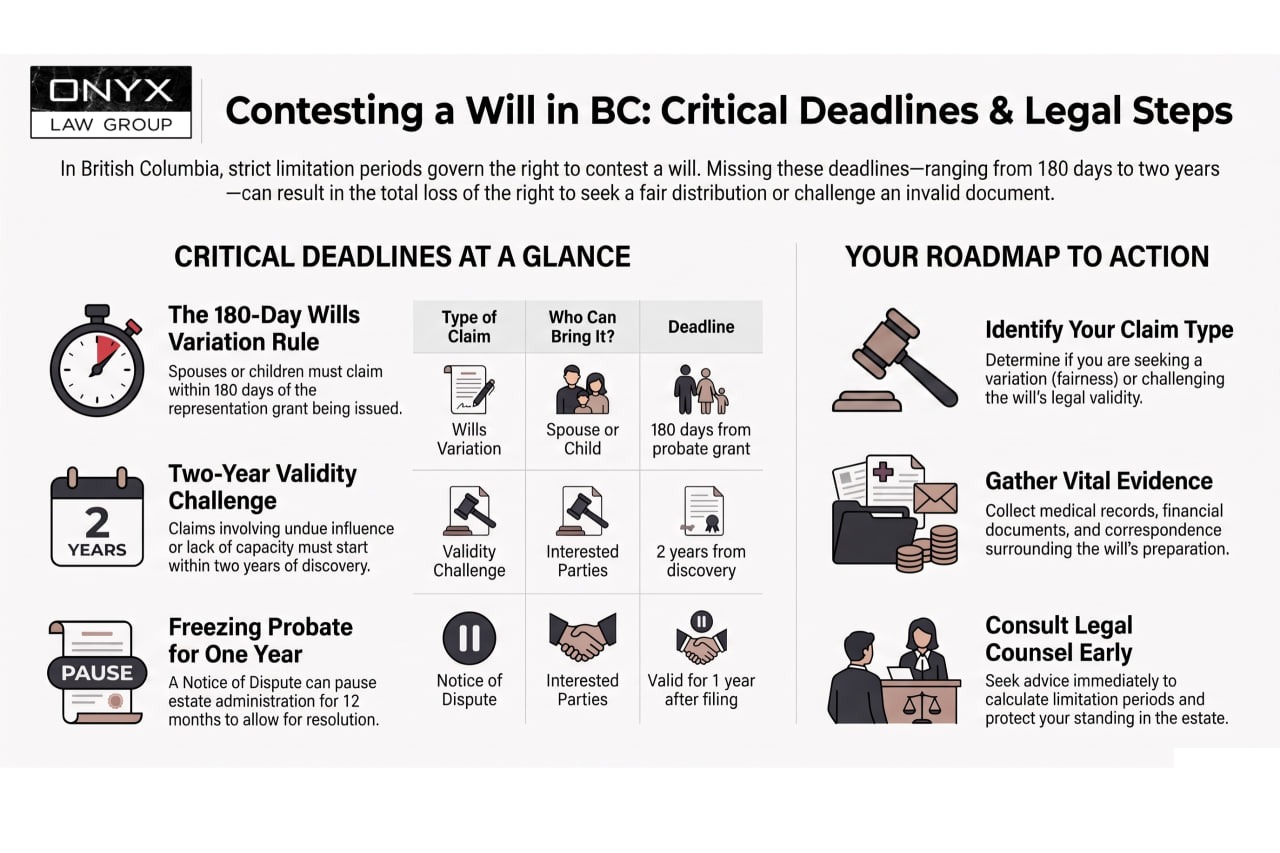
In BC, you generally have 180 days from the date the representation grant is issued to bring a wills variation claim. This applies if you are a spouse or child who was disinherited or believes the will does not make adequate provision for you. If you are challenging the validity of the will itself, different limitation periods may apply, so you should get legal advice as soon as possible.
Wondering how long you have to contest a will in Canada? With over a decade of experience focused on estate litigation, Onyx Law Group helps you act fast and protect your rights. Candace Cho, KC leads our estate litigation team, was called to the British Columbia bar in 2009, and has co-chaired the Trial Lawyers Association of BC’s Estate Litigation Essentials course four times since 2020. Book a free 30-minute consultation today.
This blog explains how long you have to contest a will in BC, which deadlines apply, and what happens if you miss them.
What Are the Timelines for Contesting a Will in BC?
As Canada’s population ages, estate and succession issues are becoming increasingly important. Statistics Canada reported that more than 7 million Canadians were aged 65 or older in 2021, representing 19% of the population.
The timeline that applies for contesting a will depends on the type of claim you are filing. You must understand the exact timeline that applies to your claim to avoid losing your right to contest the will. The timelines include:
Six-Month Deadline

The will maker’s spouse or child can apply for a variation of a will under Section 60 of the Wills, Estates, and Succession Act (WESA). The basis of a will’s variation claim, which can be brought by only the spouse or child of the deceased person, is that the will’s contents do not make adequate provision for the proper maintenance and support of the claimant in all cases, including their financial circumstances.
The timeline for starting a wills variation claim is within 180 days of the day the will is probated following the deceased’s death. While the six-month limitation period does not begin to run until probate is issued by the probate registry, you do not have to wait for probate to be granted before starting a wills variation claim. Once a will has been probated, a motion in the Supreme Court is needed to return the Certificate of Appointment of Estate Trustee.
If you do not bring a will variation claim within the six months, you will lose the right to bring a claim. There are a few narrow exceptions, if any, where this time may be extended. An earlier valid will may apply, or intestacy laws may govern the estate. One example is where other beneficiaries have already commenced a will variation claim within the six-month limitation period. Even though the six-month limitation period has passed, other eligible beneficiaries named can bring a late claim, so long as there has been no settlement in the claim that was initiated first.
According to Candace Cho, principal lawyer at Onyx Law Group, “Missing a limitation period can have serious consequences, which is why anyone considering a will challenge should seek legal advice without unnecessary delay.” If you were disinherited, denied a fair share, or treated unfairly and think you want to vary your spouse’s will or your parents’ will, the best course of action is to talk to a lawyer without delay.
Two-Year Limitation Period
You don’t have to be a spouse or biological child of the deceased to contest a will. A will can be disputed on other legal grounds, and any beneficiary under the will, a beneficiary under a previous will, a person named in beneficiary designations, or other parties with a financial interest in the estate can bring such challenges. These reasons may include a lack of testamentary capacity (mental capacity), undue influence, fraud or forgery, improper execution of the will, or ambiguity or errors in the will. “When undue influence or lack of capacity is suspected, the circumstances surrounding the preparation and signing of the will can become important evidence,” says Julia Pinnock, an estate lawyer at Onyx Law Group.
The timeline for challenging the validity of a will is two years from the day you knew or ought to have known that you had a claim. The determination based on the two-year limitation period for contesting the validity of a will is subject to the discovery rule. This means the clock starts ticking when the potential claimant discovers, or reasonably should have discovered, facts that give rise to the claim.
There are some situations where the discoverability rules may apply to postpone the limitation period. The two-year limitation period runs from the date you knew or reasonably should have known that you had a claim. In any case, you should talk to an experienced estate litigation lawyer immediately to ensure that you do not miss the limitation period.
Contesting a Will in BC: Key Deadlines at a Glance
The deadline for challenging a will depends on the type of claim you want to make. Knowing which deadline applies can help you avoid missing your opportunity to take legal action. The table below breaks down the main types of claims, who can bring them, and the relevant timelines.
| Type of Claim | Who Can Bring It? | General Deadline | What It Challenges |
|---|---|---|---|
|
Wills variation claim |
Spouse or child of the deceased |
180 days from the date the representation grant is issued |
Whether the will makes adequate provision for the spouse or child |
|
Challenge to will validity |
Certain beneficiaries and others with a financial interest in the estate |
2 years from when the person knew or ought to have known about the claim |
Whether the will is legally valid, such as due to undue influence, lack of capacity, fraud, or improper execution |
|
Notice of Dispute |
Beneficiaries and other interested parties |
Valid for 1 year after filing |
Pauses the probate process while a dispute about the estate is addressed |
Notice of Dispute to Freeze the Probate Process

Beneficiaries or other interested parties can file a Notice of Dispute under Rule 25-10 of the British Columbia Supreme Court Civil Rules, which effectively pauses any advancement of the administration of the estate.
Common grounds for this legal process include concerns about a lack of testamentary capacity, suspicions that the will-maker was unduly influenced, disagreements about who should act as executor, and suspicions of fraud or forgery. The court may consider whether a reasonable person making the will was mentally capable, acting voluntarily and with full capacity, and would have made the same decisions reflected in the will.
For example, if a beneficiary believes the will was made under undue influence or is simply invalid and intends to seek the will in solemn form to prove it, a Notice of Dispute can be filed to halt the process until the validity issue is addressed. In that case, the court registry is not permitted to issue an estate grant while a Notice of Dispute is in effect.
A Notice of Dispute is valid for one year after it is filed. The idea is that the administration of an estate should not be unduly delayed; probate can’t be granted until the notice is withdrawn or removed. Notices of Dispute are intended to encourage interested parties to either settle estate disputes or commence estate litigation to resolve disputes within that year.
Can You Appeal a Court Decision About a Will?
If you go to court to contest or vary a will in BC and the judge rules against you, you may still have options. In some cases, you can appeal the decision to the BC Court of Appeal.
An appeal is a review of whether the trial judge made an error in applying the law or in assessing the evidence. To succeed, you must show that a significant mistake affected the outcome of your case.
Appeals are subject to strict deadlines, typically within 30 days of the judgment being entered. Because the appeals process is technical and costly, it’s important to get timely legal advice to assess whether pursuing an appeal makes sense for your situation.
Steps to Contest a Will in BC
If you believe a will creates an unfair distribution or is otherwise invalid, taking the right steps early can help protect your position. Here is a general roadmap for starting a will dispute in BC.
1. Determine What You Are Challenging
First, determine whether you are seeking a wills variation or challenging the validity of the will itself. The type of claim affects who can bring it, what must be proven, and which deadline applies.
2. Check the Applicable Deadline
Find out when the relevant limitation period began and calculate how much time remains. For example, a wills variation proceeding generally must be commenced within 180 days after the representation grant is issued.
3. Gather the Relevant Evidence
Collect documents and information that may support your claim, such as the will, earlier wills, medical records, bank accounts and other financial records, correspondence, and information about the circumstances surrounding its preparation. Evidence can be particularly important when concerns involve undue influence, testamentary capacity, fraud, or improper execution.
4. Consider Whether a Notice of Dispute Is Appropriate
If probate has not yet been granted and you want to oppose the estate grant, a Notice of Dispute may be an option. Under Rule 25-10, it must generally be filed before the earlier of the authorization to obtain estate information or the estate grant.
5. Speak With an Estate Litigation Lawyer
An estate litigation lawyer can review the facts, explain your legal options, and help determine the appropriate way to proceed. Getting advice early is especially important because different estate claims have strict time limits.
6. Pursue Settlement or Court Proceedings
Depending on the circumstances, you may be able to resolve the dispute through negotiation or mediation rather than going to trial. If you cannot reach a settlement, your lawyer can help you pursue the appropriate court proceeding and present your case.
How Can an Estates and Trusts Lawyer Help You Contest a Will in BC?
Contesting a will can be complicated, especially when family relationships and a loved one’s estate are involved. An experienced estates and trusts lawyer can review the will, determine whether you have grounds to challenge it, assess your legal standing, gather relevant evidence, and make sure important deadlines and court requirements are met. Consulting a lawyer early is important because different types of will disputes have different legal requirements and strict deadlines.
For example, imagine a BC resident who discovers after his parent’s death that he was left out of the will despite having been financially dependent on the parent for years. Unsure whether he could challenge the will, he contacted Onyx Law Group for advice. The firm reviewed the circumstances surrounding the will, assessed his potential wills variation claim, helped him gather evidence, and guided him through the legal process, including negotiations aimed at reaching a resolution without a trial.
TJ Garcha, an estate lawyer at Onyx Law Group, often says, “Estate disputes can be emotionally difficult, so having a lawyer handle communications and explain the legal process can take some of the pressure off you and your family.” With the right legal guidance, you do not have to figure out the process on your own. An estate litigation lawyer can explain your options, protect your interests, and help you decide whether negotiation, mediation, or court action makes sense for your situation.
Need Help Contesting a Will in BC?
To reiterate, the timeline for contesting a will for a wills variation claim is 180 days. Meanwhile, the timeline for challenging a will’s validity is two years from when you knew or should have known you had a claim. This timeline applies to a surviving spouse and children as defined in the Wills, Estates and Succession Act and, in some cases, the Family Law Act. If you think you want to contest a will in BC, the best course of action is to talk to an estate litigation lawyer immediately to ensure deadlines aren’t missed.
Whether you are contesting a will, filing a wills variation claim, or considering an appeal, Onyx Law Group has the experience to guide you through the process. With over 13 years of experience, our team is empathetic, solution-oriented, and focused on securing the results you want. Contact us today for trusted legal guidance before the deadline passes!
FAQs About Contesting a Will in BC
Contesting a will in BC can involve several grounds, including concerns about testamentary capacity, undue influence, or whether the will was executed properly. The timeframe for contesting a will in British Columbia varies by challenge type, so the applicable deadline depends on the claim being brought.
1. How Much Does It Cost to Contest a Will in BC?
There is no fixed cost for a will contest or civil claim because legal fees depend on several factors, including the complexity of the dispute, the evidence required, and the number of parties involved. Legal representation from a law firm can help you understand the potential costs and options based on your individual circumstances.
2. Can Legal Fees Be Recovered if My Case Doesn’t Win?
The court has discretion over costs, so an unsuccessful party may be ordered to pay some of the other party’s legal costs. However, recovery is not guaranteed, and the outcome depends on the circumstances of the case and the court’s decision.
3. Can an Executor Contest a Will?
An executor is responsible for administering the estate and carrying out the will-maker’s true intentions but may also have a personal interest in challenging the will. If a conflict arises, the court can address the issue and determine how the estate should be administered while the will contest or other claim proceeds.
4. What Are the Potential Outcomes of a Wills Variation Claim?
Under WESA, a qualifying spouse or child may seek a variation if the will does not make adequate provision for their proper maintenance and support. A successful wills variation claim can adjust the distribution of the deceased’s property and, where appropriate, result in a fair distribution based on the circumstances. The court may consider the testator’s legal and moral obligation to provide for a qualifying spouse or child when assessing whether adequate provision was made.
5. What Are the Potential Outcomes of Contesting a Will?
A will contest may involve several grounds, including undue influence, lack of testamentary capacity, whether the will was executed properly, or other factors affecting its validity; a disinherited beneficiary may have valid grounds to challenge a will depending on the type of claim. The court may uphold the will, declare it valid, or modify its effect where the law permits, and if the will is invalid, an earlier valid will may apply or intestacy laws may govern the estate.
6. What Happens if the Deceased Did Not Leave a Will?
When someone dies without a will, they die intestate, and the deceased’s property forming part of the estate is distributed under BC’s intestacy laws. WESA sets out the rights of spouses and other family members, while assets that pass outside the estate may follow different rules.
Disclaimer: The information on this page is general legal information about British Columbia law, not legal advice for any specific situation. Reading this page does not create a solicitor-client relationship. BC law changes, and the procedure that applies to a specific situation depends on facts not covered here. For advice on your situation, consult a qualified British Columbia estate lawyer directly. Past results, illustrative scenarios, and reference to typical fact patterns do not guarantee similar outcomes in any specific case.