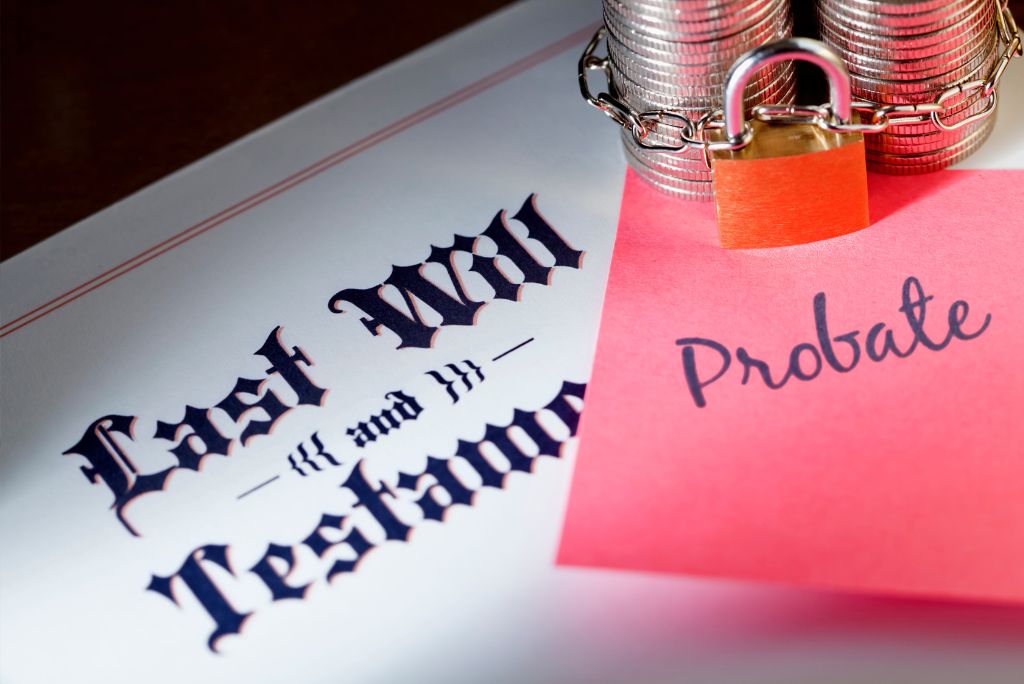
Only property that passes to the executor is governed by the will, and only that property is counted for the probate fee. Several arrangements take assets around the will altogether:
- Land or accounts held in joint tenancy pass to the surviving joint owner by right of survivorship. See joint tenancy and survivorship.
- Registered plans and life insurance with a named beneficiary are paid to that person rather than to the estate.
- An alter ego trust or joint partner trust holds assets under the trust’s own terms. The Canada Revenue Agency defines these as trusts created after 1999 by a settlor aged 65 or older, under which only the settlor (or, for a joint partner trust, the settlor and spouse) can receive income or capital during their lifetimes. Our article on alter ego trusts covers set-up and tax points.
The Probate Fee Act shows why families look at these tools. No fee is charged on an estate worth $25,000 or less; above that, the rate is $6 for every $1,000 or part between $25,000 and $50,000 and $14 for every $1,000 or part over $50,000. An estate valued at $2,000,000 for probate would pay $27,450. For someone ordinarily resident in BC, intangible property anywhere in the world is counted, along with real and tangible property in the province. See what assets are not subject to probate and our probate fee calculator.
Moving property outside the will has costs of its own. A trust has to be administered for as long as it lasts, with its own records and filings, and someone has to be willing to act as trustee. A plan built from several of these devices also needs a will that fits with them, or the estate that is left may not be enough to carry out the gifts the will makes.
What to gather before a first meeting
Because so much can sit outside the will, a first meeting about a North Shore estate goes further with the paper trail in hand:
- the latest will and any codicils, and earlier wills if a dispute is likely;
- a land title search for each property, showing how title is held and when it changed;
- any trust deed, with the trust’s account statements and tax filings;
- beneficiary designations on RRSPs, RRIFs, TFSAs, pensions and life insurance;
- statements for joint bank and investment accounts;
- the grant of probate, if one has issued, because the 180-day and 210-day periods run from its date.
Not every item will exist, and you do not need all of them to book.
When the family disputes the estate
The type of dispute determines which assets are within reach.
Claims against the will
Under section 60 of the Wills, Estates and Succession Act (WESA), a spouse or child who was not adequately provided for may ask the court to vary the will, and the judge can make the provision that is “adequate, just and equitable in the circumstances”. The order is made out of the will-maker’s estate, which is why property that passed outside the will matters so much in these cases. The claim must be started within 180 days after the BC grant of probate and served on the executor within 30 days after that period, a time for service the court can extend. Our pages on a disinherited child and a disinherited spouse describe how courts approach these claims.
A will can also be attacked as invalid, for lack of capacity, undue influence or a defect in signing. Under WESA section 52, once a challenger shows that someone was in a position where the will-maker could have depended on them or been dominated by them, the onus moves to the defender of the will to show the influence was not undue. Before the grant, a person entitled to notice can file a notice of dispute (Form P29), which stops the registry from issuing a grant while it is in effect.
Claims about lifetime transfers
Assets moved out of the estate before death are not always beyond challenge. A gift made while the giver was under pressure, or without the capacity to understand it, can be contested, and a person who contributed to property they did not own may in some cases claim for unjust enrichment. Both are on our list of estate litigation services. See contesting a gift, what counts as an estate asset and unjust enrichment. Time limits for these claims depend on the claim and its facts, so take advice early.
Candace Cho, KC leads our estate litigation practice, acting for beneficiaries, for spouses and children left out, and for executors and trustees defending their decisions. Estate litigation can be run on an hourly rate or, at the lawyer’s discretion, on contingency; see our payment options.
Executors and trustees: duties and accountability
An executor administers the estate; a trustee manages property held in trust, sometimes for years after the estate is wound up, and the same person can hold both roles. WESA section 142 requires a personal representative to administer and distribute the estate and to account to the beneficiaries and others owed an account. Beneficiaries who are kept in the dark have tools:
- An application to the court to pass the personal representative’s accounts, or to fix their pay, under Rule 25-13 of the Supreme Court Civil Rules.
- The Trustee Act caps remuneration at 5% of the gross aggregate value of the estate, capital and income included, as a fair and reasonable allowance approved by the court, unless the will provides otherwise.
- An application under WESA section 158 to remove an executor who will not act, cannot manage their own affairs, or is unresponsive or unwilling to the point that administration of the estate is hampered.
Executors themselves can ask the court for directions, and the 210-day rule in WESA section 155 protects them: they must not distribute within 210 days of the grant except by court order or with the consents the section requires. Our guides on executor fees, the Trustee Act, executor or trustee: who has more power and removing an executor or trustee go further.
Probate for a North Shore estate
The courthouse directory lists no Supreme Court registry on the North Shore and no courthouse at all in West Vancouver. The Province allows an application for probate or administration in any Supreme Court registry in BC; the Vancouver Law Courts on Smithe Street are the nearest by road. The registry is named in the notice of proposed application (Form P1), which goes to beneficiaries and others at least 21 days before the application, so choose it before the notices go out.
One piece of paperwork has to be handled outside the municipality. The wills search certificate needed for probate costs $20 and is ordered by mail or at a Service BC counter; there is no Service BC centre in West or North Vancouver, and the Vancouver, Burnaby and Surrey centres do not offer the search, so the search is ordered by mail or at a Service BC office outside those cities. Results take up to 20 business days to print, or the next business day with a $33 courier fee.
Our probate and estate administration group, led by Veronica Manski, prepares and files grant applications and advises on the accounts.
Choosing an executor and a trustee
The person named to run the estate, and the person who will hold any trust afterwards, carry the duties described above, sometimes for years. A will can name different people for the two roles, add an alternate in case the first choice cannot act, and say whether the executor is to be paid. Naming a beneficiary as sole executor is allowed, but where other beneficiaries may be unhappy with the will, an independent or professional executor can lower the temperature. Our articles on the role of an estate trustee and what happens if an executor refuses to act cover the choices.
Our estate lawyers
Candace Cho, KC and Judith A. Janzen, the firm’s principals, joined forces in 2012. West Vancouver estate files are handled by:
- Candace Cho, KC, estate litigation practice leader
- Veronica Manski, probate and estate administration practice leader
- Sandy Minh Abley, wills, trusts and incapacity planning (also Vietnamese)
- Litigation associates Valerie LeBlanc, Jackson Todd, Katya Richardson, Kevin Campbell, Louisa Ledesma, TJ Garcha, Jesse Patrao and Julia Pinnock
See the team page for everyone. For a separation, our West Vancouver family lawyers page applies.
Common questions
Does a will variation claim reach assets held in joint tenancy or in an alter ego trust?
Section 60 orders are made out of the will-maker’s estate. Property that passed by survivorship or under a trust is generally outside it, although a separate claim may be available against a particular transfer. This is fact-specific; get advice before the 180-day period runs.
Where is probate filed for a West Vancouver estate?
At any Supreme Court registry in BC. There is none on the North Shore; the Vancouver Law Courts on Smithe Street are the nearest.
How much can an executor or trustee be paid?
Unless the will says otherwise, the court can allow a fair and reasonable amount up to 5% of the gross aggregate value of the estate, capital and income. Beneficiaries can ask the court to fix it and to pass the accounts.
Is the first meeting free?
On an estate dispute, the first 30 minutes are free, in person, by phone or by video. For planning or probate, ask about first-meeting terms when you book on (604) 900-2538 or through the contact page.