


Neither executors nor trustees have precedence over each other because they derive their authority from different sources. An executor acts under the will and the Wills, Estates and Succession Act, while a trustee holds only property placed in a trust. The type of asset determines which role has control over it, so questioning whether the executor or trustee holds more power overlooks the way these two positions complement each other.
Are you planning your estate and wondering who should have authority over it? Our team of estate and trust lawyers at Onyx Law Group can help ensure that your assets are protected and that your estate planning goals are achieved. Contact us today to schedule a meeting and to get your estate planning in order.
In this blog, we will compare the powers and responsibilities of an executor and a trustee, including their decision-making authority, control over assets, and roles in managing and distributing them.
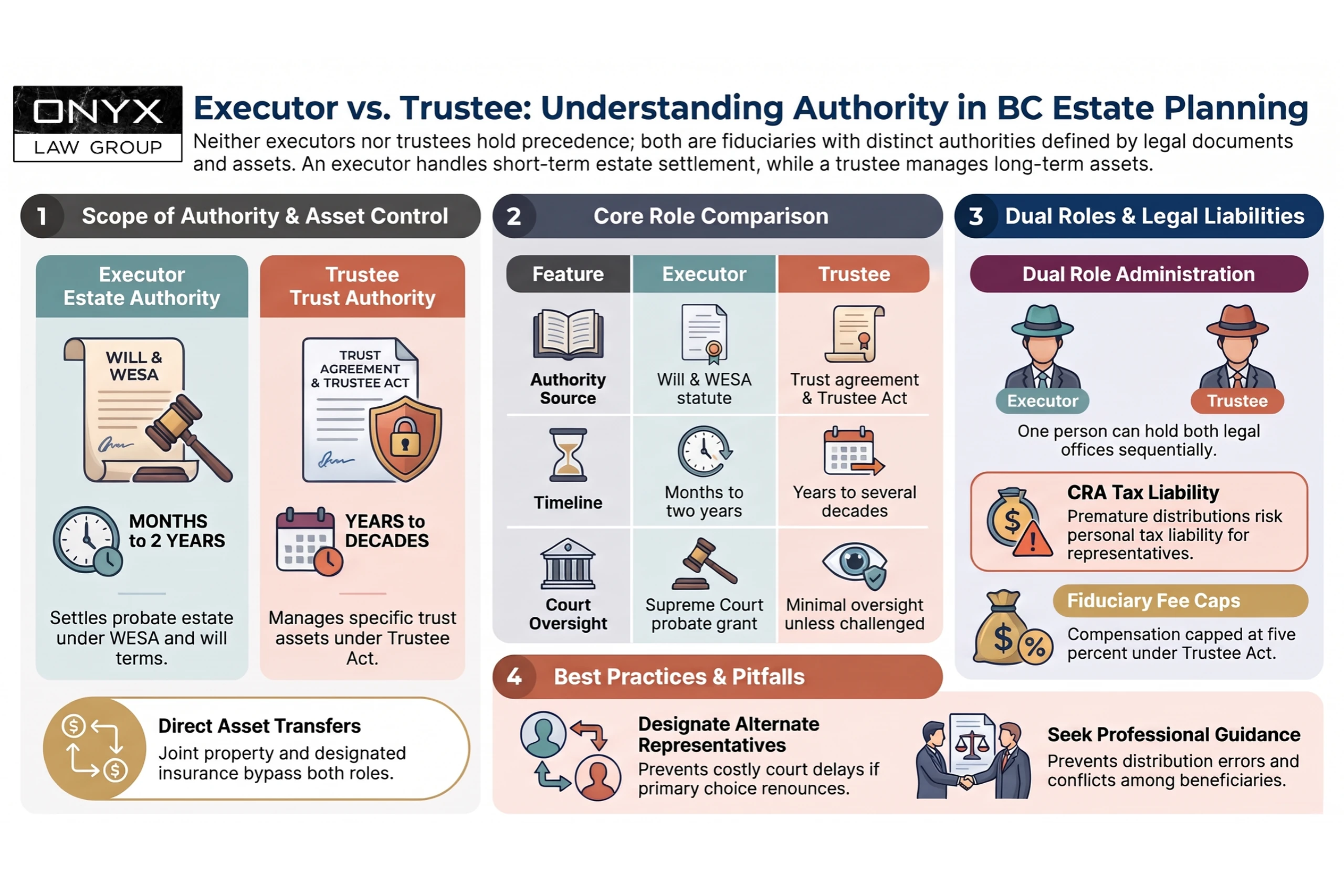
Who Holds More Authority: Executor or Trustee?
Authority for management of an estate isn’t something like a ladder where the executor is at one rung up and trustees are on another. Each person holds the powers granted by certain legal documents and specific pieces of property. Neither trustees nor executors have unfettered control over the assets. Legal responsibilities and governing documents restrict what they can do.
The executor, also known as a personal representative under the Wills, Estates and Succession Act (WESA), handles the estate of someone who has died and their probate assets. A trustee manages property on behalf of people who are supposed to benefit from something set up according to a trust document or as specified in a will. Both serve as fiduciaries and must act in the best interests of those who stand to benefit from them. Each party has a legal responsibility not to consider assets as their own personal account.
Some properties never go through either of those roles. In a home that is jointly owned, typically what happens is that ownership passes directly to the surviving owner. An RRSP or RRIF with a named beneficiary, the Canadian counterparts of US retirement accounts, does the same, as does life insurance with designated beneficiaries. That is why an executor’s authority does not reach every asset, and a trustee’s reach stops at whatever actually sits in the trust.
What Does an Executor Do Compared to a Trustee?

The executor is the person named in a will who is charged with carrying out its instructions. The first step involves collecting the assets of the deceased person, like bank accounts and investments, as well as real estate holdings. The executor puts them down on an inventory for the estate. In BC, that list then goes to court for the items called Statement of Assets, Liabilities, and Distribution. Then comes paying off debts, funeral expenses, and taxes that one still owes using these remaining assets. Then the executor must distribute assets to the people named in the will, and the remaining assets follow the residuary clause.
The executor also handles filing tax returns, including the final return for the year of death. Most executors bring in a tax advisor or a financial advisor for that matter. Paying bills and closing accounts at each financial institution takes patience, and the whole estate settlement often runs a year or more.
A trustee holds legal title to trust property for the benefit of others. On paper, the trustee is the legal owner, but in reality, the trust benefits belong to its beneficiaries. A trust is a legal setup. One can either write down a testamentary trust in their will or set one up during their lifetime. What American sources call revocable living trusts are usually inter vivos trusts in BC, often called a living trust.
Trustees manage trust assets over time, so the work is ongoing management rather than a one-time clean-up, and it is real asset management. This means investing trust assets prudently according to the prudent investor standard in the Trustee Act and keeping careful and detailed records. That also means distributing trust assets as allowed by the trust document. The appointed trustee may spend decades managing trust assets for the same family.
What Is the Decision-Making Authority of Executors and Trustees?

The clearest way to see the difference is to compare the two roles side by side. Below there is a table that shows where each role draws its power from, whether courts closely monitor that role, and for how long. It also covers pay and personal liability.
|
Feature |
Executor |
Trustee |
|---|---|---|
|
Source of power |
The will, plus WESA, gives the personal representative the authority the deceased would have had if living. |
The trust agreement or the will’s trust terms, plus the Trustee Act |
|
Court supervision |
Works under Supreme Court supervision when a grant of probate is sought and may be asked to pass accounts. |
Usually acts with minimal court oversight and without ongoing court intervention unless a beneficiary challenges the trustee. |
|
Duration |
Typically months to a couple of years, ending once the estate is settled |
Can run for many years, even decades, after the settlor’s death. |
|
Compensation |
A fair allowance set by the court or by agreement, limited to 5% of the gross estate value. |
The same 5% ceiling applies, and a professional trustee may also agree to an hourly fee or fixed annual amount |
|
Personal liability |
For distributing before taxes are cleared, or for breaching duties to beneficiaries |
For poor investment choices, self-dealing, or breaking the trust terms. |
The executor gets their authority from both the will and WESA, and then the estate of the person who has died goes into the hands of this executor once they take on that job. In day-to-day life, though, banks and land title offices usually ask for a grant of probate before they release or transfer assets. A grant of probate verifies that an executor has legal standing and hands them something to show to a financial institution. Some websites claim a trustee can act at once while an executor must wait for court approval. The BC law doesn’t put it that way.
There is no separate court for probate in BC. The Supreme Court of British Columbia issues the grant, so probate court supervision in the American sense does not exist here. The executor still files court papers to get the grant, and then the court reviews accounts later. Probate is not needed for every estate, since small estates and jointly held property often pass without it.
A trustee is still accountable to the court for dismissal, direction of actions, compensation issues, and accountabilities. If a trustee fails to meet those duties, the court can replace the trustee. The Trustee Act allows an executor or trustee a fair and reasonable allowance of up to 5% of the gross aggregate value of the estate assets. The court settles the amount based on an application. Executors get payment from assets in an estate, and trustees draw money from trust funds, and the amounts vary according to how complicated things are and how much time they spend on them. Under the same Act, first accounts generally must be passed within two years unless the beneficiaries consent in writing.
Trustees generally have more leeway with distributions compared to executors, whose duty is more strictly according to the terms of a will. A trust document allows the trustee to decide when and how much income or capital is distributed to each beneficiary, as long as the document allows for such distributions. The role of the executor is more specific. Pay the debts, give out the assets according to the will, and the authority is over.
There are limits that apply to both. A trustee must manage assets prudently and act solely in the best interest of the beneficiaries. The trust property is never for the personal benefit of the trustee. Executors owe the same loyalty, along with a duty to account for every dollar they handle.
What happens if there is disagreement between the executor and trustee? Because there is no ranking, the answer depends on the asset, since an executor manages assets within the probate estate and a trustee manages trust assets. If something is still part of the probate estate, the executor decides according to the will. If something goes into trust, then the trustee acts according to the terms of that trust. Either can ask the court for guidance.
Can an Executor Also Be a Trustee?

Yes, one person can serve as both an executor and trustee, and that happens frequently. Usually, when there is a will that sets up an estate trust for a young child or a spouse, the same person is named to do both jobs. Roles appear distinct on paper even though one person plays both parts.
BC law treats them as two offices governed by two statutes. According to Section 143(4) of WESA, someone who plays both roles of personal representative and trustee follows WESA for their first role. The Trustee Act applies to the second. That split matters in a dispute, because the legal test depends on which hat the person wore at the time.
As the estate progresses, things change roles. At first, people do executor work by gathering up assets and paying off debts while handling the probate process. Then that same person is appointed as the initial trustee, and the assets set aside for this trust go outside the estate. At that point, administration of the estate stops and trust administration starts.
What Is the Impact of Holding Both the Roles of Executor and Trustee?
Having both executor and trustee positions makes settlement go more smoothly because one person handles everything from beginning to end. Beneficiaries deal with one contact, and nothing gets lost in a handoff.
The trade-off is a possible conflict of interest, especially when the same person is also a beneficiary. An executor who is a child of the deceased may want a quick sale. As trustee, that same person must protect the long-term interests of a sibling. Some families name a corporate trustee, like a trust company, to manage trusts until an executor who is a family member steps in.
Splitting the roles also spreads personal liability. A trustee who invests poorly can be personally responsible as well, and an executor who distributes funds prematurely is liable as well. Naming different people means each answers only for their job, though the two must cooperate.
What Are the Legal Considerations When Serving as Executor vs a Trustee?
Each role has its own legal responsibilities, and people in these roles also have very high standards of care and loyalty. These duties as a fiduciary demand full transparency and careful and clear records. Anyone who accepts either job is legally obligated to account to the beneficiaries, and that legal obligation is enforceable in court.
Tax is a good example of how seriously the law regards this matter. According to the Canada Revenue Agency, the legal representative can be held personally liable for tax owing if they distribute assets without having a clearance certificate. An executor who skips that step may end up paying the tax bill personally.
The Trustee Act does offer some relief. A court can excuse an executor or trustee from personal liability for a breach. The person must have acted honestly and reasonably. Protection is based on careful documentation and sound advice. In BC, you would hire an estate lawyer, the professional American websites call this an estate planning attorney or an estate attorney.
What if an Executor Declines the Role?
Being an executor is voluntary. A named executor who does not want the job can renounce it. Then the estate transfers as if that person had never been appointed at all. WESA also allows anyone who is interested in an estate to accept or decline an executor who has been named.
First, the person named in the will should decide quickly and avoid acting on the estate while deciding. Someone who hasn’t yet taken steps like paying creditors or selling assets generally has a better chance of renouncing their debts cleanly. Then the executor signs a written renunciation document, and the lawyer who is handling this case confirms that all the right forms and steps for filing with the court have been correctly followed.
Then the backup plan kicks in. Most well-drafted wills name an alternate executor, who steps in without further process. If there is no alternate executor or that person can’t act for some reason, the court appoints an administrator with letters of administration. The estate vests in the court until then, so delay is costly.
Are There Alternative Solutions if an Executor Steps Down?
When an executor leaves office there are some choices available. It would be simplest if the person named as alternate executor takes over. If the will names no alternate, the people with the highest priority under WESA can apply to become administrator. Usually that is done by a spouse or an adult child first.
A court-appointed administrator has the same job as an executor, and the court appoints one when no executor is named. If no suitable family member will act, the Public Guardian and Trustee of British Columbia may apply to administer the estate, usually as a last resort.
Trust documents frequently also name alternate trustees. A successor trustee manages the trust when the original trustee cannot serve. The Trustee Act allows courts to appoint a new trustee if the regular way of doing so is impractical. The court’s top priority is the interests of the beneficiaries.
What Common Mistakes Do Executors Make?
Most mistakes by executors stem from wills that don’t have any plan for what happens next or because executors lack understanding of their role. A few patterns come up again and again:
Failing to designate an alternate executor or successor trustee can lead to the need for a court application if the primary choice is unable to fulfill their duties. Additionally, taking on the role without discussing the time commitment, required paperwork, and associated legal responsibilities can create challenges.
Distributing assets before settling debts and taxes may expose the executor to personal liability. Managing the estate independently, without the assistance of a lawyer, tax advisor, or financial advisor, increases the risk of making mistakes in tax filings or asset distributions.
Each of these creates headaches for family members and increases the risk that the executor is held personally liable. A short call with a lawyer before the first distribution can catch most of them. The most reliable fix is a complete estate plan with clear estate planning documents. Executors should accept this role in advance. Choose people who are good with finances and have the patience to maintain detailed records.
Do Beneficiaries Influence Executors or Trustees More?
Beneficiaries have a right to information and a right to hold executors and trustees accountable, but their influence differs between the two roles. If every beneficiary agrees in writing, an estate can sometimes be distributed early. It’s important that an executor seek legal advice first, though. Early distribution can expose the executor to a wills variation claim or to tax not yet cleared.
What Are the Influence Dynamics of Executors and Trustees?
Both roles have an obligation to act in the best interests of the beneficiaries. An attorney who works for power of attorney has a similar duty as well. That kind of authority lets someone manage your affairs only during your lifetime, and that power ends when you die. At that point, the executor’s role begins. The mission is clear: collect assets, settle debts, and then distribute according to someone’s will.
Beneficiaries have limited say on important matters because those things are set in the will. If an executor delays or acts improperly, though, beneficiaries can ask the court to compel an accounting, give directions, or remove the executor. An executor cannot rewrite the will, so a dispute only makes sense if the executor has strayed from it.
When trustees have discretionary power, there’s more pressure from the beneficiaries. If a trust lets the trustee set each beneficiary’s income, the trustee must weigh one person’s wishes against the duty owed to multiple beneficiaries. Conflict is more likely here, and family dynamics need careful handling.
Conflict Resolution
Conflict between beneficiaries and an executor or trustee is common, and prevention is the cheapest remedy. Clear estate plans and having frank conversations with the people you name as beneficiaries, along with regular communication to those who will receive from your estate, reduce most sources of conflict. Once a problem has begun, a quick letter from a lawyer often reignites communication again.
If words don’t work, mediation allows a neutral third party to help both sides understand each other better. Mediation can prevent going to court. Some disputes need a firmer response. A beneficiary who sees delay, self-dealing, or poor investment of trust assets can apply to the Supreme Court of British Columbia. Under WESA, a person with an interest in the estate can ask the court to remove an executor and appoint a substitute who consents to act.
Grounds for contesting an executor include refusing to act, dishonesty, and incapacity, and the same logic applies when co-executors cannot work together. When an executor simply goes silent, beneficiaries usually start with a written request for information and a deadline. If there’s a problem with trustees, courts can also replace them as well. Estate litigation lawyers act on both sides for such applications.
Do You Want to Understand Executor vs. Trustee Authority?
Executors and trustees hold different powers over different property, and mixing up the two can cost a family time, money, and goodwill. Choosing the right people, naming backups, and writing clear documents can help avoid most of the issues mentioned before. If you’re setting up your own plan or if things have stalled in your estate planning, seeking legal advice now is cheaper compared to having to fix mistakes later.
Estate lawyers at Onyx Law Group have offices in the Vancouver neighbourhoods of Kerrisdale and New Westminster, where they do work on wills, trusts, probate matters, and disputes. We explain your rights and responsibilities under BC law and pursue options that fit your specific circumstances. Contact Us Today to book a consultation about estate planning.
Frequently Asked Questions
Understanding the differences between an executor and a trustee can be confusing, especially when it comes to authority and responsibilities. This FAQ section answers the most common questions about who has more power, what each role entails, and how their duties impact the management and distribution of an estate.
What Are the Differences Between an Executor and a Trustee?
An executor administers the deceased’s entire estate and ensures that all debts are paid and taxes are handled. A trustee administers only the trust assets and does so for a specific, often long-term purpose.
Can an Executor Also Be a Trustee in the Same Estate?
Yes, it is very common and legally permissible for the same person to serve as both an executor and an appointed trustee.
What Is the Difference Between a Power of Attorney, Executor, and Trustee?
A power of attorney grants authority to someone to manage your financial and legal affairs while you are alive. An executor manages your estate after you die. A trustee manages trust assets for beneficiaries, which can be created during your lifetime (for instance, an inter vivos trust) or upon your death (a testamentary trust).
Who Has More Power, an Executor or a Trustee?
The executor has authority over all the deceased person’s assets for the duration of the probate process. The trustee has more specialized power for ongoing management over only the trust assets, which can last for years or decades. As a result, their powers are different in focus.
Attorney Advertising.
This article is for general information only and is not legal advice. Contacting Onyx Law Group does not create a lawyer-client relationship.