


Court appeals ask a higher court to check a lower court’s decision for legal errors, without holding a new trial. In British Columbia, most appeals from the Supreme Court of British Columbia go to the Court of Appeal. The notice of appeal is generally due 30 days after the order is pronounced.
Onyx Law Group is a Vancouver family and estate law firm led by Candace Cho, KC, who became a member of the BC bar in 2009. From our offices in Downtown Vancouver, Kerrisdale and New Westminster, we assess and argue family and estate appeals at a flat rate, whether you are challenging a decision or defending one. If you believe a judge got your case wrong, book a free 30-minute consultation before the 30-day appeal window closes.
This article explains how BC courts fit together, what appeal judges review, and each step of an appeal.
Key Takeaways
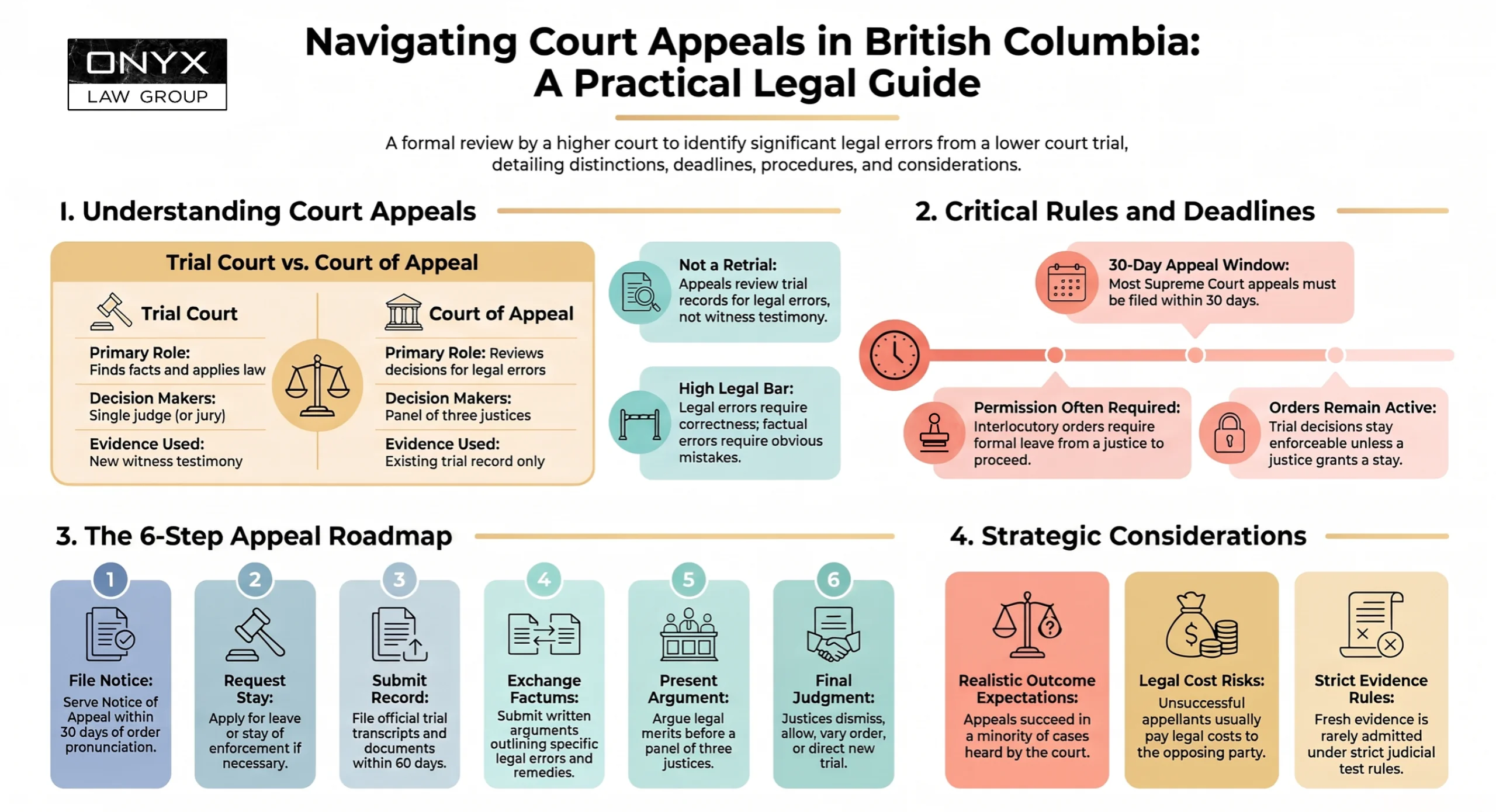
Appeals are not a second chance at trial but an opportunity to persuade a higher court that the trial court made a legal mistake. In BC, most civil appeals must be started within 30 days after the decision being appealed, and leave (permission) to appeal is required for some decisions and orders. Unless a stay is granted, the decision being appealed will remain in effect while the appeal is pending. The Court of Appeal allowed 35 percent of the appeals it heard in 2025.
What Is a Court Appeal?
If you have recently lost a case and are curious about court appeals, here’s a straightforward explanation: an appeal is a request for a higher court to examine a decision made by a lower court, such as a judgment, verdict, or order, to determine if there was a significant legal error. The party appealing is usually called the appellant. An appeal, according to the Court of Appeal guide, is not a retrial or an opportunity to re-present evidence. Rather than rehashing everything that happened in the trial court, an appellate court will typically look at the record from the proceedings below and determine if errors occurred that affected the outcome of the case.
The other party is typically the respondent. A respondent can also cross-appeal under section 14 of the Court of Appeal Act to change part of the order.
How Are Courts Organized in British Columbia?
The Provincial Court of British Columbia describes four levels of court, with three of them inside BC. The court where you initially filed your case will determine the court to which an appeal may be taken, as well as deadlines for taking such an appeal.
Provincial Court of British Columbia
The Provincial Court is one of BC’s two trial-level courts and hears most cases in the province. That includes small claims between $5,001 and $35,000, most family cases, and most criminal cases.
Many decisions made at the Provincial Court level are appealed to the Supreme Court of British Columbia. A final Provincial Court family order must be appealed within 40 days under section 233 of the Family Law Act. If you’re considering a family court appeal, find out which court made the order before you start counting! Small claims orders made after a trial carry the same 40 days under section 6 of the Small Claims Act. Appeals lie to the Supreme Court in summary conviction matters under section 813 of the Criminal Code, usually within 30 days.
Supreme Court of British Columbia
The Supreme Court of British Columbia may sound like the highest court in the land, but it is actually a trial court. It does hear some appeals, which is why it is referred to as an “appeal court” in the Provincial Court guide. Jury trials, divorces, civil disputes over $35,000, and most estate litigation start here.
Court of Appeal for British Columbia
Appeals in criminal, family, and civil cases can be made to the Court of Appeal, the province’s highest court. It will be composed of a minimum of three justices under section 4 of the Court of Appeal Act and will not conduct trials. Appeals reach it mainly from Supreme Court orders, as section 13 sets out.
Supreme Court of Canada
The Supreme Court of Canada is the court of last resort for the whole country. Most parties need leave, granted only for issues of public importance under section 40 of the Supreme Court Act. Supreme Court of Canada statistics show it granted between 6 and 10% of leave applications each year from 2016 to 2025. In 2025, the rate was 7%, and leave decisions took 4.4 months on average.
Federal Court and Federal Court of Appeal
Canada also has federal courts that deal with certain matters falling under federal (i.e. Parliament’s) jurisdiction. These courts operate independently from, not superior to, the provincial courts. According to the Department of Justice Canada, some of the types of cases they hear are federal in nature, such as cases relating to patents and immigration, as well as cases coming from many different federal boards. Judicial review of a federal tribunal must start within 30 days under section 18.1(2) of the Federal Courts Act.
How an Appellate Court Differs From a Trial Court
A trial court’s job is to find the facts. An appellate court’s job is to make sure the trial court applied the law correctly to those facts. Here’s a table that describes the differences between trial and appellate courts in terms of witnesses, evidence, and outcomes.
|
Feature |
Trial Court |
Court of Appeal for British Columbia |
|---|---|---|
|
Main job |
Hears evidence, finds facts, applies the law |
Reviews the decision for legal or clear factual error |
|
Who decides? |
One judge, sometimes with a jury |
At least three justices |
|
Witnesses |
Testify and face cross-examination. |
None |
|
Evidence |
New evidence is presented. |
Trial record only, with rare exceptions |
|
Written argument |
Pleadings and submissions |
Factums from each side |
|
Possible results |
Judgment, verdict, or order |
Dismiss, allow, vary or order a new trial. |
Appeals are generally confined to the evidence presented at trial; evidence omitted at trial generally cannot be considered on appeal.
When Can You Appeal a Court Decision in BC?
Depending on the nature of the order and who issued it, some orders are immediately appealable, while others are not.
Appeals as of Right
An appeal as of right allows your case to move forward for appeal once you file it; this is typically how the process works when you’re appealing a final order from the Supreme Court. One notable exception is in section 13: People are often surprised to learn that an associate judge’s decision cannot go straight to the Court of Appeal. Estate appeals following wills variation trials are a common example of an appeal as of right.
Interlocutory Appeals and Limited Appeal Orders
An interlocutory appeal challenges a decision made in the middle of a case (as opposed to a decision that ends the case). A party can make an interlocutory appeal of the mid-case decision. Many of these rulings are limited appeal orders, and they need a justice’s leave before any appeal proceeds. Rule 11 of the Court of Appeal Rules lists them, including interim Family Law Act orders and orders about costs alone.
If in doubt about whether leave is required, you should err on the side of caution and submit an application within 30 days of the notice. The Court of Appeal for British Columbia 2025 Annual Report shows the granting of leave is far from automatic. Of the 68 leave applications in 2025, the court allowed 16, a success rate of 24 per cent.
Judicial Review of BC Tribunal Decisions
Judicial review is where a party petitions the Supreme Court to review a decision that was not made by a judge (for example, a decision by a BC tribunal or other administrative agency), to determine whether it was made lawfully and fairly. In the case of the tribunals constituted under the Administrative Tribunals Act, section 57 prescribes a 60-day limit (extendable by the court).
What an Appeal Court Reviews

All appeals raise one question: what is the appropriate standard of review? The standard of review helps appellate courts determine the appropriate level of deference to the decision under appeal. The Supreme Court of Canada established the framework in Housen v. Nikolaisen, 2002 SCC 33, which BC appeal courts follow. Generally speaking, questions of law are reviewed for correctness and questions of fact will not be disturbed absent a palpable and overriding error.
Errors of Law and Procedure
Appeals based on legal errors are often the easiest to win because the appellate court can decide what the correct principle of law is. Common examples of this kind of appeal would be where the law was misapplied or misunderstood by the lower court; the wrong test was applied; procedures followed were unfair; or the jury was given incorrect directions. Even here, though, the appellant will need to show that the legal error made a difference to the outcome.
Findings of Fact and Discretionary Orders
Errors in fact-finding are harder to challenge since the trial judge was in the best position to assess the evidence, having seen and heard the witnesses and been presented with all the relevant documents. A “palpable” error is obvious, and an “overriding” error is one that changed the outcome. Discretionary family orders are given a significant degree of deference, including parenting time, support, and unequal property division. Appeals will generally not succeed where the trial judge has applied the correct principles and made decisions within a range of reasonable outcomes.
New Evidence and the Palmer Test
Appeals are decided on the trial record, so new evidence is admitted only in narrow circumstances. Under Palmer v. The Queen, [1980] 1 SCR 759, the court generally asks four questions before admitting it.
-
Could the evidence have been found for trial with due diligence?
-
Does it bear on a decisive issue in the case?
-
Is it credible and reasonably capable of belief?
-
Could it reasonably have changed the result at trial?
Trial evidence is usually your only option, so the answer to the first question rules out many applications. The court’s guide to fresh evidence treats these applications as contested matters that must be argued.
How the Appeal Process Works in British Columbia

A civil or family appeal in BC follows fixed steps, with the Court of Appeal Rules setting a deadline for each. Missing one can push an appeal onto the inactive list and, in time, end it without a hearing.
File and Serve a Notice of Appeal
First, the appellant must file and serve a notice of appeal within 30 days after the order is pronounced, under Rule 6(2). Extensions of time are discretionary. Time commences to run from the date of order and not from the date of entry of same. Anyone who cannot afford the filing fee can apply for an order under Rule 85 that no fees are payable. The applicant must show that the appeal is not bound to fail and that paying the fees would cause undue hardship.
Apply for Leave If the Order Requires It
Next, an appellant facing a limited appeal order files a leave application within 30 days of the notice. A single justice hears it in chambers and can grant leave on some grounds while refusing others.
Ask for a Stay If the Order Should Pause
Filing an appeal does not stop the order from taking effect, and it can still be enforced. The court’s guide to common applications explains that enforcement continues until a stay is granted. Under section 33 of the Court of Appeal Act, a justice has the power to stay the proceedings on terms. For orders made under the Family Law Act, section 234 of that Act sends a stay application to the court that made the order, not the Court of Appeal.
Order Transcripts and File the Appeal Record
The next stage is compiling the record on appeal. This is basically a compilation of the pleadings, orders, and reasons from the trial-level proceedings. Within 60 days of the notice of appeal or leave having been granted, whichever is applicable, the record and transcripts, if any, shall be filed.
Write and Exchange Factums
Appeals can turn on the quality of written advocacy, the factum. Subject to Rule 25, each side must file its factum within 30 days, and the appellant may file a reply factum within 7 days.
Argue the Appeal Before a Division of Justices
Oral argument takes place in front of at least three justices of the court. No witnesses appear during oral argument. The justices are likely to ask lawyers questions during their presentations. The court’s 2025 Annual Report says parties can generally get a hearing date within 100 days of asking.
Receive the Decision or an Order for a New Trial
Finally, the court either dismisses the appeal, in which case the decision is affirmed, or it allows the appeal, in which case it may modify the order appealed against and the effect of allowing an appeal is often that the order appealed against is set aside (reversed) in whole or in part. Under section 27 of the Court of Appeal Act, it can also set aside a verdict and direct a new trial. In 2025, 97 percent of reserved judgments were issued within the six-month time frame recommended by the Canadian Judicial Council.
How Often Do Appeals Succeed in BC?
Most appeals in BC are dismissed, so a party who loses at trial and appeals usually loses again. The court’s 2025 Annual Report shows it allowed 35 percent of the appeals it heard, or 127 of 360 cases decided. Civil appeals succeeded at that same rate, and criminal appeals came in slightly higher at 37 percent. Those figures include partial wins, with 30 of the allowed civil appeals succeeding only in part.
A partial win can look very different from what either side expected. In Volovsek v. Boisvenu Alter-Ego Trust #1, 2021 BCCA 179, Candace Cho acted for the respondent in a trespass dispute over a condominium. The court allowed the trustee’s appeal on liability but awarded nominal damages of $2,500, not the roughly $100,000 first ordered at trial. Each side then bore its costs of the appeal. Past results are not indicative of future outcomes; every case turns on its facts.
Before you spend money on an appeal, an analysis in a written opinion on your chances can separate real grounds from disappointment.
What Are Appeal Costs and Where to Get Help?
The general rule is that costs follow the event, which means that if you appeal unsuccessfully, you will usually pay some of the costs of the other side. But remember, this is in addition to the fees you pay, so litigation costs deserve careful scrutiny before you file your appeal.
Onyx charges a flat fee for appeals in estate cases. Our fees start at $30,000. The flat fee covers the notice of appeal, the appeal record, limited (up to 500 pages) evidence, a limited (one issue) factum and the appeal hearing itself. The book of authorities is included, while each added issue costs $2,500 and every extra 100 pages costs $1,000. The cost of preparing the transcript and the appeal book is extra and depends on the number of pages.
There is free help available if you cannot afford a lawyer to run your appeal. The court’s guide to getting help explains that self-represented litigants can meet an Access Pro Bono lawyer at no cost. In 2025, the court referred 329 people, and 99 received pro bono services. Legal Aid BC funds family appeals only in narrow cases, such as a child removed from a parent’s care.
How Criminal Appeals Work in BC

An appellant who has been convicted on indictment may appeal against their conviction either on a point of law or (with leave) on the facts: section 675 of the Criminal Code. The Criminal Appeal Guide says the notice of appeal is due within 30 days of sentencing. Alternatively, if the conduct of the trial was in some way unfair or the jury was misdirected in some important respect, the court may order a new trial for the accused. Criminal appeals are a steady share of the court’s work, with 191 new filings in 2025.
Ready to Talk About Appealing a BC Court Decision?
An appeal is a narrow step in the legal process, and the 30-day period would commence from the date the order is pronounced. Whether your order needs leave, a stay, or stronger grounds impacts strategy long before any hearing. An early and frank assessment is beneficial for case and expense management and protects your legal entitlements.
Candace Cho, KC, received her King’s Counsel designation from the BC Attorney General in 2025. She has practised in all levels of BC courts. Our family and estate lawyers in Vancouver tell you plainly whether an appeal is worth the cost, then prepare, file, and serve every document on time. Contact us today to review your decision before the appeal period runs out.
Frequently Asked Questions
Our lawyers handle appeals to the Court of Appeal for British Columbia in estate and family law matters, for both appellants and respondents. Below are some of the questions that we are most commonly asked at a first meeting.
What Are Court Appeals in Simple Terms?
On appeal, a higher court reviews the decision made in another court to determine whether there were any legal errors or obvious mistakes of fact. No new witnesses are heard at an appeal; rather, the appellate court makes its decision based on the record from the proceeding below.
How Long Do You Have to File an Appeal in BC?
As a rule, appeals in family and civil cases to the Court of Appeal are due 30 days after the order is pronounced. Provincial Court family and small claims orders allow 40 days, while judicial review of a tribunal decision under the Administrative Tribunals Act allows 60.
Can You Appeal Just Because You Disagree With the Decision?
In order to succeed on appeal, a party cannot simply disagree with the outcome; the party must be able to identify an error that the law will recognize, such as the application of the wrong legal test or a finding of fact that is palpably and overridingly wrong.
Can New Evidence Be Introduced on Appeal?
Evidence will rarely be admitted on appeal because appeals are based on the record made in the trial court. New evidence must also meet the requirements of the Palmer test, a four-part test that first examines whether the evidence was available at trial.
Does Filing an Appeal Stop the Order From Taking Effect?
No. Such an order remains in effect and enforceable unless a stay of enforcement is granted, which would hold the order in abeyance pending the appeal.
Can You Take Your Case to the Supreme Court of Canada?
Usually only with leave of the court, which is given where there is some question of public importance arising in the case. In 2025, the court granted leave in 7% of the applications it decided.
Disclaimer: This article is general information about British Columbia and Canadian law, not legal advice for any specific situation. Reading it does not create a lawyer-client relationship with Onyx Law Group. Appeal deadlines are short and strictly applied, and the law and procedure that apply to any particular case depend on facts not covered here. The statutes, court rules, fees, and court statistics cited were current as of November 2026 and may change. For advice on your circumstances, speak with a qualified BC appeal lawyer directly. Previous outcomes do not guarantee future results; each case depends on its specific circumstances.